#europeans

  • | |

    Security scare in Germany

    German federal authorities and counterterrorism investigators have significantly heightened their security  following alarming revelations. According to confidential police documents cited by major German media outlets—including Süddeutsche Zeitung, NDR, and WDR—a Ukrainian cargo plane parked near an explosive-rigged drone at Leipzig/Halle Airport was actively carrying a shipment of military ammunition. The discovery has transformed what was initially treated as a localized security disruption into a high-stakes counterterrorism investigation into potential state-sponsored sabotage on critical European infrastructure. The Incident at Leipzig/Halle Airport The security breach unfolded late Tuesday night when airport ground personnel spotted a small First-Person View (FPV) drone hovering low to the ground near the tarmac. The unmanned aerial vehicle (UAV) eventually came to rest directly between two massive Antonov An-124 strategic freighters operated by Ukraine’s state-owned Antonov Airlines. Surprise grew among security officials when automated drone-detection systems failed to register the rogue aircraft prior to visual sighting. Specialized bomb disposal technicians from the Saxony State Criminal Police Office (LKA) quickly deployed remote bomb-disposal robots to neutralize the hazard. Forensic teams carefully detached a detonator from a fist-sized package of high-grade military explosives attached to the drone. Subsequent laboratory testing indicated the substance was likely Semtex, a potent explosive widely utilized in military and industrial demolition. Investigative reports from national daily Bild noted that only a technical malfunction in the improvised triggering mechanism prevented the explosive payload from detonating upon contact. High-Stakes Cargo at a Vital Strategic Hub The potential severity of the incident escalated sharply once investigators confirmed the contents of the adjacent aircraft. The Antonov freighter had recently arrived from France laden with military munitions intended for onward transfer. While authorities have not officially disclosed the specific caliber or destination of the military cargo, the presence of volatile munitions alongside a military-grade explosive device drastically raised the potential damage radius had an explosion occurred. Leipzig/Halle Airport serves as a vital artery for international air commerce, but it also holds immense geopolitical importance. It is the primary operational base for NATO’s Strategic Airlift International Solution (SALIS) program, which utilizes heavy transport planes to ferry military equipment across Europe and bolster defense along the alliance’s eastern flank. A Broader Pattern of “Hybrid Attacks” The drone discovery was not the sole disruption recorded at the facility that evening. In a separate and puzzling event during the same operational window, another commercial freight aircraft performing a go-around maneuver reported a mid-air collision with an unidentified flying object near the airfield. The affected jet sustained light damage before diverting to land safely at Hanover Airport. Search teams continue to comb the surrounding countryside for wreckage or debris connected to that mid-air collision. German Interior Minister Alexander Dobrindt characterized the overall event as a classic “hybrid attack scenario,” warning of elevated threat levels against key supply chains and public infrastructure across the nation. While German federal prosecutors have not yet formally named suspects, several European lawmakers have publicly pointed toward foreign state intelligence services seeking to disrupt Western logistics networks and military support routes.   Flight operations at Leipzig/Halle Airport have since returned to normal schedules, but the incident has prompted urgent calls for updated security protocols and enhanced anti-drone defenses across major European transportation infrastructure.

  • | | |

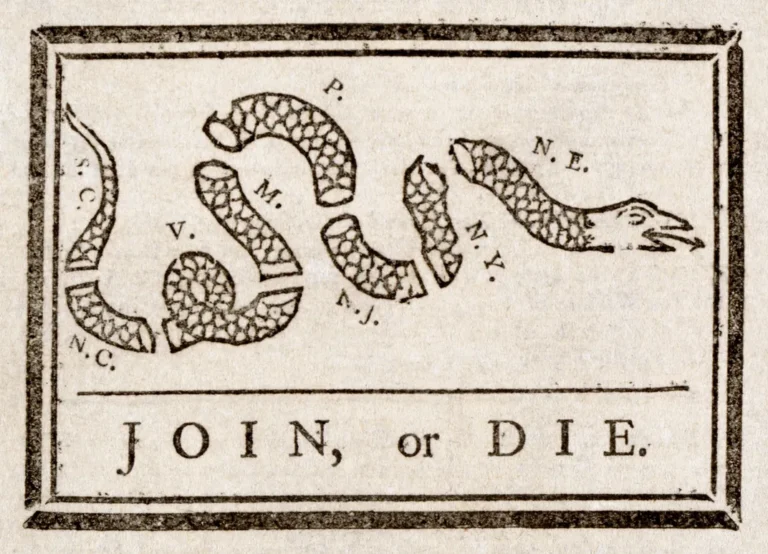
    Benjamin Franklin’s iconic ‘Join, or Die’ cartoon

    In Philadelphia, a new public artwork inspired by Benjamin Franklin’s famous “Join, or Die” woodcut is being installed on Independence Mall. Designed by artist John Collins, the impressive 46-foot-long granite sculpture is slated for its official public unveiling later this autumn on the Liberty Bell Center Block, right in the historic heart of the city. From 18th-Century Print to 21st-Century Granite The original artwork that inspired this modern installation carries significant historical weight. On May 9, 1754, Franklin published the illustration in his newspaper, the Pennsylvania Gazette, as the French and Indian War was breaking out. Created as a woodcut print, the imagery depicted a serpent severed into eight distinct segments, directly above the stark warning “JOIN, or DIE.” A Collection of American Colonies Each section of the snake was carved with initials symbolizing the American colonies of the era. N.E. (New England, grouped as one block) N.Y. (New York) N.J. (New Jersey) P. (Pennsylvania) M. (Maryland) V. (Virginia) N.C. (North Carolina) S.C. (South Carolina) At the moment he published the print, Franklin was preparing for the Albany Congress. This critical meeting brought colonial delegates together to strategize against common external threats and to negotiate a vital alliance treaty with the Iroquois Confederacy. Strength Lies in Solidarity. The cartoon served as an urgent call for collective action, warning that a fragmented collection of colonies would inevitably perish individually. “The confidence of the French in this undertaking seems well-grounded on the present disunited state of the British Colonies, and the extreme difficulty of bringing so many different governments and assemblies to agree in any speedy and effectual measures for our common defence and security,” A Lasting Legacy of American Unity   By translating this historic woodcut into a physical, segmented granite monument, the National Park Service and artist John Collins aim to give visitors an interactive connection to early American history. Set against the backdrop of Independence Hall and the Liberty Bell, the 46-foot sculpture preserves Franklin’s message: strength lies in solidarity.