Trump, Zelenskyy discuss Patriot deal and reviving talks with Russia
The whirlwind visit offers Ukrainian President Volodymyr Zelenskyy a chance to shore up US military support for Ukraine when relations are warmer than they have been in months


The whirlwind visit offers Ukrainian President Volodymyr Zelenskyy a chance to shore up US military support for Ukraine when relations are warmer than they have been in months

The FSB says the charges are related to Telegram’s failure to remove material ‘used by Ukrainian special services and by terrorist and extremist organizations to prepare and coordinate acts of sabotage and terrorism… within the Russian Federation’

Police say the man in his 50s survived but suffered shock and shrapnel injuries

Pyongyang and Moscow have grown closer since the reclusive state began deploying troops and weapons to support Russia’s war against Ukraine

President Vladimir Putin tells US envoys that Russia was making ‘real progress’ on the battlefield and was confident of achieving its goals

Ukraine is pushing to have a working prototype of a European anti-ballistic missile system, codenamed Freyja, ready by the middle of next year, as Kyiv presses its allies to accelerate development of a weapon capable of intercepting Russian ballistic missiles. Davyd Aloian, deputy secretary of Ukraine’s National Security and Defence Council and the official overseeing the Freyja project, said an international steering committee responsible for estimating research and development costs is set to meet for the first time soon. The project was formally launched two weeks ago at a summit in Paris, where leaders from ten European nations, including Ukrainian President Volodymyr Zelenskiy, joined roughly a dozen defense manufacturers to establish the anti-ballistic coalition. Aloian said the tight timeline reflects an ambitious target. He described the goal as producing a minimum viable product within the first half of next year, meaning a prototype capable of demonstrating early practical results. Ukraine currently relies heavily on American made Patriot systems, which remain the only weapon in its arsenal able to reliably shoot down Russia’s ballistic missiles, capable of traveling at multiple times the speed of sound. Deliveries of Patriot systems have been hampered by shifting political circumstances, limited stockpiles and lengthy manufacturing timelines. Russia has intensified ballistic missile strikes this month on Kyiv and the southern port city of Odesa, launching dozens of missiles that Ukraine was largely unable to intercept due to a shortage of interceptor missiles. Ukraine has offered to contribute a launcher and an interceptor missile to the Freyja project, which Zelenskiy said this month essentially needs testing at this stage. He has said he hopes to see the system operational within a year. Kyiv is counting on its allies to supply key technology, including modern radar systems, sensors and expertise in missile guidance and control electronics. Defense companies that have joined the initiative so far include Eurosam, maker of the SAMP-T interceptor, along with Leonardo, Thales and Saab. Ukrainian missile and drone manufacturer Fire Point, known for developing the Flamingo cruise missile, has said it will serve as the lead industrial partner on the project and recently struck a deal with German firm Hensoldt to supply radar technology. The Freyja system is designed as a lower cost alternative to the Patriot, a system many European nations also depend on. Other existing air defense platforms, including the Franco Italian SAMP/T and Germany’s IRIS-T, have not yet demonstrated the ability to down ballistic missiles. Zelenskiy has compared the Freyja coalition to a Lego set, describing it as a system built by combining components supplied by different defense industry leaders. Aloian said manufacturers have been asked to build a framework that allows interchangeable parts from different countries. He explained that the system’s open architecture means individual nations can select their preferred components, whether that means Denmark opting for a Danish made Weibel radar or Sweden choosing Saab’s technology. Organizers are also considering setting up a dedicated body, potentially structured as a fund, to manage contributions and ensure the project receives stable financing over time. Aloian said involving private companies directly alongside governments should help cut through bureaucratic delays, adding that the coalition is meant to function as a practical effort rather than a political one. The push for a homegrown European missile defense capability reflects a broader shift underway across the continent, as governments reassess their reliance on American weapons systems amid growing pressure to build independent defense industrial capacity in the face of a prolonged war on Europe’s eastern border.
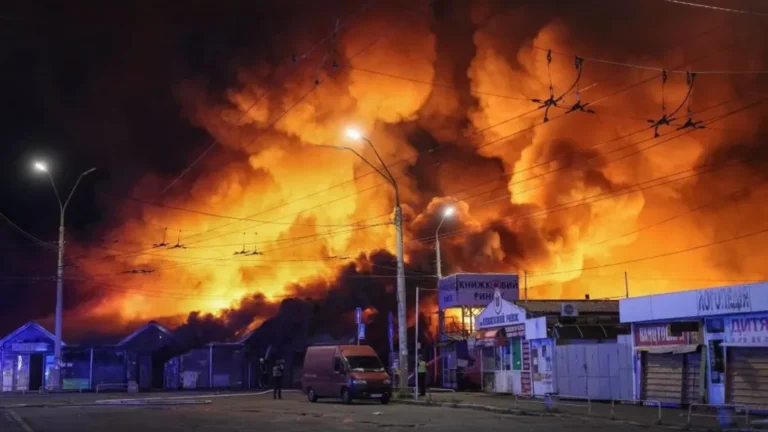
At least seven people died in Russia following what officials described as Ukraine’s largest scale attack of the year, while separate Russian strikes on Ukraine killed at least seven more people and injured over 39 others. Ukraine launched roughly 822 drones in the assault, with 600 of them targeting Moscow, according to the region’s governor, who called it one of the most massive drone attacks the Russian capital has faced in recent memory. The strikes hit a warehouse belonging to online retailer Wildberries among other targets. In Russia’s southwestern Rostov region, five people died following overnight strikes, the regional governor said. In Belgorod, which borders Ukraine, officials said a woman died after a civilian bus was hit, while Moscow region governor Andrey Vorobyov reported that an 83 year old man died in a separate drone attack. Moscow Mayor Sergei Sobyanin said a Wildberries warehouse in Koledino, about 25 kilometers, or 15.5 miles, from central Moscow, was struck and left three people injured, with video footage showing fire and heavy smoke rising above the facility. Wildberries, often compared to Amazon, has faced repeated attacks since July, when Kyiv said it was deliberately targeting logistics hubs Russians use to acquire military equipment as part of a broader effort to disrupt supply lines feeding the Russian army. In Ukraine, officials said a 66 year old man and a 64 year old woman died after a guided aerial bomb struck a private home in the Zaporizhzhia region. Two additional deaths were reported in Kryvyi Rih, a city in the Dnipropetrovsk region, while officials in Sumy, Donetsk and Kherson each reported one fatality, including a 51 year old killed in a drone strike in Sumy. Air raid sirens sounded four times overnight in Kyiv as Russian forces struck the capital. Mayor Vitali Klitschko said at least six people, including a child, were injured in the attacks. Russian officials said their strikes on Kyiv Saturday night targeted a FirePoint facility that produces components for Ukraine’s Flamingo missiles, along with a factory manufacturing drone parts. The strikes also damaged a book market in the city’s Pochayna district, leaving charred books scattered across the ground as firefighters worked to extinguish the remaining flames. Valentina, 69, whose husband ran a stall at the market, described searching through the debris and recognizing books that had belonged to his stall lying scattered on the ground. She said she never imagined something like this would happen to her family. Luba, 42, who owns a vinyl record store nearby, said she lost stock worth roughly 500,000 hryvnias, or about £8,262, in the strikes. She called the shop her life’s work and said many of the destroyed records were rare and could not be replaced. Ukrainian President Volodymyr Zelensky said 13 regions across the country came under attack this week, with Russia launching more than 1,550 attack drones, nearly 1,560 guided aerial bombs and 62 missiles during that period. He said Russian forces strike civilian infrastructure wherever their ballistic missiles can reach. Russia launched its full scale invasion of Ukraine in February 2022 and currently controls roughly a fifth of Ukrainian territory. With neither side making significant progress along the lengthy front line in recent months, the war has increasingly shifted toward an aerial contest, with both countries trading missile and drone strikes aimed at degrading the other’s capacity to keep fighting.

A notice on the popular paywall-bypass website Archive.today said that access is blocked “by decision of [Russian] public authorities.”

Russian state-owned media reported that police in Russia arrested the administrator of LeakBase, a large hacking forum.

Here’s what we know, and what you need to know, about Coruna and DarkSword, two advanced iPhone hacking tools discovered by security researchers. DarkSword has now leaked online.