cross border strikes
| |

Cross border strikes kill at least fourteen as Ukr…

At least seven people died in Russia following what officials described as Ukraine’s largest scale attack of the year, while separate Russian strikes on Ukraine killed at least seven more people and injured over 39 others.

Ukraine launched roughly 822 drones in the assault, with 600 of them targeting Moscow, according to the region’s governor, who called it one of the most massive drone attacks the Russian capital has faced in recent memory. The strikes hit a warehouse belonging to online retailer Wildberries among other targets.

In Russia’s southwestern Rostov region, five people died following overnight strikes, the regional governor said. In Belgorod, which borders Ukraine, officials said a woman died after a civilian bus was hit, while Moscow region governor Andrey Vorobyov reported that an 83 year old man died in a separate drone attack. Moscow Mayor Sergei Sobyanin said a Wildberries warehouse in Koledino, about 25 kilometers, or 15.5 miles, from central Moscow, was struck and left three people injured, with video footage showing fire and heavy smoke rising above the facility. Wildberries, often compared to Amazon, has faced repeated attacks since July, when Kyiv said it was deliberately targeting logistics hubs Russians use to acquire military equipment as part of a broader effort to disrupt supply lines feeding the Russian army.

In Ukraine, officials said a 66 year old man and a 64 year old woman died after a guided aerial bomb struck a private home in the Zaporizhzhia region. Two additional deaths were reported in Kryvyi Rih, a city in the Dnipropetrovsk region, while officials in Sumy, Donetsk and Kherson each reported one fatality, including a 51 year old killed in a drone strike in Sumy.

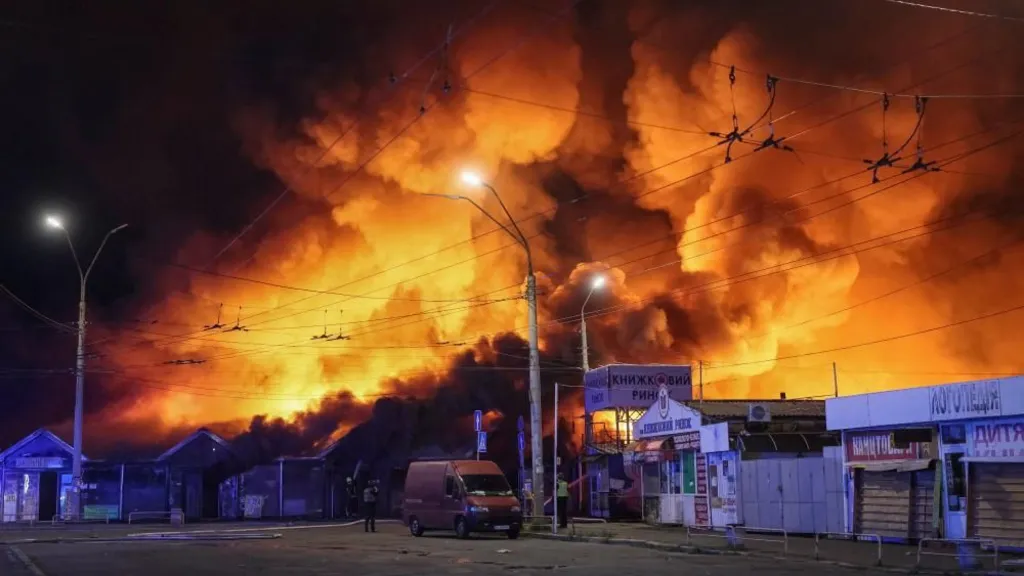
Air raid sirens sounded four times overnight in Kyiv as Russian forces struck the capital. Mayor Vitali Klitschko said at least six people, including a child, were injured in the attacks. Russian officials said their strikes on Kyiv Saturday night targeted a FirePoint facility that produces components for Ukraine’s Flamingo missiles, along with a factory manufacturing drone parts. The strikes also damaged a book market in the city’s Pochayna district, leaving charred books scattered across the ground as firefighters worked to extinguish the remaining flames.

Valentina, 69, whose husband ran a stall at the market, described searching through the debris and recognizing books that had belonged to his stall lying scattered on the ground. She said she never imagined something like this would happen to her family. Luba, 42, who owns a vinyl record store nearby, said she lost stock worth roughly 500,000 hryvnias, or about £8,262, in the strikes. She called the shop her life’s work and said many of the destroyed records were rare and could not be replaced.

Ukrainian President Volodymyr Zelensky said 13 regions across the country came under attack this week, with Russia launching more than 1,550 attack drones, nearly 1,560 guided aerial bombs and 62 missiles during that period. He said Russian forces strike civilian infrastructure wherever their ballistic missiles can reach.

Russia launched its full scale invasion of Ukraine in February 2022 and currently controls roughly a fifth of Ukrainian territory. With neither side making significant progress along the lengthy front line in recent months, the war has increasingly shifted toward an aerial contest, with both countries trading missile and drone strikes aimed at degrading the other’s capacity to keep fighting.

Similar Posts

  • | | |

    Indian cargo ship sinks after suspected attack nea…

    An Indian cargo ship sank in the Red Sea after suffering severe damage in a suspected maritime attack near Yemen’s western coast. The incident, which reportedly involved an explosive-laden boat or unidentified projectile, caused a powerful explosion and fire aboard the vessel before it eventually went down despite rescue efforts. According to international media reports, the cargo ship sustained extensive damage following the blast. Several crew members were injured during the incident, but no fatalities have been reported. The crew immediately initiated emergency procedures and alerted nearby maritime authorities, who responded with rescue operations. Authorities attempted to secure and tow the damaged vessel to a safe location. However, the ship’s condition deteriorated, and it eventually sank in the Red Sea. Medical assistance was provided to injured crew members, while rescue teams ensured the safe evacuation of everyone on board. India’s Ministry of External Affairs stated that the vessel was struck by an unidentified projectile, confirming that the cargo ship later sank. The ministry added that all crew members were safely rescued and no loss of life occurred. As of now, no group has officially claimed responsibility for the attack. However, the incident comes amid heightened security concerns in the Red Sea, where commercial shipping has faced repeated threats in recent months. Several previous attacks on merchant vessels in the region have been claimed by the Iran-backed Houthi movement, although no evidence has yet linked this specific incident to any particular group. The Red Sea has become one of the world’s most sensitive maritime routes due to ongoing regional tensions. Commercial vessels transiting the area have encountered increased security risks, prompting many shipping companies to strengthen safety measures or alter their routes. Recent months have also seen warnings and threats against ships passing through the Bab el-Mandeb Strait, a strategic waterway connecting the Red Sea with the Gulf of Aden. Disruptions in this corridor can have significant consequences for global trade, particularly the transportation of oil, gas, and other essential commodities. The Red Sea and Bab el-Mandeb Strait rank among the world’s busiest shipping lanes, serving as critical links between Europe, Asia, and the Middle East. Any disruption in these waters can affect international supply chains, increase shipping costs, and impact global energy markets. Investigations into the cause of the attack are expected to continue as maritime authorities gather evidence. Meanwhile, shipping companies and governments are closely monitoring the security situation in the region to ensure the safety of commercial vessels and international trade routes.

  • |

    PSX opens higher as KSE-100 index gains over 500 points

    KARACHI: Buying activity dominated trading at the Pakistan Stock Exchange (PSX) on Thursday, with the benchmark KSE-100 Index rising more than 500 points during the early session. At around 9:45am, the benchmark index was trading at 180,864.26 points, recording an increase of 553.05 points, or 0.31%, from the previous close. The positive trend reflected renewed investor interest in several major sectors. Strong activity was witnessed in cement, commercial banking, fertiliser, oil marketing companies (OMCs) and power generation stocks. Several index-heavy companies also contributed to the upward movement. HUBCO, Fauji Fertilizer Company (FFC), MCB Bank, National Bank of Pakistan (NBP) and United Bank Limited (UBL) were among the stocks trading in positive territory during the early hours. The latest gains come after the stock market staged a recovery in the previous session. On Wednesday, the PSX rebounded as investors returned to buying after two consecutive sessions of profit-taking. Market sentiment also improved toward the end of Wednesday’s trading session following reports regarding an extension of the US-Iran ceasefire, which helped ease some concerns among investors about geopolitical developments and their potential impact on regional markets. The KSE-100 Index ultimately closed Wednesday’s session at 180,311.22 points. Global markets provide positive cues The positive momentum at the domestic bourse was also supported by a broadly upbeat trend in Asian equity markets. Asian stocks advanced on Thursday after fresh US inflation data broadly matched market expectations. The figures reduced some expectations of an immediate tightening move by the US Federal Reserve and provided support to investor sentiment. MSCI’s broadest index of Asia-Pacific shares outside Japan rose 0.97%, while South Korea’s benchmark market climbed sharply, gaining 4.4%. Japan’s Nikkei index also advanced 1.86%. US stock futures remained relatively stable, with S&P 500 E-mini futures up 0.02% during the Asian trading session. US inflation remains in focus According to data released on Wednesday, US consumer prices increased by 0.1% in July, broadly matching economists’ expectations. The modest increase in consumer prices has lowered expectations of an immediate interest-rate hike by the Federal Reserve. Market participants are closely monitoring inflation figures as they assess the central bank’s next policy move. According to CME Group’s FedWatch tool, financial markets were pricing in around a 40% probability of a rate hike next month, down from approximately 54% a week earlier. Oil prices remain near $80 Meanwhile, international oil prices remained close to the $80-per-barrel level, as diplomatic efforts between Washington and Tehran remained unresolved. Developments in oil prices remain important for Pakistan’s economy and financial markets because changes in global crude prices can influence the country’s import bill, inflation outlook, exchange-rate pressures and corporate earnings. Investors at the PSX are expected to closely monitor both domestic economic developments and international market cues as trading progresses on Thursday.

  • |

    Diesel price rises as government increases petroleum levy

    ISLAMABAD: The federal government has increased the price of high-speed diesel after raising the Petroleum Development Levy (PDL) on the fuel by Rs1 per litre, adding further pressure on consumers and transport-related costs. Following the latest adjustment, the price of high-speed diesel has gone up by 54 paisas per litre, reaching Rs382.89 per litre. The increase comes despite a decline in the ex-refinery price of diesel, with the higher petroleum levy pushing up the final price paid by consumers. The government has raised the diesel levy by Rs1 per litre as part of the latest petroleum price adjustment. The PDL on high-speed diesel now stands at Rs76.28 per litre. The latest increase follows another adjustment made on August 12, when the government raised the petroleum levy on diesel by Rs2 per litre. The successive increases have resulted in a significant rise in the levy component of the retail price. Petrol price reduced In contrast to diesel, the government has reduced the price of petrol by 94 paisas per litre. The price of petrol has now been fixed at Rs324.98 per litre. The Petroleum Development Levy on petrol, however, has remained unchanged at Rs80 per litre. The differing price movements for petrol and diesel are largely linked to changes in their respective pricing components. While the ex-refinery price of diesel declined, the increase in the government levy more than offset the reduction, resulting in a higher retail price. The latest adjustment is expected to have an impact on transportation and logistics costs because diesel is widely used by commercial vehicles, buses, trucks, agricultural machinery and other heavy transport. Higher diesel prices can also influence the cost of goods and services by increasing transportation expenses across supply chains. Meanwhile, the reduction in petrol prices provides limited relief to motorists using petrol-powered vehicles. The government periodically reviews petroleum prices based on international oil prices, exchange-rate movements, taxation and other components of the domestic pricing mechanism. The latest changes reflect the impact of adjustments in the petroleum levy and ex-refinery prices on consumers.

  • |

    Deadly explosion near Moscow restaurant leaves several dead

      A homemade explosive device carried by a woman detonated near a high-end restaurant in central Moscow on Saturday evening, killing at least three people and injuring 21 others, according to Russian authorities. The incident has triggered speculation on social media about a possible connection to the ongoing war between Russia and Ukraine, although no official evidence has been presented linking the blast to the conflict. The explosion took place shortly before 8 p.m. near an Italian restaurant located inside one of Moscow’s famous Stalin-era skyscrapers at Kudrinskaya Square. Police said the blast occurred after a woman carrying an improvised explosive device attempted to enter the restaurant but was stopped by a security guard. Russia’s National Anti-Terrorism Committee (NAK) reported that the woman, the security guard, and a customer inside the Balzi Rossi restaurant were killed immediately following the explosion. Authorities said several other individuals were injured in the attack and emergency services were dispatched to the scene. The two additional victims who had been hospitalized died from their injuries, potentially raising the death toll to five. However, officials had not formally confirmed those additional deaths. The report also stated that six injured people remained in serious condition. Moscow Mayor Sergei Sobyanin expressed condolences to the families of those killed and injured, describing the incident as a serious terrorist attack. He promised that those responsible would face punishment. However, authorities did not immediately release the identities of the victims, name any suspects, or provide details about who may have been behind the explosion. Unconfirmed reports circulating on social media suggested that the attack may have been aimed at a senior Russian military figure. According to these claims, the alleged target survived the incident, although officials have not verified this information. The attack comes more than four years after Russia launched its full-scale invasion of Ukraine. In recent months, Russian authorities have increased security measures around senior military officials following several assassinations and attempted attacks that Moscow has blamed on Kyiv. Ukraine has not claimed responsibility for the Moscow explosion and had not issued an immediate response. Some Russian military bloggers quickly accused Ukraine of involvement, but those claims were made without publicly available evidence. The Ukrainian government has not commented on the allegations. Russian newspaper Kommersant raised the possibility that the woman carrying the explosive device may not have been aware of its presence or purpose. The publication suggested that the bomb could have been remotely activated by another person rather than being intentionally detonated by the woman herself. The restaurant’s official website stated that the venue had been closed on Saturday due to a private event, although details about the gathering were not immediately available. The incident has drawn comparisons with a previous high-profile bombing in 2023 that killed Vladlen Tatarsky, a well-known Russian pro-war blogger. In that case, a bomb hidden inside a small statue exploded while Tatarsky was holding it during an event in St. Petersburg. A young woman, Darya Trepova, was later sentenced to 27 years in prison for delivering the explosive device. She claimed that she had been following instructions from a man based in Ukraine who had provided her with money. Ukrainian officials did not accept responsibility for the attack but also did not directly deny involvement at the time. The latest Moscow explosion is now under investigation as authorities work to determine the identity of those responsible and establish the motive behind the attack.

  • | | | |

    Houthis target Saudi Aramco refinery in drone atta…

    RIYADH/SANAA: Regional tensions have taken another dangerous turn after Yemen’s Iran-aligned Houthi group claimed it carried out a drone attack on Saudi Aramco’s Jazan refinery, while a separate barrage of missiles and drones reportedly struck the Yemeni Red Sea port city of Mokha. The developments come as security concerns continue to grow across the Red Sea and Gulf, adding another layer to an already volatile regional situation. Houthi military spokesman Yahya Saree said the group had targeted the Aramco refinery in Jazan, in southwestern Saudi Arabia, with drones. Saudi authorities confirmed that a fire had broken out at the facility but said it had been brought under control and that no casualties had been reported. Saudi officials did not immediately attribute the fire to the alleged Houthi attack, leaving some details surrounding the incident unclear. The Jazan refinery is a strategically important energy facility on Saudi Arabia’s Red Sea coast. The complex has a crude-processing capacity of around 400,000 barrels per day and produces products including gasoline and ultra-low-sulfur diesel. The latest incident is not the first time Houthi attacks have been reported against Saudi energy infrastructure. The Jazan facility was also reportedly affected by an attack in late July, with parts of its gasification complex and tank farm suffering damage, according to reports. Mokha Port Also Hit The situation became even more serious when Houthi forces reportedly launched missiles and drones toward Mokha, a strategically located port city on Yemen’s western coast. Yemeni government forces and medical sources initially reported at least seven deaths, including civilians and military personnel. Later reports put the death toll at 11, with eight military personnel and three civilians among those killed. Around 32 people were reportedly wounded, although casualty figures varied between sources. Yemeni military officials said air-defence systems intercepted 11 Houthi drones during the attacks. Damage was also reported to civilian and commercial infrastructure around the port. The attacks come against the backdrop of heightened regional tensions involving Iran, Israel and the United States. The Houthis have also previously threatened measures affecting shipping in the Red Sea, framing their actions as retaliation for Saudi policies toward Yemen. The latest escalation is particularly notable because Saudi Arabia has recently deepened its defence cooperation with Pakistan and Türkiye. The new security arrangement has been presented as a collective defence framework in which an armed attack against one member is treated as an attack against all. With attacks now reported near both Saudi Arabia’s energy infrastructure and Yemen’s Red Sea coastline, fears are growing that the conflict could further disrupt an already sensitive regional security and trade environment.

  • | |

    ATC remands Mushtaq Ahmad for three days

    ISLAMABAD: An anti-terrorism court (ATC) in Islamabad on Monday granted police a three-day physical remand of former senator Mushtaq Ahmad and his associate, Daniyal, in a case linked to a protest over the recent unrest in Azad Jammu and Kashmir (AJK). The suspects were presented before Duty Judge Rukhsanda Shaheen after their arrest. During the hearing, the prosecution requested a 30-day physical remand, arguing that investigators needed additional time to recover a vehicle and alleged weapons connected to the case. After hearing arguments from both sides, the court approved a three-day remand instead of the longer period requested by the prosecution and directed police to continue their investigation. The case has been registered at Islamabad’s Shalimar Police Station. Authorities are investigating the circumstances surrounding the protest and the allegations associated with it. The development comes days after Mushtaq Ahmad’s supporters claimed he had been detained for more than 24 hours after security personnel stopped him from entering Azad Jammu and Kashmir. According to his team, the detention was linked to his public support for protests taking place in the region. Following his release, Mushtaq Ahmad addressed a press conference in Islamabad, where he announced plans to hold a condolence, solidarity and peace gathering in support of the people of AJK. He invited students, journalists, civil society members and Kashmiri residents of Islamabad to participate in the event at F-10 Markaz. Earlier, Mushtaq Ahmad had stated that he was travelling to AJK carrying white flags as a symbol of peace and solidarity with families affected by the recent violence. He said security officials stopped him at Azad Pattan Bridge and prevented him from entering the region, after which he recorded a protest message and began returning to Islamabad. His team further alleged that Punjab Police later intercepted his vehicle in Kahuta and took him into custody.

Leave a Reply

Your email address will not be published. Required fields are marked *