trump zelenskyy discusspatriot
|

Trump, Zelenskyy discuss Patriot deal and reviving talks with Russia

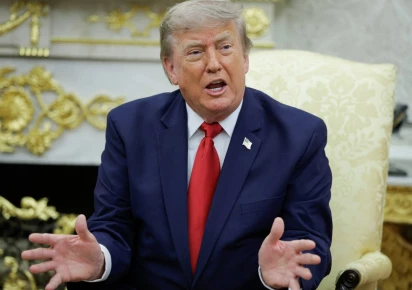
WASHINGTON, USA – US President Donald Trump and Ukrainian President Volodymyr Zelenskyy on Tuesday, July 28, discussed reviving peace talks with Russia and plans for Ukraine to produce Patriot missile interceptors, then attended the funeral of a US senator who had been one of Kyiv’s most vocal backers.

Zelenskyy met Trump privately in the Oval Office before a service honoring Senator Lindsey Graham in the afternoon. He also held talks with Finnish President Alexander Stubb at a Washington hotel and met with US senators at the US Capitol.

The whirlwind visit offered Zelenskyy a chance to shore up US military support for Ukraine when relations are warmer than they have been in months. The US, however, has been sitting on aid for Kyiv and Graham’s death means the loss of one of Ukraine’s most influential advocates in Washington.

Zelenskyy told reporters that he emphasized Ukraine’s need for anti-ballistic missile systems and interceptors during his meetings with Trump and the senators, while welcoming new US legislation advancing sweeping Russian energy sanctions.

Zelenskyy told reporters that Ukraine had drones that could destroy Iranian- and Russian-built drones but needed more weapons to defend against ballistic missiles fired by Moscow.

“The real problem is anti-ballistic systems and anti-ballistic missiles,” he said after a meeting with senators at the US Capitol. “And of course, I (shared) what we need.”

Earlier, on Telegram, he said that he had a “good meeting” with Trump and they had discussed the US leader’s promise at a NATO summit this month to grant Ukraine a license to produce its own Patriot missile interceptors.

As Russia has stepped up its air attacks, Ukraine has run chronically low on supplies of Patriots, which remain the only weapon in its arsenal capable of downing ballistic missiles.

Zelenskyy later told Fox News’ “Hannity” show that Trump had “accepted that he will give us licenses” to produce the interceptors.

“We also talked about diplomacy — it is important to step up the diplomatic process,” Zelenskyy said after the meeting with senators, referring to stalled peace talks with Russia to end the war, now in its fifth year.

US envoys Steve Witkoff and Jared Kushner, Trump’s son-in-law, have agreed to visit Ukraine for the first time as part of the effort to kick-start their mediation efforts with Russia, according to two sources familiar with the talks. The two have visited Russia and met with Russian President Vladimir Putin multiple times since Trump returned to office in January 2025.

Zelenskyy said ​last week he had spoken with the pair about the prospects for renewed talks. No specific date was set for a visit, one of the sources said.

Separately, Zelenskyy said he had met with officials from Lockheed Martin, the world’s largest weapons maker and one of the companies that produces Patriot interceptors. He said that teams were already working on solutions “to move to co-production as quickly as possible.”

Relations have improved

Following Graham’s funeral, the Ukrainian leader spoke for nearly an hour with US senators before entering the Senate chamber to witness a key vote on a bipartisan package of new sanctions on Russia. Graham had long championed the measure and announced Trump’s support just days before his death.

“Sanctions pressure on Russia is very important,” he said, saying the legislation would squeeze Russia’s ability to finance the war, while signaling US support for the Ukrainian people.

“With this vote, we are going to show Putin he can’t bully Ukraine,” US Senate Minority Leader Chuck Schumer told reporters. “America stands behind Ukraine…. We are going to back Ukraine, and they’re going to win and beat Putin.”

Zelenskyy’s visit came after a letter from the Pentagon to lawmakers showed the Trump administration has told Congress it will not finish spending $400 million authorized for aid to Ukraine until fiscal year 2029.

Democrats and some of Trump’s fellow Republicans have criticized the Pentagon for sitting on aid for Kyiv that members of both parties backed last year.

Zelenskyy and Trump clashed repeatedly early in Trump’s second term, but relations between the two have improved in recent months as Ukraine has racked up more successes in the war, including with increased attacks on Russia’s oil industry.

Graham, a South Carolina Republican who died suddenly of a heart ailment on July 11 at age 71, was one of Trump’s most visible allies. He was a defense hawk who regularly called for an interventionist US role on the world stage and strongly backed Ukraine.

He met with Zelenskyy in Kyiv only a day before his death, the 10th time he had visited Ukraine since Russia’s 2022 invasion. – Rappler.com

Similar Posts

  • Thai PM Anutin to Trump: ‘We Are Defending Our People from Cambodian Attacks’

    BANGKOK – Prime Minister Anutin Charnvirakul stated that he informed United States President Donald Trump during a phone call on Friday night that Thailand’s military actions are purely defensive, taken in response to Cambodian attacks that have killed Thai citizens and damaged property. The Prime Minister emphasized that Cambodia had violated the peace declaration between […]

  • |

    Over 80,000 flee as escalating wildfires ravage south-west France and Spain

    More than 80,000 people have been forced to flee their homes and holiday accommodation across south-west France and central Spain as fierce, uncontained wildfires continue to sweep through the region. Fanned by relentless winds and intense heatwave conditions, the blazes have triggered national emergency declarations and prompted urgent requests for international military and civilian aerial support. In France, authorities ordered the total evacuation of the Cap Ferret peninsula on the Atlantic coast as a vast wildfire in the Gironde department consumed over 12,500 hectares of forest and destroyed at least 80 homes. With the main access road threatened by advancing flames, hundreds of residents and holidaymakers were evacuated by sea using ferries and local boats. A secondary blaze further south near Biscarrosse has burned an additional 2,500 hectares, leaving coastal emergency services struggling to contain the perimeter. Across the border in Spain, the central government declared a national emergency after two massive blazes merged outside Madrid and threatened to join a third active fire in the neighbouring province of Ávila. Over 19,000 people were evacuated overnight across affected municipalities as thick acrid smoke reached the capital’s outskirts. Spanish officials described the convergence of high temperatures, parched terrain, and strong winds as an unprecedented crisis for the region. Both nations have activated the European Union’s Civil Protection Mechanism to request specialized firefighting aircraft, with reinforcements deployed from Portugal, the Czech Republic, Croatia, and Slovakia. Environmental scientists highlight that Europe is warming at roughly twice the global average rate, warning that prolonged droughts and extreme seasonal weather patterns are driving wildfire destruction to historic levels across the continent.

  • |

    Japan unveils first spy agency since WWII

    Japan has launched its first centralized intelligence agency since the end of World War II. The move marks one of the country’s biggest security reforms in decades. It comes as Japan faces rising regional tensions and growing concerns over espionage, cyber threats, and global instability. The new body is called the National Intelligence Bureau (NIB). It officially began operations on Friday. It replaces the Cabinet Intelligence and Research Office (CIRO), which had served as Japan’s main intelligence office for years. However, experts often criticized the old system for lacking authority and coordination. Prime Minister Sanae Takaichi described the new agency as the first step in a broader intelligence reform plan. She said today’s security environment is changing rapidly. According to her, modern conflicts now involve cyberattacks, intelligence operations, and other non-traditional forms of warfare. She stressed that Japan must strengthen its intelligence capabilities to protect national security. The National Intelligence Bureau will collect, analyze, and coordinate intelligence gathered by various government departments. These include the ministries of defense, foreign affairs, justice, and the National Police Agency. Under the new system, government agencies will be required to share information with the bureau. Officials believe this will improve cooperation and eliminate delays caused by fragmented intelligence networks. The bureau will work under the newly created National Intelligence Council. The council will be chaired by the prime minister and include senior cabinet ministers. It will oversee national intelligence policy and coordinate responses to major security threats. The agency’s responsibilities will cover a wide range of issues. These include counterterrorism, emergency response, cybersecurity, foreign espionage, and efforts to detect covert influence operations carried out by hostile states. Security analysts have long argued that Japan’s intelligence system has been weaker than those of many other developed countries. Unlike several of its close allies, Japan does not have a dedicated foreign intelligence agency that operates overseas. The country also lacks a comprehensive anti-espionage law, making it more difficult to investigate and prosecute espionage activities. Experts say these weaknesses have raised concerns among Japan’s international partners. Countries sharing sensitive intelligence expect strong security measures to prevent leaks. A weak intelligence system can reduce confidence and limit intelligence cooperation. Calls for reform are not new. In the 1980s, former Prime Minister Yasuhiro Nakasone warned that Japan had become a “paradise for spies.” He proposed stronger anti-espionage laws, but the plan faced strong public opposition and was never approved. At the time, many Japanese feared that expanding intelligence powers could revive the surveillance and repression experienced before and during World War II. Today, the security situation is very different. Japan faces increasing military and strategic challenges from China, North Korea, and Russia. The country also hosts thousands of US military personnel, making it an important strategic partner in the Indo-Pacific region. Officials believe foreign intelligence services are actively seeking information about Japan’s defense systems, advanced technology, and military cooperation with its allies. Growing military cooperation among China, Russia, and North Korea has also increased concerns in Tokyo. Their joint military activities and closer political ties have reinforced the belief that Japan must strengthen its national security institutions. Prime Minister Takaichi has made defense and intelligence reform a key priority since taking office. With strong support in parliament, her government is expected to push for further changes. These may include introducing an anti-espionage law and creating a dedicated foreign intelligence service similar to those operated by other major democratic nations. Despite the government’s arguments, the reforms remain controversial. Opposition lawmakers and civil rights groups warn that expanding intelligence powers could threaten privacy and individual freedoms if proper safeguards are not introduced. They argue that stronger oversight, parliamentary scrutiny, and independent monitoring will be essential to prevent misuse of power.

  • |

    Indian officer suspended after firing rifle during student protest

    Indian authorities have suspended a police officer after he fired an AK-47 rifle into the air while attempting to disperse student protesters in the eastern state of Bihar. The incident has intensified criticism of the government’s handling of nationwide demonstrations that recently led to the resignation of Education Minister Dharmendra Pradhan. The confrontation took place on Saturday in the city of Siwan, where students were protesting against alleged irregularities in national examinations and broader concerns about unemployment. Videos shared on social media showed a police officer in riot gear running toward a crowd of protesters before pointing his assault rifle into the air and firing at least three rounds. Police later confirmed that the footage was authentic. Senior Bihar police official Nilesh Kumar said no one was injured during the incident. He explained that the suspended officer belonged to an intelligence unit that normally deals with dangerous criminals and had been issued the rifle as part of his official duties. However, Kumar said the weapon was used inappropriately because the protesters were students and did not pose a threat that justified such action. He said the officer’s conduct could not be defended under any circumstances and confirmed that disciplinary proceedings had begun. According to Kumar, further action will be taken following an investigation into the incident. The protests began after question papers for a national medical college entrance examination were leaked in May. More than two million students had taken the exam before authorities were forced to order a retest because of the security breach. The controversy sparked widespread anger among young people who accused the government of failing to protect the integrity of the examination process. As demonstrations grew larger, students also began raising concerns about rising unemployment and fears that artificial intelligence could reduce future job opportunities, especially in India’s information technology and outsourcing sectors. These issues helped expand the movement beyond the examination scandal, drawing support from students across different parts of the country. Public pressure eventually led to the resignation of Education Minister Dharmendra Pradhan, who stepped down after nearly five weeks of protests. Despite the resignation, demonstrations have continued as students demand broader reforms and greater accountability from the government. The police response has faced increasing criticism. Officers have been accused of using excessive force against demonstrators, including beating students with batons and firing tear gas during a large march toward India’s parliament in New Delhi earlier this month. Human rights advocates and opposition leaders argue that authorities have responded too aggressively to mostly peaceful protests. Speaking in parliament, Congress Party president Mallikarjun Kharge condemned the police action and described it as one of the most serious attacks on democratic rights in recent years. He said reports that an assault rifle had been used against student protesters in Bihar were deeply troubling and called for those responsible to be held accountable. Parliamentary proceedings were repeatedly disrupted as opposition lawmakers raised the issue and demanded answers from the government. Ministers did not immediately respond before both houses were adjourned amid heated exchanges. The controversy also drew attention from India’s judiciary. Supreme Court Justice Ujjal Bhuyan expressed concern about what he described as the shrinking space for people to express different opinions in the country. In a public speech, he said the right to voice opinions and participate in peaceful demonstrations is a fundamental freedom guaranteed to every citizen. His remarks were seen as an unusual intervention by a sitting judge and added to growing calls for restraint in the handling of public protests.

  • | |

    Cross border strikes kill at least fourteen as Ukr…

    At least seven people died in Russia following what officials described as Ukraine’s largest scale attack of the year, while separate Russian strikes on Ukraine killed at least seven more people and injured over 39 others. Ukraine launched roughly 822 drones in the assault, with 600 of them targeting Moscow, according to the region’s governor, who called it one of the most massive drone attacks the Russian capital has faced in recent memory. The strikes hit a warehouse belonging to online retailer Wildberries among other targets. In Russia’s southwestern Rostov region, five people died following overnight strikes, the regional governor said. In Belgorod, which borders Ukraine, officials said a woman died after a civilian bus was hit, while Moscow region governor Andrey Vorobyov reported that an 83 year old man died in a separate drone attack. Moscow Mayor Sergei Sobyanin said a Wildberries warehouse in Koledino, about 25 kilometers, or 15.5 miles, from central Moscow, was struck and left three people injured, with video footage showing fire and heavy smoke rising above the facility. Wildberries, often compared to Amazon, has faced repeated attacks since July, when Kyiv said it was deliberately targeting logistics hubs Russians use to acquire military equipment as part of a broader effort to disrupt supply lines feeding the Russian army. In Ukraine, officials said a 66 year old man and a 64 year old woman died after a guided aerial bomb struck a private home in the Zaporizhzhia region. Two additional deaths were reported in Kryvyi Rih, a city in the Dnipropetrovsk region, while officials in Sumy, Donetsk and Kherson each reported one fatality, including a 51 year old killed in a drone strike in Sumy. Air raid sirens sounded four times overnight in Kyiv as Russian forces struck the capital. Mayor Vitali Klitschko said at least six people, including a child, were injured in the attacks. Russian officials said their strikes on Kyiv Saturday night targeted a FirePoint facility that produces components for Ukraine’s Flamingo missiles, along with a factory manufacturing drone parts. The strikes also damaged a book market in the city’s Pochayna district, leaving charred books scattered across the ground as firefighters worked to extinguish the remaining flames. Valentina, 69, whose husband ran a stall at the market, described searching through the debris and recognizing books that had belonged to his stall lying scattered on the ground. She said she never imagined something like this would happen to her family. Luba, 42, who owns a vinyl record store nearby, said she lost stock worth roughly 500,000 hryvnias, or about £8,262, in the strikes. She called the shop her life’s work and said many of the destroyed records were rare and could not be replaced. Ukrainian President Volodymyr Zelensky said 13 regions across the country came under attack this week, with Russia launching more than 1,550 attack drones, nearly 1,560 guided aerial bombs and 62 missiles during that period. He said Russian forces strike civilian infrastructure wherever their ballistic missiles can reach. Russia launched its full scale invasion of Ukraine in February 2022 and currently controls roughly a fifth of Ukrainian territory. With neither side making significant progress along the lengthy front line in recent months, the war has increasingly shifted toward an aerial contest, with both countries trading missile and drone strikes aimed at degrading the other’s capacity to keep fighting.

  • |

    Trump appoints Will Scharf as new White House counsel

    US President Donald Trump has named Will Scharf as the incoming White House counsel and assistant to the president, succeeding David Warrington on September 1, 2026. Warrington, who previously served as general counsel for Trump’s campaign and managed initial administration legal affairs, will be departing for the private sector. Scharf currently serves as the White House staff secretary, a role where he manages the daily flow of papers and documents reaching the president’s desk. In addition to these duties, he chairs the National Capital Planning Commission, where he helped fast-track approvals for a controversial $400 million White House ballroom project. A former federal prosecutor and appellate law clerk, Scharf joined Trump’s personal legal team in 2023. He played a central role in defending Trump across several high-profile legal battles, including the federal election interference case and the landmark presidential immunity ruling before the US Supreme Court. In his new post, Scharf will lead the administration’s legal strategy. His responsibilities will include overseeing executive privilege, managing judicial nominations, liaising with the Department of Justice, and preparing for potential congressional inquiries ahead of the upcoming midterm elections.

Leave a Reply

Your email address will not be published. Required fields are marked *