#wildfire

  • | |

    Wildfires keep Spain and France on alert amid extr…

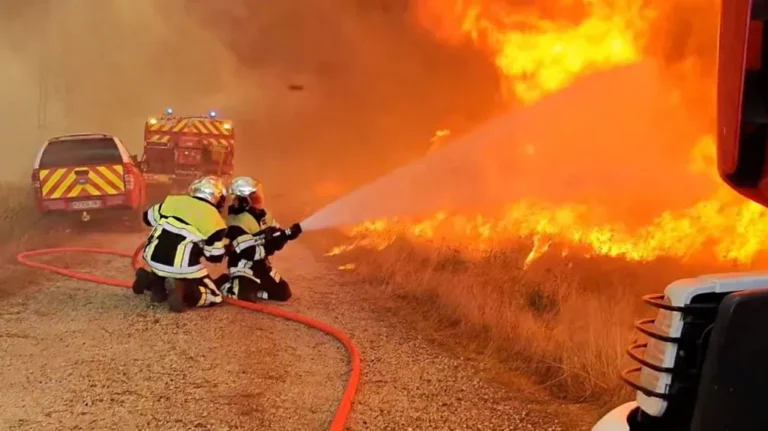
    Firefighters battling wildfires across Spain and France warned Wednesday that the risk of additional blazes remains very high in the coming days, even as a major fire in Spain’s central Guadalajara province eased enough to allow some residents to return home. Wildfires have already scorched more land across Europe this year than the continent’s average over the past two decades, according to available data, as the world’s fastest warming continent endures its third stifling heatwave in close succession this year. In France, where two firefighters died Tuesday after their truck became engulfed in flames in the southwestern Gironde region, authorities urged residents in areas affected by the heat to avoid using barbecues, stressing that nine out of ten wildfires start as a result of human activity, whether accidental or not. Meanwhile, in the Western Balkans, the nature of the threat has shifted from heat to hailstorms, with several people injured in North Macedonia and eastern Kosovo. Scientists say human driven climate change continues to intensify heatwaves, droughts and wildfires, while also creating conditions that can trigger sudden and destructive storms. Real time data from a climate monitoring tool showed the average high temperature across Western Europe is forecast to reach 26.6 degrees Celsius, about 3 degrees above the historical norm for July 22 based on the 1961 to 1990 reference period. Spain’s most severe wildfire so far this year has burned an estimated 32,000 hectares in the Guadalajara region. The fire began to stabilize Tuesday after forcing evacuations across 34 municipalities and confinement orders in 14 others. Castilla La Mancha’s regional fire service, INFOCAM, said residents of five villages have been allowed to return home, though other restrictions remain in place. Visiting the affected region Wednesday, Prime Minister Pedro Sanchez said Spain has already experienced 22 major wildfires this year. He said the country has already surpassed 100,000 hectares burned before even reaching the most critical period of the wildfire season, noting that figure matches Spain’s annual average over the past decade. He added that more action is needed to prevent future fires. Spain’s national weather agency, AEMET, said wildfire danger remains very high or extreme across most of mainland Spain and the Balearic Islands and is expected to climb further in the coming days. The agency urged extreme caution as the ongoing heatwave combines with dry thunderstorms and Saharan dust blowing into the region. While temperatures are expected to ease slightly in some areas Thursday, forecasters expect a dry westerly wind to drive a fresh surge of heat into Mediterranean regions, where highs of 42 to 44 degrees Celsius could be recorded in some locations. The back to back heatwaves and wildfires this summer add to a growing pattern of extreme weather events across southern Europe, with officials in both Spain and France continuing to stress prevention measures as the region moves deeper into what is traditionally its most dangerous period for wildfire activity.

  • |

    Wildfires in south‑west France flare up as region braces for new 40°C heatwave

    Firefighters in France’s Gironde region are battling renewed blazes as the country braces for its fourth heatwave of the summer, with temperatures forecast to reach 40°C by Wednesday. Regional prefect Sophie Brocas said 14 areas already scorched by earlier fires saw fresh flare‑ups on Tuesday. “We are not in the clear,” she warned. More than 2,000 firefighters have been deployed, with national federation spokesman Eric Brocardi describing the struggle as “David against Goliath.” Four firefighters have died in recent weeks across France. The wildfires have forced more than 70,000 people to evacuate their homes. While Bordeaux is not currently under direct threat, one blaze came within 15km of the city earlier this week. Commander Rémi Lassoureille, leading the Gironde response, voiced concern about the impact on Bordeaux’s metropolitan area, where air quality has deteriorated sharply. Residents and tourists reported smoky skies, ash falling on clothes, and restaurants closing due to pollution. Spain has also endured severe fires, though some evacuation orders have been lifted, allowing 44,000 people to return home. Prime Minister Pedro Sánchez said the situation remained challenging but expressed hope that “light is beginning to appear at the end of the tunnel.” In Portugal, 400 firefighters are tackling a major blaze in the eastern Guarda area. French Health Minister Stéphanie Rist urged residents in affected zones to remain indoors, citing air pollution risks. “Many people have lost their homes or their businesses, not to mention the firefighters who have been hard at work for weeks now and who must be exhausted,” she said. Locals in Cap Ferret voiced fears for the peninsula’s forests, warning that while Bordeaux’s concrete structures may be safe, the destruction of woodland is catastrophic.

  • | |

    Belgium’s largest wildfire in decades double…

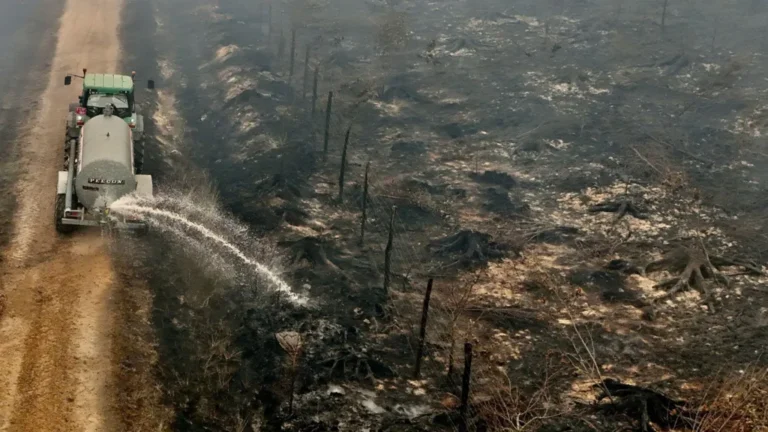
    A wildfire officials describe as the largest in Belgium’s recent history more than doubled in size within 24 hours, local authorities said Sunday, as hundreds of firefighters entered a third day battling flames tearing through the country’s largest nature reserve. The blaze has forced the evacuation of two villages near Hautes Fagnes, a protected reserve close to Belgium’s eastern border with Germany. Local farmers have hauled water tankers toward the park to assist firefighting crews, while water bombing aircraft and helicopters sent from Sweden and the Netherlands have joined the effort from the air. The Belgian fire is one of several burning across Europe this weekend. At least two people died in forest fires on a Greek island off the coast of Athens on Sunday, part of a broader pattern of blazes spreading across the continent. Belgian officials said intense heat combined with the reserve’s difficult terrain, a mix of bog like wetlands, moorland and forest, has made the fire especially hard to contain. According to figures reported by a French news agency citing local officials, the fire grew from 80 hectares, or about 200 acres, on Friday to 850 hectares by Saturday morning, before expanding further to 3,000 hectares by early Sunday. Belgian Interior Minister Bernard Quintin said two fronts of the fire, one advancing toward Jalhay and the other toward Monschau, have now been brought under control. Authorities said conditions remain difficult overall and that they continue to rely heavily on aerial support to bring the fire under control, though no homes have been damaged so far. Two water bombing aircraft arrived from Sweden on Sunday afternoon to reinforce four helicopters, two Belgian and two Dutch, already working the fire. Nicolas Yernaux, a spokesman for regional authorities in Wallonia, said Saturday that the blaze ranks as the largest the country has seen in recent history. He said firefighters have allowed portions of the heathland to burn because those areas are extremely difficult to reach. Rescue teams have been unable to access the location where the fire started, leaving its cause unknown for now. Additional forest fires have broken out in Croatia, Spain and Serbia since Friday, following a summer of extreme heat that has left large parts of Europe either burning or scorched brown. In southwestern France, local officials in the Landes region said a separate wildfire forced the evacuation of 650 residents on Saturday. That fire first broke out Thursday and reignited Saturday, prompting authorities to deploy more than 500 firefighters to bring it under control. The EU’s climate monitoring service, Copernicus, has confirmed that western Europe just experienced its hottest June to July period on record, a finding that aligns with the wave of wildfires now spreading across multiple countries on the continent.

  • | |

    British Columbia declares emergency as fast-moving…

    British Columbia declared a provincial state of emergency on Saturday after a rapidly spreading wildfire forced thousands of residents in the western Canadian province to flee their homes overnight, with the blaze nearly doubling in size within hours. The Bald Range wildfire burned out of control and expanded rapidly to roughly 9,500 hectares, prompting evacuation orders across Summerland, Peachland and other districts west of Okanagan Lake in the province’s southern interior. The region produces the majority of British Columbia’s wine and ranks as Canada’s second largest wine producing area, adding an economic dimension to the disaster beyond the immediate threat to homes and lives. Officials describe explosive fire behaviour Premier David Eby told a news conference on Saturday that one fire official had compared the blaze to an explosion going off. Eby said the official described flames reaching 100 feet up trees, with additional flames shooting a further 200 feet above that, and the fire generating its own weather system that produced lightning, which in turn fed further fire growth in a self-sustaining cycle. “Homes have been lost, and properties have been destroyed,” Eby said, adding that some residents became trapped as conditions shifted rapidly and required rescue. The premier described the situation as highly dynamic and continuing to pose a serious threat to the region. Summerland had a population of about 12,000 residents according to the 2021 census, while neighbouring Peachland is home to roughly 6,500 people. Province activates emergency powers The declaration of a state of emergency grants provincial authorities immediate access to special powers, including the ability to impose travel restrictions, protect essential supplies from price gouging and deploy specific tools to coordinate rescue operations across affected areas. Officials said the Bald Range wildfire has triggered the largest evacuation event of the summer so far, with more than 20,000 people across British Columbia forced from their homes since the fire began its rapid expansion. Summerland Mayor Doug Holmes, speaking by phone from nearby Penticton, said a large number of farms in the area have been affected and that officials do not yet know the full extent of structural losses. “They’re still busy fighting the fire,” Holmes said, adding that the community needed to prepare for the worst possible outcome as firefighting efforts continued. Residents flee as highways begin closing Many residents left their homes overnight, driving south toward Penticton or north toward Kelowna before several highways in the region began closing due to the advancing fire. Terry Fries, a Summerland resident, said he was watching a football game on Friday night when a neighbour warned him to prepare an emergency bag as the fire continued to grow nearby. Fries said the fire remained visible behind nearby hills earlier in the evening before conditions worsened. When British Columbia authorities issued the formal evacuation order around midnight, Fries and his family drove approximately 45 kilometres north to the city of Kelowna to reach safety. Residents captured video footage showing fires burning along the highway and structures engulfed in flames as they fled the area. By Saturday afternoon, ash had begun settling on cars and houses in nearby communities as smoke from the fire cast an orange glow across the sky. Power and water systems disrupted Summerland lost electricity on Saturday and issued a boil water notice for residents after untreated water entered the municipal system when it bypassed the standard water treatment plant due to disruptions caused by the wildfire. Wildfires strain resources nationwide Several Canadian provinces, including Ontario and Quebec, have battled significant wildfires this year as hot and dry weather conditions fuelled blazes across dense forest regions. International firefighting crews from Mexico, Australia, France and New Zealand have travelled to Canada to assist local personnel in combating the fires. In British Columbia specifically, where continued hot and dry conditions have heightened the risk of further fire spread, approximately 1,500 firefighting personnel are currently battling more than 100 active fires across the province. Authorities have issued 40 formal evacuation orders and an additional 49 evacuation alerts as the fire season continues to intensify. Wildfires have burned through approximately 4 million hectares of land across Canada so far this year, according to figures from the Canadian Interagency Forest Fire Centre, underscoring the scale of a fire season that has placed sustained pressure on emergency services and firefighting resources nationwide.