belgium8217s largest wildfire
| |

Belgium’s largest wildfire in decades double…

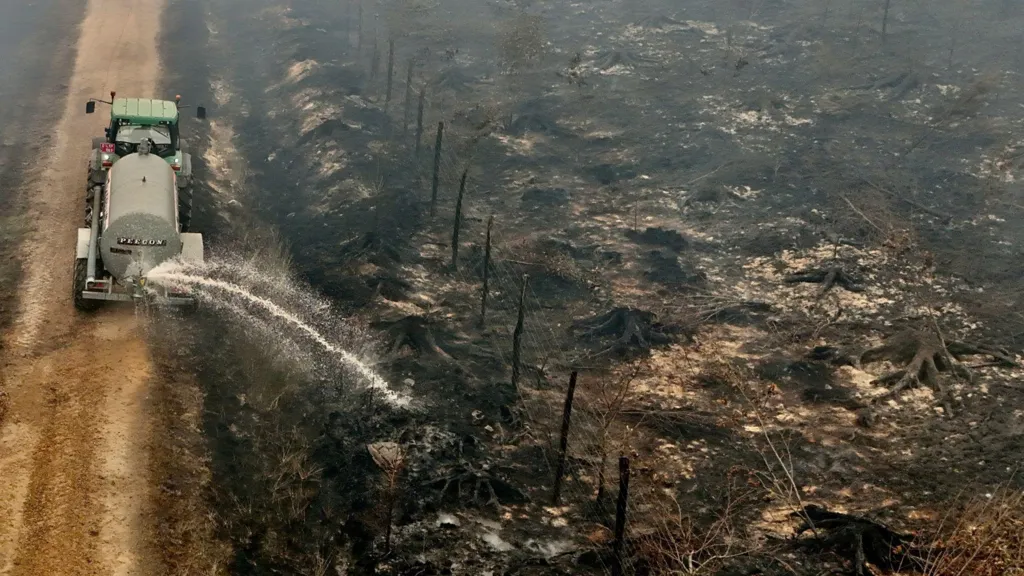
A wildfire officials describe as the largest in Belgium’s recent history more than doubled in size within 24 hours, local authorities said Sunday, as hundreds of firefighters entered a third day battling flames tearing through the country’s largest nature reserve.

The blaze has forced the evacuation of two villages near Hautes Fagnes, a protected reserve close to Belgium’s eastern border with Germany. Local farmers have hauled water tankers toward the park to assist firefighting crews, while water bombing aircraft and helicopters sent from Sweden and the Netherlands have joined the effort from the air.

The Belgian fire is one of several burning across Europe this weekend. At least two people died in forest fires on a Greek island off the coast of Athens on Sunday, part of a broader pattern of blazes spreading across the continent.

Belgian officials said intense heat combined with the reserve’s difficult terrain, a mix of bog like wetlands, moorland and forest, has made the fire especially hard to contain. According to figures reported by a French news agency citing local officials, the fire grew from 80 hectares, or about 200 acres, on Friday to 850 hectares by Saturday morning, before expanding further to 3,000 hectares by early Sunday.

Belgian Interior Minister Bernard Quintin said two fronts of the fire, one advancing toward Jalhay and the other toward Monschau, have now been brought under control. Authorities said conditions remain difficult overall and that they continue to rely heavily on aerial support to bring the fire under control, though no homes have been damaged so far.

Two water bombing aircraft arrived from Sweden on Sunday afternoon to reinforce four helicopters, two Belgian and two Dutch, already working the fire. Nicolas Yernaux, a spokesman for regional authorities in Wallonia, said Saturday that the blaze ranks as the largest the country has seen in recent history. He said firefighters have allowed portions of the heathland to burn because those areas are extremely difficult to reach. Rescue teams have been unable to access the location where the fire started, leaving its cause unknown for now.

Additional forest fires have broken out in Croatia, Spain and Serbia since Friday, following a summer of extreme heat that has left large parts of Europe either burning or scorched brown. In southwestern France, local officials in the Landes region said a separate wildfire forced the evacuation of 650 residents on Saturday. That fire first broke out Thursday and reignited Saturday, prompting authorities to deploy more than 500 firefighters to bring it under control.

The EU’s climate monitoring service, Copernicus, has confirmed that western Europe just experienced its hottest June to July period on record, a finding that aligns with the wave of wildfires now spreading across multiple countries on the continent.

Similar Posts

  • | |

    Dr Summaiya flags 14 flaws in Mir Raza Ali post-mo…

    KARACHI: Police Surgeon Dr Summaiya Syed has identified 14 serious deficiencies in the post-mortem examination of Mir Raza Ali and formally raised concerns with the police, calling for a thorough review of the forensic findings. In a letter addressed to the Senior Superintendent of Police (SSP) District East, Dr Summaiya questioned the quality and completeness of the autopsy report prepared by Dr Osama Sheikh. She highlighted several procedural and forensic shortcomings that, according to her, could affect the accuracy and credibility of the investigation. According to the letter, no X-rays were conducted on the body before or during the post-mortem examination. Dr Summaiya stated that such imaging is a standard forensic requirement and can help identify bullet trajectories, fractures and other internal injuries that may not be visible during a routine examination. She further pointed out that no chemical analysis was carried out to determine the presence of gunpowder residue around the entry wound. The absence of such testing, she noted, limits the ability to determine the firing distance and other important forensic details. The police surgeon also stated that the internal examination of the skull and neck was not performed. She said these examinations are essential in cases involving firearm injuries, particularly when determining the exact cause of death and the path of the bullet. Dr Samia’s letter also criticised the documentation process followed during the autopsy. She said no measurement scale was used while recording the injuries, making it difficult to accurately assess the size of the wounds. She added that photographs of the injuries were not taken in accordance with accepted forensic standards. She further observed that the report did not adequately explain the bone characteristics associated with the entry and exit wounds, making the injury assessment incomplete. The letter also highlighted that the nature and stage of decomposition of the body had not been clearly described in the report. According to Dr Summaiya, documenting decomposition is important in estimating the time of death and assessing the condition of the body. Another major concern raised was the reported size of the wounds. The post-mortem report recorded the entry wound as significantly larger than the exit wound, a finding Dr Summaiya described as unusual and requiring immediate re-examination and verification. She also questioned the identification process, stating that although the face of the deceased was reportedly unrecognisable, no DNA sample was collected to scientifically confirm the identity of the body. Dr Summaiya urged the investigating authorities to carefully review the post-mortem findings and address the identified shortcomings to ensure that the forensic investigation meets professional standards and supports a fair and transparent legal process.

  • |

    Hasan Mahmud joins Wasim Akram in elite Australian Test list

    Bangladesh fast bowler Hasan Mahmud has entered an elite group featuring Pakistan legend Wasim Akram after producing a match-winning performance in his maiden Test appearance in Australia. The 26-year-old claimed nine wickets as Bangladesh stunned Australia by nine wickets at Marrara Stadium on Sunday, helping the Tigers secure a historic Test victory on Australian soil. Hasan was particularly destructive in Australia’s first innings, ripping through the hosts’ batting order with a six-wicket haul. His spell helped Bangladesh dismiss Australia for just 198 on the opening day. The right-arm pacer continued his impressive work in the second innings, taking another three wickets and finishing the match with nine wickets overall. His performance earned him the third-best Test match figures by a visiting bowler in a maiden Test in Australia, placing his name alongside some of the game’s greatest fast bowlers. Bangladesh’s historic victory was built around outstanding contributions from Hasan and all-rounder Mehidy Hasan Miraz. Mehidy scored a crucial half-century in the first innings before producing a five-wicket haul in the second. Together, the pair dismantled Australia’s batting resistance and played central roles in one of Bangladesh cricket’s most memorable victories. For Hasan, the achievement marks a remarkable arrival on the Test stage in Australia and puts him in distinguished company with legendary pacers, including Wasim Akram. The result not only gave Bangladesh a historic win but also announced Hasan Mahmud as a fast bowler capable of making a major impact on the biggest stages. Best Figures by a visiting bowler in their first Test in Australia Pakistan – Wasim Akram, 11-160 in 1990 England – Maurica Tate, 11-128 in 1924 Bangladesh – Hasan Mahmud, 9-111 in 2026

  • | | |

    Rhea Chakraborty opens up about years of suspicion…

    Indian actress Rhea Chakraborty has opened up about one of the most difficult periods of her life, saying that she spent years under suspicion following the death of her former boyfriend and actor Sushant Singh Rajput. Rhea’s life changed dramatically in 2020 after Sushant Singh Rajput was found dead at his Mumbai residence. The case attracted enormous public attention, while Rhea faced intense scrutiny, criticism and legal proceedings. Months ago, the Central Bureau of Investigation (CBI) reportedly filed a closure report in the case, providing major relief to Rhea. She was cleared of the allegations connected to the case. Rhea and her brother Showik Chakraborty had also been arrested by India’s Narcotics Control Bureau in connection with a drugs-related case linked to the investigation into Sushant’s death. The actress recently discussed her experience while appearing on the second season of The Traitors. During a conversation with host Karan Johar, she was asked whether she would prefer to present herself as innocent or as a traitor in order to survive the show. Rhea chose the role of the innocent. Explaining her decision, she said that she had finally received a clean chit and that people had learned she was innocent. She added that she had remained under suspicion for a very long time and no longer liked the feeling of being viewed through that lens. The actress has previously spoken about the impact the controversy had on her life. She said the experience affected her mental well-being and that she struggled with post-traumatic stress disorder following the intense period of public and legal scrutiny. For Rhea Chakraborty, the recent developments appear to represent an important turning point. After years of controversy surrounding her name, the CBI closure report has allowed her to publicly emphasize her position and move forward. Her comments on The Traitors have once again brought attention to the long-running controversy, while also highlighting the personal toll she says the ordeal took on her. Rhea Chakraborty says she is innocent, and her latest remarks show how deeply the years of suspicion and public scrutiny continue to shape her perspective on that chapter of her life.

  • |

    Tanzania opens government debt market to all overseas investors

    Tanzania has relaxed its foreign exchange regulations to permit all international investors to purchase government-issued Treasury bills and bonds. The Bank of Tanzania announced that the policy change aims to deepen domestic financial markets and position the country as an attractive investment destination. Participation in government securities was previously restricted to residents of the East African Community, the Southern African Development Community, and the Tanzanian diaspora. President Samia Suluhu Hassan’s administration is seeking fresh revenue options following recent reductions in aid from international partners.

  • | |

    FBISE unveils SSC 2026 results, 1st time AI assist…

    ISLAMABAD: The Federal Board of Intermediate and Secondary Education (FBISE) has announced the results of the Secondary School Certificate (SSC) Part-I and Part-II First Annual Examination 2026, revealing strong overall performance while introducing artificial intelligence (AI) in the paper-marking process for the first time. The results were officially declared during a ceremony in Islamabad, where Federal Minister for Education and Professional Training Dr Khalid Maqbool Siddiqui inaugurated the announcement. Addressing the event, FBISE Chairman Prof Dr Ikram Ali Malik highlighted the Board’s efforts to ensure smooth and transparent examinations. He said a total of 292,831 students appeared in the SSC examinations this year, with 1,006 examination centres established across the country. To oversee the process, 2,012 supervisory staff members and 6,996 invigilators were deployed. The chairman also revealed that more than 10,700 teachers applied to assess examination papers, while 4,855 examiners were selected for the task. He described the introduction of AI-assisted marking as a major step towards improving accuracy and efficiency in the evaluation process. During the examination period, 86 cases involving the use of unfair means were reported. According to the results, SSC Part-I recorded an overall pass percentage of 59.77 per cent, with 88,646 students passing out of 150,077 candidates. SSC Part-II achieved a significantly higher success rate of 91.33 per cent, as 128,070 of the 141,653 candidates cleared the examinations. In the Science Group, Afeera Ijaz secured the top position with 1,089 marks. Amna Nauman claimed second place with 1,088 marks, while Huzaifa Haider finished third with 1,086 marks. Among Humanities students, Fatima Zahra emerged as the overall topper with 1,037 marks. Muhammad Maaz and Manaal Zahid shared second position after each scoring 1,031 marks, while Aneesa Nisar secured third place with 1,023 marks. The Board said the introduction of AI-assisted marking reflects its commitment to modernising Pakistan’s examination system while maintaining transparency and fairness in the assessment process.

  • |

    30 children geared to have been conceived using wrong IVF donors

    At least 30 children, most of them believed to be British, may have been conceived through IVF treatment in northern Cyprus using sperm or egg donors different from those selected by their parents. The allegations have emerged from an investigation into fertility clinics in the region, raising serious concerns about the treatment of international patients and the regulation of fertility services. The parents involved say they carefully chose anonymous donors before undergoing treatment. Their decisions were based on detailed information provided by clinics, including the donors’ medical backgrounds, physical appearance, education, personalities, interests and hobbies. However, after their children were born, some parents began to question whether the donors they had selected were actually used during their IVF procedures. The latest investigation has identified at least 30 cases in which parents believe the wrong sperm or egg donors may have been used. This is a significant increase from the seven cases . Around half of the children were reportedly conceived following treatment at Dogus IVF Centre, a fertility clinic in northern Cyprus. Several individuals involved in the treatment of these patients have come under scrutiny, including doctors Firdevs Uguz Tip and Sevket Alpturk, as well as patient coordinator Julie Hodson. One mother, identified as Rachel, said she recently discovered that the sperm donor used during her treatment may not have been the donor she had chosen. She described the situation as extremely shocking and unacceptable. The parents have raised concerns that staff members at the clinic may have provided misleading information about the donors. Dr Firdevs Uguz Tip has denied any wrongdoing. The investigation has also uncovered information about the relationship between Dogus IVF Centre and Cryos International, one of the world’s largest sperm banks. Cryos placed Dogus on its blacklist in 2016, adding another concern surrounding the clinic’s practices. Northern Cyprus has become a popular destination for British and other international patients seeking fertility treatment. The region offers relatively low treatment costs, reportedly high success rates and access to a wide selection of sperm and egg donors. However, its regulatory system is significantly different from that of European Union countries. Northern Cyprus is internationally recognised only by Turkey, and EU laws do not apply there. Fertility clinics in the territory have been described as operating under relatively loose regulation, raising questions about oversight and accountability. According to previous reports on the emerging allegations in March, when seven parents came forward with concerns that they may have been misled about the donors used in their treatments. Following those reports, the Ministry of Health in northern Cyprus said it had opened an official investigation. However, the ministry has reportedly failed to provide further information. Many parents said clinics had promised them donors who had undergone health screening and were from Western European backgrounds. Their suspicions reportedly grew after their children were born. DNA testing has provided further evidence that has intensified these concerns. Eleven of the 30 children have undergone commercial DNA tests, with results indicating genetic ancestry connected to Turkey or nearby regions. According to the investigation, these results may suggest that the donors selected by the parents were not the individuals whose genetic material was ultimately used. The allegations have caused distress among affected families, many of whom travelled abroad believing they were receiving carefully selected fertility treatment. The growing number of cases is now raising serious questions about donor identification, patient information, clinic accountability and the regulation of fertility services in northern Cyprus.

Leave a Reply

Your email address will not be published. Required fields are marked *