2300 israeli settlers
| |

2,300 Israeli settlers storm Al-Aqsa

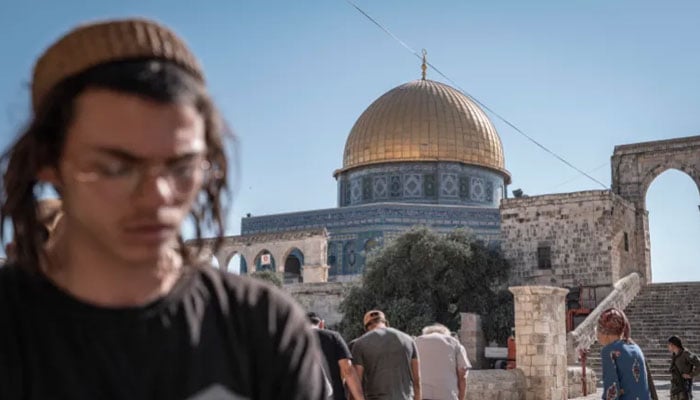
Around 2,300 Israeli settlers entered the Al-Aqsa Mosque compound in occupied East Jerusalem on Wednesday morning, according to Palestinian officials and international media reports.

Palestinian authorities described the mass entry as one of the largest such incursions this year. The incident took place as Jewish settlers marked Tisha B’Av, a religious day of mourning that commemorates the destruction of ancient Jewish temples, according to Jewish tradition.

The site holds deep religious significance for both Muslims and Jews. Muslims refer to it as the Al-Aqsa Mosque compound, while Jews call the area the Temple Mount.

Israel’s far-right National Security Minister Itamar Ben-Gvir also entered the compound under heavy police protection. His presence at the sensitive holy site has previously drawn strong criticism from Palestinians and sparked concerns over rising tensions in Jerusalem.

The Jerusalem Governorate said the number of Israeli settlers entering the compound could increase further by sunset. Palestinian officials also reported that Israeli forces imposed tight security restrictions around the entrances to Al-Aqsa and across the Old City of Jerusalem.

Large numbers of Israeli security personnel deployed throughout the area, while Palestinian worshippers faced restrictions on accessing the mosque. According to the governorate, only a limited number of Palestinians managed to reach Al-Aqsa for the dawn prayer.

Palestinian officials further alleged that Israeli forces assaulted several worshippers and local residents during the heightened security measures.

The latest incident comes amid continued tensions surrounding access to and control of the Al-Aqsa Mosque compound, one of the most sensitive religious and political flashpoints in the Israeli-Palestinian conflict.

Similar Posts

  • | |

    Iran’s ultimatum to Gulf neighbors amid US standoff

    Geopolitical conflict in the Middle East reached a state of alert today following a direct diplomatic ultimatum from Tehran to neighboring Arab nations. Iranian authorities have issued an explicit warning to Gulf states, urging them to exert diplomatic leverage over the United States administration to curb aggressive posturing, or face severe regional consequences, including potential retaliatory actions targeting critical infrastructure and trade corridors. The ultimatum highlights the delicate tightrope walked by oil-rich nations in the Arabian Peninsula, who find themselves caught in the crossfire of renewed political and economic pressure campaigns. As global energy markets closely monitor the developing situation, Tehran’s warning serves as a stark reminder of how rapidly regional proxy disputes can evolve into broader threats to global supply chains and economic stability. A High-Stakes Regional Warning In recent communications conveyed through diplomatic channels, Iranian officials emphasized that Gulf nations can no longer claim strict neutrality while allowing their territories, airspace, or strategic partnerships to support foreign military or economic pressure campaigns. Tehran made it clear that if aggressive measures against its economic interests and sovereignty continue, the operational security of neighboring states could be compromised. The tone of the warning reflects Tehran’s strategy to leverage the economic vulnerabilities of its neighbors. By raising the prospect of disruptions to regional oil production facilities, shipping lanes through the Strait of Hormuz, and commercial hubs, Iran aims to compel Gulf leaders to actively advocate for de-escalation in Washington. The Dilemma Facing Gulf States For neighboring countries such as Saudi Arabia, the United Arab Emirates, Qatar, and Kuwait, this ultimatum poses a major strategic dilemma. In recent years, these nations have pursued a dual policy: strengthening their defense alignments with Western partners while simultaneously opening diplomatic dialogue with Iran to reduce regional tensions. However, an intensified standoff severely limits their ability to maintain that equilibrium. Much of the Gulf’s economic diversification and energy output relies on uninterrupted commerce and stable maritime routes. Any direct target on infrastructure could disrupt worldwide energy prices and local economies. While these nations house key military installations and host international forces, they remain geographically exposed to short-range missile, drone, and naval capabilities possessed by regional forces. Gulf leadership must weigh the risks of pushing back against Western strategies versus the immediate security threats posed by an angered neighbor across the water. Global Energy Markets and Future Outlook The immediate ripple effects of these threats were felt across international markets, where Brent crude futures showed immediate volatility reflecting a built-in risk premium. Analysts warn that even minor disruptions in energy transport or localized incidents near vital waterways could trigger sharp price spikes, compounding existing global economic uncertainties.   As diplomatic envoys work behind the scenes to de-escalate the rhetoric, the situation remains fluid. The coming days will test whether Gulf states can successfully mediate between opposing forces to prevent localized tensions from spilling over into a wider, economically damaging regional conflict.

  • |

    US issuing final opportunity for nuclear agreement with Tehran before extreme military action

    US President Donald Trump has issued a final ultimatum to Iran, stating that Tehran has one last opportunity to negotiate a diplomatic resolution with Washington before facing severe military force, which he referred to as decapitation. Speaking from the Oval Office, the American leader confirmed he had paused planned air strikes following direct requests from Persian Gulf nations, including Saudi Arabia, Qatar, and the United Arab Emirates, who urged Washington to allow diplomacy one final window. The framework for the proposed negotiations relies on a two-stage approach, with the initial phase requiring the immediate and unconditional reopening of the Strait of Hormuz to international shipping. The subsequent phase will address the complete denuclearisation of Iran, referencing commitments previously outlined in a joint memorandum signed in June. Trump further dismissed any personal domestic political considerations regarding the timeline, emphasising that his decision to delay military action was driven by a desire to prevent widespread loss of life while pursuing a durable diplomatic outcome.

  • |

    Shift in Democratic backing signals growing rift over US support for Israel

    A long-standing bipartisan consensus in Washington regarding unyielding support for Israel is facing unprecedented strain, primarily driven by deepening fractures within the Democratic Party. Escalating military action in Gaza, broader regional conflict, and Prime Minister Benjamin Netanyahu’s close alignment with US Republicans have steadily eroded traditional Democratic backing, threatening to transform America’s foreign policy landscape into a sharp partisan divide. This internal tension is increasingly evident across Capitol Hill and key electoral contests. Congressional votes attempting to restrict or eliminate annual military assistance, which amounts to billions of dollars alongside recent emergency packages, have gained significant momentum, drawing support from senior figures like former Speaker Nancy Pelosi despite pushback from House leadership. High-profile primary races in battlegrounds such as Michigan, Florida, and Colorado highlight this rift, pitting progressive candidates advocating a complete halt to military funding against establishment figures emphasising the strategic necessity of security ties. Recent public opinion polls reinforce this realignment, with a solid majority of Democratic voters maintaining that Washington is overly supportive of Israel, reflecting a generational shift that could permanently alter future US diplomatic relations.

  • |

    Bangladesh hints at joining Pakistan-Saudi-Türkiy…

    DHAKA: Bangladesh has signalled that it could consider joining the emerging economic or defence framework involving Pakistan, Saudi Arabia and Türkiye, opening a potentially significant new chapter in regional diplomacy and security cooperation. Bangladesh Prime Minister’s Foreign Affairs Adviser Humayun Kabir said Dhaka was taking a positive view of the possibility of becoming part of a framework involving the three countries. His comments come only weeks after Pakistan, Saudi Arabia and Türkiye signed the Makkah Joint Defence Agreement. The agreement, signed in Makkah on Aug 7, commits the three countries to strengthening collective security and defence cooperation. It also states that an armed attack against any one of the three signatories would be regarded as an attack against all three. Kabir, speaking to Bangladesh’s state news agency, indicated that Dhaka would examine the idea through the lens of its own national interests and the rapidly changing global economic and trade environment. “The government is following a Bangladesh First policy,” Kabir said, according to reports, stressing that national interests remain at the centre of Dhaka’s foreign policy. The remarks are particularly noteworthy because Bangladesh has recently been working to strengthen practical ties with Pakistan. Kabir said the two countries were seeking greater cooperation in trade and people-to-people contacts, suggesting that economic engagement could form an important part of the relationship. For Pakistan, Bangladesh’s interest could give the Makkah framework a wider South Asian dimension. For Saudi Arabia and Türkiye, Dhaka’s possible participation could also expand the reach of an arrangement that the signatories have described as defensive rather than directed against any particular country. Turkish President Recep Tayyip Erdogan has said the agreement is open to other friendly countries seeking peace, prosperity and stability in the region. Turkish officials have also stressed that the pact does not identify a common enemy and is intended to strengthen defence cooperation and collective deterrence. Bangladesh’s possible move comes as Dhaka is also deepening its relationship with Saudi Arabia. Kabir said Prime Minister Tarique Rahman is expected to visit Saudi Arabia following an invitation from Crown Prince Mohammed bin Salman. The visit could provide an opportunity for discussions on economic cooperation, regional security and Bangladesh’s possible role in broader regional frameworks. For now, Dhaka has not announced any formal decision to join the defence agreement. But its positive signal is already attracting attention, particularly because Bangladesh’s participation could reshape the strategic picture across South Asia and the wider Muslim world. The next step will likely depend on how Dhaka assesses the proposed framework against its national interests, economic priorities and wider foreign-policy objectives.

  • |

    7.4-magnitude quake strikes Colombia

    A powerful earthquake struck Colombia and several other parts of Latin America on Monday, causing injuries, damaging buildings and forcing evacuations in the capital, Bogota. The earthquake was recorded at different magnitudes by geological agencies. Colombia’s geological service measured it at 6.6, while the United States Geological Survey estimated its magnitude at 7.4. The epicentre was located in western Colombia at a depth of around 100 kilometres. Strong tremors were felt across large areas of the country. The shaking was also reported in neighbouring Ecuador and as far north as Panama. In Bogota, residents rushed out of buildings as emergency sirens sounded. Some people were seen gathering in the streets after leaving their homes and workplaces. Authorities ordered evacuations from a number of buildings as a precaution while emergency teams assessed possible structural damage. The situation was particularly serious in the western parts of Colombia. The governor of Choco province reported injuries and significant damage to buildings in Quibdo, the provincial capital. Cali, one of Colombia’s largest cities, also suffered substantial damage. Mayor Alejandro Eder said at least 20 buildings had collapsed and that people were believed to be trapped inside some of the structures. Rescue operations were launched in the affected areas. Cali authorities requested additional emergency teams from Bogota and Medellin to assist with search and rescue efforts. Images broadcast by local media showed buildings with damaged facades and sections of structures affected by the powerful tremors. Emergency authorities continued to assess the extent of the destruction as rescue teams searched damaged buildings for survivors. Officials have not yet released a complete account of casualties or property losses. The number of injured people is expected to change as assessments continue. The depth and strength of the earthquake allowed tremors to be felt across a wide area, including outside Colombia. Authorities urged residents to remain cautious and follow instructions from emergency services, particularly in buildings that may have suffered structural damage. The earthquake comes as parts of northern South America remain vulnerable to major seismic activity. In June, two powerful earthquakes struck Venezuela, with reported magnitudes of 7.2 and 7.5, causing widespread destruction and thousands of deaths.

Leave a Reply

Your email address will not be published. Required fields are marked *