oil dependence bad
| | | |

Oil dependence is bad for the climate and the economy, UN chief tells COP31

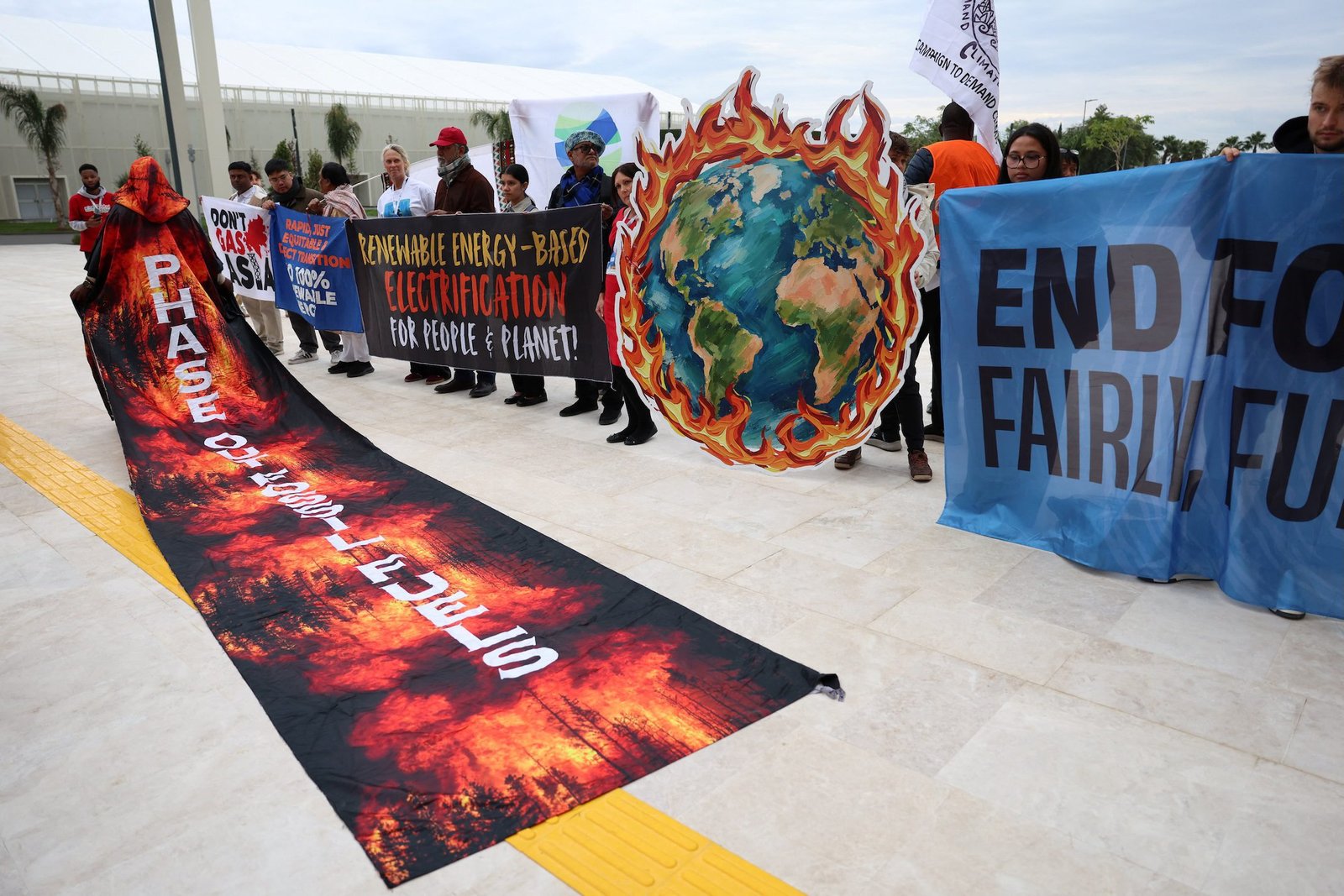
ANTALYA, Turkey – United Nations Secretary-General Antonio Guterres took aim at oil companies making billions of dollars in profits while families, businesses and governments suffer, as he used the COP31 climate conference to criticize fossil fuel dependency.

Tayyip Erdogan, president of the talks’ host nation Turkey, meanwhile, welcomed an oil discovery in the Turkish mountains, and the country’s climate negotiators pushed governments to sign a pledge to electrify their economies. The pledge does not specify whether the electricity involved would be renewable or from fossil fuels.

Taken together, the discourse on Tuesday, November 10, the second day of the two-week UN conference in Antalya, highlights a tension at the heart of the climate debate: fossil fuels underpin the global economy, but also hurt it through costly climate damage and often-volatile energy prices.

A UN report last month showed the world is poised to warm well beyond the 1.5 degrees Celsius (2.7 degrees Fahrenheit) threshold scientists say could unleash the worst consequences of climate change, as greenhouse gas emissions continue to grow.

While many people endure the impact of inflation, oil companies have largely benefited from a rise in fossil fuel prices since the US-Israeli war on Iran disrupted energy shipments from the Middle East.

“Fossil fuels are not only driving the climate crisis. Dependence on them carries a steep economic and security price — as the crisis in the Middle East has laid bare,” Guterres, who will step down at the end of the year, said.

“Families, businesses and governments are paying the price. Meanwhile, nine oil companies are on track to rake in more than $95 billion in just three months. That is more than one billion dollars a day.”

Guterres did not name the companies. Exxon Mobil, Chevron Corp, BP, and Shell have reported windfall earnings since the Iran war began at the end of February.

Electrification ambition, but will it be green?

Earlier, COP31 host Turkey urged countries to sign up to a goal to increase the share of electricity in global energy use to 35% by 2035 — up from around a fifth today.

Turkey is seeking to incorporate that electrification goal into the formal outcome of the talks, according to a person familiar with the matter.

COP31 President Murat Kurum told a press conference in Antalya that the goal was a way to cut emissions, drive economic growth and ensure long-term energy security.

Climate advocates have criticized the pledge because it does not require that the additional electricity come from low-carbon sources — something Kurum said was not required.

“I put forth a target for electrification. An exit from fossil fuels has already been put forth in previous COPs. You have a path ahead of you today, one is becoming more costly, and one is becoming cheaper. Which one would you prefer?” he said.

The target is meant to help reduce planet-warming emissions by speeding the global shift away from fossil fuel-powered vehicles, furnaces, boilers, cooking stoves, and other greenhouse gas-emitting equipment.

Turkey and Australia rely on coal

The previous COP in Brazil was unable to reach consensus on the need for a global plan to reduce dependency on fossil fuels, but the COP presidency has in recent weeks published a roadmap aimed at keeping that idea at the center of the climate negotiations. The roadmap asks countries to first plan and assess their energy systems by 2028, then work together to reduce fossil fuel supply from 2031.

Turkey, the conference host, and Australia, which is leading the negotiations, both rely on fossil fuels for electricity.

Coal generated about a third of Turkey’s electricity last year and more than 40% of Australia’s, according to government data.

Speaking alongside the Brazilian team at an event in Turkey, former US secretary of state and climate envoy John Kerry said that despite previous COPs having agreed on the need to transition away from fossil fuels, investment poured into new oil and gas fields.

“The hard truth is that fossil fuels story is still moving in the wrong direction,” he said. “We don’t need more promises. We need plans.”

Erdogan on Monday, November 9, had cheered a rise in crude oil production from Turkey.

“Good news keeps coming from the mountains of Gabar,” he said following a cabinet meeting, after announcing that oil production from the Gabar fields in the country’s southeast would exceed 100,000 barrels per day in the second half of 2027.

Climate activist Greta Thunberg, attending her first COP talks in five years, said the UN process was failing to deliver enough action to match the severity of the crisis.

“These COPs have become greenwash circuses, that is the reality,” she told reporters.

“Of course it is absolutely crucial that we still do everything we possibly can because this is an opportunity to mobilize people and to say that the people in power do not have the situation under control.” – Rappler.com

Similar Posts

  • | |

    Shein turns to China as Hong Kong IPO nears

    Fast-fashion giant Shein is preparing to make its stock market debut in Hong Kong after years of efforts to list in the United States and Britain, marking a significant shift in how the company presents its relationship with China. The company is expected to raise around $1.7 billion through its Hong Kong initial public offering, with a valuation of about $26.5 billion. That figure is considerably below the company’s valuation in 2022. Shein had previously sought to establish itself as a global company. It moved its headquarters to Singapore in 2021 and promoted plans to expand manufacturing and operations in countries including Brazil, Türkiye and parts of Europe. However, its attempts to secure a Western listing faced regulatory and political obstacles. Chinese authorities were also reportedly involved in blocking earlier efforts to list in New York and London. After shifting its focus to Hong Kong in 2025, Shein founder Sky Xu increased his engagement with Chinese officials and became more involved in regulatory and capital-market discussions inside the country, according to people familiar with the matter. Xu also made a rare public appearance at a business forum in Guangdong earlier this year, where he announced plans for Shein to invest $1.5 billion in the province. He said the company would deepen its presence in Guangdong and develop its smart supply-chain system while contributing to the region’s fashion industry. Shein also opened a research and development centre in Nanjing, the eastern Chinese city where the company was founded in 2012. These moves helped reinforce the company’s economic links with China at a time when Beijing has been paying close attention to companies with major overseas operations. Officials in Guangdong also reportedly highlighted Shein’s contribution to employment and domestic economic activity when engaging with central authorities. The company has sought to emphasise that its main business is overseas rather than in China. Shein does not market its extremely low-priced products to Chinese consumers, allowing it to distance itself from the intense competition among domestic e-commerce platforms. Shein has instead argued that its international operations benefit China by generating foreign currency and supporting Chinese manufacturing and supply chains. The company’s Hong Kong prospectus describes China as the foundation of its global logistics and fulfilment network. Nearly 80 per cent of Shein’s workforce is based in mainland China. The shift comes after growing difficulties in Western markets. In the United States, lawmakers raised concerns over Shein’s supply chains and called for stronger assurances that its products were not linked to forced labour. The company has also faced scrutiny in Europe over competition, product safety and items offered through its online marketplace. At the same time, changes to low-value import rules in the US and Europe have created additional challenges for Shein’s business model, which relies heavily on inexpensive shipments directly to consumers. Analysts say the company’s experience demonstrates how geopolitical tensions are increasingly influencing corporate decisions and stock-market listings.

  • |

    Lt Gen (R) Abdul Qayyum calls for global peace through dialogue; FIRD Chairman Toaha Qureshi backs strong armed forces

    LONDON:  Senator Lt Gen (R) Abdul Qayyum (HI(M)), President of the Pakistan Ex-Servicemen Society, called for greater respect for international law, dialogue under the umbrella of the United Nations and enhanced cooperation among Muslim countries to address global security challenges, while Forum for International Relations Development (FIRD) Chairman Toaha Qureshi reaffirmed support for Pakistan’s armed forces, saying they remained the country’s defenders and that the Field Marshal had enhanced Pakistan’s reputation on the global stage. Addressing the Second International Conference on Global Peace, organised by FIRD in London, Senator Abdul Qayyum said lasting peace could only be achieved through diplomacy and adherence to international law. “Respect for international law and pursuing dialogue as a strategy for peace under the umbrella of the United Nations can help resolve even the most complex global challenges. Destructive wars can only lead to catastrophic consequences and bring suffering to humanity as a whole,” he said. During his address, the senator argued that the post-Cold War unipolar world had witnessed repeated violations of international law and human rights, weakening the effectiveness of institutions such as the United Nations and the International Court of Justice. Discussing global security, he said colonialism had evolved into neo-colonialism in the modern era and referred to the establishment of US military bases around the world. He also cited recent developments in the Middle East, saying they had highlighted the importance of national self-reliance in defence and strategic planning. Senator Abdul Qayyum said vulnerable states increasingly needed to strengthen their own defence capabilities while developing strategic partnerships through mutual defence agreements. Referring to recent tensions involving Iran, Israel and the United States, he said the evolving regional security environment had prompted Gulf countries to reassess their strategic priorities and seek greater autonomy. He said Pakistan, with its strategic geographical location and strong defence capability, could play a constructive role in promoting closer cooperation among Muslim-majority countries. He added that greater unity among Muslim states, beyond sectarian divisions, could strengthen regional stability and collective security. The senator warned that unilateral actions and disregard for international law risked pushing the world towards another major global conflict. Referring to former US President Richard Nixon’s geopolitical doctrine, he said pragmatic diplomacy, a balance of power and economic stability remained essential foundations for international peace. Addressing interfaith harmony, Senator Abdul Qayyum said dialogue and mutual respect remained essential to strengthening relations between different faith communities. He expressed concern over the rise of Islamophobia and called for greater engagement, education and cooperation to counter prejudice and promote peaceful coexistence. Speaking at the conference, FIRD Chairman Toaha Qureshi said Pakistan’s armed forces were the guardians of the country’s sovereignty and deserved the nation’s continued support. “Pakistan’s armed forces are the protectors of the country. We need strong armed forces, and it is necessary that we continue to support this institution,” he said. Qureshi added that Pakistan’s Field Marshal had earned the country greater international recognition and enhanced its standing through his leadership. The conference also heard from educationist and businessman Mian Muhammad Jehangir, who stressed the importance of meaningful education in shaping future generations and driving national development. He said Pakistan’s youth possessed immense talent and potential, adding that investment in quality education, skills development and character-building was essential for the country’s progress. He praised the achievements, resilience and capabilities of Pakistan’s young people, expressing confidence that they would play a pivotal role in building a stronger, more prosperous and globally competitive nation.

Leave a Reply

Your email address will not be published. Required fields are marked *