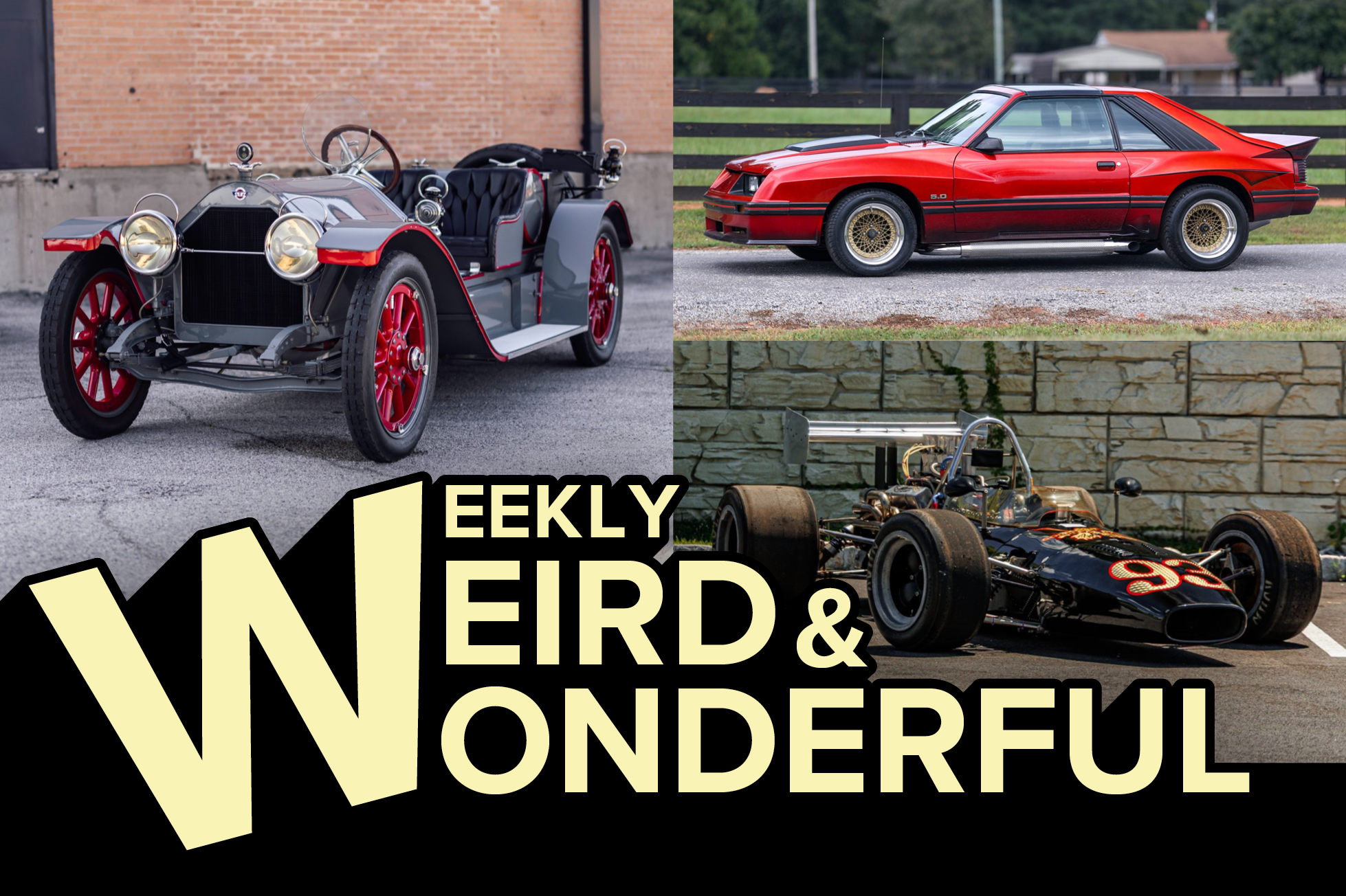
Understanding this Week’s Weird and Wonderful—October 10, 2025
Welcome to the Weekly Weird and Wonderful—your sign that you’ve successfully made it to the end of another work week. Herein you will find a collection of the most interesting cars on the site at the moment, though whittling down the selection was no easy task. We thought we were being picky, and still ended up with a few dozen interesting vehicles that we couldn’t highlight here. You can find those and more on our live auctions page.

Enjoy this week’s Weird & Wonderful, and let us know what other listings piqued your interest in the comments.
Barchetta-Bodied 1952 Ferrari 212 Inter


The history of chassis 0259EU, like most Ferraris of this vintage, takes a few twists and turns. We’ve seen part of this car before on BaT, when we featured its removed Pinin Farina coupe body back in 2011. The body it now wears is a replica of Touring’s Superleggera Inter Barchetta coachwork, rendered in aluminum over a steel tube framework by D. Moroney in Cheshire, England around the turn of the Millennium.


The car’s well-documented journey began in Florence, Italy, but it was quickly scooped up by an SCCA muckety-muck on the East Coast and subsequently underwent a couple of engine swaps, ending up with a V12 sourced from a 250 GT Boano, which it still carries today. The engine and body swaps haven’t posed much of an issue for the Pebble Beach crowd, and the car remains significant for being one of 80 racier “Inter” cars intended for both street and competition use.


The price of lift tickets has gotten out of control, and this is the way to fight back. With room for seven and a trusty Chrysler V8 under the hood, this surprisingly luxe Sno-Cat can take you and your crew to places no ski cop can follow. As an added bonus, it’s bound to make an impression with jaded Aspen valets tired of parking Sterratos and Bataygas.


This is the first Sno-Cat we’ve auctioned on BaT, and only the second we’ve seen here in our 18 years on the Internet. Sometimes, a strange vehicle will sell here and a then bunch more come through the door behind it. We’ll close our eyes and cross our fingers and hope for a Sno-Cat avalanche.
Jerry Seinfeld’s RUF-Modified 1971 Porsche 911S Coupe


You are welcome to use the term “restomod,” but you won’t hear us saying it. If a car is modded, it’s not resto’ed, and if it’s resto’ed, it’s not modded. This longhood 911S was modified in grand fashion by Alois Ruf, who kept things stock-ish on the outside. Underneath is a RUF-tuned suspension and a 3.4-liter twin-plug six with one of the more lurid exhaust notes you’ll hear.

It’s a shame this car didn’t show up a week ago when Seinfeld’s friend/co-writer/automotive enabler Spike Feresten was on the BaT Podcast. We’re sure he knows a thing or two about it. The discussion thread is full of favorite Seinfeld quotes, but we’ll refrain from making any further references here, ’cause we don’t wanna be a pirate.
Custom Chevrolet COE-Style Car Hauler


We’ve certainly seen our fair share of crew-cab COEs, but this build took things to a whole new level—literally. @CoeGuy51 grafted a pair of Chevy COE cabs together and mounted them to a rollback-style bed. The whole thing rides on a GM P30 motorhome dually chassis. The project took seven years, and the seller fittingly calls it the COCOE for “Cab Over Cab Over Engine.” It’s also relatively well-equipped with power steering, front discs, rear auxiliary air springs, and a 454ci V8 under the double-decker cab to haul it all.
1953 Jaguar Mk VII Cabriolet Prototype by Beutler


From 1950 to 1956, Jaguar’s Mk VII was sold exclusively as a four-door saloon. Swiss coachbuilder Beutler took it upon themselves to design a two-door Mk VII cabriolet, and displayed it at the 1953 Geneva Motor Show. Legend has it that the car made its way back to the Jaguar factory in Coventry, and it later sold to a private owner. The car was eventually acquired by marque specialist Roland Urban, who highlighted it in his 1993 book Métamorphoses du Jaguar, describing it as a very Jaguar-esque interpretation of a Jaguar—a high compliment considering that the only other Mk VII convertible prototype, a 1954 model designed by Giovanni Michelotti, took greater stylistic liberties.

Its pontoon-style bodywork was refinished in white earlier in its life, and the car underwent a refresh in 1996. It resurfaced in 2014 when it was sold into the Ronald Lauder Collection, and now we’re honored to this rare cat find a new home.


We were pretty intrigued when @911r told us about this car in his interview a couple weeks ago, but we had no idea it would show up here so soon! This is the Bocar XP-7R, a rare supercharged variant of the already-rare XP-7, itself a naturally-aspirated version of the supercharged XP-6. This would have been confusing to people, but not many knew about it in the first place. To wit, this car is chassis #003, and may be the only one of its kind left. Since driving impressions are going to be hard to come by, we dug up this feature on the XP-6 from the January, 1960 issue of Sports Car Illustrated.

Like many period sports racers, the XP-7R featured fiberglass bodywork over a tube-steel frame—interestingly, the car used VW Beetle front suspension and rack-and-pinion steering. The engine itself is truly wild—a Chevy small block with Rochester fuel injection augmented by a massive GM 4-71 blower mounted to the front of the motor and driven directly off the crankshaft, like a Blower Bentley. This seems like the kind of car that would live out its days on display at a museum, but previous owners have run it in the California Mille and Colorado Grand rallies.
1999 DeTomaso Guarà Spyder Prototipo


Simply put, this one’s crazy. Inspired by the track-only Maserati Barchetta, the DeTomaso Guarà was first introduced as a coupe, and it would become the final model produced by the company under Alejandro de Tomaso. In all, 43 Guaràs were built, which included 10 windshield-less Barchettas and three Spyders. This Spyder Prototipo was the first of those three, and de Tomaso commissioned a design firm called pro industria Manfred Lang to carry out the design. A demonstrator coupe was then converted by Bacchelli and Villa’s Carrozzeria Autosport in Bastiglia, Italy, and it was later unveiled to the public at the 2000 Turin Motor Show.

Like other Guaràs, it was powered by a 4.0L BMW V8. Later production cars moved to a 4.6L Ford V8, which posed a problem with the convertible’s folding top design. Production ultimately ceased at three units. This car remains registered with its current owner, and it’s presently offered on his behalf by BaT seller and European Local Partner @ImageStreetClassics with prints of design sketches. The entire gallery is worth the look alone, and the driving video delivers a full dose of BMW V8 sound.
1939 Steyr 220 Sport Roadster by Gläser


Steyr it a city in upper Austria, and lent its name to the local automotive factory, which had officially become known as Steyr-Daimler-Puch by the 1930s. The 220 was the firm’s bigger, more luxurious offering, and some 5,900 units were produced, including six Sport Roadster variants. This rare 1939 Steyr 220 is one of those six, and featured hand-formed bodywork fabricated by German coachbuilder Gläser-Karosserie. This particular example is chassis CC3041S, and lived its postwar life in what is now known as Kaliningrad, along the Baltic coast. A multi-year refurb ensued following the current owner’s acquisition in 2021.
Bentley 3-Litre Tourer Re-Creation Project


This “Bitsa” Bentley is a fascinating build that brings together several swap-meets worth of period parts, an orphaned chassis number, and 14 years of labor. Add in some skilled metalwork and creative parts substitutions, and you have the only Bentley 3-Litre with a digital odometer as original equipment. Critically, the engine and radiator shell are legitimate W. O. Bentley items—with so much variation in the early 3-Litre cars, these two elements are the ones that best convey “Bentley-ness.” The side steps are pretty convincing, too. With a Chrysler Torqueflite, Chevy rear end, and Wilwood disc brakes, the seller clearly intended the car to be driven, and is said to have put 2k miles on it before parking it. We definitely need to hear more about this creation from @doccy1.
Propane-Powered 1968 Ford Ranchero


Don’t listen to the tailgate—this Ford does not run on 100% alcohol and water. Hypothetically, its driver could, but we don’t recommend it. This car was converted as part of an alternative fuels demonstration project sponsored by the US Department of Energy in the 1970s. The timeline is a bit unclear, but at some point it received a 200ci straight-six converted to run on propane fuel, which is stored in a tank mounted in the bed. It spent a good deal of time in the Minnesota collection of Ernie Tuff, a NASCAR engine builder who built Fireball Roberts a motor so good it was banned by the France family. This is the kind of car that would make Hank Hill weep tears of joy—the ultimate propane accessory.
Honorable Mentions:
1974 Volkswagen 412 3-Door Wagon

The 412 was an uncharacteristically short-lived model for VW, though the design had a longer life in South Africa and Brazil. It represents a bit of a transitional period for Volkswagen, retaining traditional elements like the rear-mounted, air-cooled flat-four (shared with the 914!), and a MacPherson strut front suspension shared with the contemporary Super Beetle. The body is a Brooks Stevens update of a Pininfarina design, but 1974 was its final year of production. Giugiaro’s crisp, angular lines would become the prevailing VW design language just one year later with the introduction of the Rabbit.
2002 Tabbert Baronesse 740 Caravan w/11k-Mile 1995 Cadillac Fleetwood Brougham


Why yes, that is a fireplace you see next to the refrigerator. And the chandelier is from the Django Reinhardt estate. The counters are marble, the leather is white, and the draperies are swagged. Oh yeah—there’s a Cadillac attached to it, too.
No Reserve: Six-Wheeled, V6-Powered 1980 Toyota Pickup w/Trailer


This modified 1980 Toyota truck and custom trailer combo once shuttled visitors around the Irem Country Club in Dallas, Pennsylvania. The tailgate seems to indicate that children at the country club were subjected to forced marches.
Thanks for checking out this edition of the Weekly Weird & Wonderful! Follow this page to get updates when new installments post, and tell what caught your eye or what you think we’ve left out!