CATL shares extend slide to one-year low as Li Auto, Xiaomi spread battery orders to rivals — Explained

- CATL’s Shenzhen-listed shares fell another 3.84% on Wednesday and are down about 35% from their recent peak in early May.
- Li Auto and Xiaomi are accelerating efforts to diversify their battery supply, but CATL still held a 41.45% share of China’s power battery installations in August.
CATL (SZSE: 300750; HKEX: 3750) shares extended their decline on Wednesday to a fresh one-year low, as investors worry that Chinese automakers are speeding up efforts to diversify their battery supply chains, weakening customer loyalty to the world’s largest power battery maker.
As of press time, CATL’s A-shares were down 3.84% at 304.22 yuan on Wednesday, after briefly falling below the 300 yuan mark during the session. The stock closed down 6.16% on Tuesday, already a one-year low.
At the current price, CATL shares have retreated about 35% from their recent high of 467.35 yuan in early May. Its Hong Kong-listed shares had earlier dropped from a high of nearly HK$800 to around HK$500.

In contrast to the leader’s decline, second-tier battery stocks rallied. Sunwoda (SZSE: 300207) was up more than 12% as of press time, while Gotion High-tech (SZSE: 002074) and Farasis Energy (SSE: 688567) also gained.
Behind the divergence is an automaker-led restructuring of the battery supply chain that is moving from rumor to reality. The industry convention of recent years, under which premium new energy vehicles (NEVs) came standard with CATL batteries, is being broken by several leading automakers.
Li Auto (NASDAQ: LI; HKEX: 2015) switched all variants of its new-generation Li L8, launched in June, to Sunwoda cells, with battery packs produced by the two companies’ joint venture, removing CATL from that model’s supply chain.
Li Auto also said earlier this month that it plans to invest 2.65 billion yuan in Sunwoda Electric Vehicle Battery Co Ltd (Sunwoda EVB), the power battery subsidiary of Sunwoda, and will directly hold an 8.79% stake upon completion, becoming its second-largest shareholder. Entities affiliated with Li Auto will together hold 11.17% of Sunwoda EVB.
The automaker said on September 7 that its in-house developed batteries will gradually be rolled out across its entire lineup, and that the new-generation Li Mega will also switch from CATL batteries to its in-house developed batteries.
The latest filing with China’s Ministry of Industry and Information Technology (MIIT) shows that Li Auto’s 2026 Li i6 all-electric SUV (sport utility vehicle) will also be equipped with batteries from CALB (HKEX: 3931).
Xiaomi (HKEX: 1810), meanwhile, has expanded its battery supplier roster to 4 companies: CATL, FinDreams, CALB and Sunwoda. Batteries for its new Sky Nomad lineup are supplied by Sunwoda and CALB, with CATL absent.
In addition, the Aito brand under the Huawei-led HIMA (Harmony Intelligent Mobility Alliance) has shifted from sourcing exclusively from CATL to adding CALB and Gotion High-tech, while Xpeng elevated CALB to its largest battery supplier several years ago.
The imbalance in profit distribution is seen as the core reason automakers are broadening their supplier base. CATL’s overall gross margin was 23.93% in the first half of 2026, while Li Auto’s vehicle margin in the second quarter was just 9.4%, down 10 percentage points year on year.
CATL’s revenue in the first half was 276.9 billion yuan, up 54.80% year on year, and its net profit attributable to shareholders was 43.28 billion yuan, up 41.98%.
By comparison, total profit for China’s entire auto industry in January-July 2026 was just 20.9 billion yuan, down 28% year on year, with a profit margin of 2.4%, according to a report late last month by Cui Dongshu, secretary-general of the China Passenger Car Association (CPCA).
The consumption tax on lithium batteries that took effect on September 1 is also reinforcing the trend. China levies a 2% consumption tax on lithium-ion batteries, rising to 4% from September 2027, while automakers that produce their own batteries and install them directly in vehicles can avoid or deduct the tax.
Still, the shift away from CATL has yet to translate into any substantive erosion in its operating data. CATL’s domestic power battery installations were 32.54 GWh in August, keeping it in first place with a 41.45% share, though down from 42.33% in July, according to data from the China Automotive Battery Innovation Alliance (CABIA).
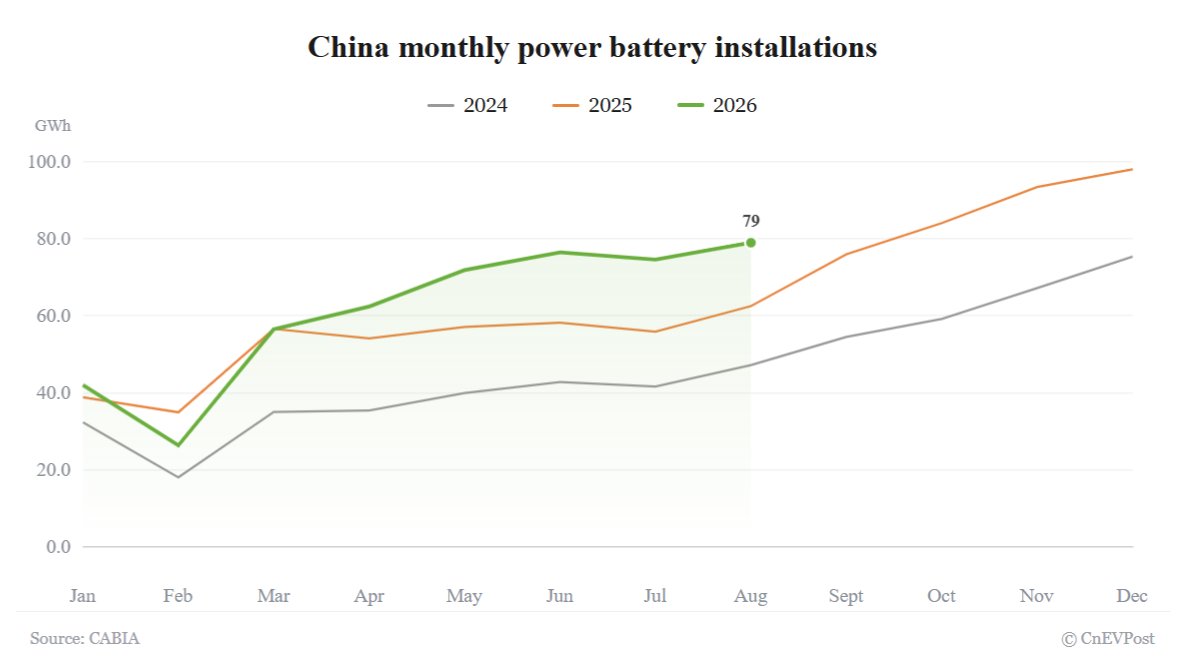
China’s total power battery installations were 79.0 GWh in August, up 26.3% year on year and 5.9% from July, the highest so far this year, according to data compiled by CnEVPost.