Celebrating 4/09 with a Look at Chevrolet’s Real Fine 409 You Should Know
By the early 1960s, the horsepower wars were in full swing among American automakers. As we discussed earlier this week, Ford’s FE big-block V8 was evolving, Pontiac’s Super Duty 421 was tearing up the strip, and Chrysler’s “Max Wedge” 413 was on the horizon. The 409, famously enshrined in song, was Chevrolet’s ace from 1961 to 1965, when it was phased out by the mighty 3-9-6 porcupine-headed Mark IV V8.

First, a brief background on where the 409 came from. This was the final evolution of the “W-Series” engine family, which began with the venerable 348 introduced in 1958 and took its name from the shape of its unique cylinder head design. Instead of a conventional-style combustion chamber recessed into the head, the 348’s heads were milled flat, and the block deck was milled at 74 degrees. Domed pistons resembling a gabled roof were used to create a quench and squish area for combustion, which essentially created a wedge-shaped chamber within the cylinder itself. Period literature referred to it as the “chamberless” cylinder head. The valves were also offset, giving the engine its distinct valve cover shape—an upside-down “W.” The rest of the lump was standard Chevrolet V8 fare.
Click above to open the article in a full-window viewer, or hit the “share” arrow to download the PDF.
As we mentioned above, the 409 was derived from the 348, with an increased bore and stroke of 4.312 inches and 3.50 inches, respectively, and thicker cylinder walls. Ray Brock wrote an exhaustive comparison between the two mills in this 1961 feature from Hot Rod Magazine. Larger valves were used, and most notable was a hotter camshaft with an “experimental” grind that had been waiting on the shelf for some time. Otherwise, the engines were essentially the same aside from the minutiae referenced in the article like connecting rod length and bearing material.
The 409 found its way under the hood of a number of GM products, including Canadian Pontiac models—but it was born to go fast, and truly came alive at the drag strip. Competition cars were void of automatic transmissions and air conditioning, and while power steering was available, hot rodders could not be swayed by such conveniences in the pursuit of lower ETs. 409-equipped cars dominated the quarter mile, famously at the hands of drivers like Dave Strickler, Don Nicholson, and Hayden Proffitt. In the video above, we see Nicholson and Strickler duke it out in the Super Stock Class at the 1962 NHRA Winternationals; each drove a Bel Air, which served as both a proving ground and a poster child for the 409.


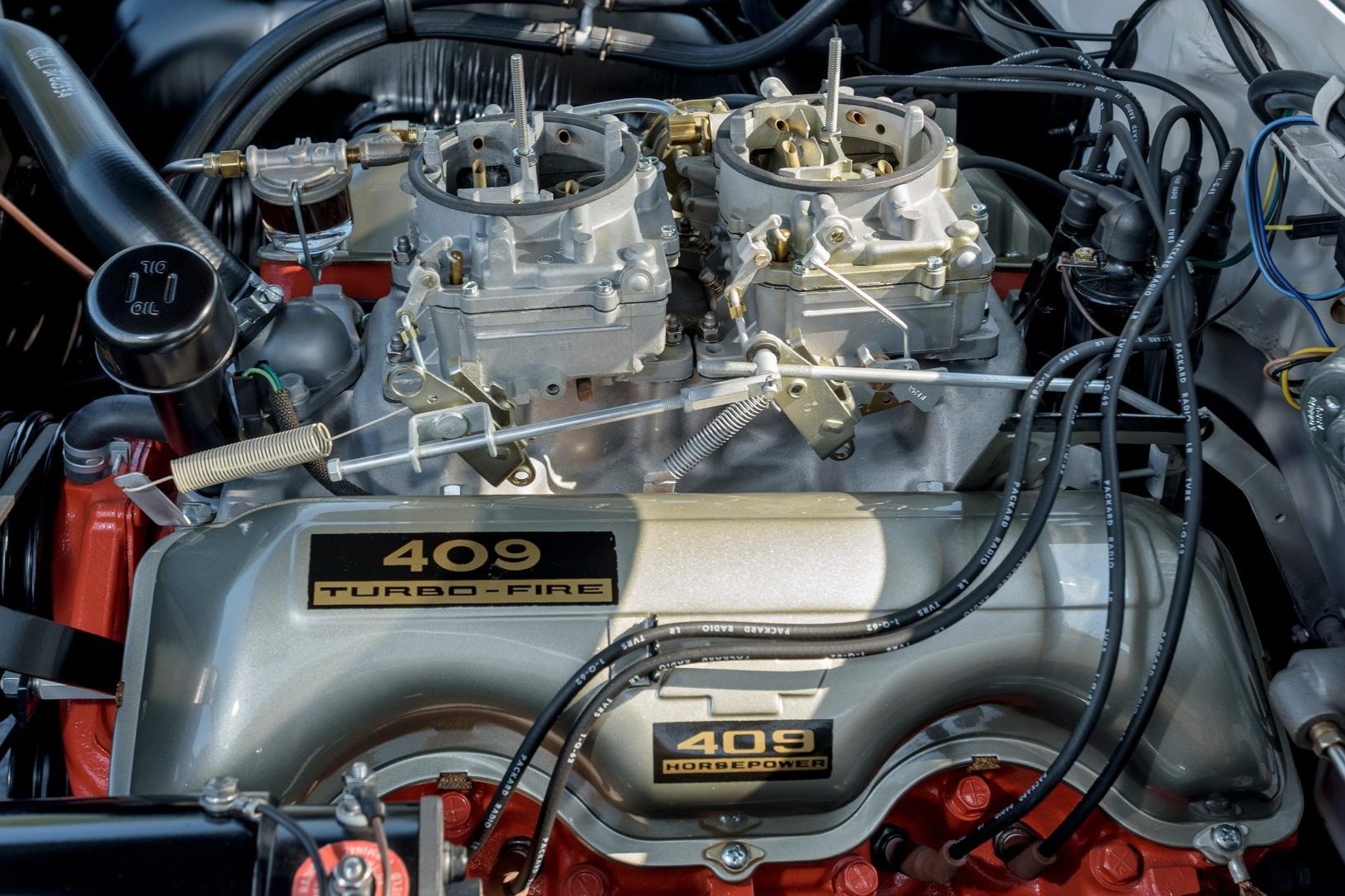
1962 was also a banner year for the 409 on the street. Two versions of the Turbo-Fire 409 V8 became available: a 380-horsepower four-barrel variant and a (♫ four-speed), dual-quad, (Positraction ♪…) version rated at an even 409 horsepower. By 1963, three versions of the 409 had hit the streets at varying horsepower levels: 340, 400, and a high-compression, solid-lifter variant with dual quads rated at a whopping 425 equine units—this despite GM’s official ban on factory racing efforts. But as NASCAR competition pushed toward higher RPMs throughout the mid-1960s, the W-series 409 began to fall out of favor, and the new Mark IV engines brought the first chapter of GM’s big-block story to a close.
Reference: Mac’s City Motor Garage