
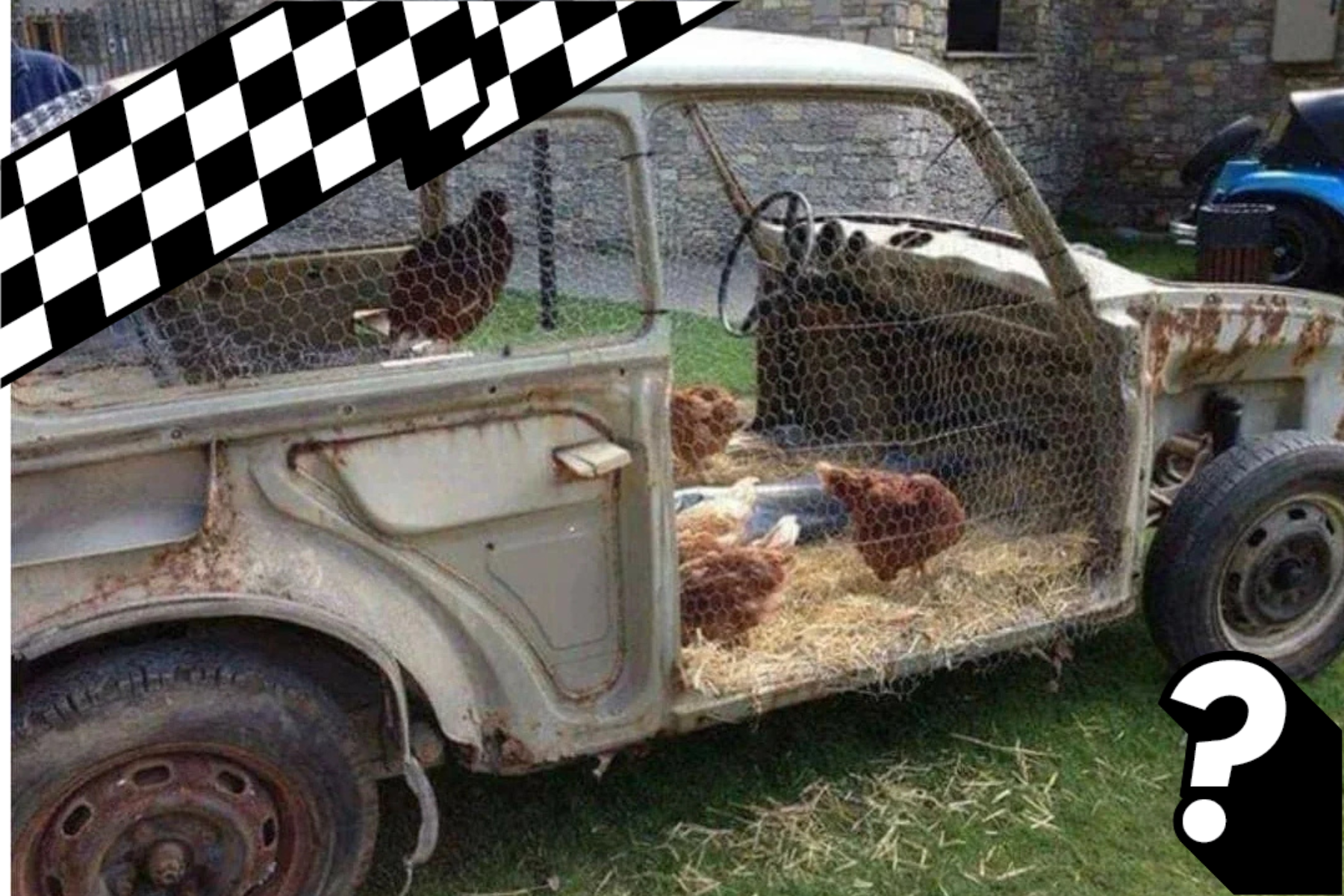
Here’s question of the Week: What’s The Most Interesting Repurposed Car You’ve Ever Come Across?—WINNER’S UPDATE
WINNER’S ANNOUNCEMENT:
We’re back to announce the winner for our Question of the Week, where our victor will accept a $25 credit for a hat or T-shirt from the BaT Gear Store and the acclaim of their peers.
Our question this week: What’s the most interesting repurposed car you’ve ever come across?
Thanks to everyone who participated! Welp, your nominations certainly ran the gamut—some expected and others not so much. So we couldn’t help but hand out two prizes this week!
Winner #1: storyteller extraordinaire @Bill_Noon received the most love this week for his nomination of a Bug. Just not that Bug, but the “Boog”—a Bugatti Type 51, that is:

Image: Goodwood
Twenty-five-ish years ago, a client who owed our company money and could not pay us back tipped me off on a Bugatti Type 51. He offered to put me in touch with the current owner to buy some extra time.
Post-war, the car was bought by a part-time farmer who also fancied racing boats on the various lakes in New England and New York, where such a sport was quite popular after the war. He wanted the engine alone and converted it to run on methanol, but the project stalled and was never finished.

Image: Goodwood
The frame became a cart on his farm, the front bonnet a breeding pen for baby chicks, and the tail cone a seasonal dog house for shade when his dog got hot in the summer sun.
The farm passed to a new owner, so I made a trip to visit with him and explained my purpose and goal. He knew what the car was and vaguely had an idea of potential value, but it meant little to him beyond that. The engine and gearbox were under a bench in his barn, the frame/cart and wheels under a wood pile, and the bonnet, radiator, and tail cone more or less where they had been sitting for decades, covered in chicken poop.
While researching the car, a Bugatti guru I had contacted tipped off a collector who pleaded to buy the deal for a tidy price, but I declined initially while I worked out the logistics of gathering everything up. A final inventory of all the items indicated there were actually quite a few spares, extra rims, a head, and a few other items. All that seemed to be missing was the chassis plate. The identity of the car was, however, confirmed by the frame number on the rear crossmember of the original frame.
I was leaving town and stopped by an antique store to get a gift for my wife, and in the display case by the cash register was the original chassis plate for the Bug. I paid the shop owner her asking price and asked her how it came to be there, and she said, as far as she could remember, when she was a little girl it had always been there.
I did eventually accept the offer to sell the project, mainly because it saved me having to gather up and clean years of farm droppings off of all that was there.
Years passed, and I learned from someone that the owner never did get to restoring the car, and a few years ago, it was sold to a collector in Belgium, where it may be finally getting the restoration it deserves.
Anyway, that’s how a GP Bugatti ended up giving shelter, shade, and warmth for many seasons to various animals on a farm here in the States…
Bill

Image: Goodwood
Winner #2: we also came across an intriguing nomination left by @Paul_Allen. His pick quite literally came from left field, and we’re handing him the second prize.
This late-1940s Chrysler was repurposed as a glider winch out in the European pastures, and he writes:
I just saw this post, so I’m probably too late, but this is waaaay too cool to not share.


Somewhere in Switzerland, 1982. I bought a new 911 from my Cincinnati dealer but did European delivery, so my fiancée and a buddy and I (yes, three of us!) had flown to Europe, picked the car up, and were doing a 2 week cramped tour of Germany and Switzerland. One day I noticed sailplane (glider) activity off to the side of the highway, so we got off and eventually found our way to the facility, which after doing some web sleuthing, I think was probably a place called Thun Airfield.


They were doing aero tows, but there was a vintage American-made Chrysler at the end of the field that had been set up for doing stationary winch tows- it’s visible in the lower right corner of the first picture. The winch was inside the car; there was a PTO setup hooked to the engine. Not what I expected to find in Europe!

Great photos, Paul_Allen! Our curiosity also led us to the Czech-built Herkules III, which was one of the first mass-produced self-propelled glider winches of the 1950s. That alone probably deserves its own feature, but we found this video showing it in action just to give everyone an idea of what glider-winch duty looked like.
Congratulations to this week’s winners! Be sure to check your emails to claim the prize.
Now, let’s take a look at some other popular nominations from this week’s discussion thread:

BaT member @bodhi1601 writes:
AEROSMITH TOUR VAN.

What started out as a plain old 1964 International Harvester Metro metamorphosed into the tour bus for Steven Tyler and his internationally famous rock band Aerosmith. But before they got rich and famous, it was that beat-up commercial truck that got them to their gigs around New England. One of which was at my high school. Yes, as I have been telling anyone who would listen for the last 50 years, Aerosmith played at my high school. No, we weren’t some progressive school for the arts that specialized in concert events. Quite the opposite, it was a very conservative, all-boys, catholic high school, but being a catholic school, they were always short of money. The clergy staff would run bake sales and raffles and anything else they could think of to raise money, but it was my brother Mathew, who was class president, who came up with the ultimate money-making scheme that would keep the school doors open for decades. Having no girls of our own, we had to import them from neighboring schools for our dances. We charged admission, and the dances made some money. The dean didn’t like the dances. He felt they were a corrupting influence on all his fine young men. But my brother saw untapped potential. Boston is a music mecca. Growing up around Boston, we got used to listening to good, live music at our dances. Every high school in the state booked live music for their dances, but Mathew decided to up the ante. He proposed booking major acts for the dances. This required an investment in stage lights and an upgraded sound system, and it would only make financial sense if we increased the number of dances from two per year to one per month. This was, of course, an extremely popular idea with all the red-blooded male students. It did carry Mat to the presidency for all his remaining years at that school. Still, it was a very hard lift with the administration. He persevered, and he prevailed. He booked everyone from Harry Chapin to J. Geils. Chuck Berry was almost our house band. The money rolled in, and the dean couldn’t stop it.
Along the way, Mat got wind of a local start-up band with some pretty good tunes, and Steven Tyler with Aerosmith graced our makeshift gymnasium stage. I gotta say they were really, really good. My brother remained friends with them for many years, and whenever they played here in Virginia, he would be their stage doctor. Somewhere around here I’ve got pictures of his kids up on stage dancing around with Steven Tyler’s microphone. But I digress. This story is about the van. Cars and trucks are different things to different people, and often they are used for things the manufacturer never imagined. Sometimes they are the things dreams are made of.

“On U.S. military installations all over the united states, and even the world, there are old Jeeps, K5s, M715s, tanks etc. that are used as targets to ensure new troops have the proper training to make sure freedom rings for years to come. The interesting part is that some are in great shape still. Ranges that were built and then shut down for various reasons, but the vehicles still stay.
Heck, even ‘Doc’, one of the last airworthy B-29 Bombers was once a target for troops before it was…”

A number of cars this week had their anterior and posterior sliced off in the name of art or furniture, and the Gadzooks Bug was one example nominated by @da-cat:
During the 1980s and 1990s, there was a chain of teenage-focused mall clothing stores named “Gadzooks”. The store used VW Beetles for decorations, and they were cut in half, where the front half went to one store and the rear half to another store.
Both halves had wheeled casters hidden to support the cut lines, and plywood panels sealed the cut lines and became a clothing rack! Chains secured the sprung rear suspension at the axles to account for the missing weight of the motor.

I learned about these Gadzooks VWs when my father-in-law asked me to see what one of his property renters had left behind after moving away- it was a back half of a Gadzooks Beetle. I was tasked with removing it and ended up trading it for a Yamaha 400xs project motorcycle! The owner of a local VW shop offered the trade and immediately found a place for the back half of a Beetle; against the side of his shop visible from the road!
But the funny part, and I wish I had taken a picture, was how I transported half of a VW; I merely rented a short flatbed truck from the local Lowe’s home improvement store for like $20 per hour. But who knew the coincidence? Half a car on half a flatbed!
“Ok, so along with the international harvester, my neighbor took his Porsche 356 and took the bathtub architecture TOO literally and made a bathtub out of it!!!”
“I’m not sure how safe and reliable this Volvo 245 hot tub is, but I’m weirdly inclined to entrust my life to it…”


The classic “turning your car into a rolling body of water” was another popular nomination this week.
BaT member @a990dna penned a rather incendiary story:
This story has always stuck with me because I actually saw the aftermath for years.
Growing up in Southern California, our family used to drive by Eddie Campos’ house on Sunday mornings on the way to church. Sitting on his front lawn was the burned-out shell of his 1971 Lincoln Continental Mark III with a lemon tree growing out of the top. As a kid, I knew the story about his struggles with his new Lincoln because I knew where he had purchased the car.
I later read in the Whittier Daily News that Campos had bought the Lincoln new for nearly $10,000, only to have it plagued by one problem after another. After more than 20 trips back to the dealer for repairs to the brakes, air conditioning, ignition, alignment, power windows, and other systems, he’d finally had enough.

On August 31, 1972, he drove the car to Ford’s assembly plant in Pico Rivera, parked it on the front lawn, and set it on fire as a public protest. We also drove by that Ford plant every other Sunday on our way to my grandparents’ house for Sunday dinner. I’d always look over to the northeast corner of the plant, at Rosemead Boulevard and Washington Boulevard, where he had torched that Lincoln.
He later kept the charred Lincoln, planted a lemon tree in it, and displayed it as a rolling reminder of what he believed was a defective automobile and a company unwilling to make things right.
Whether or not his protest directly led to today’s lemon laws, it became one of Southern California’s best-known automotive consumer stories. Every time I see a discussion about quality control or warranty issues, I think back to those Sunday mornings, and that burned Lincoln sitting on the lawn with a lemon tree sticking out of it. It’s one of those images you never forget.
“An old Ford running the bunny slope t-bar at a mom-and-pop ski area. No wait, that’s not unusual. Just about every little ski hill had Model T-powered lifts. Once upon a time in America.”
“When I was in Japan, I had a chance to visit SEGA Joypolis back when they had a Toyota AE86, a Mazda RX-7, and a Subaru Impreza WRX used as arcade cabinets for Initial D. Yes, the cars were real.”

“A plant nursery had an Afla Romeo Spider that had been turned into a planter.”


Cars are seemingly the ultimate planter boxes.
“30+ years ago, I saw a Datsun 240Z that was converted to a BBQ smoker. The meat went into the rear hatch and the wood went in the passenger compartment.”

That’s it for this week’s Question of the Week! Thanks again to everyone who participated, and congratulations once again to our winners, Bill_Noon and Paul_Allen. We’ll be back with a new question soon.
ORIGINAL POST:
Welcome to the BaT Question of the Week! For those unfamiliar, here are the rules: we ask an automotive-themed question, and the author of our favorite answer from the comments is awarded a $25 credit to the BaT Gear Store.
You’ve probably seen them on the side of the road, at the track, or on a farm in the middle of nowhere—Volkswagen Beetle chicken coops, Citroën H-Van cafés, NASCAR racers used for driving schools, and old buses turned into tiny homes, just to name a few. Some cars never die—they just…become something else. So this week, we’re asking:
What’s the most interesting repurposed car you’ve ever come across?

Tell us your suggestions in the comments, and give a thumbs-up to any nominations that grab your attention. We’ll announce the winner on Monday.

“When I was in Paris last September I saw a red Amphicar on the back deck of a large river barge, tied up on the Seine. It was not a commercial barge but someone’s very cool home. I presume the Amphicar was used as their dingy. I took a few pictures. So cool.”
6
NextLife commented on Question of the Week: What's The Most Interesting Repurposed Car You've Ever Come Across?—WINNER’S UPDATE