What to Know About this Week’s Weird and Wonderful—April 17, 2026
Welcome to the Weekly Weird and Wonderful, a curated list of the most interesting and unusual vehicles on BaT this week. For the sake of brevity, we can only feature a handful—there are plenty of chips left in the bag, i.e. over 1,000 other auctions currently live on the site. So if you’re still hungry when you finish this feature, head on over to our live auctions page for even more automotive fun.

Enjoy this week’s selection of Weird and Wonderful BaT auctions, and let us know what else you think should be on our list!
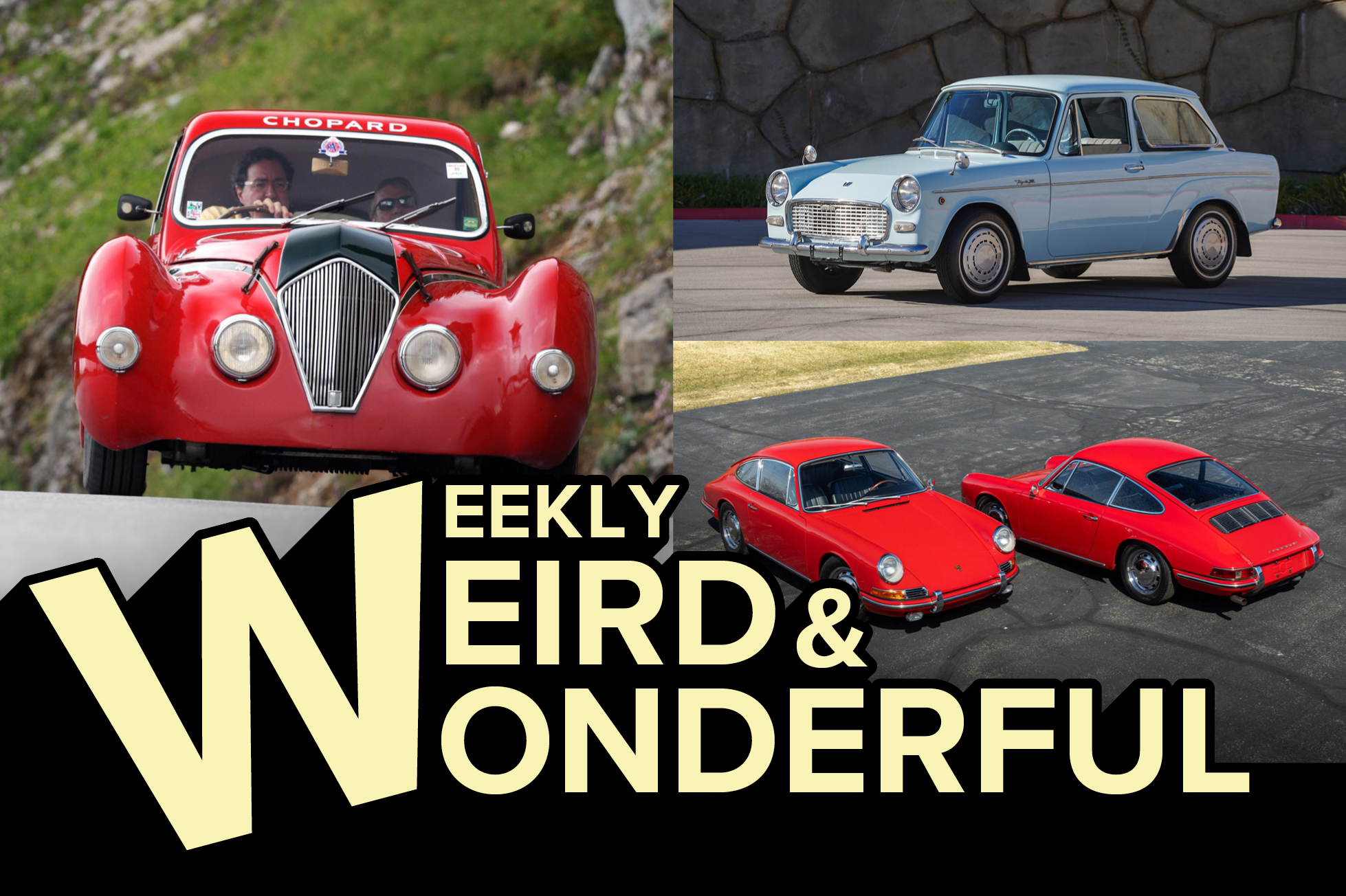
Sequential-VIN 1965 Porsche 911 Coupes

We know, we know—there are more 911s on BaT than Toyota Corollas, but we promise that these two deserve to be here. Chassis 300717 and 300718 are both early-production SWB 911s that rolled off the line in succession wearing identical colors and similar equipment, and were distributed through the same dealer near Portland, Oregon. They went on to live two very different lives before the seller reunited them in 2019 (he was restoring #717 when #718 popped up on BaT). The former was on the road less than 20 years, then was parked for more than three decades before being refurbished in the late 2010s. The latter lived its life with a car person—Pacific Northwest drag racing champion John Schmauder—who kept it operational and installed some typical mods like Weber carburetors and a Bursch exhaust. To ask whether or not these cars are worth more as a pair is missing the point—it’s just cool that they ended up back together in the first place.
1966 Toyota 700 Deluxe Toyoglide Sedan


BaT old-timers might remember this car from its previous appearance in 2011. We are happy to say that it later found an appreciative owner in the Malamut Auto Museum, where it has since spent a decade in the company of the other obscure microcars. The 1990s refurbishment of this car must have been a labor of love—it looks cleaner than some of the flashy Italian sports cars that appear on our pages. There can’t be more than a handful of these in North America, but we’re happy to say that we sold another example a few years back.
1909 Hupmobile Model 20 Runabout


Robert C. Hupp was in his mid-20s when he designed the Curved-Dash Runabout for Oldsmobile, and just 31 when he built the prototype that would launch his own company, the Hupmobile Model 20. He launched Hupmobile in 1909 with $25,000 of deposits, and went on to build 1,618 cars that year. There are a number of things about this lovingly restored car that speak to how fast automobile technology was advancing in the 1900s; note the monobloc cylinder castings, each containing two cylinders. This was an L-head design, and the petcocks outboard of the spark plugs released fuel from priming cups into the cylinder when starting (hat tip to @ModelAKid for that fascinating tidbit).

Also note the brass plate referencing a patent licensed from George B. Selden, who had absolutely nothing to do with the development of this Hupmobile (or any car for that matter). Selden was a patent attorney who squatted on the idea of using an internal-combustion engine to power a four-wheeled wagon (US Patent #549,160). He was a tinkerer, but never produced a working prototype himself. Nevertheless, he used his patent filing to collect hundreds of thousands of dollars in royalties and licensing fees from early automakers. When sued by Henry Ford in 1903, Selden dragged out the legal process until 1911. He finally lost on appeal, and that was the last time a shameless opportunist of dubious moral character ever found their way into the automobile business…
Ex–Mille Miglia Storica 1947 Healey Elliott Saloon


In 1947, the Healey Elliott saloon was apparently the fastest four-seat production car in the world, though this example reportedly played second fiddle to its cloth-topped cousin—a Westland Healey roadster driven by Donald Healey himself—on a cross-USA promotional tour. Now, that history is somewhat contested, but either way, this is one of 101 Healey Elliott saloons built in the early days of the company, and it has been active in the vintage racing and rally scenes for half of its life. It’s as quirky as it is cool, with aluminum body panels, suicide doors, and a twin-cam Riley four. If the Mille Miglia Storica is on your bucket list, this car could be one of the more accessible points of entry.


Like a medium channeling a departed loved one from the spirit realm, the Bayliff Packard imposed a warbly, barely-recognizable spectre of Packard upon the vessel of a malaise-era Cadillac. C. Budd Bayliff started adding Neo-Classic elements to contemporary cars during the 1960s, and in 1978 acquired the rights to the Packard name.

Bayliff’s new “Packard” replaced the front bodywork of a Cadillac or Buick with a design somewhat reminiscent of Virgil Exner’s Stutz Blackhawk. Even at half the price of the Stutz, the Packard still rang up at $40k or more, surely attributable to the high global demand for velour at the time.
19k-Mile “The Observer Coupe” 1982 BMW 635CSi 5-Speed

The Observer Coupé (pronounced “coo-pay,” don’tcha know) was conceived of and executed by Mike Gibbs of MGA Developments, who enlisted both BMW of Great Britain and The Observer newspaper to fund the creation of a retractable-glass-roof convertible E24 over a period of just 17 weeks. Gibbs must have been one heck of a salesman to pull these unlikely bedfellows together on such a tight timeline, and he wrapped up his concept with a bow made of purple prose. The car was:
“A collaborative project to promote three companies who share the same philosophy—a pursuit of originality, quality, and excellence.
An extraordinary car for extraordinary people.
A vehicle to stimulate ideas in thinking people. A testament to endeavor.”
Froofy marketing-speak aside, the car is a neat one-off. MGA fabricated new aero pieces for the lower body and raised the profile of the deck lid to accommodate a pocket (ahem, “plenum”) for the two glass panels of the sliding roof, which could ostensibly be retracted at speed, making the Observer Coupé “a car for all seasons.” Think of it as a cross between a Baur cabriolet and a 993 Targa. The original plan may have been to drum up publicity for a “convertible of the future” through the 1982 Birmingham International Motor Show and subsequent coverage in The Observer, but the car’s front page feature was bumped by coverage of the Iran-Iraq War.
Did it work? Why, in fact, it did! You can see the mechanism in action in this period promotional film about the car. Was it fit for production? We’ll never know, as the retraction mechanism was removed and the glass panels fixed in place in 1988.
37-Years-Owned 1929 Erskine Model 52 Sedan

Erskine was a short-lived, European-focused offshoot of the Studebaker company—a handsome, short-wheelbase, luxury-economy model that sold more than 25,000 units in two years. Not a bad start for a car company, but things started to fall apart in 1929. Studebaker absorbed the brand and Albert Russel Erskine, President of Studebaker, failed to adapt to the realities of the Great Depression. By 1933, the Erskine brand was gone and the entire Studebaker company was bankrupt.

On a happier note, this car is here on behalf of its long-timer owner, being represented by resident Studebaker expert and seller @mbstude, and a lot of great history is coming out in the discussion. That current owner? Well, he’s the guy pictured above in the red shirt, just 36 years older.
1929 Lincoln Model L Sport Touring by Locke


Lincoln, a brand that in recent decades has tried mightily to shuck off its image as a carmaker for the elderly, first went into business with the Model L, which was viewed as an old-fashioned design even back in 1921. If history doesn’t repeat itself, it often rhymes. The cars were, however, luxurious and elegant, as this nicely-refurbished Sport Touring model demonstrates.
1977 Triumph TR8 ACN-Series Coupe

The Wedge was Triumph’s sunset—their last sports car designed and built entirely in the UK. Just 400 of the fixed-head TR8 coupes were built and only 150 hard-roof cars made it to the US, all of which were pre-production examples bearing the ACN prefix in their chassis number. Many of those went to notable racers like John Buffnum and the late Bob Tullius. With its aerodynamic shape and highly tunable aluminum Rover V8, the TR8 menaced competitors in SCCA, IMSA, and Trans-Am races as well as Group 4 rally competition (though Triumph fudged mightily on homologation requirements). This one has received an extreme level of attention for a late-’70s Triumph, spending four years at the British Connection in Bellflower, California and finishing up at The Wedge Shop in Taunton, Massachusetts.
Jaguar-Powered Custom Roadster


Interesting powertrain choices always get our attention, and that’s what drew us to this funky metal-bodied roadster with a Jaguar inline-six under the hood. The listing says that the car was built using a kit of some sort, which seems to have been augmented with custom pieces. The resulting creation is spartan to an extreme level, with what amounts to a couple of throw pillows for driver comfort. The running gear is all 1950s Jaguar, with independent front and rear suspension as well as disc brakes all around.
Honorable Mentions:
2006 Alfa Romeo Brera 3.2 JTS V6 Q4 6-Speed


This is the production version of Giugiaro’s gorgeous Brera concept car, and we are sad we never got it in the US. It’s not like it couldn’t have happened—the car is based on a platform co-developed by Saab, GM, and Alfa Romeo. It’s just that nobody ever bothered to ask us if we wanted a mid-size AWD 2+2 hatchback sport coupe. We would have said yes! This one is currently in Canada, and those of us in the States will have to wait a few more years before we can get one south of the border. Sigh.
383-Powered 1969 Acadian Sport Coupe 4-Speed


It’s not a Chevy Nova. It’s an Acadian Sport Coupe—a Canadian-built Nova SS that can also speak French.


The original Duster was a variant of the Plymouth Valiant, so there was precedent for applying the name to the Valiant’s successor, the Volare. Alas, it was 1979, and a Duster trim package was all that Chrysler could manage. That said, it looks pretty cool with its plaid seats, quarter-window louvers, pinstriping, and color blocking. Does it need a V8? Of course, but we couldn’t bring ourselves to chop up this period survivor.
Thanks for checking out this edition of the Weekly Weird & Wonderful! Follow this page to get updates when new installments post, and tell what caught your eye or what you think we’ve left out!