
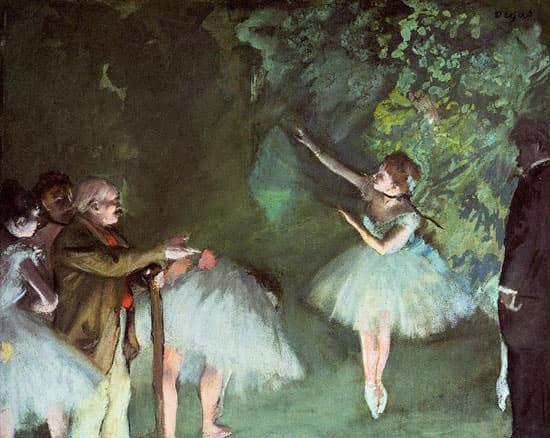
Edgar Degas, Ballet Rehearsal, 1834 – 1917
Green paint is like peanut butter is for dieters, dangerously addictive.
I don’t quite know why, maybe the freshness, the feeling of a landscape, the memory of nature… whatever the reason it’s a bad one.
Step 1. If you buy a starter set of beginners paints, throw away the green that is included (usually this is Emerald green)
It is usually terrible and very unforgiving when trying to create harmonious colour in painting.
“Can’t I use it to tone down red? or use red to tone down the green? I know about complementary colours; I’ve only just bought it, I can’t throw it away!”
You must.
Still got it?…
Why is green such a problem, and how can you solve it?
It is always tempting for a beginner to make the green brighter, add a little more yellow, a little brighter blue. This can be especially dangerous in acrylics because you have nothing for the paint to mix into to help tone it down.
A vivid green can be easy to mix but hard to balance.
You can help yourself tone down the green by:
1. Adding red to the green mix to mute it down.
2. Always try and mix greens from a mixture of two colours rather than premixed greens.
3. Try working on a warm ground, even pinkish, to help balance the tone.
4. Paint in the Autumn!
How to make beautiful greens
Don’t use blue or bright yellow.
Well, not to start with, a good colour to start with is yellow and brown.
Below is a list of mixtures, starting from the dullest through to the most vivid and brightest green:
- Burnt umber & Cadmium yellow light
- Prussian blue & Yellow ochre
- Ivory black & Cadmium yellow light
- Ultramarine blue & Yellow ochre
- Ultramarine blue & Cadmium yellow light
- Phthalo blue (Green) & Cadmium yellow light
- Phthalo blue (Green) & Hansa yellow (sometimes called Lemon yellow)
Don’t be scared of the Burnt Umber & Cadmium Yellow Light; it can be very useful in creating a greenish undertone without going in too strong.
Some nice premixed greens:
If you have to use a premixed green, there are some nice ones; I often favour the more muted tones.
Terre Verte – very handy for toning down pinks in portrait painting. Often used in classical paintings as an undertone colour.
Green umber – appears very muted put can look surprisingly bright when juxtaposed with a warm red based image. (Using the effects of simultaneous contrast to your advantage)
Green gold – as a transparent glazing paint for acrylics this is great. I only usually use a small amount towards the end of a painting to help give areas the ‘wow’ factor. It is quite potent so that you can put your colour mixtures out quite quickly. A small amount is the key. Also nice in watercolours for creating ‘Turneresque’ paintings.
Viridian – Handy for oil painting, gives a deep green.
“This is a very beautiful permanent green, but very dangerous in the hands of the inexperienced painter for grass and trees. How many crimes has it not been responsible for on the canvases of the young landscape painter.”
Harold Speed, commenting on Viridian – taken from ‘Oil painting techniques and materials.’
Green is very easy to overuse, and people often presume you can only produce bright, vibrant paintings with acrylics due to the overuse of bright greens in amateur painting.
The reality is when mixing greens with a more muted acrylic palette; the results can be fantastic and sophisticated.
In the above video, I mix a selection of greens with different blues to show you the huge variety of greens, depending on the blue used.
So do I ever use a vivid green in my landscape paintings?
Yes, but with caution.
Mix your muted greens with other colours on your palette first, and then slowly add tiny amounts of the intense green, and your landscapes will look much more harmonious.
You might also like:
How your hairdresser can teach you to mix colour
The hidden hues of colour mixing
How to choose a basic colour palette for acrylic painting


