
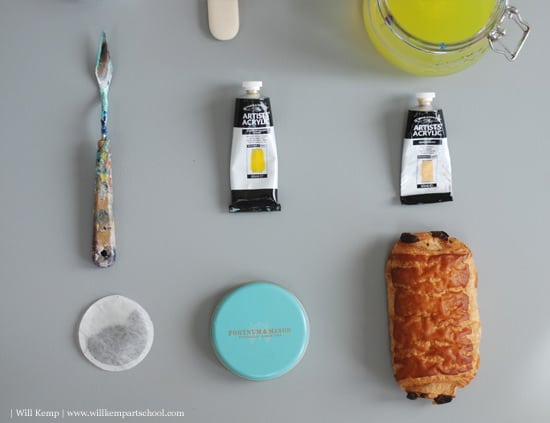
Essential acrylic painting starter set!
This is the final part of the painting and we can start to reap the rewards from our careful underpainting and patience.
If you’ve just stumbled on the tutorial you can catch up below:
- Part 1 & 2 of the French cafe painting tutorial
- Part 3 French cafe painting tutorial
- Part 4 French cafe painting tutorial
This week we start to introduce a brighter red and a yellow.
A step-by step French Café Scene acrylic painting
Materials you will need for this stage of the painting:
- 12mm Acrylic brush – Pro Arte Prolene – flat
- Size 4 Kolinsky sable from Rosemary & co – round – (any small round will be fine)
Paints (All Golden Heavy body acrylics unless stated)
- Artist quality Titanium white
- Burnt Umber
- Phthalo Blue (Red shade) or (Green shade) – I demonstrate using Phthalo blue green shade
- Cadmium Red Light
- Cadmium Yellow Light or Cadmium Yellow Medium
- Permanent Alizarin Crimson (Winsor & Newton Artists’ Acrylic)
- Naples Yellow (Winsor & Newton Artists’ Acrylic)
Other materials used
- Kitchen roll
- Jam jar for cleaning brush.
- Small dipper for diluting paint
- Stay-wet or tear off palette
- Palette knife – 45 RGM
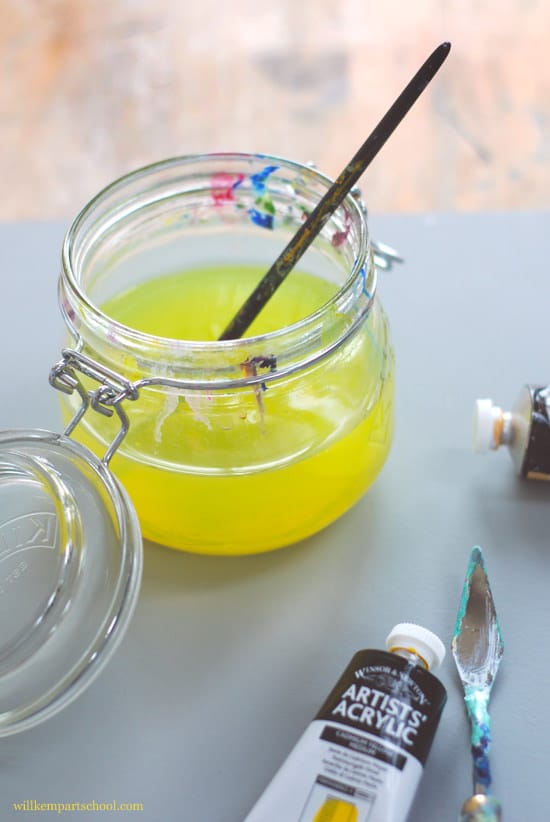
Step 1: Mixing brighter greens
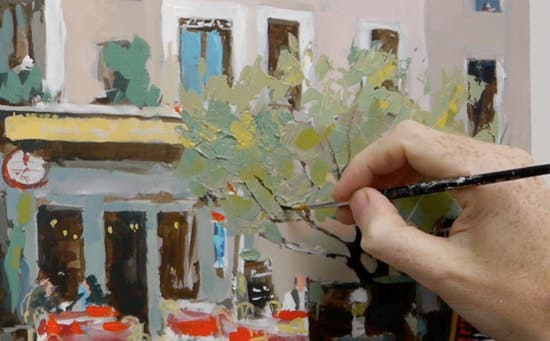
I start to mix in some cadmium yellow with the green, this will give it some more punch so the impression of the leaves will start to stand out.
If you’re using Phthalo Blue red shade your green will be slightly duller than the Phthalo Blue green shade.
(I list both Phthalo Blue green shade & Phthalo Blue red shade as sometimes they can be hard to track down).
I also paint over any branches that may have been lost in the application of the paint with the palette knife.
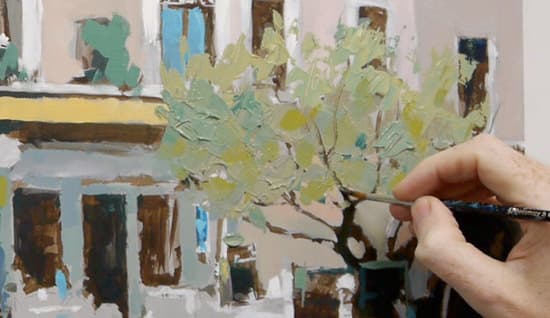
Using a watery mix of the Permanent Alizarin Crimson I start to wash in the red colours of the tablecloth.
I also add some of the Titanium White so I can clearly see the differences in tone between the tables.
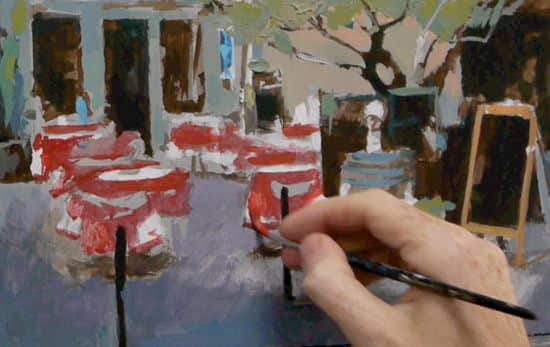
Step 2: Using an opaque Red
Now I introduce a more opaque red, a Cadmium Red Light.
You’ll notice when painting with these two reds the big difference in coverage.
The Permanent Alizarin Crimson is perfect for glazing applications, and tinting whites whilst the Cadmium reds are so good at covering over colours to give a bright finish.
I use the square brush to apply the paint more thickly.
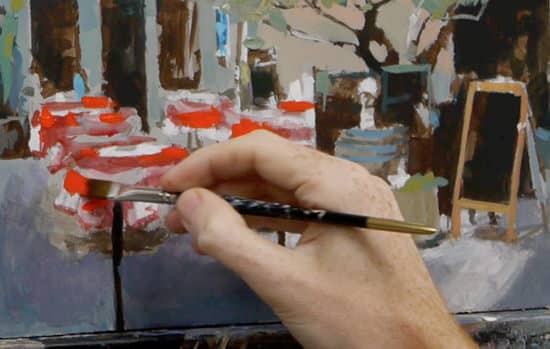
Step 3: Adding the Details
Then, by loading up the small round brush, I paint the ‘menu’ on the board, squint your eyes at the image to try and simplify the shapes, hold the brush loosely so the marks aren’t too stiff.
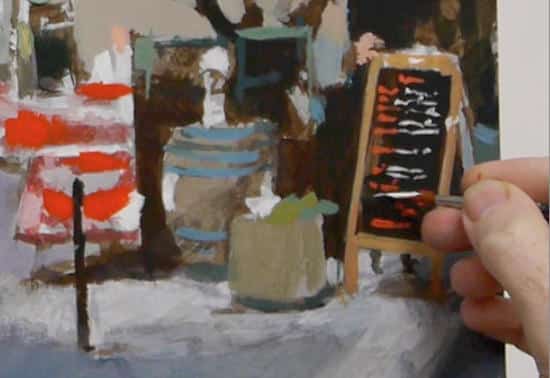
I use the same squinting technique when painting in the figures, I don’t want too many details, just an impression so keep the brush marks flowing.
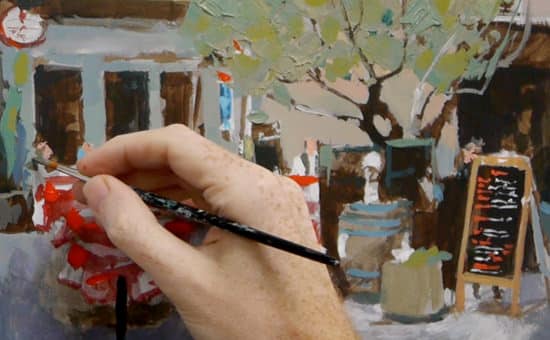
The same technique that was used on the menu is used again here when painting the chairs.
Pro tip: If you have a student quality yellow it’s a little more tricky because it might not cover over the existing paint aswell, just add a bit more Titanium white to your mix to give you some more opacity.
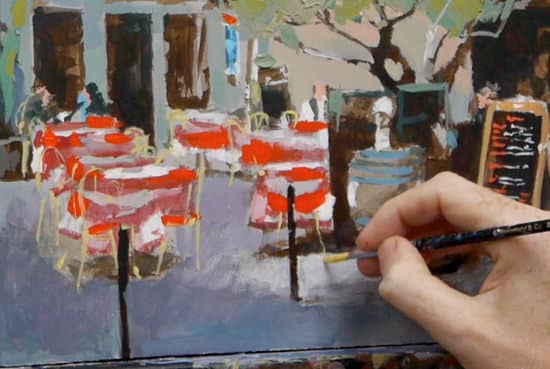
Then a few more dots of lights in the windows to balance out the yellow we’ve painted on the chairs.
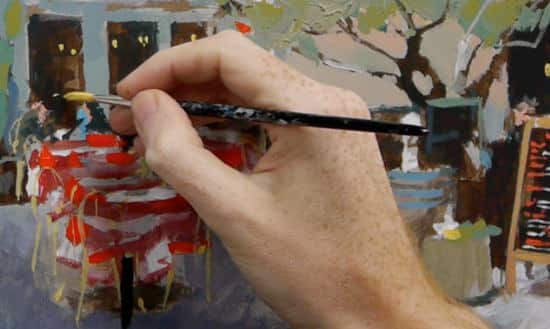
Adjust any drawings or add any details you can see in your painting just to bring it to more of a finish.
French Café scene Acrylic painting – Free video Course |Part 5
Click the video below to watch the tutorial.
Here’s the finished painting: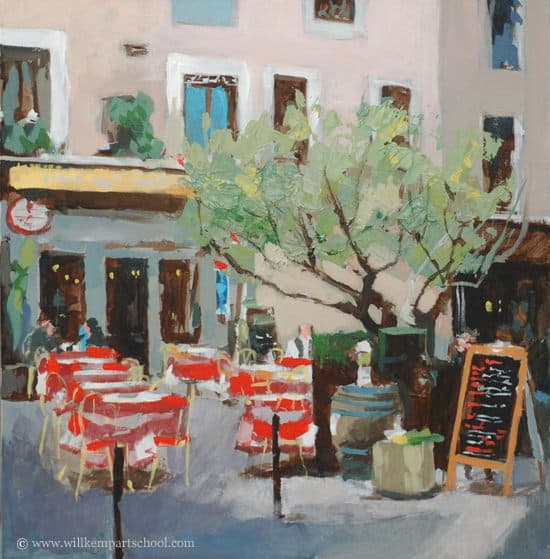
Hope you enjoyed the series, let me know how your painting turns out.


