50000 scholarship cards

50,000 scholarship cards announced for Pakistani youth

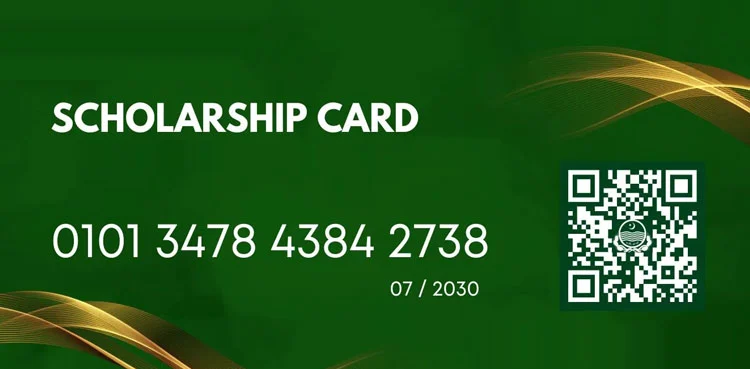
Lahore – A total of 50,000 scholarship cards have been announced for Pakistani youth with the deadline for submitting applications set for August 21, 2026.

According to details, the Hunarmand Punjab Advanced IT and Technical Training Program has been launched to promote digital and technical skills among Pakistani youth. The deadline for applications for the program is August 21, 2026.

Eligibility criteria

All Pakistani citizens aged 15 to 50 years who have at least a matriculation-level education are eligible to apply for the program.

Under the initiative, 50,000 scholarship cards will be distributed across the country. Of these, 25,000 will be allocated to Punjab while the remaining 25,000 will be distributed among Azad Jammu and Kashmir, Khyber Pakhtunkhwa, Sindh and Balochistan.

Applicants will be required to obtain at least 85% marks in the final evaluation test and fulfill the other program requirements to qualify for a scholarship card.

According to the announced merit criteria, candidates who secure 85% marks may qualify for fee reimbursement. Candidates scoring 86% to 88% will be eligible for a solar panel while those securing 89% to 91% will be offered a Chromebook.

Candidates who score 92% to 94% will be eligible for a laptop while those obtaining 95% or above will be offered an e-bike.

The training program includes courses in more than 30 fields including artificial intelligence, digital marketing, web development, graphic designing, e-commerce, cybersecurity, data science, freelancing, video editing, app development and YouTube monetization.

Other courses offered under the program include Amazon Virtual Assistant, Shopify and Daraz business, WordPress, React and Node.js, MERN Stack, PHP Laravel, Python programming, machine learning, SEO, Google Ads, IELTS preparation, textile designing, digital embroidery and penetration testing among others.

Similar Posts

  • | |

    Islamabad symposium examines Xi Jinping’s approa…

    ISLAMABAD: A joint symposium on “Xi Jinping Thought on Party Building” was held in Islamabad on Wednesday, bringing together senior Pakistani and Chinese officials, diplomats, parliamentarians, academics and representatives of think tanks to discuss China’s approach to political organisation, governance and institutional development. The symposium was organised by the Embassy of the People’s Republic of China in Pakistan in collaboration with the Institute of Regional Studies (IRS). Chairman Senate Syed Yousaf Raza Gilani attended the event as chief guest. The Chinese delegation included Liu Daxiu, Head of Delegation and First-Class Inspector at the Party Building Research Institute of the Organization Department of the Communist Party of China (CPC) Central Committee, and Zheng Huan, Professor of Party Building at the Central Party School of the CPC Central Committee. Chinese Ambassador to Pakistan Jiang Zaidong also addressed the gathering. While adressing, Pakistani and Chinese representatives reaffirmed the longstanding partnership between the two countries, noting that political and institutional exchanges have expanded alongside cooperation in economic, infrastructure and development-related fields. They further added that dialogue between political parties has become an important pillar of the Pakistan-China strategic relationship. Speakers outlined the evolution of Xi Jinping Thought on Party Building, describing it as a doctrine centred on strengthening the Communist Party of China through disciplined leadership, rigorous internal governance, organisational cohesion and ideological development. They said the framework seeks to ensure the Party’s long-term capacity to govern while maintaining accountability, institutional resilience and public trust. CPC’s efforts to curb corruption and maintain discipline, while strengthening the organisation at different levels were also discussed. The recurring theme throughout the symposium was that China’s development should not be viewed solely through the lens of economic growth. Pakistani and Chinese speakers argued that the country’s transformation has also been shaped by strong political organisation, consistent policy implementation and institutional continuity. At the same time, Chinese experts stressed that these experiences were not being presented as a model for direct replication, noting that every country must pursue its own path according to its national circumstances. Participants also reflected on the broader relevance of the CPC’s experience for political parties worldwide, discussing issues such as governance capacity, organisational resilience, leadership development and the ability of institutions to translate policy into tangible results. Chairman Senate Yousaf Raza Gilani, Ambassador Jiang Zaidong and IRS President Jauhar Saleem affirmed the importance of sustained engagement between the two countries and welcomed continued exchanges on governance, public policy and institutional development. The symposium concluded with an interactive session in which participants discussed the relevance of Party building, leadership and governance reforms to contemporary political challenges and future Pakistan-China cooperation.

  • | |

    Quaid’s Mazar chandelier restoration plan revive…

    The restoration of the historic chandelier at Mazar-e-Quaid and measures to improve facilities for visitors were discussed at a meeting of the Quaid-e-Azam Mazar Management Board on Thursday. Federal Minister for National Heritage and Culture and board chairman Aurangzeb Khan Khichi chaired the 102nd meeting, where officials reviewed several proposals concerning the preservation and management of the national monument. The meeting examined a proposal to restore the historic chandelier and subsequently shift it to the National Museum. Officials also discussed plans to introduce a shuttle service at Bagh-e-Quaid to provide visitors with easier access to the mausoleum. Khichi directed the National Engineering Services Pakistan (NESPAK) to approach the restoration project as a matter of national heritage and service rather than treating it purely as a commercial undertaking. He said the historic chandelier had been removed from its original position in 2016. Its restoration has since faced repeated delays because of financial and administrative issues associated with the proposed project. The minister stressed the importance of preserving historical artefacts associated with the country’s founder and called for efforts to ensure that the restoration work moved forward without further unnecessary delays. The meeting also reviewed ways to improve the experience of people visiting Bagh-e-Quaid and the mausoleum. The proposed shuttle service is aimed at making transportation within the premises more convenient, particularly for visitors who may face difficulties covering the distance on foot. Khichi also acknowledged the cooperation extended by Sindh Chief Minister Syed Murad Ali Shah to the Quaid-e-Azam Mazar Management Board. He said the provincial government’s support had contributed to the maintenance of Mazar-e-Quaid and helped the board manage its affairs in Karachi. The discussions underscored the need to protect the country’s historic heritage while upgrading facilities at one of Pakistan’s most important national landmarks.

  • | |

    Punjab cybercrime crackdown, 28 suspects arrested

    LAHORE: Authorities have arrested 28 suspects in Lahore, Faisalabad and Multan as part of a major crackdown on organised online fraud, exposing alleged schemes that relied on impersonation, fake investment opportunities and fabricated official identities to deceive citizens. The arrests were made during a province-wide operation by the National Cyber Crime Investigation Agency (NCCIA) Punjab, directed by Punjab Director Muhammad Ali Wasim, officials said. Investigators also seized 24 mobile phones and a laptop, which are now being examined for evidence that could lead to other members of the alleged network. The investigation has revealed how fraudsters allegedly manipulated trust to convince victims to hand over large sums of money. Millions allegedly lost in Lahore scam In Lahore, 18 suspects were arrested in separate operations. Investigators said the suspects allegedly impersonated relatives, visa agents, government officials and personnel associated with the Punjab Safe Cities Authority. In one case, suspects allegedly posed as both a relative and a visa agent and persuaded a victim to transfer Rs25.86 million. The case has highlighted how scammers can combine apparently familiar identities with urgent requests to make their schemes appear legitimate. Rs54.66m trading fraud uncovered Three suspects were arrested in Faisalabad in connection with alleged online trading fraud and unauthorised access to a company email account. According to investigators, a victim was shown fabricated trading records, digital-wallet balances and purported profit statements to create the impression that substantial returns were being generated. After being persuaded to invest, the victim allegedly lost Rs54.66 million, investigators said. The case demonstrates the growing sophistication of investment scams, where criminals allegedly use manipulated digital information to make fraudulent platforms appear genuine. Multan arrests expose impersonation tactics In Multan, seven suspects were arrested for allegedly posing as relatives, bank employees and individuals claiming to be based in Britain. Officials said victims were approached with various demands, including payments supposedly required for prize money, customs clearance, taxes and visa renewals. Such tactics typically create a sense of urgency, leaving victims with little time to verify the identity of the caller or the authenticity of the demand. Digital evidence now under forensic examination NCCIA investigators are examining the seized devices through forensic analysis. Financial transactions, call records and digital communications are also being reviewed to establish the full extent of the alleged operation and identify other people who may be connected to it. The crackdown comes amid growing concern over online financial fraud in Pakistan. The NCCIA’s own statistics identify financial fraud as a major category of reported cybercrime. The latest arrests underscore a simple but increasingly important warning: an apparently familiar voice, official-looking message or promising investment opportunity may not be what it seems. Authorities are expected to continue the investigation as they trace the alleged network and follow the digital and financial trails left behind.

  • | |

    PM Shehbaz arrives in Madinah, visits Masjid-e-Nab…

    Prime Minister Shehbaz Sharif has arrived in Madinah during his visit to Saudi Arabia and paid his respects at Masjid-e-Nabawi ﷺ. The prime minister was accompanied by members of his delegation during his visit to the holy mosque. Prime Minister Shehbaz offered Nafl prayers at Riyaz-ul-Jannah. He also prayed for the peace, progress and prosperity of Pakistan and the well-being of its people. During his visit, the prime minister also had the honour of visiting Roza-e-Rasool ﷺ. He offered prayers and paid his respects at the sacred site. The visit to Madinah is part of Prime Minister Shehbaz Sharif’s ongoing engagement with Saudi Arabia. His visit also reflects the close and longstanding ties between Pakistan and the Kingdom of Saudi Arabia. The prime minister’s presence at Masjid-e-Nabawi ﷺ was marked by prayers for the country’s stability, development and prosperity. He also prayed for the safety and well-being of the Pakistani nation. Earlier, Prime Minister Shehbaz Sharif has described the signing of the Makkah Agreement for Joint Defence between Pakistan, Saudi Arabia and Türkiye as a historic step towards strengthening peace, security and regional stability. In a post on X, the prime minister said he had the honour of signing the agreement alongside Saudi Crown Prince and Prime Minister Mohammed bin Salman and Turkish President Recep Tayyip Erdogan.

  • | |

    FBR imposes immediate advance sales tax on Gujranw…

    The Federal Board of Revenue (FBR) has imposed an immediate advance sales tax on the steel mill sector in Gujranwala, directing electricity distribution companies to begin collecting the tax through power bills. According to the FBR, eligible steel mills will have to pay an additional Rs30 per unit in advance sales tax through their electricity bills. The tax collection has been ordered to begin immediately. The FBR issued a written directive to electricity distribution companies, instructing them to recover the applicable amount from steel mills falling within the scope of the new advance tax arrangement. The revenue authority has also released a list of steel mills that are subject to the advance sales tax. The move is expected to affect the operating costs of businesses included in the notified category. However, the FBR has clarified that steel mills importing a significant proportion of their raw materials will be exempt from the advance sales tax. According to the notification, mills that import 70% of their raw material will not fall under the new tax requirement. Electricity distribution companies have been directed to start collecting the advance tax immediately and submit a compliance report to the FBR by August 23. The decision represents another significant tax measure affecting Pakistan’s industrial sector. Collecting the tax through electricity bills provides the authorities with a direct mechanism for recovering the amount from eligible industrial units. For steel manufacturers, however, the additional Rs30 per unit could increase electricity-related operating expenses, particularly for mills with high energy consumption. The impact will depend on individual production levels, electricity usage and whether a particular mill qualifies for the exemption. The steel industry is an important component of Pakistan’s manufacturing sector, supplying products for construction, infrastructure and other industrial activities. Changes in taxation and energy costs can therefore have wider implications for production costs and market prices. The latest FBR directive also places responsibility on electricity distribution companies to ensure timely collection and reporting. Mills covered by the notification will need to account for the additional charge in their electricity bills as the new collection mechanism takes effect. The government’s decision comes as the FBR continues efforts to strengthen tax collection and broaden revenue measures. The implementation deadline of August 23 means the authorities are expected to monitor compliance closely over the coming days.

  • | |

    Punjab launches drone flood surveillance

    The Punjab government has introduced drone-based monitoring for the first time to strengthen its flood management system and improve early warning capabilities across the province. The new initiative is aimed at detecting flood surges before they reach populated areas, allowing authorities to take timely preventive measures and reduce the risk of damage to lives, property and infrastructure. According to a spokesperson for the Punjab government, the drone surveillance programme has been launched on the directions of Chief Minister Maryam Nawaz. The operation covers all major barrages, rivers and headworks in Punjab. Officials are using drones to monitor water levels, river flow and changing conditions in real time. The spokesperson said the technology will help authorities identify any sudden increase in water flow and provide advance warnings to disaster management agencies. This will improve emergency planning and allow local administrations to respond more quickly if flood conditions develop. As part of the monitoring campaign, drones surveyed Trimmu Barrage, where water levels were found to be within the normal range. Drone inspections were also carried out along the Ravi and Sutlej rivers in Pakpattan. Officials reported that water levels in both rivers remained stable and did not pose any immediate threat. Further drone surveillance was conducted at Talibwala Bridge over the Chenab River in Sargodha. Authorities observed that the river’s flow was normal. Similar monitoring was also carried out at Head Sidhnai, where officials reviewed water movement and overall river conditions through aerial imaging. At Head Marala, drones recorded a water flow of 174,000 cusecs. Authorities also monitored water conditions at Rasul Barrage in Mandi Bahauddin to assess the overall flood situation in the region. The provincial government said drone technology will play a key role in modernising Punjab’s flood monitoring system. Real-time aerial surveillance will help officials detect changes in river conditions more accurately and improve coordination among disaster response agencies.

Leave a Reply

Your email address will not be published. Required fields are marked *