
islamabad symposium examines
| |

Islamabad symposium examines Xi Jinping’s approa…

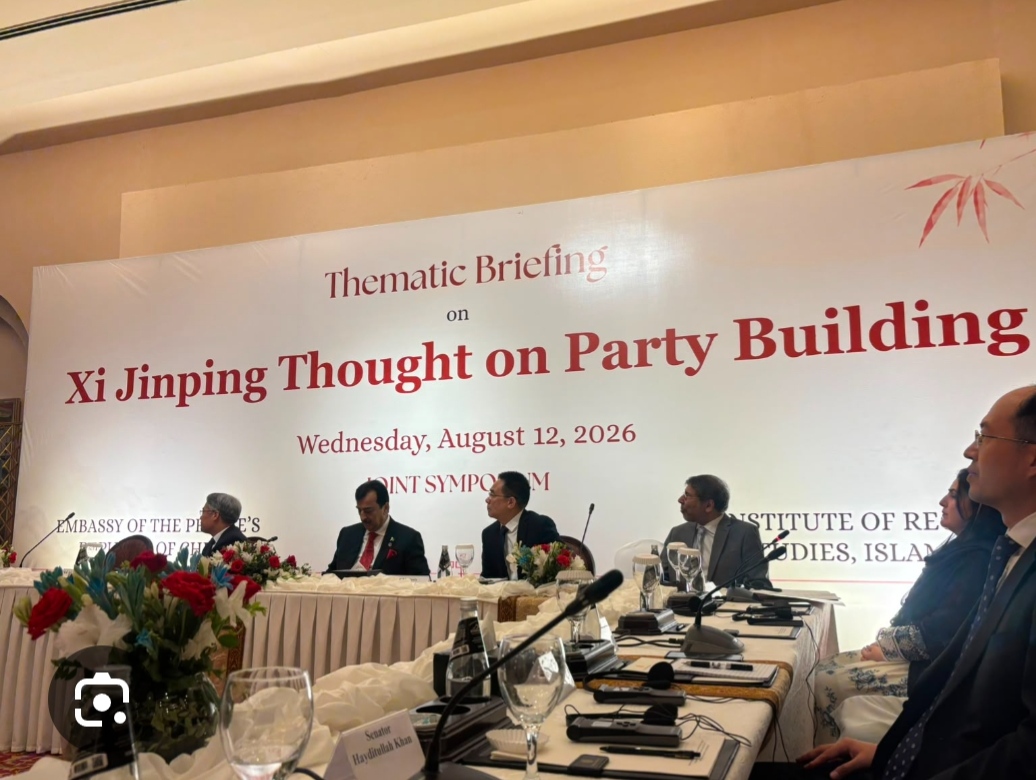
ISLAMABAD: A joint symposium on “Xi Jinping Thought on Party Building” was held in Islamabad on Wednesday, bringing together senior Pakistani and Chinese officials, diplomats, parliamentarians, academics and representatives of think tanks to discuss China’s approach to political organisation, governance and institutional development.

The symposium was organised by the Embassy of the People’s Republic of China in Pakistan in collaboration with the Institute of Regional Studies (IRS). Chairman Senate Syed Yousaf Raza Gilani attended the event as chief guest.

The Chinese delegation included Liu Daxiu, Head of Delegation and First-Class Inspector at the Party Building Research Institute of the Organization Department of the Communist Party of China (CPC) Central Committee, and Zheng Huan, Professor of Party Building at the Central Party School of the CPC Central Committee. Chinese Ambassador to Pakistan Jiang Zaidong also addressed the gathering.

While adressing, Pakistani and Chinese representatives reaffirmed the longstanding partnership between the two countries, noting that political and institutional exchanges have expanded alongside cooperation in economic, infrastructure and development-related fields. They further added that dialogue between political parties has become an important pillar of the Pakistan-China strategic relationship.

Speakers outlined the evolution of Xi Jinping Thought on Party Building, describing it as a doctrine centred on strengthening the Communist Party of China through disciplined leadership, rigorous internal governance, organisational cohesion and ideological development. They said the framework seeks to ensure the Party’s long-term capacity to govern while maintaining accountability, institutional resilience and public trust. CPC’s efforts to curb corruption and maintain discipline, while strengthening the organisation at different levels were also discussed.

The recurring theme throughout the symposium was that China’s development should not be viewed solely through the lens of economic growth. Pakistani and Chinese speakers argued that the country’s transformation has also been shaped by strong political organisation, consistent policy implementation and institutional continuity. At the same time, Chinese experts stressed that these experiences were not being presented as a model for direct replication, noting that every country must pursue its own path according to its national circumstances.

Participants also reflected on the broader relevance of the CPC’s experience for political parties worldwide, discussing issues such as governance capacity, organisational resilience, leadership development and the ability of institutions to translate policy into tangible results.

Chairman Senate Yousaf Raza Gilani, Ambassador Jiang Zaidong and IRS President Jauhar Saleem affirmed the importance of sustained engagement between the two countries and welcomed continued exchanges on governance, public policy and institutional development.

The symposium concluded with an interactive session in which participants discussed the relevance of Party building, leadership and governance reforms to contemporary political challenges and future Pakistan-China cooperation.

Similar Posts

  • | |

    Barrister Saif calls for new provinces, governance…

    PESHAWAR: Former Khyber Pakhtunkhwa Information Adviser Barrister Muhammad Ali Saif has called for the creation of additional administrative provinces, saying Pakistan needs major structural reforms to improve governance and public service delivery. In a statement issued on Sunday, Saif said the proposal to establish new provinces should be taken seriously, arguing that the existing administrative framework is no longer capable of addressing the growing needs of the population efficiently. He said discussions alone would not bring meaningful change and urged the federal government to move beyond proposals by initiating practical measures for administrative restructuring. According to him, governance can only improve if reforms are implemented instead of remaining limited to public debate. Saif maintained that decision-making authority is concentrated within a small section of the bureaucracy, which limits administrative efficiency and delays the resolution of public issues. He stressed that a more balanced distribution of powers would strengthen governance and improve accountability. He said Pakistan requires comprehensive administrative reforms that would transfer greater authority to lower levels of government. Establishing new provinces, he added, would bring the government closer to the people, improve access to public services and ensure faster responses to local challenges. The former adviser also highlighted the importance of an effective local government system, saying empowered local bodies are essential for addressing citizens’ problems at the grassroots level. He argued that decentralisation and stronger local institutions would enhance transparency, improve service delivery and promote sustainable development across the country.

  • |

    MQM-P announces public rallies for protest movement and new province demand

    The Muttahida Qaumi Movement–Pakistan (MQM-P) has unveiled a schedule of public rallies across Karachi and Hyderabad as part of the next phase of its protest movement, primarily focused on pressing its demands, including the creation of a new province. The decision was formalised during a meeting at the party’s Bahadurabad centre, attended by senior leadership including Anis Qaimkhani and central committee member Furqan Ateeb. Under the newly announced schedule, the party will kick off its public demonstrations in Surjani Town on August 9, followed by a second gathering in Orangi Town on August 23. The movement will then expand to Hyderabad on September 11, before concluding this phase of demonstrations with a rally in PIB Town on September 27. In addition to the protest lineup, the party leadership resolved to hold large-scale Independence Day celebrations. Festivities are scheduled to run from August 1 through August 14 across all towns, union councils, educational institutions, colleges, and universities.

  • Family Launches Urgent Fundraising Campaign To Repatriate British Crash Victim From Thailand

    BANGKOK, Thailand — The family of a young British man who suffered life-threatening injuries in a road crash in Thailand has launched an urgent fundraising campaign to bring him back to the United Kingdom for specialist medical treatment. Ethan Lacey, a 20-year-old father from the Castle Vale area of Birmingham, has spent the last five […]

  • | | |

    Pakistan unveils major construction reforms to boo…

    ISLAMABAD: The federal government is preparing a wide-ranging reform package aimed at revitalising Pakistan’s construction industry, improving regulatory oversight and attracting greater investment in modern infrastructure. The proposed measures include the establishment of a Construction Industry Development Board (CIDB), consideration of a specialised Construction Development Bank (CDB), targeted tax reforms and changes to import and export policies. The proposals were discussed during a high-level meeting chaired by Federal Minister for Economic Affairs and Establishment Division Senator Ahad Khan Cheema. The meeting brought together senior government officials, representatives of the Construction Association of Pakistan and other stakeholders to examine the sector’s financial, regulatory and operational challenges. Under the proposed framework, the CIDB would promote the development of the construction industry while also regulating contractors, consultants and industry standards. The body would include representatives from both the public and private sectors and would seek to establish more consistent construction standards across the country. Senator Cheema said the government and the Construction Association of Pakistan were in agreement over the need for a dedicated regulatory and development body. The proposed framework will be presented to Prime Minister Shehbaz Sharif for approval. The government also plans to introduce targeted tax incentives and rationalise import and export policies to encourage the use of modern construction technologies and strengthen local production capacity. In a significant move to improve the quality and durability of public infrastructure, the standard Defect Liability Period for public development projects is expected to increase from one year to three years, with a longer-term plan to extend it to five years. The proposed reforms would also increase accountability for consultants. Unlike contractors, who can face penalties for poor performance, consultants currently have limited direct legal accountability. Under the new framework, consultants could be subjected to regulatory oversight and held financially and legally responsible for design defects and technical errors. The government is also examining the construction industry’s difficulties in obtaining financial and performance guarantees. Senator Cheema directed Minister of State for Finance Bilal Azhar Kayani to consult the State Bank of Pakistan and Pakistan Banks Association on these issues and assess the feasibility of establishing a dedicated Construction Development Bank. The government says the reforms are intended to ensure that public infrastructure projects deliver better value for money, remain durable and meet higher technical standards. Officials believe stronger regulation and accountability could reduce disputes, improve construction quality and bring Pakistan’s industry closer to international standards.

  • Protection of human life and property top priority, Salman Rafique

    Lahore: On the instructions of Chief Minister Punjab Maryam Nawaz Sharif, Provincial Minister and Chairman Cabinet Committee for Disaster Management Khawaja Salman Rafique visited the flood-affected areas and protective bunds of Jalalpur Pirwala. The Provincial Minister reviewed the flood arrangements and protective measures in detail. DG PDMA Saif Anwar Jappa also accompanied the Provincial Minister. On this occasion, Provincial Minister and Chairman Cabinet Committee for Disaster Management Khawaja Salman Rafique said that the protection of human life and property is the top priority of the Punjab government, all institutions are on full alert. Both the protective bunds Jalalpur Pirwala and Nooraja Bhatta have been constructed at a cost of about Rs 2 billion. To prevent floods and other natural disasters, modern machinery and rescue equipment worth billions of rupees have been provided to Rescue 1122 and other related departments. The Punjab government has provided resources for flood prevention in all districts including Multan. Khawaja Salman Rafique inspected the flood embankments, rescue arrangements, evacuation plans and relief preparations on the spot. Khawaja Salman Rafique also directed to ensure timely completion of safety projects and availability of all necessary resources. The provincial minister appreciated the performance of the commissioner, district administration and related institutions for making flood management more effective in the light of last year’s experiences. Commissioner Aamir Karim Khan gave a comprehensive briefing to the provincial minister on the flood arrangements of Multan division. Commissioner Aamir Karim Khan informed about the permanent safety measures taken after last year’s flood. On this occasion, Commissioner Aamir Karim Khan said that the 7.2-kilometer protective flood embankment of Jalalpur Pirwala has been completed. The protective embankment will protect Jalalpur Pirwala from the backflow of Chenab. The flood contingency plan, evacuation plan and rescue plan have been fully implemented. For the first time this year, evacuation points and relief camps have been set up separately. Digital mapping of flood-affected areas, complete data of focal persons and resources have been prepared. Rescue agencies have completed their exercises, the control room and all relevant agencies are on high alert. The current river situation is normal, however, there is full preparedness to deal with any emergency. Member Punjab Assembly Lal Muhammad Joyia, Member Punjab Assembly MPA Nazk Karim Long, Deputy Commissioner Multan Dr. Faisal Saleem, Additional Commissioner Revenue Akhlaq Ahmed, Director Emergency Dr. Hussain Mian and Chief Engineer Anhar Muhammad Azeem were present.

  • |

    Oil prices rise as Hormuz tensions escalate

    Oil prices climbed on Monday as uncertainty over a possible diplomatic breakthrough between the United States and Iran increased, while a sharp slowdown in tanker movements through the Strait of Hormuz heightened concerns about disruptions to global crude supplies. Brent crude futures gained as much as 1% during early trading to reach $89.40 per barrel. The benchmark was later up 72 cents, or about 0.8%, at $89.20 a barrel by 0229 GMT. US West Texas Intermediate (WTI) crude also moved higher, rising 44 cents to $82.83 per barrel. Both international benchmarks posted gains of more than 5% last week after a series of attacks involving energy and shipping assets in and around the strategically important Strait of Hormuz. The incidents have intensified fears that further escalation could affect one of the world’s most important oil transit routes. Market sentiment was further affected by developments over the weekend, when Iranian Foreign Minister Abbas Araqchi said Tehran had yet to decide whether it would resume negotiations with Washington. US President Donald Trump, meanwhile, told Americans to prepare for somewhat higher gasoline prices as the conflict continues. Analysts said the renewed uncertainty had brought geopolitical risk back into crude markets after oil prices had previously come under pressure on expectations that diplomatic efforts could ease tensions. “Oil prices have now rebounded almost completely from the lows seen in early August, as hopes for a more permanent resolution between the US and Iran have faded and geopolitical risk premiums have returned to the market,” said Priyanka Sachdeva, head of market insights at Phillip Nova in Singapore. Sachdeva cautioned, however, that the rally could lose momentum unless there is evidence of a further deterioration in the situation. She said the market would need to see renewed aggression in the Strait of Hormuz, particularly significant damage to oil tankers or energy infrastructure, before prices were likely to move substantially higher. Hormuz shipping activity slows Concerns over physical supply disruptions increased after ship-tracking data showed a marked decline in vessel traffic through the Strait of Hormuz over the weekend. According to data from Kpler, only five commodity vessels crossed the strategic waterway on Saturday, while no such transits were recorded on Sunday. This compared with 31 commodity vessel crossings during the previous weekend. The slowdown is significant because the Strait of Hormuz is a critical route for international energy shipments. Any prolonged disruption could increase transportation risks, raise insurance costs and place additional upward pressure on crude prices. The United Arab Emirates also accused Iran of attacking another vessel operated by Abu Dhabi National Oil Company (ADNOC) while it was passing through the strait on Friday, according to the Emirati state news agency WAM. The UAE had earlier blamed Iran for two separate incidents involving ADNOC-operated vessels on Thursday evening. The latest incidents have added to concerns among traders that the conflict could increasingly affect commercial shipping and energy infrastructure, rather than remaining confined to military and diplomatic confrontation. Markets remain focused on escalation risks The Strait of Hormuz remains particularly important to global oil markets because a substantial volume of crude and petroleum products moves through the waterway. Any sustained interruption could therefore have consequences well beyond the region. For now, traders are closely monitoring developments involving US-Iran diplomatic contacts, attacks on shipping and the movement of tankers through the strait. While the latest price gains reflect a higher geopolitical risk premium, analysts remain cautious about predicting a prolonged rally. If shipping activity resumes and diplomatic channels reopen, some of the premium built into crude prices could quickly unwind. Conversely, additional attacks on tankers, oil facilities or other critical infrastructure could trigger a stronger market reaction and push prices higher as traders reassess the security of regional supplies.

Leave a Reply

Your email address will not be published. Required fields are marked *