74magnitude quake strikes
|

7.4-magnitude quake strikes Colombia

A powerful earthquake struck Colombia and several other parts of Latin America on Monday, causing injuries, damaging buildings and forcing evacuations in the capital, Bogota.

The earthquake was recorded at different magnitudes by geological agencies. Colombia’s geological service measured it at 6.6, while the United States Geological Survey estimated its magnitude at 7.4.

The epicentre was located in western Colombia at a depth of around 100 kilometres.

Strong tremors were felt across large areas of the country. The shaking was also reported in neighbouring Ecuador and as far north as Panama.

In Bogota, residents rushed out of buildings as emergency sirens sounded. Some people were seen gathering in the streets after leaving their homes and workplaces.

Authorities ordered evacuations from a number of buildings as a precaution while emergency teams assessed possible structural damage.

The situation was particularly serious in the western parts of Colombia.

The governor of Choco province reported injuries and significant damage to buildings in Quibdo, the provincial capital.

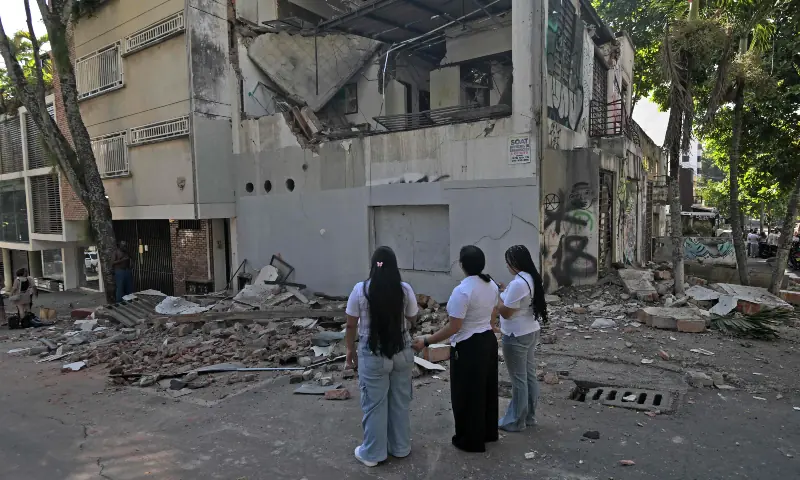
Cali, one of Colombia’s largest cities, also suffered substantial damage. Mayor Alejandro Eder said at least 20 buildings had collapsed and that people were believed to be trapped inside some of the structures.

Rescue operations were launched in the affected areas. Cali authorities requested additional emergency teams from Bogota and Medellin to assist with search and rescue efforts.

Images broadcast by local media showed buildings with damaged facades and sections of structures affected by the powerful tremors.

Emergency authorities continued to assess the extent of the destruction as rescue teams searched damaged buildings for survivors.

Officials have not yet released a complete account of casualties or property losses. The number of injured people is expected to change as assessments continue.

The depth and strength of the earthquake allowed tremors to be felt across a wide area, including outside Colombia.

Authorities urged residents to remain cautious and follow instructions from emergency services, particularly in buildings that may have suffered structural damage.

The earthquake comes as parts of northern South America remain vulnerable to major seismic activity. In June, two powerful earthquakes struck Venezuela, with reported magnitudes of 7.2 and 7.5, causing widespread destruction and thousands of deaths.


Similar Posts

  • | |

    Bangladeshi model Ridhika Ridhi found dead

    Bangladeshi model and actress Ridhika Ridhi was found dead at her residence in Dhaka on Saturday, according to Bangladeshi media reports. Ridhi was found in the Bashundhara residential area of the capital. Police said she was discovered hanging from a ceiling fan at around 6am. Family members and others reportedly took her to a nearby hospital soon after she was found. Doctors examined her after she arrived at the hospital. The doctors later confirmed that she had died. Mazharul Islam, officer-in-charge of Vatara Police Station, said police received information about the incident and reached the hospital. According to the police official, Ridhi’s body was recovered at the hospital. Authorities have initially suspected that the actress may have died by suicide. However, police have not reached a final conclusion. An investigation is underway to determine what happened before her death. Police are expected to examine the circumstances surrounding the incident. They will also gather relevant information as part of the investigation. Ridhi was active in Bangladesh’s entertainment industry. She worked as a model and also appeared in television dramas.

  • |

    Electricity tariff may rise by Rs2.50 per unit as July FCA pushes recovery above Rs34bn

    ISLAMABAD: Electricity consumers across Pakistan could face an additional burden of around Rs2.50 per unit as the government moves to recover more than Rs34 billion through the July 2026 monthly Fuel Charges Adjustment (FCA), according to sources. The proposed increase is expected to affect consumers of distribution companies (Discos) as well as K-Electric, with the final adjustment to be determined by the National Electric Power Regulatory Authority (Nepra) after reviewing the relevant power purchase and generation costs. Sources said the expected positive FCA for July has largely been driven by higher electricity consumption during the peak summer season and greater reliance on expensive generation sources. Among the key factors behind the anticipated increase are the use of liquefied natural gas (LNG) procured from the spot market and furnace oil to meet additional electricity requirements, particularly during periods of high demand. June FCA already approved The expected July adjustment comes after Nepra approved a positive FCA of Re0.7503 per unit for electricity consumed in June 2026. The adjustment was lower than the Rs1.20 per unit sought by the Central Power Purchasing Agency-Guaranteed (CPPA-G). Under the FCA mechanism, variations in fuel costs and other electricity generation and purchase-related expenses are passed on to consumers through periodic adjustments. For July, CPPA-G will submit its relevant claims to Nepra, which will examine the costs and determine the admissible adjustment before issuing separate decisions for the respective distribution companies. Multiple costs to be examined The regulator is expected to assess several components included in the FCA claim before determining the final amount recoverable from consumers. Separate adjustments will subsequently be calculated for each Disco after taking into account electricity purchased through CPPA-G, bilateral arrangements with small power producers and captive power producers, as well as electricity supplied under net-metering arrangements. The final impact on consumers could therefore vary depending on the individual power procurement mix and applicable tariff structure of each distribution company. Expensive generation raises concerns The expected tariff increase has emerged at a challenging time for Pakistan’s industrial sector, where electricity prices remain a major concern for manufacturers and exporters. Industrial consumers are already facing pressure from elevated production costs, while exporters are also dealing with uncertainty caused by deteriorating security and economic conditions in the Middle East. The latest FCA discussion has also brought the issue of partial-loading charges under scrutiny. During a recent hearing, Nepra raised questions over approximately Rs4.9 billion in partial-loading costs and asked CPPA-G to explain the reasons behind the additional expenditure and measures being considered to control it. Solar power changes demand pattern CPPA-G told the regulator that the partial-loading charges were not primarily the result of inefficient operation by power plants. Instead, the agency attributed the costs largely to changes in electricity consumption patterns caused by the rapid expansion of rooftop solar generation. According to CPPA-G, daytime demand from the national grid has declined as more consumers generate electricity through rooftop solar systems. Conventional power plants are consequently required to operate below their optimum capacity during solar-generation hours. However, demand rises again in the evening when solar generation falls, forcing grid-connected power plants to increase generation quickly. This change in the daily demand curve has created additional operational costs for the power system. The authority noted that partial-loading charges recorded in June 2026 were around Rs1 billion higher than the corresponding amount in June 2025, highlighting the growing financial impact of the changing electricity demand pattern. Plant shutdowns could increase costs The Independent System and Market Operator (ISMO) also informed the regulator that shutting down power plants during periods of lower demand would not necessarily provide a cheaper solution. According to ISMO, taking plants completely offline to avoid partial-loading charges could result in substantial start-up expenses when the units are required again to meet evening demand. The issue has therefore become increasingly important as the rapid growth of distributed solar generation continues to alter the traditional pattern of electricity consumption. Exporters seek cheaper fuel options Amir Sheikh, a prominent textile exporter, called for the removal of the levy imposed on high-speed diesel and furnace oil-related generation costs, arguing that furnace-oil-based power plants could offer an alternative to expensive RLNG-fired generation under certain circumstances. He maintained that allowing more flexible use of available generation sources could help reduce the overall cost of electricity, particularly during periods when LNG prices remain elevated. Sheikh also proposed a change in the way FCA-related surcharges are calculated. He suggested that the additional charges should be recovered on the basis of projected electricity consumption rather than only through the conventional mechanism, similar to the approach followed under quarterly tariff adjustments (QTA). Falling demand creates another challenge Another concern raised during the discussion was the continuing decline in electricity demand and its possible implications for future tariff adjustments. Rehan Javed highlighted the potential impact of lower electricity consumption on the power sector’s financial structure, particularly as fixed system costs are spread over a smaller volume of electricity sales. The Ministry of Energy’s Power Division, however, said the decline in demand was largely linked to the increasing number of consumers using net-metering facilities. The ministry maintained that although distributed solar generation was changing electricity consumption patterns, its impact on future quarterly tariff adjustments would not necessarily be as severe as feared by industrial consumers. Government seeks to avoid costly LNG purchases The Power Division further explained that electricity demand was being managed in a manner designed to reduce dependence on expensive RLNG spot-market cargoes. Officials said excessive reliance on spot LNG during the summer could significantly increase power generation costs and ultimately translate into higher electricity tariffs for consumers. The government is therefore attempting to balance electricity availability, fuel costs and demand management while dealing with the changing structure of Pakistan’s power market. If Nepra ultimately approves an FCA close to the expected Rs2.50 per unit, consumers could face another substantial increase in their electricity bills. The final adjustment, however, will depend on Nepra’s assessment of CPPA-G’s July claim and the costs deemed

  • |

    US fuel opens a capitalist crack in Cuba

    HAVANA: Gasoline selling for as much as $38 a gallon, diesel advertised on social media and fuel stored inside cramped apartments are offering an unusual glimpse of private enterprise in communist Cuba, where the energy sector has long remained firmly under state control. A US policy allowing American companies to export fuel to private Cuban businesses has triggered an unexpected transformation. As Cuba struggles with shortages, blackouts and a weakened public transport system, imported fuel is creating a growing private market — while also exposing a sharp divide between those who can afford it and millions who cannot. The change follows the collapse of Cuba’s traditional fuel supplies from Venezuela and Mexico after the United States removed Venezuelan President Nicolas Maduro in January. With sanctions discouraging tankers from sailing toward the island, fuel shortages have increasingly affected transport, hospitals, schools and other essential services. Under an exception to Washington’s oil restrictions, however, private Cuban restaurants, retailers, taxi operators and other businesses have been allowed to import fuel. The impact has been striking. Between February and May, around 900,000 barrels of US fuel entered Cuba — enough to meet only about nine days of the country’s energy requirements. Yet those relatively small shipments have helped create a new network of legal wholesalers, private buyers and illegal resellers. Gasoline becomes a luxury For ordinary Cubans, the new fuel market has often brought frustration rather than relief. On a July afternoon in Havana, 53-year-old Amarilis Sanchez waited for hours at a bus stop after attending her daughter’s birthday celebration. Public buses, which normally cost only two pesos, were unreliable. Nearby, taxi drivers offered rides in vintage cars, but one driver quoted Sanchez 1,000 pesos for the journey — roughly 500 times the price of a bus ride. Unable to afford it, Sanchez considered spending the night at her daughter’s home and trying again for a bus the following day. Her experience illustrates how Cuba’s fuel crisis is creating two very different realities: one for people with access to private vehicles and imported fuel, and another for those dependent on the country’s struggling public transport network. Black-market gasoline prices reportedly reached $10 per litre, or about $38 per gallon, during the spring before falling as imports increased. Social media fuels a new market The emerging trade is increasingly visible online. WhatsApp groups and Facebook pages advertise gasoline and diesel, while some sellers store fuel in apartments and small shops despite the dangers posed by fire, explosions and toxic fumes. At one Havana convenience store, a shopkeeper reportedly kept around a dozen 20-litre fuel containers in a backroom, selling gasoline for approximately $5 per litre. Private companies are also moving into the newly emerging legal wholesale market. By late July, almost 200 Cuban businesses had received permission to distribute fuel wholesale to other private companies. One company, A Granel, advertises diesel through social media and charges $2.50 per litre for a 940-litre tank. The promotion reportedly features a model walking through a warehouse of diesel containers while Daddy Yankee’s famous song Gasolina plays in the background — an unusually flashy image for a country where the energy industry has historically been dominated by the state. Are Cuban gas stations next? The transformation could go further. Cuban lawmakers approved a broad package of economic reforms in June aimed at opening the energy sector to private and foreign investment. Prime Minister Manuel Marrero Cruz later announced that Cuba had approved its first foreign investment project focused on importing and selling fuel, although he did not name the company. The reforms have raised the possibility that private operators could eventually take control of some of Cuba’s familiar state-run Cupet petrol stations. For now, however, retail fuel sales remain largely under state control. Some state-owned stations are storing imported fuel but can distribute it only to vehicles belonging to authorised private businesses. Cuban authorities have defended the reforms while rejecting the idea that they represent a move toward large-scale privatisation. President Miguel Diaz-Canel has accused Washington of imposing a “genocidal siege” on Cuba and said economic changes were not being introduced to satisfy the United States. A lifeline with a heavy price The new fuel market has helped prevent some businesses from shutting down completely. During recent power outages, restaurants and shops with generators powered by imported fuel remained illuminated while much of Havana was plunged into darkness. But experts warn that the emerging system could deepen inequality. With the average government salary reportedly around $10 a month, imported gasoline remains unaffordable for most of Cuba’s roughly nine million residents. Cuban sociologist Mayra Espina said the limited fuel supplies had helped prevent “complete paralysis” but warned that the benefits were overwhelmingly concentrated among those able to pay. The result is an extraordinary contradiction: a small opening toward private enterprise is helping Cuba keep parts of its economy running, while simultaneously making access to basic mobility and energy increasingly dependent on wealth. For a country that has spent decades keeping fuel firmly within the state system, Cuba’s new gasoline economy may therefore prove to be more than a temporary response to shortage. It could become an early test of how far Havana is prepared to let capitalism into one of its most tightly controlled sectors.

  • | |

    Roma Ria steps into national director role for Mis…

    Roma Ria is entering a new chapter in her pageant journey as she officially steps into the role of National Director for Miss Universe Pakistan. The announcement marks an important moment for Ria, who previously represented Pakistan as Miss Universe Pakistan 2025. Sharing her feelings about the new responsibility, Ria described the appointment as a deeply meaningful achievement. She said she was “incredibly humbled, grateful, and honored” to be officially announced as the national director. The new position places Ria in a role that goes beyond the spotlight, giving her an opportunity to help shape the future of Pakistan’s participation in the Miss Universe competition. As national director, she will have a greater role in guiding the pageant, supporting contestants and helping prepare future representatives for the international stage. Ria’s transition from titleholder to leadership also adds a personal touch to the development of Miss Universe Pakistan. Having experienced the competition herself, she understands the preparation, expectations and pressure that come with representing the country internationally. Her journey has also been connected with advocacy and community work. Online references to Ria describe her as the founder of Rehmat Foundation, an initiative associated with supporting girls’ access to education. (Instagram⁠) This gives her new position a wider dimension, as her public platform has increasingly extended beyond fashion and pageantry. For Ria, the national director role appears to be about creating opportunities as much as celebrating beauty. Pageants today increasingly place emphasis on confidence, communication, social causes and leadership, allowing contestants to use their visibility to represent something larger than themselves. Her appointment could therefore signal an evolving direction for Miss Universe Pakistan, with greater attention on empowering contestants and preparing them to become confident representatives of the country. Ria’s announcement has also highlighted the significance of her own journey. From wearing the national title on an international stage to helping guide the next generation of Pakistani contestants, she is now moving from competitor to mentor and decision-maker. With gratitude at the heart of her announcement, Ria is embracing the responsibility with optimism. Her new role gives her a chance to contribute to the pageant from behind the scenes while helping future contestants step onto the global stage with confidence. As Miss Universe Pakistan continues to build its presence, Roma Ria’s move into the national director position represents a fresh beginning — one that combines pageantry, leadership and a commitment to creating meaningful opportunities for women in Pakistan. (Instagram⁠)

  • | |

    Punjab finalises security and facilities for 983rd…

    LAHORE: The Secretary/Chief Administrator Auqaf Punjab, Dr. Ehsan Bhutta, has announced that the three-day celebrations marking the 983rd annual Urs Mubarak of Hazrat Ali Hajveri (RA), popularly known as Hazrat Data Ganj Bakhsh (RA), are commencing today (August 2–4) with profound reverence, bringing together hundreds of thousands of devotees from Lahore, across the country, and abroad. Speaking after personally visiting and conducting detailed inspections of the Milk Sabeel (Dhood Sabeel), the specially set up Marquee for pilgrims’ Langar, overall Langar distribution logistics, and the Smaa event arrangements, Dr. Bhutta stated that under the special directives of Chief Minister Punjab Maryam Nawaz Sharif and the continuous monitoring of Chief Secretary Punjab, the Auqaf Department, alongside DG Religious Affairs Punjab Hafiz Anees-ur-Rehman, district administration, and security agencies, has finalized foolproof security, traffic management, dedicated parking, clean drinking water sabeels, medical camps, ambulance services, control rooms, help desks, and separate facilities for women, senior citizens, and persons with disabilities to provide a peaceful spiritual environment. He highlighted that the three-day event will feature Quran recitations, Khatam-e-Khwajgan, Naat assemblies, spiritual Smaa sessions, Qawwali, Dhikr, academic conferences, and Qirat competitions attended by prominent scholars, Mashaikhs, and Qaris. Emphasizing that the saint’s timeless teachings preach divine love, peace, tolerance, and service to humanity, Dr. Bhutta reiterated the Punjab Government’s vision to transform Data Darbar into an exemplary model shrine equipped with modern amenities, strictly warning that no negligence will be tolerated in public facilities as facilitating millions of pilgrims is both a sacred honor and a primary duty for the Auqaf Department.

  • | |

    At UN Summit, Tanweer Ahmed demands global action …

    American Pakistani businessman and analyst Tanweer Ahmed has called for greater investment in young people and urged governments, businesses and international institutions to ensure that artificial intelligence (AI) expands opportunities rather than deepens existing inequalities. Addressing a Youth and AI Summit at the United Nations on International Youth Day 2026, Ahmed said young people should be viewed not only as beneficiaries of development but also as innovators, decision-makers, community leaders and partners in shaping the future. He described AI as a defining force of the Fourth Industrial Revolution, saying rapid advances in artificial intelligence, robotics, data, connectivity, biotechnology and automation were transforming economies and societies at an unprecedented pace. Ahmed said the impact of AI would extend across education, healthcare, public services, entrepreneurship, security and employment, creating both challenges and opportunities for the younger generation. He highlighted the growing importance of digital skills, creativity, adaptability, ethical decision-making and technological confidence in preparing young people for future jobs. “Talent is everywhere. Opportunity is not,” he said, stressing that young people in cities such as Karachi, Nairobi, Riyadh and Dhaka could possess the same potential as those living in major global technology centres but often lacked equal access to resources and opportunities. According to Ahmed, AI could help bridge this gap by allowing students to access knowledge beyond traditional classrooms, entrepreneurs to reach international markets and researchers to process information at unprecedented speeds. However, he cautioned that technological progress alone would not guarantee equal opportunity. Access to education, skills, credentials and technology must also be expanded to prevent AI from worsening existing inequalities. Pakistan’s AI potential Speaking about Pakistan, Ahmed said the country’s large young population could become a major economic strength if properly prepared for the emerging digital economy. He pointed to initiatives including ACT AI — Awareness, Competency and Tools Training for Artificial Intelligence, associated with the state-owned enterprise AXI. The programme focuses on practical AI capabilities, including generative AI, agentic AI systems, productivity tools, automation and sector-specific applications. Ahmed emphasised the importance of making AI education accessible to young people from different academic backgrounds, including those without previous programming or AI experience. He said young Pakistanis should be equipped to use AI not only for education and employment but also for entrepreneurship, public service and innovation. He also highlighted the role of MicroCerts, a government-backed initiative aimed at providing accessible and market-oriented skill certifications. Ahmed argued that traditional university degrees would continue to be valuable, but rapidly changing technology required young people to keep learning throughout their careers. Micro-certifications, he said, could help workers demonstrate specific skills and create new pathways to employment, freelancing, entrepreneurship and further education. Youth urged to become AI creators Ahmed said young people should not be trained merely to consume AI technologies. Instead, they should learn to develop, question, govern and innovate with AI while understanding its ethical and social consequences. He stressed that technology could not replace human compassion, character, judgement and responsibility. “AI can process enormous amounts of information,” he said, while emphasising that decisions about the kind of society humanity wants to build must remain a human responsibility. He also called for stronger international cooperation to develop common skills frameworks, support youth-led innovation and expand access to recognised digital credentials. Governments, universities, technology companies, international organisations and civil society, he said, must work together to ensure young people can participate meaningfully in the AI-driven economy. Ahmed further stressed that technological development must be accompanied by environmental responsibility, noting that AI systems, data centres and cloud computing require significant infrastructure and energy. Addressing young people around the world, he urged them to actively shape the future rather than wait for it. He called on the younger generation to learn emerging technologies, develop solutions, create businesses and communities, and use AI with a clear sense of purpose. Who is Tanweer Ahmed, the Pakistani-American philanthropist? Pakistani-American businessman and philanthropist Tanweer Ahmed has attracted renewed attention in Pakistan following his reported $9 million contribution to the National University of Sciences and Technology (NUST) and his recent appearance alongside senior Pakistani officials in the United States. Ahmed, who is based in Houston, has built a diverse business portfolio in the United States while also becoming involved in philanthropy, education, healthcare and cricket. His recent contribution to NUST is aimed at supporting talented students from financially disadvantaged backgrounds. The endowment is expected to provide scholarships to deserving students each year, with a particular focus on fields such as artificial intelligence, information technology, science and other emerging technologies. Ahmed has said his objective is to ensure that talented Pakistani students are not deprived of quality education because of financial difficulties. He has also expressed plans to expand similar scholarship initiatives to other educational institutions. The businessman has also supported infrastructure and technology-related initiatives at NUST, including the development of facilities intended to strengthen research and innovation. His philanthropic activities extend beyond education. Ahmed has been associated with healthcare initiatives in Pakistan and has supported efforts aimed at providing assistance to communities affected by natural disasters. He also drew attention for his role in relief efforts following the devastating floods that struck Pakistan in 2022. He has been credited with helping mobilise substantial humanitarian assistance for flood-affected communities. Ahmed’s business journey began after he moved to the United States as a student. According to accounts of his career, he initially worked in restaurants and at gas stations while trying to establish himself. He later moved through several positions in the American fast-food industry. His career accelerated after he joined Jack in the Box as a shift manager. His performance and business approach helped him move into senior management positions, eventually leading to opportunities in the Taco Bell franchise system. Ahmed later expanded into franchising and developed a large portfolio of food outlets across several US states. His business interests have also extended into insurance, energy, transportation and other sectors. Over the years, he has developed a reputation as an entrepreneur who combines commercial ventures with philanthropic activities. Ahmed

Leave a Reply

Your email address will not be published. Required fields are marked *