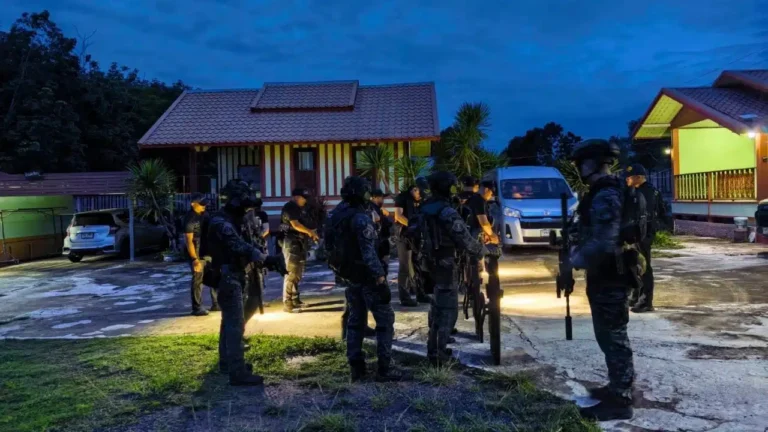
police rescue university

Police Rescue University Students Held Hostage by Phone Scam Gang

BANGKOK – Police in central Thailand successfully rescued two university students on July 15, 2026. A ruthless call center gang tricked the students into hiding and staging their own kidnappings. The criminals used these fake situations to extort heavy ransoms from the victims’ families.

The drama unfolded near a prominent university campus in the Rangsit area of Pathum Thani province. The operation began after a suspicious mother noticed red flags in her son’s behavior. She quickly realized that scammers were attempting to steal hundreds of thousands of baht.

Key Takeaways

  • Deceptive Tactic: Scammers tricked two sophomore university students into self-confinement using fake overseas scholarship documents.
  • Extortion Scheme: The gang forced the victims to stage a kidnapping video, successfully stealing 450,000 baht from one family.
  • Police Action: Officers traced the students to a local room, rescued them safely, and caught the criminals watching them via a live video call.

According to Pak Klong Rangsit police, the overseas criminal gang targeted second-year college students. The scammers contacted the 19-year-old victims and claimed they won prestigious scholarships to study abroad. To make the scam look real, the gang sent forged documents containing the university’s official logo.

Once the students believed the lie, the scammers changed their tactics completely. The gang told the teenagers that they needed to pay advance fees to secure the international travel. They also ordered the students to cut off all contact with friends and family members.

Police Rescue University Students

Staging a Fake Kidnapping

The criminals forced the students to check into a local resort before moving them to a hidden room. From there, the gang ordered the victims to tie themselves up to create a fake hostage situation. The criminals then used these distressing images to demand 450,000 baht from each family.

During the rescue operation, police officers discovered one student with his ankles bound by a towel. Investigators found that the gang was watching the students through a continuous live video call. The police immediately rushed in and brought both teenagers to safety without any physical injuries.

One victim’s mother revealed that she initially sent 350,000 baht after her son expressed excitement about the trip. She grew highly suspicious when a strange voice demanded an additional 100,000 baht for travel expenses. She checked the university’s official data and found that the professor’s social media profile was completely fake.

Local police are urging the public to stay alert against these evolving virtual kidnapping tactics. Authorities emphasize that real police or university officials will never conduct official business through video calls. Families should immediately report any suspicious financial demands to local law enforcement before transferring funds.

 Trending News:

Pattaya Police Officers Investigated After Kuwaiti Tourists Allege Extortion

Chiang Mai Police Crack Down on Karaoke Bar for 150,000 Baht Tourist Scam

Similar Posts

  • | |

    Punjab cybercrime crackdown, 28 suspects arrested

    LAHORE: Authorities have arrested 28 suspects in Lahore, Faisalabad and Multan as part of a major crackdown on organised online fraud, exposing alleged schemes that relied on impersonation, fake investment opportunities and fabricated official identities to deceive citizens. The arrests were made during a province-wide operation by the National Cyber Crime Investigation Agency (NCCIA) Punjab, directed by Punjab Director Muhammad Ali Wasim, officials said. Investigators also seized 24 mobile phones and a laptop, which are now being examined for evidence that could lead to other members of the alleged network. The investigation has revealed how fraudsters allegedly manipulated trust to convince victims to hand over large sums of money. Millions allegedly lost in Lahore scam In Lahore, 18 suspects were arrested in separate operations. Investigators said the suspects allegedly impersonated relatives, visa agents, government officials and personnel associated with the Punjab Safe Cities Authority. In one case, suspects allegedly posed as both a relative and a visa agent and persuaded a victim to transfer Rs25.86 million. The case has highlighted how scammers can combine apparently familiar identities with urgent requests to make their schemes appear legitimate. Rs54.66m trading fraud uncovered Three suspects were arrested in Faisalabad in connection with alleged online trading fraud and unauthorised access to a company email account. According to investigators, a victim was shown fabricated trading records, digital-wallet balances and purported profit statements to create the impression that substantial returns were being generated. After being persuaded to invest, the victim allegedly lost Rs54.66 million, investigators said. The case demonstrates the growing sophistication of investment scams, where criminals allegedly use manipulated digital information to make fraudulent platforms appear genuine. Multan arrests expose impersonation tactics In Multan, seven suspects were arrested for allegedly posing as relatives, bank employees and individuals claiming to be based in Britain. Officials said victims were approached with various demands, including payments supposedly required for prize money, customs clearance, taxes and visa renewals. Such tactics typically create a sense of urgency, leaving victims with little time to verify the identity of the caller or the authenticity of the demand. Digital evidence now under forensic examination NCCIA investigators are examining the seized devices through forensic analysis. Financial transactions, call records and digital communications are also being reviewed to establish the full extent of the alleged operation and identify other people who may be connected to it. The crackdown comes amid growing concern over online financial fraud in Pakistan. The NCCIA’s own statistics identify financial fraud as a major category of reported cybercrime. The latest arrests underscore a simple but increasingly important warning: an apparently familiar voice, official-looking message or promising investment opportunity may not be what it seems. Authorities are expected to continue the investigation as they trace the alleged network and follow the digital and financial trails left behind.

  • Thai Citizens Use Shoes To Reserve Places In Bank Queues

    BANGKOK, Thailand — Thai citizens in multiple provinces have adopted an unconventional approach to securing their place in line at Krung Thai Bank branches, placing their footwear in queues stretching from bank entrances as they wait to register for the government’s ‘Thai Chuay Thai Plus’ welfare scheme, according to social media reports and local media […]

  • Police SWAT Team Takes Down One of Thailand’s Most Wanted Murder Suspects

    BANGKOK –  A Police SWAT team has successfully captured a highly sought-after murder suspect after a long hunt in northeastern Thailand’s Sisaket province. The man had been hiding from regional law enforcement officers for nearly two full years. He was even ranked 74th on the Royal Thai Police’s official most-wanted criminal calendar. The daring arrest […]

  • | |

    Pakistan Embassy in Ankara marks Kashmir Exploitat…

    The Embassy of Pakistan in Ankara commemorated Kashmir Exploitation Day with national spirit and dignity, reaffirming Pakistan’s unwavering support for the people of Indian Illegally Occupied Jammu and Kashmir (IIOJK) and their right to self-determination. The event marked seven years since India’s August 5, 2019, decision to revoke the special constitutional status of Jammu and Kashmir. Participants reiterated solidarity with the Kashmiri people and called for a peaceful resolution of the dispute in accordance with United Nations Security Council resolutions. The ceremony was attended by prominent Turkish political leaders, diplomats, academics, members of parliament, representatives of think tanks, members of the diplomatic corps, media personnel, and members of the Pakistani and Turkish communities. The event began with the recitation of the Holy Quran, followed by special messages from President Asif Ali Zardari and Prime Minister Shehbaz Sharif. The messages reaffirmed Pakistan’s support for the Kashmiri people’s struggle and urged the international community to play an effective role in implementing UN Security Council resolutions on the Kashmir dispute. Chairman of the Geopolitical Foresight Institute, retired Major General Goray Alpar, highlighted the strategic and geographical importance of Jammu and Kashmir. He said the people of Pakistan and Türkiye share deep historical, cultural, and brotherly ties. He also warned that India’s unilateral actions, constitutional changes, and attempts to use shared water resources as political leverage could threaten peace and stability across the region. SESRIC Director General and former Turkish minister Zehra Zümrüt Selçuk reaffirmed the Organisation of Islamic Cooperation’s principled stance on the Kashmir issue. She said a just and lasting solution could only be achieved by allowing the people of Kashmir to exercise their right to self-determination in line with UN Security Council resolutions. She also drew parallels between the situations in Kashmir and Palestine, urging the international community to fulfil its responsibilities in pursuing a fair and durable solution. Turkish parliamentarian and Deputy Chairman of the Felicity Party, Mustafa Kaya, strongly criticised India’s policies in Indian-administered Kashmir, describing them as “demographic terrorism.” He said efforts to alter the region’s demographic composition, deprive local residents of land rights, and implement settlement policies similar to those seen elsewhere would not suppress the Kashmiri people’s aspirations for freedom. In his concluding remarks, Pakistan’s Ambassador to Türkiye, Dr. Yousaf Junaid, thanked the Turkish government and people for their continued support on the Kashmir issue. He alleged that India was pursuing a policy of demographic change in the region by issuing millions of domicile certificates to non-local residents while maintaining restrictions on independent media and continuing state repression. The ambassador said India’s unilateral constitutional measures could not change the internationally recognised disputed status of Jammu and Kashmir. He stressed that lasting peace, security, and stability in South Asia depended on a just resolution of the Kashmir dispute and reiterated Pakistan’s call for a free, fair, and impartial UN-supervised plebiscite to allow the Kashmiri people to determine their political future.

  • | |

    Christopher Nolan calls out modern film criticism …

    Acclaimed filmmaker Christopher Nolan has shared his thoughts on the growing culture of online movie criticism, arguing that many discussions about films have become more focused on quick judgments than thoughtful analysis. Speaking during an interview on the Beijing China podcast with host Zong Xu, the Oscar-winning director reflected on what he believes is a fundamental flaw in today’s film criticism. (worldofreel.com⁠) Nolan’s comments come shortly after the release of The Odyssey, his latest epic adaptation inspired by Homer’s classic tale. While the film has received strong reviews from professional critics and audiences alike, the director used the interview to address a broader issue rather than responding to reactions to his own work. He suggested that the rise of social media has encouraged many people to evaluate films too quickly without fully engaging with them. (worldofreel.com⁠) According to Nolan, the biggest problem is not that people criticize movies but that criticism often becomes instant and superficial. He argued that meaningful film discussion requires patience, context and a willingness to understand what a filmmaker is trying to achieve instead of immediately deciding whether a movie is “good” or “bad.” In his view, cinema is an art form that deserves deeper conversation rather than snap reactions designed to attract attention online. (worldofreel.com⁠) The director also emphasized that audiences should feel free to form their own opinions. However, he warned against treating every personal opinion as informed criticism. Nolan explained that professional critics often spend years studying film history, storytelling and filmmaking techniques, allowing them to provide context that goes beyond simple personal preference. He believes this difference is sometimes overlooked in today’s digital landscape. (worldofreel.com⁠) Nolan has long been known for creating ambitious films that spark debate, including Inception, Interstellar, Dunkirk and the Oscar-winning Oppenheimer. His projects frequently encourage viewers to revisit them, discovering new themes and details with each viewing. That philosophy, he suggested, is becoming harder to appreciate in an era dominated by immediate online reactions. (britannica.com⁠) His latest remarks have already generated discussion across social media, with some agreeing that thoughtful criticism has become less common, while others argue that online platforms have made film discussion more accessible and diverse than ever before. The debate reflects the changing relationship between filmmakers, critics and audiences in the digital age. As The Odyssey continues its global theatrical run, Nolan hopes viewers will take the time to experience films with an open mind before rushing to judgment. For the celebrated director, meaningful criticism should encourage deeper appreciation of cinema rather than reducing complex works to quick opinions shared in the heat of the moment.

  • | |

    Punjab boards introduce digital result cards

    All nine educational boards across Punjab have approved a new Digital Result Card System to modernise examination records and make student services more accessible. Under the new system, boards will stop issuing traditional printed result cards to students. Instead, candidates will receive digital result cards through newly developed online result portals. Students will be able to download and print their certificates from home or use commercial printing facilities when needed. The move will also end the Rs550 fee that boards currently collect from each candidate for issuing conventional result cards at the time of admission. As a result, the boards are expected to lose a significant source of revenue. The first phase of the system will cover Class IX and First Year annual examination results. Class X and Second Year students will join the digital system in the second phase. However, students whose results were scheduled for announcement on August 6 will continue to receive printed result cards under the existing system. Board officials said digital result cards for both regular and private candidates will become available online immediately after results are announced. Regular students will access their certificates through their institutions’ online portals, while private candidates will download them directly from their respective board websites. The new certificates will carry QR codes and other security features to prevent tampering and allow educational institutions and employers to verify them electronically. Officials have also confirmed that digital result cards will have the same legal and official status as conventional certificates. They will remain valid for university admissions, employment, scholarships, equivalence certificates, document verification and other academic and official requirements. The initiative marks a major shift towards paperless examination services and is expected to make the process faster, more convenient and easier for students across Punjab.

Leave a Reply

Your email address will not be published. Required fields are marked *