pti founder strong
| | |

PTI founder strong, reads the Quran and its transl…


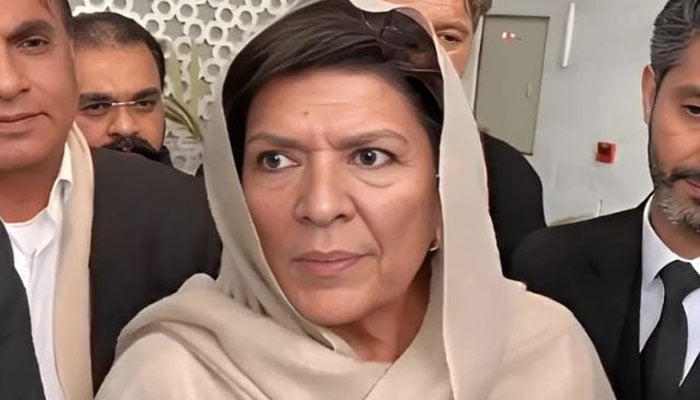
ISLAMABAD: Aleema Khan, the sister of the founder of Pakistan Tehreek-e-Insaf (PTI), has said that her brother remains mentally and physically strong despite being in prison. Speaking to the media outside the Islamabad High Court on Thursday, she stated that the PTI founder continues to spend his time reading the Holy Quran along with its translation, describing this as a source of strength and resilience during his incarceration.

Aleema Khan also raised concerns about her brother’s health, claiming that he has been experiencing vision problems for several months. According to her, the PTI founder informed his lawyer, Salman Safdar, back in December that he was having difficulty seeing and that there was an issue with one of his eyes. She suggested that despite bringing the matter to the attention of his legal counsel, adequate medical attention had not been provided.

Speaking further about his conditions in custody, Aleema Khan alleged that the PTI founder’s access to reading material has been restricted. She claimed that prison authorities had confiscated his books, preventing him from continuing his regular reading routine. According to her, books have always been an important part of his daily life, and taking them away has made his time in prison more difficult.

Despite these alleged restrictions, Aleema Khan insisted that the PTI founder has remained determined and steadfast. She said he continues to focus on reading the Quran and reflecting on its translation whenever possible, adding that his faith has helped him maintain a positive outlook while facing the challenges of imprisonment.

Her remarks came as PTI leaders, supporters, and lawyers gathered outside the Islamabad High Court, where they continued to call for legal relief for the former prime minister. The media interaction attracted significant attention as party members expressed concern over the PTI founder’s health and prison conditions.

Aleema Khan’s comments are the latest in a series of statements from the PTI leadership regarding the treatment of the party founder during his detention. Party officials have repeatedly voiced concerns about his medical care, access to books, and overall prison environment. They have urged the authorities to ensure that he receives appropriate healthcare and is granted facilities in accordance with prison regulations.

The government and prison authorities have previously rejected or disputed several allegations made by PTI leaders regarding the former prime minister’s treatment in custody. However, the issue continues to remain a point of political debate, with PTI maintaining that its founder’s legal rights and well-being should be protected.

As legal proceedings continue, Aleema Khan reiterated that her brother remains firm in his resolve. She concluded by saying that, despite the challenges he faces in prison, he remains spiritually strong through his regular recitation of the Holy Quran and reading of its translation.

Similar Posts

  • |

    FPCCI seeks industry consultation before revision of incremental power package

    ISLAMABAD: The Federation of Pakistan Chambers of Commerce and Industry (FPCCI) has called on the National Electric Power Regulatory Authority (Nepra) to consult industry representatives before making any changes to the Incremental Package for industrial electricity consumers. The business community has warned that revising the package without taking major industrial stakeholders into confidence could create market distortions, undermine the intended benefits of the scheme and potentially transfer additional costs to industries that do not qualify for incremental consumption incentives. In post-hearing comments submitted to Nepra on August 12, 2026, FPCCI said the regulator had already directed that the proposed changes to the Incremental Package should first be presented to and discussed with industry representatives before being brought back for approval. The federation welcomed the direction, describing meaningful stakeholder participation as essential for developing a workable electricity pricing mechanism for industrial consumers. FPCCI highlights delayed review FPCCI also raised concerns over the failure to conduct the package’s scheduled quarterly review. According to the federation, the Incremental Package was specifically designed to undergo a review every three months. However, no review had been conducted for approximately eight months. The federation said the prolonged delay had created uncertainty for industrial consumers and prevented the timely identification and correction of issues within the package. FPCCI urged Nepra to immediately carry out the overdue review and ensure that the quarterly review mechanism is followed consistently in the future. The federation argued that regular reviews were particularly important because industrial electricity consumption, production conditions and operating costs can change significantly over time. Major industry bodies seek participation FPCCI requested Nepra to formally engage leading industry organisations before the next hearing on the proposed revision. The organisations named by the federation include the Karachi Chamber of Commerce and Industry (KCCI), Korangi Association of Trade and Industry (KATI), All Pakistan Textile Mills Association (APTMA), as well as other major chambers and industrial associations. FPCCI said the participation of these organisations would allow the regulator to understand the practical challenges faced by different categories of industrial consumers. It stressed that the revised package should be based on actual industrial requirements and should not discriminate against existing consumers who are unable to qualify as incremental users. Warning against cost shifting The federation expressed concern that changes to the package could result in an unintended transfer of costs to non-incremental industrial units. FPCCI said any revised mechanism should ensure that incentives provided to additional electricity consumption do not create a financial burden for other consumers. It also called for clear safeguards to ensure that only genuine incremental electricity consumers receive the benefits of the package. According to the federation, the regulator should introduce mechanisms capable of preventing existing consumption from being presented as new or incremental demand merely to obtain preferential electricity rates. FPCCI maintained that a transparent verification system would be necessary to protect the integrity of the package and prevent potential misuse. Requests submitted to Nepra In its submission, FPCCI made a series of requests to the power regulator. The federation asked Nepra to formally consult FPCCI, KCCI, KATI, APTMA and other major industry bodies before the next hearing. It also requested the authority to provide sufficient advance notice of the date and time of any consultation, along with an online meeting link, so that FPCCI could coordinate participation by relevant chambers, associations and industrial representatives. The federation further sought a formal opportunity to present detailed recommendations on the proposed redesign of the Incremental Package. It called for safeguards restricting benefits to genuine incremental units and urged Nepra to immediately conduct the quarterly review that has remained pending for the past eight months. FPCCI also proposed making consultation with major industrial chambers and associations mandatory before any future revision or review of the Incremental Package or similar electricity pricing schemes. Invitation to power-sector institutions In a further effort to promote direct dialogue, FPCCI invited Nepra, the Power Planning and Monitoring Company (PPMC) and the Central Power Purchasing Agency-Guaranteed (CPPA-G) to visit its head office in Karachi. The federation proposed holding detailed discussions with the relevant institutions in the presence of industry representatives. FPCCI said direct engagement would provide an opportunity for all stakeholders to examine the existing mechanism, identify practical shortcomings and develop solutions based on actual operating conditions in the industrial sector. It maintained that consultation could help bridge the gap between regulatory objectives and the realities faced by industrial consumers. Industry seeks predictable power policy The dispute over the Incremental Package comes amid continued concerns among industrial consumers over electricity costs, competitiveness and the predictability of power-sector policies. For export-oriented and energy-intensive industries, electricity pricing is a major component of production costs. Business representatives have therefore repeatedly called for stable and transparent tariff mechanisms that allow companies to plan production and investment decisions. FPCCI said any changes to the Incremental Package should balance the objective of increasing electricity consumption with the need to maintain fairness among different categories of industrial consumers. The federation believes that a properly designed package, supported by regular reviews and meaningful industry consultation, could encourage additional industrial electricity consumption without imposing unintended costs on existing consumers.

  • |

    Naseem Shah breaks his silence on fitness concerns

    Naseem Shah has responded to concerns about his fitness. He is preparing for his return to competitive cricket. The pacer says injuries are simply a part of the game. According to him, they should not be seen as a sign of poor conditioning. The 23-year-old has been out since April. He suffered a side strain while playing for Rawalpindiz in PSL 11. The injury ruled him out for the rest of that tournament. He has not played a competitive match since. He is now set to make his comeback. The stage will be the National Champions Cup. It is a 50-over tournament featuring four teams. These are Pakistan Greens, Pakistan Whites, Pakistan Blues and Pakistan Gold. The event runs from August 11 to 18. It will be held at the Multan Cricket Stadium. Naseem has been picked for the Pakistan Greens squad. All-rounder Shadab Khan will lead the side. The tournament also plays a bigger role. It forms part of Pakistan’s build-up to the 2027 ICC Men’s Cricket World Cup. Selectors are currently tracking a wider pool of 44 players. Speaking to the media, Naseem explained an important distinction. He said physical fitness and match fitness are not the same thing. An injury during a match or training session does not mean a player is unfit. He added that any player can get hurt while playing. He also spoke about workload management. He said today’s game demands careful planning from players. Cricket keeps evolving, and fast bowlers must adapt with it. This, he said, is now part of the job. Naseem also touched on Pakistan’s fast-bowling legacy. He said success was never just about raw pace. Line and length, he explained, matter just as much as speed. He credited this balance for the team’s past bowling success. On his own pace, Naseem stayed confident. He said he still bowls at competitive speeds. In T20 cricket, he touches close to 140 kilometres per hour. He noted that one-day cricket brings a different challenge altogether. He ended by addressing his availability. Naseem said he is ready for any format. He added that it is not his job to choose. His only responsibility, he said, is to play whenever Pakistan calls upon him.

  • | |

    Bessent tells allies to pick a side as US ramps up…

    US Treasury Secretary Scott Bessent has told Washington’s allies they must choose between backing or opposing the United States’ push to economically isolate Iran, as President Donald Trump moves to intensify pressure on Tehran. Bessent told a US broadcaster that the campaign would amount to the largest coordinated economic isolation effort in history, framing the choice facing allied nations as a binary one. Asked whether Washington intends to pressure China into joining the effort, Bessent said certain conversations are best conducted privately, while urging Beijing to align itself with the campaign. He said the administration’s plan to sharply escalate sanctions and economic pressure on Iran is ultimately designed to bring down the Iranian government, predicting the strategy would work and lead to the regime’s collapse. Bessent added that expanded economic pressure could actually lower the odds of the United States resuming large scale military action against Iran, arguing that a maximum pressure economic approach makes a return to major combat operations less likely. He said he plans to hold a press conference Monday to detail the administration’s next steps regarding Iran. Iran’s foreign ministry condemned the latest round of US sanctions, calling them a violation of international law and an attempt to undermine the country’s sovereignty. In a statement, the ministry said Washington had unveiled comprehensive economic sanctions despite previously claiming its measures targeted the government rather than ordinary Iranians. Tehran argued there is no legal or economic justification for the sanctions and described them as part of a broader US policy that threatens the international system and undermines rules governing relations between states. The ministry said the sanctions explicitly target Iranian citizens and institutions and represent a continuation of hostile American policy, adding that economic pressure functions as the flip side of military aggression. Iranian officials called the new measures a repeat of a strategy that has already failed and said the country would not bow to the pressure, vowing to defend its sovereignty and respond to what it characterized as hostile US actions. Separately, Egypt and Qatar emphasized the need for continued coordination toward a final, sustainable agreement to end the broader Middle East war while addressing the concerns of Gulf states, according to a statement from Qatar’s foreign ministry. The two countries discussed regional developments and diplomatic efforts aimed at reducing tensions and strengthening stability, and both underscored the importance of reopening the Strait of Hormuz and protecting the security and freedom of maritime navigation, calling uninterrupted trade through the waterway essential to both regional and global economic stability. Qatari Foreign Minister Sheikh Mohammed bin Abdulrahman bin Jassim Al Thani said traffic through the Strait of Hormuz needs to return to pre war conditions, adding that no party to the conflict should attempt to pressure or blackmail the other. Speaking at a press conference following talks in El Alamein, Egypt, he said the war’s consequences have been severe both within the Gulf region and beyond, and called for a return to how things stood before the conflict began, condemning any threats or obstacles standing in the way. Iran’s Revolutionary Guards warned separately that Saudi Arabia will be unable to contain Yemen’s Houthi movement as the group escalates attacks on the kingdom. A Guards spokesman said Saudi Arabia cannot stay safe from Houthi attacks, arguing that recent days have shown that the more the kingdom strikes, the more it gets hit in return. Iranian Foreign Minister Abbas Araghchi dismissed Trump’s economic threats as an attempt to distract American public attention from domestic financial troubles, including record debt levels and rising interest costs. He said Washington’s continued reliance on what he called failed policies would only produce further failures and further alienate the Iranian public, describing US economic pressure as a threat to the global economy and to national sovereignty more broadly. Deputy Foreign Minister Kazem Gharibabadi added that the US has shifted to what he called an economic war after failing to achieve results militarily, arguing that Washington’s need to compensate for miscalculations is driving it toward a bigger failure. Iranian Parliament Speaker Mohammad Bagher Ghalibaf, during a visit to Baghdad, met with Faiq Zaidan, president of Iraq’s Supreme Judicial Council, and blamed the United States for recent regional conflicts and disruptions to Gulf energy routes, while highlighting opportunities for deeper cooperation between Iran and Iraq. Separately, Iranian state media reported that authorities executed a man identified as Qaem Hosseini, a foreign national, over charges tied to his alleged role in nationwide protests in January, including accusations that he participated in events that led to the deaths of security force members. Trump underscored the stakes of the broader campaign in a social media post Wednesday evening, warning that any country allowing its financial institutions, businesses, airports or government entities to provide Iran with any kind of lifeline would face tremendous economic consequences. He promised what he called economic warfare and isolation on an unprecedented scale, though he offered few specific details. The war between the US and Iran, now in its sixth month, has killed thousands of people and drawn in countries across the Gulf, rattling global markets as Iran demonstrated its ability to disrupt shipping through the Strait of Hormuz, a waterway that carried roughly a fifth of the world’s traded oil before the conflict began. Two previous ceasefire agreements between Washington and Tehran, announced in April and June, both collapsed shortly after being reached, even as Israel has largely pulled back from direct fighting with Iran to focus its attacks on civilian infrastructure in Lebanon.

  • Swat peace rally blast kills 14, injures over 20

    By Haroon Siraj SWAT – At least 14 people were killed and more than 20 others injured in a bomb blast during a peace demonstration at Kabal Chowk in Swat district on Sunday, according to rescue officials. The demonstration had been organised by Olasi Pasoon, with people from different parts of the district gathering to demand peace amid growing security concerns and recent militant activity in the area. Participants were chanting slogans calling for the restoration of peace when the explosion occurred. Rescue officials said nine bodies and at least 16 injured people were shifted to Saidu Sharif Teaching Hospital, while five bodies and several injured were taken to Tehsil Headquarters Hospital, Kabal. Police and security forces cordoned off the area immediately after the blast and launched a search operation. The nature of the explosion and those responsible were not immediately confirmed, while an investigation was underway. The incident comes days after an armed clash between suspected militants and police in the Shalkho Sar area of Swat’s Matta and Kabal tehsils. In that exchange of fire, one police was killed, while police claimed that militants were also killed during the operation. No group had claimed responsibility for Sunday’s blast at the time this report was filed.

  • | | |

    Congo Ebola outbreak death toll crosses 2,000

    KINSHASA: The Ebola outbreak in the Democratic Republic of Congo has intensified dramatically, with the death toll reaching 2,061 as authorities reported 4,449 confirmed cases, highlighting the growing challenge facing health workers and communities. The latest figures, reported by Congolese authorities on Tuesday, show how quickly the outbreak has expanded since it was officially declared on May 15. The outbreak is being driven by the Bundibugyo virus, a species of Ebola for which there is currently no licensed vaccine or specific treatment. Health authorities have been relying heavily on early diagnosis, supportive care, surveillance and infection-control measures. The outbreak began in Ituri province, with cases subsequently reported in other parts of the country. The World Health Organisation has warned that insecurity, population movement and limited healthcare infrastructure are complicating efforts to contain transmission. The current epidemic is Congo’s 17th Ebola outbreak, according to health authorities. Its rapid growth has raised concerns among international health agencies, particularly as affected communities face humanitarian and security challenges. Medical teams are working under difficult conditions, wearing protective equipment while treating patients and tracing contacts. WHO has said that strengthening surveillance, contact tracing, clinical care and community engagement remains central to the response. Recent research has also suggested that the outbreak may involve a previously unrecorded variant of the Bundibugyo strain and could have resulted from a new animal-to-human transmission event, underscoring the importance of monitoring potential spillover from wildlife. With thousands of confirmed infections and deaths already recorded, authorities face an urgent race to slow transmission and prevent the outbreak from spreading further across the region.

  • British Tourist Attacks Thai Police Officer Inside 7-Eleven, Video Sparks Outrage

    PATTAYA — A video showing a British tourist attacking a Thai police officer inside a 7-Eleven store has surfaced online, quickly drawing attention and sparking widespread condemnation of the tourist’s behavior. British Man Attacked Inside a Beer Bar in Pattaya The footage, shared on social media on March 7, depicts the British national forcing the […]

Leave a Reply

Your email address will not be published. Required fields are marked *