lopez family confirms
| | | |

Lopez family confirms a sale inside ultimate parent firm Lopez Inc.

MANILA, Philippines – On August 9, First Philippine Holdings Corporation (FPH) told the stock exchange that one of its directors, Roberta Lopez-Feliciano, had resigned, effective immediately, in a letter dated the same day. The filing gave a reason in a single sentence: Feliciano was stepping down because Crème Investment Corporation had sold its shares in Lopez Inc., the private company that sits at the top of the Lopez corporate structure.

CREME. First Philippine Holdings Corp. (FPH) discloses to the Philippine Stock Exchange the sale of Crème Investment Corp. of its shares in ultimate Lopez parent firm, Lopez Inc. Screenshot from FPH disclosure

This is the first on-the-record confirmation that a sale of Lopez Inc. shares has actually taken place, after weeks in which the possibility circulated in market chatter and brokerage commentary without a single company confirming it directly. The sale was significant enough to prompt a board resignation. And it does not say whether FPH, or any of the listed companies beneath Lopez Inc. in the ownership chain, considers this sale to be a change in control.

What ‘Item No. 4’ means, in plain terms

Every Securities and Exchange Commission (SEC) Form 17-C lists which numbered item it is reporting on, out of a standard menu of disclosable events set by regulators. FPH’s August 9 filing is logged under Item No. 4, which covers changes in a company’s directors or officers. It is not logged under the item that covers a change in control of the company itself. In practice, that means FPH has told the exchange about a resignation and the reason given for it, but has not made a separate statement saying that control of Lopez Inc., or of FPH, has changed hands.

That could mean several things, and right now there is no way to know which from the filing alone. It could mean FPH does not believe the sale amounts to a change in control under the rules. It could mean the company is still assessing the transaction and has not reached a conclusion. Or it could mean a separate disclosure is coming and simply had not been filed as of this writing. 

The stock exchange’s own disclosure rules require listed companies to promptly tell the public about specific events, including a change in control, and separately require a company to speak up and clarify matters once a report about it is already circulating, even if the company has not confirmed anything itself. Whether those obligations have been triggered here, for a sale that happened two layers above FPH rather than at FPH directly, is an open legal question this story will return to once more facts are confirmed.

Who is Crème?

Crème Investment Corporation holds 25.68% of Lopez Inc., the privately held family holding firm that sits two levels above First Philippine Holdings on the ownership ladder, with Lopez Holdings sitting in between as FPH’s immediate parent. 

Roberta Lopez-Feliciano
EXIT. Roberta Lopez-Feliciano resigns from Lopez firm, First Philippine Holdings Corp., FPH tells the Philippine Stock Exchange on August 10, 2026. Screenshot from ABS-CBN Foundation

Roberta L. Feliciano, known as “Berta,” was the one Crème shareholder who sat on FPH’s board, representing the branch descended from Eugenio “Geny” Lopez Jr., the same branch led by her brother Gabby. That is what makes her resignation carry more weight than a routine board departure. When Crème sold its stake in Lopez Inc. to tycoon Ramon Ang (story on this to follow), the Geny branch did not just cash out of the family’s top holding company. It also lost its only seat at FPH, an operating company two levels below.

The rest of FPH’s board draws from the other three family branches unevenly, alongside several directors who are not Lopez family members at all. Federico “Piki” Lopez himself chairs the board. His brother, Benjamin Ernesto R. Lopez, known as Jay, and their sister Mercedes Lopez-Vargas, known as Cedie, fill out three seats held by Croslo Holdings Corporation, the branch descended from Oscar Lopez Jr. 

Miguel Ernesto L. Lopez holds the board’s single seat tied to Mantes Corporation, the branch descended from Manuel “Manolo” Lopez. Presta Holdings Company, the branch descended from Presentacion Lopez-Psinakis, holds no seat on FPH’s board at all. 

The remaining directors, David O. Chua, Francis Giles B. Puno, Diana V. Pardo-Aguilar, Richard B. Tantoco, and Emmanuel Antonio P. Singson, along with independent directors Stephen T. CuUnjieng, Jaime I. Ayala, Cielito F. Habito, and Cirilo P. Noel, are not Lopez family members and do not represent any of the four family holding companies.

A board that hasn’t faced its own shareholders this year

Berta’s seat did not just belong to a board with an uneven family balance. It belonged to a board that has not been elected, in whole or in part, at any point in 2026.

FPH’s annual meeting was originally set for May 28, then pushed back. In early May, the company disclosed that the SEC’s Markets and Securities Regulation Department had allowed a July 27 meeting to proceed while excluding the election of directors from the agenda altogether, citing the ongoing family dispute. That meant the sitting board, Piki as chairman included, would stay in place on holdover, governing under the principle that directors continue to serve until their successors are elected, with no date set for when that election would happen.

On July 3, the SEC’s Ad Hoc Committee on the Lopez matter narrowed that guidance, clarifying that the deferral applied only to board seats covered by the Mandaluyong court’s injunction protecting Piki specifically, which opened the door to a partial election on July 27 for whichever seats fell outside that protection. That plan did not hold either. On the evening of July 17, the same committee directed FPH to reschedule the meeting entirely, to a new date within 60 days, so the company would have enough time to properly prepare for an actual election. As of this writing, FPH has not announced that new date, and the board remains on holdover.

Must Read

When the ASM has no election: What the Lopez family dispute means for every investor


When the ASM has no election: What the Lopez family dispute means for every investor

What is already known about the ownership chain

That context changes what Berta’s resignation means. She did not step down from a board that had recently faced its shareholders and would soon face them again. She stepped down from a board that has not stood for election all year and has no confirmed date to do so, leaving her seat vacant on a board operating, for the moment, without a fresh mandate from anyone.

Lopez Inc. owns 54.74% of Lopez Holdings Corporation. Lopez Holdings owns 60.67% of FPH. FPH owns 67.84% of First Gen Corporation’s common shares. FPH itself has 424,500,608 shares outstanding, as of July 22, 2026.
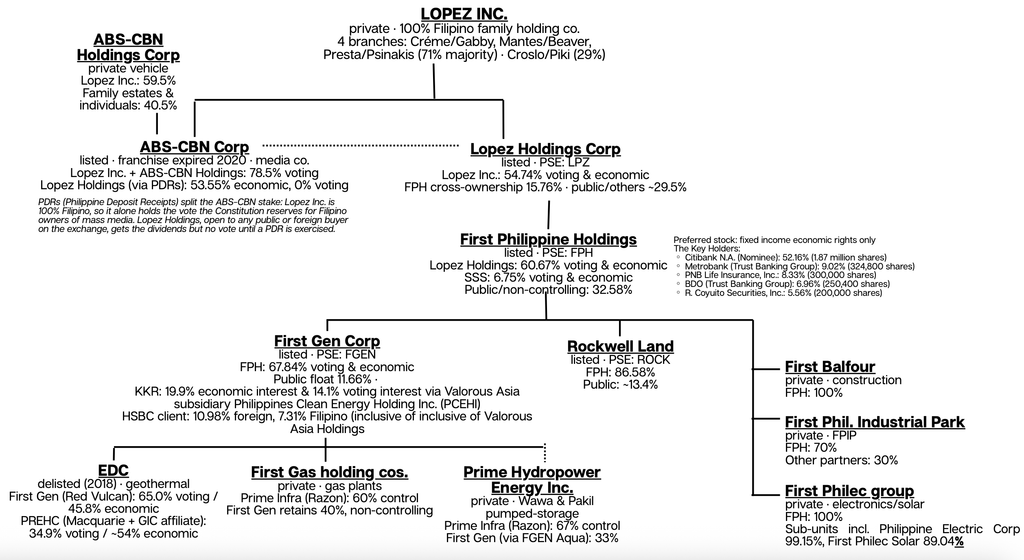
Lopez empire shareholder tree
LOPEZ INC. The Lopez empire shareholder tree. Graph by Lala Rimando

Separately, First Gen’s own disclosure on its financing for the 2026 hydropower acquisition with Prime Infrastructure Capital named a specific ownership threshold: the loan agreement’s change-of-management provisions are triggered if Federico “Piki” Lopez and his family cease to own, directly or indirectly, at least 29.17% of Lopez Inc. That figure is a useful anchor for readers trying to understand how a Lopez Inc. sale by other branches could leave Piki’s own family stake untouched in percentage terms while still changing who controls the company around him. – Rappler.com

Lala Rimando wrote about Philippine business, and managed newsrooms, including Newsbreak, ABS-CBN, Rappler, and Forbes, for over 25 years. She’s now based in La Union, taking care of her mom with dementia, and working on the multimedia biography of the late John Gokongwei.

Must Read

Buying into the Lopez empire: ABS-CBN or Lopez Inc?


Buying into the Lopez empire: ABS-CBN or Lopez Inc?

Similar Posts

  • |

    Government raises petrol price by Rs4.45, cuts diesel by Rs2

    The federal government has announced a fresh revision in petroleum prices, increasing the cost of petrol while providing a slight reduction in the price of high-speed diesel. According to a notification issued by the Petroleum Division, the revised fuel prices came into effect on August 6 as part of the government’s regular fortnightly price adjustment mechanism, which is based on fluctuations in international oil markets and the exchange rate. Under the latest revision, the price of petrol has been increased by Rs4.45 per litre, taking the new retail price to Rs333.10 per litre. In contrast, the price of high-speed diesel (HSD) has been reduced by Rs2.00 per litre, bringing its new retail price down to Rs383.86 per litre. The increase in petrol prices is expected to affect millions of private vehicle owners, motorcycle riders and commuters across the country, as petrol is the primary fuel used in passenger transport. Meanwhile, the modest reduction in diesel prices may provide limited relief to the transport and agriculture sectors, where diesel is widely used for heavy vehicles, machinery and irrigation equipment. Petroleum prices in Pakistan are reviewed every two weeks, with adjustments reflecting movements in global crude oil prices, refined petroleum product premiums, freight costs and the rupee-dollar exchange rate. The government says the pricing mechanism is intended to align domestic fuel rates with international market trends while meeting fiscal commitments. The latest adjustment comes at a time when international oil markets remain volatile amid geopolitical developments and shifting global supply expectations. Analysts believe future fuel prices will continue to depend on global crude oil trends and currency movements.

  • Thailand Bets Heavily on Natural Gas For Its Economic Growth

    BANGKOK – As Southeast Asia rapidly emerges as a major global energy hub, Thailand’s state-backed conglomerate PTT Plc is aggressively expanding its liquefied natural gas (LNG) trading operations. Facing an expensive global shift toward green energy, Thai leaders are heavily utilizing natural gas to secure domestic economic growth and power stability. The nation aims to […]

  • |

    PSX faces heavy selling as KSE-100 index drops over 1,300 points

    KARACHI: Selling pressure intensified at the Pakistan Stock Exchange (PSX) on Tuesday as investor sentiment weakened amid growing uncertainty over the prospects of a peace agreement between the United States and Iran and the reopening of the strategically important Strait of Hormuz. The benchmark KSE-100 Index came under pressure during the trading session, losing more than 1,300 points as investors remained cautious and reduced exposure to major stocks across several sectors. At around 2pm, the KSE-100 Index stood at 179,996.62 points, showing a decline of 1,313.66 points, or 0.72%, from the previous close. The market witnessed broad-based selling, with several major sectors contributing to the decline. Automobile assemblers, cement companies, commercial banks, fertiliser manufacturers, oil and gas exploration firms and oil marketing companies (OMCs) remained under pressure. Several index-heavy stocks also traded in negative territory. Prominent companies including HUBCO, Mari Petroleum (MARI), Oil and Gas Development Company (OGDC), Fauji Fertilizer Company (FFC), Habib Bank Limited (HBL), MCB Bank, Meezan Bank (MEBL) and United Bank Limited (UBL) were among the stocks weighing on the benchmark index. Previous session also ends lower The latest decline follows a weak close in the previous trading session. On Monday, the PSX initially moved higher but lost momentum during the second half of the session as investors opted to book profits in heavyweight shares. The KSE-100 Index eventually closed at 181,310.28 points, down 119.74 points, or 0.07%. The continued weakness suggests that investors are closely monitoring developments in international markets, particularly the situation surrounding oil supplies and the Strait of Hormuz. US-Iran tensions keep markets on edge Global financial markets remained unsettled on Tuesday as hopes for an agreement between Washington and Tehran appeared to fade. Negotiations aimed at ending the conflict and restoring normal shipping through the Strait of Hormuz have encountered fresh difficulties. US President Donald Trump on Monday responded to Iran’s conditions for a possible peace agreement by putting forward his own demands, including calls for compensation related to deaths and losses associated with wars, attacks and protests. The tougher rhetoric has raised concerns that diplomatic efforts could take longer, potentially prolonging disruptions around the crucial maritime route. The Strait of Hormuz is one of the world’s most important energy corridors, and prolonged disruption to shipping through the waterway could have significant consequences for crude oil supplies and global energy prices. Oil prices climb to highest level since July 31 The uncertainty surrounding the situation was reflected in international oil markets. Brent crude futures climbed to around $88 per barrel, while US West Texas Intermediate crude futures rose to approximately $82.45 per barrel. Both benchmarks reached their highest levels since July 31 after recording gains of roughly 5% during Monday’s trading session. Higher oil prices are a major concern for economies that depend heavily on imported energy. For Pakistan, sustained increases in global crude prices could increase the country’s import bill and place additional pressure on external accounts, inflation and domestic fuel prices. The rise in energy prices is also being closely watched by investors because higher input costs can affect corporate profitability and influence monetary policy expectations. Asian markets remain cautious The uncertainty was not limited to Pakistan. Asian equity markets moved within a narrow range as investors assessed the potential impact of rising energy prices on inflation and economic growth. MSCI’s broadest index of Asia-Pacific shares outside Japan moved between gains and losses before trading modestly higher. South Korea’s Kospi also recorded a slight increase. However, the escalation in tensions around the Gulf kept overall market sentiment fragile, with investors remaining wary of further developments that could affect energy supplies and global trade. US stock futures were also slightly positive on Tuesday. Nasdaq futures rose around 0.28%, while S&P 500 futures gained approximately 0.1%, following a weaker session on Wall Street on Monday. Inflation data in focus Investors are also awaiting the latest US consumer price data, which could provide further clues about the direction of interest rates and inflationary pressures in the world’s largest economy. The increase in crude oil prices has added another element of uncertainty ahead of the inflation report. A sustained rise in fuel and energy costs could complicate efforts to bring inflation closer to central-bank targets. For Pakistani investors, the combination of geopolitical uncertainty, higher global oil prices and pressure on heavyweight shares is likely to remain a key factor influencing trading sentiment in the near term.

  • | |

    Another Reko Diq-Sized mining project in Pakistan,…

    ISLAMABAD: The United States has expressed strong confidence in Pakistan’s mineral sector, with a senior US Embassy official revealing that the Trump administration is prepared to support another mega mining project on the scale of  to invest in Pakistan despite security concerns, viewing the country’s vast mineral wealth as strategically important for future global industries. During a background briefing with journalists on Wednesday, the embassy official said Washington considers Pakistan a key partner in the global race for critical minerals that are essential for advanced technologies, clean energy, artificial intelligence, semiconductors and defence manufacturing. According to the official, the US government is encouraging American investors to explore Pakistan’s untapped mineral resources, ranging from large-scale copper and gold projects to smaller mining ventures worth only a few million dollars. US Prepared to Finance Another Mega Project The official said the US administration is ready to support another project comparable to the multibillion-dollar Reko Diq development if geological surveys and feasibility studies demonstrate strong commercial potential. He added that financing support could be extended through US institutions such as the Export-Import (Exim) Bank and the Development Finance Corporation, both of which are playing a growing role in securing global supply chains for critical minerals. The official noted that American companies are not only interested in major mining investments but are also examining opportunities to acquire, develop and expand smaller mining operations across Pakistan. Reko Diq Progress Continues Despite Delays Discussing the Reko Diq copper and gold project, the official acknowledged that work is progressing, although at a slower pace than initially anticipated. He explained that project costs are currently being reassessed, after which developers will return to financiers to finalize the remaining funding package. The first phase of the Reko Diq project is estimated to cost around $7.7 billion, while the US Exim Bank has already offered $1.25 billion in financing. However, the overall financial structure remains under discussion. The project has experienced delays due to rising construction costs and security concerns in Balochistan, prompting project stakeholders to revise cost estimates more than once. Earlier this year, Barrick Gold, which owns a 50 percent stake in the project, also reviewed development timelines because of increasing costs and security-related challenges. Major Economic Benefits Expected The embassy official said Reko Diq has the potential to transform Pakistan’s economy once it becomes fully operational. According to the estimates shared during the briefing, the project could generate nearly $2 billion in annual free cash flow. Of this amount, around $500 million would go directly to the Government of Balochistan, while another $500 million would benefit Pakistan’s state-owned enterprises. The official further stated that Pakistan’s mining sector currently contributes roughly 3 percent to the country’s economy, while Reko Diq alone could increase national GDP by approximately 0.5 percentage points, highlighting its significance for long-term economic growth. Critical Minerals Becoming Strategic Priority The US official emphasized that critical minerals have become a top strategic priority for Washington as demand continues to rise across technology, renewable energy and defence sectors. Pakistan possesses commercially attractive reserves of copper, antimony, tungsten and several other minerals considered essential for future industries. He said American companies believe Pakistan has enormous untapped potential, particularly as global demand for copper is expected to rise sharply over the coming decades. The official added that US firms are actively seeking long-term supply agreements for minerals extracted from Pakistani mines, while some investors are interested in purchasing and developing smaller mining assets. Investment Opportunities Across Pakistan Besides Balochistan, American investors are also exploring mineral opportunities in Khyber-Pakhtunkhwa, particularly for copper deposits, while rare earth mineral prospects in Gilgit-Baltistan have also attracted attention. The official said the United States is searching globally for around 60 critical minerals needed for emerging technologies, many of which are found in Pakistan. He noted that several companies have already begun exploration and extraction activities in different regions of the country. Security Remains the Biggest Challenge Despite strong investment interest, the official acknowledged that security remains one of the most significant obstacles facing mining projects in Pakistan. He said US companies fully understand the risks associated with operating in regions such as Balochistan and Khyber-Pakhtunkhwa but remain willing to invest if appropriate security arrangements are provided. The official stressed that the Pakistani government should continue strengthening security measures and facilitating investors to ensure long-term success of mining projects. He added that American companies are encouraged to partner with local firms, which possess valuable experience in navigating operational and security challenges in remote mining areas. US Calls for Transparent Investment Environment The embassy official also urged Pakistan to maintain a transparent, predictable and competitive investment climate to attract greater foreign investment into the mineral sector. He noted that Pakistan’s participation in the US Critical Minerals Initiative earlier this year reflects growing cooperation between the two countries in securing future mineral supply chains. According to the official, if exploration and investment continue at the current pace, Pakistan’s mining industry could emerge as one of the country’s strongest economic sectors over the next 10 to 20 years, creating employment, increasing exports and significantly boosting national revenues.

Leave a Reply

Your email address will not be published. Required fields are marked *