lopez family confirms
| | | |

Lopez family confirms a sale inside ultimate parent firm Lopez Inc.

MANILA, Philippines – On August 9, First Philippine Holdings Corporation (FPH) told the stock exchange that one of its directors, Roberta Lopez-Feliciano, had resigned, effective immediately, in a letter dated the same day. The filing gave a reason in a single sentence: Feliciano was stepping down because Crème Investment Corporation had sold its shares in Lopez Inc., the private company that sits at the top of the Lopez corporate structure.

CREME. First Philippine Holdings Corp. (FPH) discloses to the Philippine Stock Exchange the sale of Crème Investment Corp. of its shares in ultimate Lopez parent firm, Lopez Inc. Screenshot from FPH disclosure

This is the first on-the-record confirmation that a sale of Lopez Inc. shares has actually taken place, after weeks in which the possibility circulated in market chatter and brokerage commentary without a single company confirming it directly. The sale was significant enough to prompt a board resignation. And it does not say whether FPH, or any of the listed companies beneath Lopez Inc. in the ownership chain, considers this sale to be a change in control.

What ‘Item No. 4’ means, in plain terms

Every Securities and Exchange Commission (SEC) Form 17-C lists which numbered item it is reporting on, out of a standard menu of disclosable events set by regulators. FPH’s August 9 filing is logged under Item No. 4, which covers changes in a company’s directors or officers. It is not logged under the item that covers a change in control of the company itself. In practice, that means FPH has told the exchange about a resignation and the reason given for it, but has not made a separate statement saying that control of Lopez Inc., or of FPH, has changed hands.

That could mean several things, and right now there is no way to know which from the filing alone. It could mean FPH does not believe the sale amounts to a change in control under the rules. It could mean the company is still assessing the transaction and has not reached a conclusion. Or it could mean a separate disclosure is coming and simply had not been filed as of this writing. 

The stock exchange’s own disclosure rules require listed companies to promptly tell the public about specific events, including a change in control, and separately require a company to speak up and clarify matters once a report about it is already circulating, even if the company has not confirmed anything itself. Whether those obligations have been triggered here, for a sale that happened two layers above FPH rather than at FPH directly, is an open legal question this story will return to once more facts are confirmed.

Who is Crème?

Crème Investment Corporation holds 25.68% of Lopez Inc., the privately held family holding firm that sits two levels above First Philippine Holdings on the ownership ladder, with Lopez Holdings sitting in between as FPH’s immediate parent. 

Roberta Lopez-Feliciano
EXIT. Roberta Lopez-Feliciano resigns from Lopez firm, First Philippine Holdings Corp., FPH tells the Philippine Stock Exchange on August 10, 2026. Screenshot from ABS-CBN Foundation

Roberta L. Feliciano, known as “Berta,” was the one Crème shareholder who sat on FPH’s board, representing the branch descended from Eugenio “Geny” Lopez Jr., the same branch led by her brother Gabby. That is what makes her resignation carry more weight than a routine board departure. When Crème sold its stake in Lopez Inc. to tycoon Ramon Ang (story on this to follow), the Geny branch did not just cash out of the family’s top holding company. It also lost its only seat at FPH, an operating company two levels below.

The rest of FPH’s board draws from the other three family branches unevenly, alongside several directors who are not Lopez family members at all. Federico “Piki” Lopez himself chairs the board. His brother, Benjamin Ernesto R. Lopez, known as Jay, and their sister Mercedes Lopez-Vargas, known as Cedie, fill out three seats held by Croslo Holdings Corporation, the branch descended from Oscar Lopez Jr. 

Miguel Ernesto L. Lopez holds the board’s single seat tied to Mantes Corporation, the branch descended from Manuel “Manolo” Lopez. Presta Holdings Company, the branch descended from Presentacion Lopez-Psinakis, holds no seat on FPH’s board at all. 

The remaining directors, David O. Chua, Francis Giles B. Puno, Diana V. Pardo-Aguilar, Richard B. Tantoco, and Emmanuel Antonio P. Singson, along with independent directors Stephen T. CuUnjieng, Jaime I. Ayala, Cielito F. Habito, and Cirilo P. Noel, are not Lopez family members and do not represent any of the four family holding companies.

A board that hasn’t faced its own shareholders this year

Berta’s seat did not just belong to a board with an uneven family balance. It belonged to a board that has not been elected, in whole or in part, at any point in 2026.

FPH’s annual meeting was originally set for May 28, then pushed back. In early May, the company disclosed that the SEC’s Markets and Securities Regulation Department had allowed a July 27 meeting to proceed while excluding the election of directors from the agenda altogether, citing the ongoing family dispute. That meant the sitting board, Piki as chairman included, would stay in place on holdover, governing under the principle that directors continue to serve until their successors are elected, with no date set for when that election would happen.

On July 3, the SEC’s Ad Hoc Committee on the Lopez matter narrowed that guidance, clarifying that the deferral applied only to board seats covered by the Mandaluyong court’s injunction protecting Piki specifically, which opened the door to a partial election on July 27 for whichever seats fell outside that protection. That plan did not hold either. On the evening of July 17, the same committee directed FPH to reschedule the meeting entirely, to a new date within 60 days, so the company would have enough time to properly prepare for an actual election. As of this writing, FPH has not announced that new date, and the board remains on holdover.

Must Read

When the ASM has no election: What the Lopez family dispute means for every investor


When the ASM has no election: What the Lopez family dispute means for every investor

What is already known about the ownership chain

That context changes what Berta’s resignation means. She did not step down from a board that had recently faced its shareholders and would soon face them again. She stepped down from a board that has not stood for election all year and has no confirmed date to do so, leaving her seat vacant on a board operating, for the moment, without a fresh mandate from anyone.

Lopez Inc. owns 54.74% of Lopez Holdings Corporation. Lopez Holdings owns 60.67% of FPH. FPH owns 67.84% of First Gen Corporation’s common shares. FPH itself has 424,500,608 shares outstanding, as of July 22, 2026.
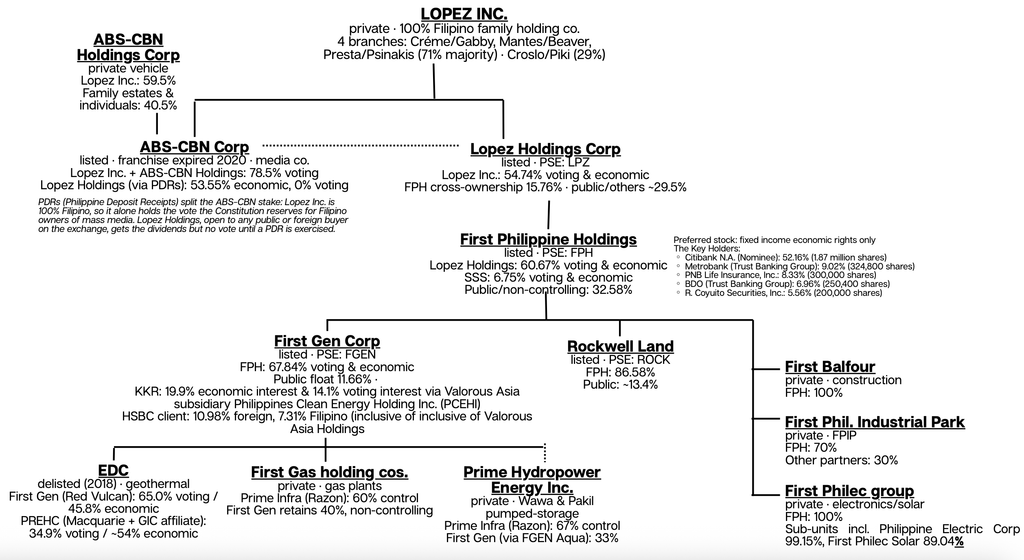
Lopez empire shareholder tree
LOPEZ INC. The Lopez empire shareholder tree. Graph by Lala Rimando

Separately, First Gen’s own disclosure on its financing for the 2026 hydropower acquisition with Prime Infrastructure Capital named a specific ownership threshold: the loan agreement’s change-of-management provisions are triggered if Federico “Piki” Lopez and his family cease to own, directly or indirectly, at least 29.17% of Lopez Inc. That figure is a useful anchor for readers trying to understand how a Lopez Inc. sale by other branches could leave Piki’s own family stake untouched in percentage terms while still changing who controls the company around him. – Rappler.com

Lala Rimando wrote about Philippine business, and managed newsrooms, including Newsbreak, ABS-CBN, Rappler, and Forbes, for over 25 years. She’s now based in La Union, taking care of her mom with dementia, and working on the multimedia biography of the late John Gokongwei.
Must Read

Buying into the Lopez empire: ABS-CBN or Lopez Inc?


Buying into the Lopez empire: ABS-CBN or Lopez Inc?

Similar Posts

  • |

    Government adjusted petrol and diesel rates

    The federal government has announced the rate of petrol by Re0.94 per litre while raising high-speed diesel (HSD) by Re0.54 per litre. Under the newly adjusted tariffs, petrol will now sell at Rs324.98 per litre, whereas HSD will cost consumers Rs382.79 per litre. Despite these minor shifts, significant fiscal levies remain embedded in local pump prices, with taxes and duties standing at Rs114 per litre for petrol and Rs100 per litre for diesel. According to official directives issued by the Petroleum Division, the revised rates take effect immediately for August 13. This latest decision highlights a broader downward trend from the historic spikes observed earlier this year. Fuel prices experienced an unprecedented surge following the breakout of the US-Iran conflict in late February. HSD, which traded around Rs281 per litre before the geopolitical crisis, climbed sharply to reach an all-time peak of Rs520.35 on April 3 before gradually retreating. Similarly, petrol prices escalated from Rs266 in early March to a maximum height of Rs458.41 on the same April date before cooling down to present levels. In a structural shift to handle ongoing market volatility, Petroleum Minister Ali Pervaiz Malik revealed that fuel pricing will transition to a daily adjustment mechanism. While the government had temporarily relied on weekly pricing revisions and targeted subsidy schemes since March to buffer against Middle Eastern supply disruptions, authority over price setting has now been formally handed over to the Oil and Gas Regulatory Authority (OGRA). Under the approval of the Prime Minister and the federal cabinet, OGRA will directly track daily international market fluctuations to determine local retail costs. However, this policy pivot has met swift pushback from commercial stakeholders. The All Pakistan Dealers Association strongly rejected the transition to daily rate changes, warning that the organization is formulating a formal protest strategy to oppose the decision.   The economic stakes of these pricing shifts remain high across every level of society. Petrol costs directly influence everyday commuters, small vehicle operators, rickshaw drivers, and motorcycle owners, placing immediate financial pressure on middle- and lower-income households when rates rise. On the other hand, diesel price movements carry a broader inflationary impact, as HSD powers heavy transport fleets, agricultural machinery, power generation plants, and industrial backup generators. Together, petrol and diesel form the bedrock of the national energy supply and state revenue, generating massive combined monthly sales of 700,000 to 800,000 tonnes, compared to a meager 10,000 tonnes of monthly demand for kerosene. Daily adjustments will now determine how these vital economic drivers impact consumers nationwide.

  • |

    Electricity tariff likely to increase by Rs1 per unit from next month

    ISLAMABAD: Electricity consumers across Pakistan may face higher power bills from next month as electricity distribution companies have approached the National Electric Power Regulatory Authority (NEPRA) seeking a quarterly tariff adjustment. According to sources, the proposed adjustment could result in an increase of around Rs1 per unit in electricity prices during the upcoming quarter. The distribution companies have submitted their adjustment request to NEPRA, which will examine the figures and determine the impact on consumers under the applicable quarterly tariff mechanism. Sources said the expected increase is linked to the expiry of the existing quarterly adjustment relief. Under the current arrangement, consumers are receiving a relief of Rs1.99 per unit, which is scheduled to expire at the end of the current month. With the relief ending, electricity tariffs are expected to rise for consumers across the country from next month, subject to NEPRA’s approval of the proposed adjustment. The quarterly tariff adjustment mechanism is used to pass on changes in electricity generation costs and other relevant expenses to consumers. Depending on the regulator’s assessment, the resulting adjustment can either increase or reduce electricity bills. The proposed increase is likely to add to the financial burden on households and businesses already facing elevated electricity costs. Consumers are now awaiting NEPRA’s decision, which will determine the final impact on electricity tariffs in the upcoming quarter. NEPRA is expected to review the distribution companies’ submissions before announcing its decision. The final adjustment may differ from the amount initially sought by the power distribution companies following the regulator’s scrutiny of the data and applicable costs.

  • |

    Oil prices tumble to three-week low as Trump delays Iran strike

    LONDON: Global oil prices recorded their sharpest single-day decline in weeks on Monday, falling to a three-week low after US President Donald Trump stepped back from plans for a military strike against Iran, raising hopes that diplomatic efforts could ease tensions and prevent disruptions to energy supplies from the Gulf. International benchmark Brent crude dropped 7 percent, or $6.35, to settle at $83.77 per barrel, while US West Texas Intermediate (WTI) crude fell 5.1 percent, losing $4.33 to close at $80.34 per barrel. The decline marked Brent’s weakest closing level since mid-July. Market analysts said the drop was also influenced by the expiry of the higher-priced September Brent contract, with the less expensive October contract becoming the new front-month benchmark. Investor sentiment shifted sharply after Trump announced that he had postponed military action against Iran, saying he wanted to allow time for diplomacy aimed at reaching an agreement that could reduce regional tensions and potentially increase Iranian oil exports. The possibility of additional crude entering global markets eased concerns over supply shortages, prompting traders to sell oil futures and pushing prices lower. However, Tehran quickly dismissed suggestions that negotiations with Washington were underway. Iranian Foreign Ministry spokesman Esmail Baghaei said there were no talks taking place with the United States and no meetings had been scheduled. He added that Iran had no plans to host foreign delegations or send negotiators abroad in the coming days. Trump, meanwhile, maintained that discussions with Iran were in progress and warned Tehran of serious consequences if it failed to reach an agreement aimed at ending the ongoing confrontation. Analysts call market reaction excessive Energy analysts said oil markets appeared to react strongly to political rhetoric rather than confirmed developments. According to analysts at energy consultancy Ritterbusch and Associates, the steep decline in crude prices reflected what they described as an overreaction by investors to Trump’s comments suggesting that an agreement with Iran could be imminent. They noted that the US president has repeatedly made strong statements regarding Iran before later softening his position, creating significant volatility in energy markets. Analysts also observed that Trump’s public calls for lower fuel prices in the United States have frequently weighed on oil markets by reducing expectations of sustained price increases. During Monday’s trading session, US gasoline and diesel futures also declined by nearly 5 percent, reflecting broader weakness across the energy sector. Shipping routes remain under pressure Despite hopes for diplomacy, concerns over maritime security in the Middle East continued to influence market sentiment. Shipping data showed that six Saudi-flagged supertankers altered their routes in recent days, avoiding the Gulf of Aden and instead sailing around southern Africa after Yemen’s Iran-backed Houthi movement threatened to target Saudi vessels. At the same time, some oil tankers continued to transit the region. Two Saudi oil tankers successfully crossed the Bab el-Mandeb Strait over the weekend, while vessel movements through the Strait of Hormuz slowed following reports of attacks on commercial shipping. The Strait of Hormuz remains one of the world’s most strategically important energy chokepoints, carrying roughly one-fifth of global oil trade before hostilities between the United States, Israel and Iran escalated earlier this year. A Panama-flagged tanker transporting Russian naphtha also reportedly abandoned plans to pass through the Bab el-Mandeb, choosing the longer route around Africa due to security concerns. Russia boosts maritime security Russia announced on Monday that it was strengthening security measures for commercial shipping in the Azov-Black Sea region while working to expand alternative export routes, following increased attacks on vessels linked to the conflict in Ukraine. As one of the world’s largest crude producers and a leading member of the OPEC+ alliance, Russia remains a key player in global energy markets. Disruptions to exports from the Gulf, Russia and Kazakhstan have continued to limit global oil supplies throughout the year, preventing previously announced OPEC+ production increases from fully reaching international markets. In a separate development, OPEC+ approved a production quota increase of approximately 188,000 barrels per day beginning in September. Although the move is intended to gradually raise output, analysts believe geopolitical risks and transportation disruptions could continue to limit the actual flow of additional crude to global buyers.

  • | |

    PSX closes higher despite volatile trading

      The Pakistan Stock Exchange (PSX) witnessed a positive trading session on Tuesday, with the benchmark KSE-100 Index gaining 1,116 points to close at 177,083 points. The index remained volatile throughout the trading session and moved within a range of 1,755 points. It reached an intraday high of 178,768 points before easing from its peak as investors adjusted their positions. Trading activity remained strong, with approximately 710 million shares changing hands in 25 billion rupees worth of transactions. The high trading volume reflected continued investor participation and active buying and selling across various sectors. Despite the rise in the benchmark index, the overall market capitalisation declined by around 120 billion rupees, falling to 19,833 billion rupees by the end of the session. The market’s performance reflected a mixed trend, as investors continued to monitor economic developments and market conditions while actively repositioning their portfolios.

  • |

    North Carolina man wins $1 million lottery after trusting his lucky number 7

    A North Carolina man has struck it rich after relying on what he has always believed to be his lucky number, winning a $1 million prize from a scratch-off lottery ticket. According to international media reports, Thomas Moonves, a resident of Biscoe in North Carolina, purchased a $10 Triple Red 777 Jackpot scratch-off ticket from a local convenience store. He said he chose the ticket because the number 7 has always held special meaning in his life. Moonves explained that his connection with the number dates back to his birth, as he was born on the 7th day of the month in 1977. Believing the number had consistently brought him good fortune, he decided to try his luck with a ticket featuring multiple sevens. Soon after buying the ticket, Moonves scratched it on the spot and was stunned to discover he had won the game’s top prize of $1 million. Recalling the unforgettable moment, he said he was overwhelmed with excitement and could hardly believe what he was seeing. The unexpected win turned an ordinary trip to the store into a life-changing experience.

Leave a Reply

Your email address will not be published. Required fields are marked *