beyond public finance

Beyond Public Finance: Towards Constitutional Poli…

The Part VI of this series argued that Pakistan cannot escape dependency merely by improving tax administration. Better value added taxation, digital integration and fiscal coordination are necessary, but they cannot substitute for constitutional restraints, accountable government and dismantling of systems of privilege.

The same intellectual caution must be applied to the history of economic thought. Conventional accounts often move from Greek philosophy to European scholasticism, mercantilism, Adam Smith and modern economics, leaving several centuries of Muslim intellectual activity in an unexplained gap. This omission creates the false impression that systematic thinking about taxation, markets, money, public expenditure, state responsibility and economic justice developed almost exclusively in the West.

Muslim scholars did not describe their work as “economics” in the modern sense. Economic questions appeared within jurisprudence, ethics, administration, history and political philosophy. Imposing contemporary categories upon them would be anachronistic. Excluding their contributions from the history of economic ideas is equally indefensible. Modern scholarship has documented a substantial body of Muslim economic thought that conventional textbooks have frequently overlooked.

The purpose is not to replace a Western monopoly with a Muslim one. Knowledge has always travelled across cultures as common heritage of mankind. Muslim thinkers drew upon Islamic sources, practical experience and Greek, Persian, Roman and Indian traditions. Their works were subsequently transmitted, debated and transformed in other intellectual settings. The proper objective is to restore missing pages to a shared human history.

One of the earliest important works on public revenue was Abu Yusuf’s Kitab al-Kharaj. It did not treat taxation as a ruler’s unrestricted right to maximise extraction. Tax liability had to take account of productive capacity, conditions of the land and the taxpayer’s ability to bear the burden.

Abu Yusuf preferred proportional agricultural taxation where a fixed assessment would become oppressive in a poor harvest and unduly favourable during exceptional production. He insisted that collectors should be honest, collection economical and taxpayers treated justly. He opposed arrangements capable of turning revenue collection into tyranny and also emphasised irrigation, transportation and other infrastructure necessary for production.

This was more than tax administration. It was an early recognition that revenue depends upon institutions, incentives and the conduct of public officials. A tax may be lawful in form and oppressive in operation. The character of the collector, method of assessment and use of revenue are therefore integral to the legitimacy of taxation. Pakistan’s fiscal debate still struggles to absorb this elementary insight.

In the Land of Pure, tax laws are judged by the amounts they collect, while blocked refunds, arbitrary demands, compliance costs and damage to productive capacity are treated as secondary matters. Revenue obtained by weakening the taxpayer is celebrated as administrative success. Abu Yusuf’s approach reverses the perspective: the state must preserve the source from which sustainable revenue arises.

Al-Ghazali examined markets, exchange, specialisation, division of labour, money and the interdependence of economic activities. He explained that production of even an ordinary item required the cooperation of numerous workers performing specialised functions. His examples involving bread and needle-making appeared centuries before Adam Smith’s famous pin factory.

He also recognised that markets emerge from mutual need and voluntary exchange, while public authority remains necessary to maintain justice and prevent harmful practices. Economic development was not separated from education, security, infrastructure and public welfare. Prosperity, justice and legitimate political authority formed parts of an interdependent social order.

This understanding is richer than the artificial contest often presented between state and market. Markets require rules, trust, reliable money and protection against fraud. The state must provide these conditions without converting regulation into a mechanism for distributing arbitrary favours.

Ibn Taymiyyah similarly distinguished between price increases produced by changes in supply and demand and those caused by injustice, hoarding or monopoly. Not every increase in price justified administrative interference. Market forces had to be understood before intervention was attempted.

Intervention became necessary where concentrated power allowed monopolists to exploit the public. Ibn Taymiyyah therefore combined recognition of market mechanisms with restraint upon abuse—an approach far removed from both indiscriminate price control and unregulated private coercion.

Pakistan repeatedly swings between these extremes. Governments interfere through administered prices, selective subsidies and discretionary regulation, while tolerating cartels, protected industries and barriers to competition. The result is not a free market or an effective developmental state. It is a negotiated market in which access to authority frequently determines economic advantage.

Al-Maqrizi’s analysis of monetary debasement and inflation provides another striking antecedent. Writing in the context of monetary disorder, scarcity and maladministration, he connected the excessive issue of inferior money with rising prices, disruption of exchange and hardship for the population. Ibn Taymiyyah had also warned that circulation of currencies with different intrinsic values could drive better money out of use.

The instruments have changed. Modern states no longer depend upon metallic coins in the same manner. The underlying warning remains relevant: governments cannot conceal fiscal disorder indefinitely through manipulation of money. Inflation transfers resources without transparent legislative approval and imposes its harshest burden upon those least able to protect their savings and incomes.

The most comprehensive contribution came from Ibn Khaldun. His Muqaddimah connected taxation with state formation, political authority, incentives, production, public expenditure, urban development, elite luxury and dynastic decline.

Ibn Khaldun observed that during the earlier stages of a dynasty, moderate assessments could generate substantial revenue because economic activity remained vigorous. As ruling establishments expanded, expenditure increased and elites became accustomed to luxury, new taxes and higher rates were imposed. Productive incentives weakened, the tax base contracted and larger assessments produced smaller revenues.

Arthur Laffer expressly acknowledged this antecedent in 2004, writing: “The Laffer Curve, by the way, was not invented by me”. He immediately referred to Ibn Khaldun’s analysis of high assessments and declining revenue. Laffer also mentioned other predecessors, so historical accuracy requires us to describe Ibn Khaldun as a major antecedent rather than the sole originator of the idea.

Reducing Ibn Khaldun to the Laffer Curve would nevertheless diminish his contribution. His argument was not merely that tax cuts might increase revenue. He was describing a broader political and institutional cycle. As the ruling establishment becomes more expensive, it seeks additional revenue. As taxation becomes oppressive, incentives and production decline. As productive activity contracts, the government raises burdens further. The state eventually consumes the economic foundations upon which its authority depends.

This is Constitutional Political Economy centuries before the term was coined—not in its modern mathematical or contractual form, but in its central concern with how political institutions and incentives shape fiscal outcomes.

Pakistan’s experience gives Ibn Khaldun’s analysis disturbing contemporary relevance. The state protects privileges, expands non-developmental expenditure, borrows to meet recurring obligations and imposes additional burdens upon documented and productive sectors. Each revenue shortfall produces new withholding provisions, levies, minimum taxes and advance collections. The failure of one coercive measure becomes the justification for another.

A wider normative framework also emerges from the Islamic intellectual tradition. There is no need to reproduce or mechanically cite scriptural verses in a newspaper discussion. The underlying principles can be expressed in universal constitutional language: justice in public burdens; accountability of those exercising authority; consultation in collective decision-making; protection against arbitrary appropriation; honest measurement in exchange; fulfilment of public trusts; wider circulation of wealth; protection of vulnerable persons; and restraint upon unjust enrichment.

These principles do not offer a ready-made tax code for a modern federation. They provide standards by which fiscal institutions can be judged.

A tax cannot be defended merely because Parliament has enacted it. Its constitutional legitimacy also depends upon equality, rational classification, due process, protection of property, representative consent and use of public resources for legitimate purposes. Revenue collection divorced from these values becomes fiscal coercion.

Modern CPE, particularly the work of James Buchanan, contributes powerful analytical tools for examining the rules under which political decisions are made. Richard Abel Musgrave remains indispensable for understanding allocation, distribution and stabilisation. Douglas North explains how formal and informal institutions shape incentives and long-term performance.

Their contributions should be studied alongside, rather than instead of, Abu Yusuf, Al-Ghazali, Ibn Taymiyyah, Al-Maqrizi and Ibn Khaldun.

The West has no monopoly over reason. Muslim societies have no monopoly over justice. The common task is to recover and critically examine every intellectual tradition capable of helping humanity restrain power, promote production and organise public resources fairly. Pakistan’s tragedy is not that it lacks intellectual inheritance. It is that its rulers repeatedly invoke inherited ideals while constructing fiscal institutions that contradict them.

In the next part, we shall examine taxation, power and constitutional incentives in Pakistan, and ask whether parliamentary enactment alone can legitimise taxes designed through executive convenience, delegated legislation and unequal political bargaining.

[To be continued]

Postscript

Professor Ehtisham Ahmad has clarified that the paper discussed in Part VI was only a preliminary outline circulated for initial comments and not a final monograph. Our purpose in engaging with it was to initiate a serious and constructive debate on Pakistan’s constitutional political economy, not to question his scholarship or cause him any personal hurt. We deeply regret that our intervention was perceived otherwise and have already conveyed an unqualified apology to him for any unintended distress. We also extend our sincere wishes and prayers for the speedy recovery of his wife, who is presently unwell.

____________________________________________________________________

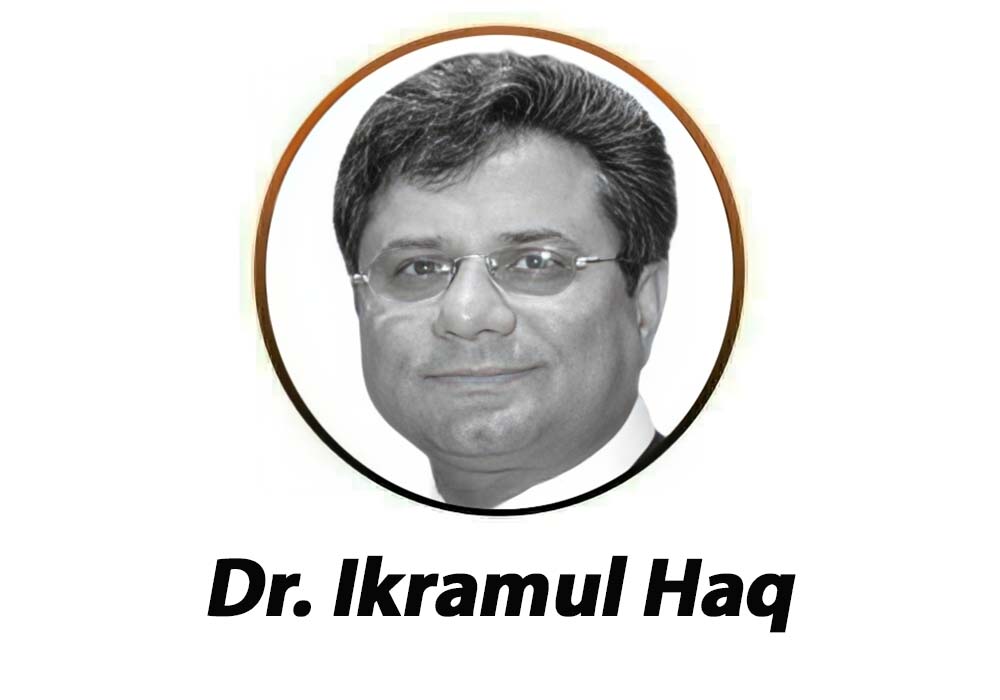
Dr. Ikramul Haq, Advocate Supreme Court, Adjunct Faculty at Lahore University of Management Sciences (LUMS), member Advisory Board and Visiting Senior Fellow of Pakistan Institute of Development Economics (PIDE), holds an LLD in tax laws. He was full-time journalist from 1979 to 1984 with Viewpoint and Dawn. He also served Civil Services of Pakistan from 1984 to 1996.

Similar Posts

  • Imposed War and Imposed Peace Have Failed

    Today, the world faces unprecedented challenges, including the spread of unbridled unilateralism, the weakening of the fundamental principles of the United Nations Charter, the illegal recourse to force, the imposition of unilateral and indiscriminate sanctions, and the instrumental use of economic and financial mechanisms to exert political pressure. Members of the international system, particularly states as its primary actors, must defend multilateralism, respect for national sovereignty, sovereign equality of states, and the rule of law in international relations. Since June 2025, the nation of the Islamic Republic of Iran has experienced its bitterest days. The martyrdom of the Supreme Leader of the Islamic Revolution—as the highest political and religious authority of the Islamic Republic of Iran—the tragic attack on the Minab school resulting in the martyrdom of 168 school children, the testing of America’s latest lethal weapons and cluster missiles in the attack on the city of Lamerd in Fars Province and the indiscriminate assassination of its defenseless people, along with attacks on medical and healthcare facilities, educational environments, and universities, and the continuation of these crimes demonstrate that when a superpower turns rogue, international peace and security are put at risk. By imposing war, the U.S. government has driven several rounds of negotiations with Iran into a deadlock. The mediatory efforts of Pakistan to restore peace and tranquility to the region are commendable, and Iran has respected this vital role. It is crystal clear that wars are always initiated by one side, but ending them requires the presence and role of both warring parties. If the Americans, who imposed this war, desire to end it, they must respect the Pakistan Memorandum of Understanding and stop trying to impose peace on Iran through their own self-authored rules. However, it appears the United States seeks to dictate its demands upon Iran, whether through war or through peace. You cannot have your cake and eat it too. The Americans want everything at once and afford no standing to the opposing side. The blatant violation of the terms of the Pakistan MoU, continued attacks on transportation infrastructure, drinking water facilities, fishing boats, local commercial vessels, meteorological centers, and other civilian infrastructure are clear instances of violations of international law and international humanitarian law, as well as a stark example of the ongoing policy of resort to force and disregard for international obligations. The Islamic Republic of Iran underscores its firm resolve to defend its sovereignty, independence, and territorial integrity. The U.S. government is an untrustworthy and law-defying regime that does not adhere to international rules, regulations, and agreements. For this reason, many political analysts believe that U.S. conduct regarding West Asian regional issues poses a threat to the stability of the international community. What Trump has been asserting since last year regarding a U.S. victory and the defeat of Iranian military forces is merely a strategic mirage; continuing Trump’s self-destructive policies will pull America into a deep quagmire, demonstrating that they lack a proper understanding and perception of Iran’s history and its people. Direct U.S. intervention in the implementation of security and maritime arrangements in the Strait of Hormuz, alongside the re-imposition of a naval blockade, has once again endangered the security of one of the world’s most strategic waterways and disrupted the normal flow of international commercial shipping. The principled policy of the Islamic Republic of Iran has always been grounded in dialogue, diplomacy, good-neighborliness, and regional cooperation. We firmly believe that lasting peace will only be realized when aggression, occupation, threats, and double standards give way to mutual respect, the impartial execution of international law, and genuine commitment to international obligations. Although the Islamabad Memorandum of Understanding was signed by the presidents of both Iran and the United States, neighboring and regional countries—especially the Arab states of the southern Persian Gulf, acting as “Middle Eastern allies” of the U.S. government—are required under Articles 1 and 2 of this agreement to cooperate toward an immediate and permanent end to the war and the establishment and maintenance of peace. These countries must not forget that their territories were used to commit aggression against the Islamic Republic of Iran, and that such acts of aggression persist. Whether the territory of these nations was placed at the disposal of the United States, or the United States exploited their territory against Iran without their consent, makes no difference, as ultimately their facilities and capabilities were utilized against us. Consequently, these states form part of the war front against Iran, and they too must remain faithful to the Pakistan MoU. Brad Cooper, Commander of United States Central Command (CENTCOM), explicitly announced the involvement of several Persian Gulf Cooperation Council (PGCC) member states and Jordan in the United States’ military aggression against Iran. If this claim is merely a falsehood, these countries must officially and transparently refute it. The pervasive insecurity and raging fires across the region are the exclusive byproduct of continuous aggression against Iran, and regrettably, the territory of certain states serves these destabilizing actions. The Islamic Republic of Iran reserves its inherent right to self-defense to protect itself. We hope our neighboring countries reach a common understanding that the actions taken by Iran do not stem from hostility toward regional nations. We all believe that we are neighbors and will remain neighbors. Iran has repeatedly emphasized the logic of a “Strong Region,” believing that the entire region must become powerful—a region capable of resolving its own issues and challenges without relying on foreign forces, which are themselves the source of instability and insecurity. This region is a shared home; its security belongs to all its nations, and everyone must endeavor to create and maintain peace, security, and prosperity.

  • Trump reopens the Saudi nuclear deal

    For a few hours this week, it looked like Washington and Riyadh had quietly closed one of the more consequential files of Donald Trump’s second term. On Wednesday, US Energy Secretary Chris Wright and his Saudi counterpart signed a civil nuclear cooperation agreement, a deal years in the making, offering American firms a foothold in a market Riyadh has long promised and long withheld. Then, a day later, the president reopened it himself. In a Truth Social post on Thursday, Trump declared the agreement “will be approved,” but added that it was “totally subject to Saudi Arabia joining the very respected and successful Abraham Accords.” He also inserted a second condition that had not been part of the signed text: no enrichment of nuclear material on Saudi soil. Within hours, press secretary Karoline Leavitt was telling reporters the deal was simply “off” unless the kingdom normalised relations with Israel, even though, by her own account, the president had not actually spoken to Crown Prince Mohammed bin Salman since posting the ultimatum. It is worth sitting with how unusual this is. A nuclear cooperation agreement, negotiated over years and signed by cabinet level officials on both sides, was retroactively rewritten by a presidential social media post, with the Saudi government left to respond through silence, and American wire services unable to get so much as a background comment out of Riyadh. Steven Cook, a Middle East scholar quoted by NPR, put the underlying question bluntly: whether “a social post supersede a signed diplomatic agreement.” That a serious foreign policy analyst even has to ask the question tells its own story about how this White House does business. The Saudi position, however, is not new, and it is not merely stubbornness. The kingdom has said for years, through King Salman and now through the Crown Prince, that normalisation with Israel requires a credible pathway to Palestinian statehood. That position survived the first Trump term’s Abraham Accords push, the Biden administration’s own normalisation efforts, and it hardened further after the October 2023 Hamas attack on Israel and the war in Gaza that followed. Riyadh’s calculus is also generational: across the Arab and Muslim world, sympathy for the Palestinian cause remains a live political fact that no government, however close to Washington, can casually override. There is also an Israeli dimension worth naming honestly. Israel’s own unease was never really about Saudi Arabia’s civilian nuclear ambitions; officials have signalled for months that they had made peace with the idea, provided it came bundled with normalisation. What Israeli commentators and officials appear to actually fear is a Saudi Arabia empowered, prestige laden, and unbound to the Accords: a regional heavyweight whose recognition Israel still needs, and has not been granted, absent a resolution nobody has yet found for the Palestinians. That is the crux the deal has now run into, and it is not a problem Trump’s Truth Social account can post its way out of. None of this means the deal is necessarily dead. Trump has a long history of issuing maximalist conditions in public while negotiating something narrower in private, and Saudi Arabia has strong economic and strategic incentives of its own to keep the nuclear track alive. But the manner in which this condition was added, abruptly, publicly, and without prior coordination with Riyadh, is itself a signal worth reading. It suggests an American approach to the region that still assumes the old leverage of the first Abraham Accords era holds unchanged, even as the ground beneath it, in Gaza’s aftermath and in Saudi public opinion, has shifted considerably. Whether Washington adjusts to that reality, or simply keeps repeating the demand more loudly, will say a great deal about how the rest of this file plays out.

  • Guardians of Mind in the digital deluge

    A meticulous examination of human civilization reveals a fundamental, unrelenting truth: the ultimate destiny, rise, and moral endurance of nations are never dictated solely by the expansion of their treasuries, the volume of their industrial output, or the brute dominance of their military might. Rather, they hinge upon their intellectual sovereignty, their engagement with the zeitgeist, and the preservation of their scholarly legacy. Knowledge constitutes the living soul of any dignified society—an indispensable force that enables a people to safeguard their intellectual frontiers, foster collective evolution, and claim a distinguished standing in the global council of minds. The sturdiest, most ancient, and most sacred citadel dedicated to preserving this intellectual momentum, organizing it within modern scientific frameworks, and transmitting it across generations remains the library. Yet, it is a poignant and deeply troubling irony that our prevailing socio-educational attitudes routinely reduce the library to a sterile edifice of stone and mortar—a mere repository of silent shelves and dust-laden volumes. Through this narrow, utilitarian lens, the profession of the librarian is similarly diminished, cast as little more than a routine counter clerk or a custodian issuing loans. Such apathy betrays a profound collective negligence toward the very architects of our intellectual heritage and the true sentinels of wisdom. In an era ensnared by algorithmic echo chambers, sensationalist digital flows, and an unrelenting deluge of Artificial Intelligence—where the sheer abundance of information has blurred the boundaries between verified truth and superficial noise—the librarian’s vocation has acquired a heightened, almost sacred imperative. The modern librarian is no longer a passive guardian of books; they serve as an authoritative, discerning Information Navigator amidst a tempestuous ocean of data. They erect the scientific and critical filters that protect researchers, scholars, and students from sinking into the quagmires of misinformation. Ensuring the equitable, uninterrupted, and rigorous transmission of knowledge is the ultimate guarantee of a society’s intellectual sovereignty, and the librarian stands as the quiet architect fortifying that foundation behind the scenes. Throughout the subcontinent’s intellectual history, libraries served as the vital organs of the body politic—its heart and mind. In tracing the evolutionary arc of library science across South Asia, August 12 emerges as a watershed moment. This date marks the birth anniversary of Professor Dr. S.R. Ranganathan (1892–1972), the towering polymath and founding father of modern library science in the region. Ranganathan revolutionized traditional custodial practices, elevating library management into a structured, universally recognized scientific discipline. His seminal Five Laws of Library Science remain the universal constitution of bibliothecal organization. He catalyzed an epistemological shift by asserting that books are not meant to be locked away in archival isolation but are living tools for active inquiry; bridging the gap between every reader and their required text lies at the very core of a library’s purpose. Celebrating August 12 as Librarians’ Day across South Asia is, therefore, a public tribute to this intellectual legacy and an unequivocal affirmation of the nobility of the profession. It was against this rich historical backdrop that the Quaid-e-Azam Central Library at the University of Gujrat recently hosted a distinguished academic symposium to commemorate Librarians’ Day. Chaired by the Chief Librarian, A.R. Sheikh, the gathering transcended routine ceremonial formality. It served as a rigorous reaffirmation of the historical contributions of libraries in South Asia and an exploration of the evolving mandates of librarianship within contemporary higher education and research. The professional staff of the Quaid-e-Azam Central Library used the occasion not merely to celebrate history, but to renew their solemn pledge: to reignite the culture of deep reading and to transform the library into the region’s most dynamic, responsive, and technologically adept sanctuary for scholarly inquiry. The panel discussion opened with compelling insights from Senior Librarian Mrs. Rameeza Mushtaq, who underscored that no institution of higher learning can claim completeness without a fully realized library—the true intellectual heart of any university. Senior Librarian Mr. Liaquat Ali emphasized that while the digital age and e-books have fundamentally reshaped reading habits, the enduring value of physical texts and historical archival materials remains absolute; librarians serve as the indispensable bridge sustaining the bond between students, faculty, and authentic scholarship. Expanding on the technological horizon, Librarian Mrs. Khadija Munawar highlighted how modern information technology has expanded the librarian’s scope, transforming them into high-level information navigators capable of guiding researchers through vast digital landscapes. The capstone of the symposium was the presidential address delivered by Chief Librarian A.R. Sheikh—a masterclass in scholarly vision and professional reflection. In his keynote address, A.R. Sheikh articulated a powerful thesis: > “A library is not merely an inert structure built of brick and mortar, nor is it a quiet sanctuary of passive bookshelves; it is the ultimate fountainhead of a nation’s intellectual and ideological sovereignty. The true academic stature of any university or nation resides in its capacity for original research and the rigorous processing of information. In this era of chaotic digital overabundance, discerning signal from noise and quality from triviality is the defining professional test of the modern librarian. August 12 reminds us that safeguarding knowledge and ensuring its unimpeded flow is a sacred trust.” > This presidential manifesto resonates as a clarion call for our broader educational landscape. A close institutional assessment of the Quaid-e-Azam Central Library at the University of Gujrat demonstrates how a modern library can effectively anchor the research and pedagogical needs of a region. Beyond housing an extensive collection of print literature and rare manuscripts, the library’s staff has actively integrated state-of-the-art digital infrastructure. Through seamless access to the HEC Digital Library, international peer-reviewed journals, Online Public Access Catalogs (OPAC), specialized research bays for MPhil and PhD scholars, and robust plagiarism detection frameworks, the library stands as a vibrant, operational engine of advanced inquiry. Yet, while acknowledging such institutional achievements, we must confront a starker, systemic reality across our broader society: the guardians of books—our librarians and library staff—remain deeply underappreciated despite their quiet, indispensable contributions. This pervasive social blind spot reflects a broader intellectual stagnation. The time has come to

  • Who Owns Your Digital Self? The Emerging Market fo…

    For years, people uploaded photographs, videos and voice recordings believing they were sharing moments or building audiences. What many did not realise was that public material could become training data for artificial intelligence. Large AI systems may be developed using datasets containing personal information collected from websites and platforms. European regulators acknowledge that AI models can be trained on personal data, while the UK Information Commissioner says developers still need a lawful basis even when information comes from the open web. Training a general model and cloning a person are not identical. The first learns patterns across datasets; the second uses targeted samples to reproduce an identifiable voice or appearance. Yet both raise the same question: who authorised the use? A new proposition is emerging: instead of companies quietly collecting human material, people may knowingly license their faces, voices and movements for AI development or commercial digital replicas. In return, they could receive a one-time payment, royalties or a fee whenever their synthetic identity is used. This is beginning. Shutterstock operates a contributor fund that compensates contributors when material from its library is licensed for AI model development. SAG-AFTRA has negotiated protections for digital replicas. The voice platform Narrativ allows performers to set prices and advertising preferences for AI-generated versions of their voices, with payment for approved uses. At first glance, this is progress. People’s data has already been feeding digital systems, often without their knowledge, meaningful choice or financial benefit. A transparent marketplace could be fairer. At least individuals would know that a voice sample or facial scan was being collected. There would be a contract, and some value created from human identity could return to the human being. It could also create work. A person might license a recorded voice for educational narration in several languages. A model could approve a digital replica for advertisements without attending repeated shoots. People far from production centres might gain opportunities previously unavailable to them. But payment is not the same as protection. A person offered a modest amount may sign away far more than they understand. A broadly written agreement could allow a company to reproduce a face or voice for years, transfer it to other businesses, train additional models and place the replica in contexts the person would never endorse. The human receives one payment; the synthetic version may generate revenue indefinitely. Faces and voices are not ordinary digital products. A password can be changed after a breach. A face cannot. A cloned voice can imitate a family member, support a fraudulent request or manufacture a statement that was never made. The US Federal Trade Commission has warned that scammers can create convincing voice clones from short audio clips found online. The answer is not to ban every voluntary AI licence. It is to establish non-negotiable human protections. Consent must be specific, informed and renewable. Companies should state whether material will be used for training, identity replication or both. Agreements must define the product, audience, country, platform and time period. Permission for an educational video must not silently become permission for political advertising, gambling, medical claims, intimate material or religious messaging. Compensation should continue when the replica continues earning. Where a digital identity is repeatedly used, the person should receive royalties or per-use payments, not merely a small initial fee. Individuals should be able to set minimum prices, reject industries and see where their replica appeared. There must also be a genuine right to stop future use. Companies should delete source files, block new generations and notify third parties when a licence ends. Independent audits should test compliance. Strong security and penalties for leaks are essential because biometric material cannot simply be replaced. Every synthetic performance should carry visible disclosure and a machine-readable marker. The European Union’s transparency rules, applicable from 2 August 2026, require certain AI-generated or manipulated material to be identifiable and deepfakes to be disclosed. Labels will not prevent every abuse, but they help preserve the distinction between human action and machine-generated imitation. Children need stronger protection. Parents should not be able to permanently commercialise a child’s future identity. Any limited agreement should expire and require the individual’s fresh consent upon adulthood. Pakistan should treat this as urgent. As of 2026, the country still lacks a comprehensive enacted personal data protection law. This creates vulnerability just as international companies may seek diverse and comparatively inexpensive populations for AI training.  The greatest risk is not that humans will earn from AI. Fairly sharing value could correct years of silent extraction. The danger is that people will exchange permanent control for temporary payment. As AI advances, societies must recognise the face, voice and digital personality as extensions of the human person, not raw material waiting to be harvested. Without consent, continuing compensation, traceability and the power to say no, we may lose more than jobs or privacy. We may lose the trust that allows us to believe what we see, hear and recognise. AI should expand human possibility, not gradually replace human ownership of the self.

  • More Provinces, or Better Government?

    Every age has its favourite political illusion. Ours is the belief that if a state redraws its map, it can redraw its destiny. The illusion is neither new nor uniquely Pakistani. Throughout history, rulers confronted with public discontent have often reached first for the cartographer rather than the reformer. Kingdoms were partitioned, provinces were multiplied and capitals were relocated with the promise that a new administrative design would produce a new political reality. Sometimes it did. More often, the map changed while the lives of ordinary people remained stubbornly the same. The road stayed broken. The school remained understaffed. The hospital still lacked medicines. Geography had moved; governance had not. Pakistan has once again arrived at one of those historical moments. The debate over new provinces has returned with renewed intensity. South Punjab, Bahawalpur, Hazara and, occasionally, urban Sindh have re-entered political discourse. Television studios debate new boundaries with remarkable confidence. Politicians promise administrative revolutions. Constitutional amendments are drafted, revised and forgotten. Yet beneath all these proposals lies a single assumption that Pakistan’s crisis is fundamentally geographical. It is an attractive assumption because geography is visible. A new province can be announced, celebrated and printed on official maps within months. Institutions do not yield so easily. Honest administration, competent bureaucracy, independent local government and accountable public service demand years of patient political labour. They produce fewer headlines than constitutional amendments, but they determine whether citizens experience the state as a servant or a burden. This is not an argument against creating new provinces. It is an argument against believing that new provinces alone can rescue a failing administrative culture. The debate deserves seriousness rather than slogans because the pressures giving rise to it are entirely real. According to the 2023 Population and Housing Census, Pakistan’s population has exceeded 250 million, making it the fifth most populous country in the world. Punjab alone contains approximately 127 million people—more inhabitants than almost every country in Europe. Balochistan stretches across nearly forty-four per cent of Pakistan’s landmass while containing only a small fraction of its population. Sindh continues to experience one of the fastest rates of urbanisation in South Asia. Such demographic realities naturally provoke questions about administrative efficiency, regional representation and equitable development. Communities demanding new provinces are therefore not merely inventing grievances. South Punjab has long argued that development has been disproportionately concentrated in central Punjab. Bahawalpur invokes historical identity and constitutional commitments made at the time of accession. Hazara has repeatedly asserted that its political priorities differ from those of the wider Khyber Pakhtunkhwa. These demands arise from genuine perceptions of administrative neglect and unequal political influence. A mature federation should listen carefully before dismissing them. Yet listening carefully also requires asking difficult questions. If the existing provinces have themselves become highly centralised, why should another layer of provincial government automatically bring authority closer to the people? If citizens already struggle to persuade provincial bureaucracies to repair roads, improve schools or manage municipal services, why should replacing one provincial capital with another necessarily transform that experience? Is Pakistan’s principal challenge really the number of provinces, or is it the distance that has gradually grown between government and the governed? History offers reasons for caution. In 1955, Pakistan adopted the One Unit Scheme, merging the provinces of West Pakistan into a single administrative entity. The stated objective was efficiency, administrative coherence and national integration. Instead, the policy deepened provincial resentments, weakened regional identities only in theory and strengthened them in practice. By 1970, the experiment had collapsed. The map had changed twice within fifteen years, but governance had not become more responsive. The lesson was clear enough for anyone willing to see it— political legitimacy cannot be manufactured by administrative engineering alone. The framers of the 1973 Constitution attempted a different approach. They recognised Pakistan as a federation in which diversity would be accommodated rather than erased. Decades later, the Eighteenth Amendment significantly expanded provincial autonomy, transferring important subjects—including health, education and culture—from the federation to the provinces. Many constitutional scholars rightly regarded it as one of the most consequential democratic reforms in Pakistan’s constitutional history. Yet an uncomfortable paradox remains. If greater provincial autonomy was expected to produce more responsive government, why do so many Pakistanis still experience the same frustrations in their daily dealings with public institutions? Why do overcrowded hospitals, deteriorating municipal services, inadequate schools and inaccessible bureaucracies continue to dominate public complaints? Perhaps because Pakistan decentralised authority from Islamabad to provincial capitals but never completed the journey from provincial capitals to the people themselves. That distinction lies at the heart of the present debate. The real question before Pakistan is therefore not whether the federation should eventually have four provinces, six provinces or eight. Every federation evolves with changing demographic, political and economic realities. The more fundamental question is whether power should continue to accumulate in increasingly distant capitals or finally begin to reside where citizens actually live—in districts, municipalities, towns and villages. Before Pakistan redraws another map, it must first decide what government is supposed to do. A state exists not to administer territory but to serve people. Maps are only instruments; institutions are the purpose. When governments forget that distinction, they begin to mistake the appearance of reform for reform itself. The debate over new provinces is therefore important. But it is important for a reason larger than cartography. It compels Pakistan to confront a more profound constitutional question, does the country require more provinces, or does it require government that is finally prepared to come closer to its citizens? History possesses an inconvenient habit of refusing to validate political shortcuts. Nations that confuse administrative rearrangement with institutional reform usually discover, sooner or later, that maps can change more quickly than governments. The temptation to redraw boundaries is understandable because it promises visible action. Yet the record of history suggests that boundaries alone seldom transform the quality of governance. Pakistan’s own constitutional evolution illustrates this truth. At independence in 1947, the new state inherited

  • From steel to semiconductors and back

    It is widely believed that the more things change, the more they remain the same. For nations to stand on their own feet, the basics have to be covered; it is the lesson of history which must never be ignored. Steel has always been considered the basic building block of advancement. Pakistan started off well in producing its metals. In the decade of the sixties, the Kalabagh Iron deposit was upgraded by the German Krupp Wrenn process to be later converted into steel. Germans are known for thoroughness; they produced VW cars with the local metal. The powerful import lobby prevailed and the Pilot Plant was shut down. Precious time was lost. Finally, in the decade of the seventies the Soviet Union came to our help. The Pakistan Steel Mills project was started outside Karachi at Port Qasim. In the decade of the eighties Pakistan started producing its own steel based on imported ore and coal. The plan was to gradually replace the imported raw materials with the indigenous. At its peak the mill produced about 3 MTPY ( Million Tons per year ) against a national demand of 5 MTPY. Instead of increasing capacity, the plant was shut down in the year 2015. Coming from a family of technologists, I opted for Metallurgical Engineering. I wanted to join Pakistan Steel Mills ( PSM ) which was recruiting students for education and training in USSR. But instead, I landed in the USA where I completed my masters study from the College of Mines University of Arizona ( U of A ). Arizona was considered the world Copper Capital with several mines around. In the decade of the seventies an organization was established at the federal level called Resource Development Corporation ( RDC ) with its head office in Karachi while PUNJMIN ( Punjab Mineral Company ) covered Punjab where Kalabagh and Chiniot Iron deposits were located. It was RDC that launched the first Copper-Gold project at Saindak through its subsidiary SML ( Saindak Metals Limited ) in the year 1992. I was closely associated with this project as the bench studies were conducted in Tucson by a consulting firm by the name of MSME ( Mountain States Mineral Enterprise ). Till my master’s level, mining remained my focus. After graduating in 1981 when I returned in 1983 to start my doctoral program in Arizona, mining had been replaced by high-tech Silicon based Semiconductors. Research was focused on electronic materials. Silicon was produced from Silica Sand on which Integrated Circuits ( ICs ) were built. Metals like Aluminum, Titanium, Gold and Copper were being used. Then came the Solar Cells which Pakistan had produced in the decade of the seventies but missed opportunity due to lack of commercial linkages. While the Semiconductors and Solar batteries are in great demand, the material needs have increased manifold. Mining is back with a bang. Without basic raw materials, the technological advancements are not possible. I have gone full circle in my own career, and so have the technological advancements. From Steel to Copper, then Silicon based Semiconductors followed by mining and gasification of Coal. As a nation, we have missed several opportunities. Catch-up is possible through Leap-Frogging which is widely used by late entrants. China and India have adopted this approach effectively. The crusade should start with a Minerals Development roadmap. PMDC ( Pakistan Mineral Development Corporation ) and PUNJMIN can take the lead. Most of our mineral deposits remain un-tapped which can be developed to meet our needs. Self-sufficiency in Steel and Copper is achievable. Even lithium is available to produce batteries. Minerals are the basic building blocks of the nation which have been ignored. High grade Silica Sand is available in the north to produce Solar Cells and Semiconductors. India has made major investments in the high-tech Semiconductor sector. In the recently held Mining Conference in Karachi, it was agreed to expand the operations at Thar to meet our energy and fertilizer needs after gasification of the Black Gold. Basics have to be covered; advancement cannot be achieved through imports and borrowing. The party should finally come to an end for nation building to start.

Leave a Reply

Your email address will not be published. Required fields are marked *