meralco customers pay
| | |

Meralco customers to pay P595M for system loss, after Marcos SONA call

MANILA, Philippines – The Energy Regulatory Commission (ERC) has allowed the Manila Electric Company (Meralco) to collect a net P8.709 billion in previously unrecovered pass-through costs, including P595.05 million related to system loss, over roughly three years.

In a decision released Sunday, August 2, the regulator authorized the collection of P7.30 billion in generation costs, P615.93 million in transmission costs, P595.05 million in system loss costs, and P228.88 million in real property taxes. The four main undderrecoveries will generally be collected over 36 months beginning in the next billing cycle.


Meralco customers to pay P595M for system loss, after Marcos SONA call

For residential customers, the four main recurring adjustments total P0.0803 per kWh, equivalent to about P16.06 for a household consuming 200 kWh. The actual bill impact may be slightly higher or lower depending on the customer’s location and the separate lifeline, senior-citizen and local-franchise-tax adjustments.

The P8.709-billion figure is already a net amount, after larger underrecoveries were offset by small refunds for lifeline and senior-citizen subsidies and local franchise taxes. 

The decision follows a separate ERC order requiring Meralco to refund P9.51 billion in excess distribution rate collections over six months. Comparing the two orders leaves customers with an aggregate net refund of about P798 million.

Customers, however, should not expect a single net refund entry. For the P9.51-billion distribution refund, customers will see a separate line item in their bill called “AWAT (Refund)/Collect.” Meanwhile, the additional collections for generation, transmission, and system loss will be reflected under their respective bill components. Real property tax and local franchise tax adjustments will appear as separate line items labeled “RPT Adj.” and “LFT Adj.”

The two orders also run on different timelines as the refund is spread over six months while the collection is over 36 months. Most of the collections would continue after the six-month refund ends.

Meralco’s challenges

Such reconciliations are part of the ERC’s regular true-up process and are not unique to Meralco. Distribution utilities periodically compare allowable pass-through costs with what they actually billed; differences can result in either refunds or additional collections.

But this approval is particularly sensitive because part of the collection covers system loss underrecoveries, even as Meralco faces renewed scrutiny over the charge. President Ferdinand Marcos Jr. has called for consumers to stop shouldering system loss and the value-added tax imposed on it.

System loss refers to electricity lost while passing through wires, transformers, and other equipment, as well as losses caused by power theft, illegal connections, defective meters, and billing errors. The charge currently accounts for around 5% of the average Meralco bill. (READ: EXPLAINER: What is system loss, and how does it affect your power bill?)

Meralco chairman Manuel V. Pangilinan has warned that the power industry “may not survive” if utilities are required to absorb the entire cost, which he said could reach tens of billions of pesos.  – Rappler.com

Must Read

Meralco chair Pangilinan: Power industry ‘may not survive’ if asked to absorb system loss


Meralco chair Pangilinan: Power industry ‘may not survive’ if asked to absorb system loss

Similar Posts

  • |

    PSX plunges amid investor jitters

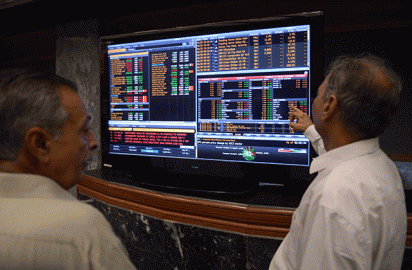
    The Pakistan Stock Exchange (PSX) came under heavy selling pressure on Wednesday as investors turned cautious amid rising geopolitical uncertainty and external market risks. The benchmark KSE-100 Index surrendered its early gains and remained in negative territory throughout most of the trading session. The market opened on a slightly positive note, with the KSE-100 Index posting modest gains during early trading. However, the positive momentum quickly faded as investors began selling shares across major sectors, causing the benchmark index to reverse course. Selling pressure intensified as the session progressed, dragging the KSE-100 Index down by more than 1,000 points. During intraday trading, the benchmark also touched a low of over 1,800 points below the previous close, reflecting weak investor confidence and heightened market volatility. Analysts said investors remained cautious due to uncertainty surrounding global developments, prompting many traders to reduce exposure to equities and book profits after recent gains. The decline was broad-based, with losses recorded across several key sectors of the market. Automobile assemblers, oil marketing companies, cement manufacturers, fertilizer producers and power generation companies were among the worst-performing segments during the session. The widespread selling indicated that investors were avoiding risk rather than reacting to company-specific developments, highlighting concerns over the broader economic and geopolitical environment. Despite the decline in share prices, trading activity remained healthy. More than 172 million shares changed hands during the session, while the total value of traded shares exceeded Rs9 billion, indicating continued participation by investors despite market weakness. The latest decline came a day after the stock market ended slightly higher following a volatile session. On Tuesday, the KSE-100 Index had climbed more than 2,000 points during intraday trading before profit-taking erased most of the gains, allowing the market to close with only a modest increase.

  • |

    Pakistan sets record with 5,438 companies registered in July

    Islamabad – A new business record has been set in Pakistan with thousands of new companies registered with the Securities and Exchange Commission of Pakistan (SECP) in a single month. Business activity in Pakistan’s corporate sector has witnessed a significant acceleration as the SECP set a new record for the registration of new companies during July. According to official figures, 5,438 new companies were registered across the country in July marking the highest number of registrations recorded in a single month. During the same period, five international companies also established their offices in Pakistan including companies from Malaysia, the United Arab Emirates and China. According to the report, 112 newly registered companies have foreign directors on their boards indicating growing foreign investment and international business interest in Pakistan. The newly registered companies include 3,148 private limited companies while Punjab remained at the top with 2,756 new companies registered. This was followed by Islamabad with 1,053, Sindh with 864, Khyber Pakhtunkhwa with 450, Gilgit-Baltistan with 180 and Balochistan with 135 newly registered companies. IT sector leads new registrations A sector-wise analysis shows that Information Technology (IT) remained the leading sector with 1,008 new companies registered. Other sectors also recorded significant registrations including 845 companies in trading, 638 in services, 348 in construction, 256 in food and beverages, 207 in tourism, 181 in e-commerce, 165 in education, 162 in real estate development and 145 in corporate agriculture. According to business experts, the increasing number of new company registrations reflects growing private-sector investment, business confidence and new economic activity in the country. The rapid growth in registrations in the IT sector is also being viewed as a positive sign for the expansion of Pakistan’s digital economy.

  • | | | | |

    Welcome to the ‘United States of Makati,’ where family income is PH’s highest – and most unequal

    Makati had the country’s highest average family income at P796,990 in 2025, but families in its top 10% earned nearly eight times as much as those in the bottom 10%

  • |

    Power sector circular debt rises by Rs364 billion in FY2025-26

    ISLAMABAD: Pakistan’s power sector circular debt increased by Rs364 billion during fiscal year 2025-26, highlighting persistent weaknesses in the electricity supply chain despite substantial government subsidies and efforts to contain the buildup of unpaid liabilities. According to the circular debt report for June 2026, the increase was significantly higher than the previous year, when the debt had risen by around Rs45 billion. The latest increase represents a surge of roughly 709% year-on-year in the annual flow of circular debt. The Power Division has not yet formally uploaded the one-page circular debt report for June 2026 on its official website. The latest figures indicate that structural problems, including distribution company inefficiencies, weak bill recovery, payment disputes and delays in tariff adjustments, continue to generate fresh liabilities in the power sector. The development comes despite the government’s efforts to contain the debt through budgetary support and subsidies. IMF target and government commitments The International Monetary Fund (IMF) had permitted Pakistan to record up to Rs400 billion in circular debt flow during the year, while simultaneously requiring the government to take measures to prevent the accumulation of new liabilities and eventually bring the flow down to zero. Under the IMF programme, the government has been relying on tariff adjustments, subsidy rationalisation and other reforms to improve the financial health of the electricity sector. However, the latest increase suggests that governance and operational problems remain a major obstacle to achieving a sustainable reduction in circular debt. The government provided approximately Rs302 billion in subsidies aimed at supporting the power sector and reducing the debt burden. However, the amount was insufficient to maintain the circular debt stock at the level of Rs1.614 trillion recorded at the end of June 2025. As a result, the debt stock recorded a net increase of around Rs61 billion during the year. The Power Division had earlier stated that the federal government allocated Rs893 billion for the power sector in the FY2025-26 budget. However, around Rs98 billion of the allocated amount was not released, affecting the government’s ability to reduce the outstanding liabilities. A Power Division spokesperson said that if the entire budgeted allocation had been released, the circular debt stock could have fallen further to around Rs1.577 trillion. The funding shortfall, according to the official, contributed to the Rs61 billion increase recorded during the year. Distribution companies remain a major source of losses Inefficiencies within power distribution companies continued to be one of the biggest contributors to the accumulation of circular debt. The government incurred approximately Rs262 billion in losses during FY2025-26 because of inefficiencies in distribution companies. The amount was only around Rs3 billion lower than the previous year, indicating that little progress has been made in addressing operational weaknesses. Another Rs64 billion was added to the circular debt because of lower electricity bill recoveries. Although significant, this amount was around 51% lower than the corresponding figure recorded in the preceding year. The figures underline the financial pressure created by electricity theft, transmission and distribution losses, weak collection systems and inadequate enforcement against non-paying consumers. Privatisation of distribution companies The government has initiated the process of privatising three relatively profitable distribution companies — Faisalabad Electric Supply Company, Gujranwala Electric Power Company and Islamabad Electric Supply Company. However, the proposed privatisation is not expected to immediately resolve the broader circular debt problem because a substantial portion of sector losses originates from other distribution entities. Earlier, the government had considered a model under which profitable distribution companies would be combined with loss-making entities before privatisation. The plan, however, was subsequently abandoned in favour of offering comparatively stronger companies separately. Experts have repeatedly argued that privatisation alone cannot eliminate circular debt unless the underlying issues of electricity theft, poor recoveries, governance and operational losses are addressed across the entire distribution network. K-Electric dispute adds to debt Payment disputes with K-Electric also contributed substantially to the increase. According to the report, approximately Rs194 billion was added to the circular debt because of non-payments by K-Electric. The company’s outstanding payments are linked to a dispute concerning the delayed finalisation of its multi-year tariff by the National Electric Power Regulatory Authority. The prolonged disagreement has created financial pressure throughout the power supply chain, adding to the accumulation of unpaid liabilities. In addition, around Rs75 billion was added to the circular debt because of delays in tariff adjustments. The government, meanwhile, made payments of approximately Rs129 billion against principal loans of the power sector. Without these payments, the annual circular debt flow could have exceeded Rs600 billion, according to the figures. The Power Division also benefited from a reduction of around Rs98 billion in the circular debt flow because of subsidy payments. Interest payments add further pressure Interest charges also contributed to the accumulation of liabilities, adding around Rs14 billion to the circular debt during the fiscal year. These financing costs ultimately increase the burden on consumers because the cost of servicing the sector’s outstanding liabilities is recovered through electricity bills. Consumer groups have frequently criticised the practice, arguing that households and businesses that regularly pay their electricity bills are effectively being charged for inefficiencies, theft and non-payment elsewhere in the system. Subsidies and burden on consumers The government’s continued reliance on subsidies has helped prevent an even larger accumulation of circular debt, but it has also placed pressure on the national budget. The power sector received hundreds of billions of rupees in subsidies during the year, while the government simultaneously pursued tariff increases and other measures intended to improve cost recovery. The contrast has raised questions about whether existing policies are addressing the underlying causes of circular debt or merely shifting the burden between consumers, the federal budget and power-sector entities. The government has also been under pressure to address similar financial problems in the gas sector. Although no comparable subsidy was provided for the gas sector, the authorities were expected to prevent a further increase in its circular debt. The government reportedly refrained from passing the full reduction in gas prices on

Leave a Reply

Your email address will not be published. Required fields are marked *