
npc sounds alarm
| |

NPC sounds alarm as 10 gov’t agencies report leaks

MANILA, Philippines – The National Privacy Commission (NPC) announced on Tuesday, November 10, that 10 government agencies had submitted breach notifications following reports of potential data leaks.

In a statement released on Tuesday, the NPC confirmed receiving personal data breach notifications from the following offices:

  • Presidential Commission on Good Government
  • Department of Information and Communications Technology (DICT)
  • Department of Labor and Employment, through its Bureau of Local Employment 
  • Bureau of Internal Revenue (BIR)
  • Philippine Amusement and Gaming Corporation
  • Department of Justice, through its Office for Alternative Dispute Resolution
  • Securities and Exchange Commission (SEC)
  • Philippine Coast Guard
  • Department of Trade and Industry
  • Department of Science and Technology-Philippine Institute of Volcanology and Seismology
NPC sounds alarm as 10 gov’t agencies report leaks

NPC spokesperson and Deputy Privacy Commissioner Jose Belarmino II said the notifications comply with Republic Act No. 10173 or the Data Privacy Act of 2012, and NPC Circular 16-03.

“Each notification received by the NPC is reviewed and assessed by our Compliance and Monitoring Division, which examines the nature and circumstances of the reported incident…. Following its assessment, the Division prepares a report containing its findings and recommendations for submission to the Commission En Banc,” Belarmino explained.

The announcement comes a week after the commission said it was coordinating with government agencies to verify reports of suspected government data leaks.
Must Read

NPC probing reports of alleged gov’t data leaks


NPC probing reports of alleged gov’t data leaks

Citizens notified of breach

Under Section 20 of the Data Privacy Act, personal information controllers like government agencies are required to “promptly inform” the NPC and affected individuals if any sensitive personal data has been compromised.

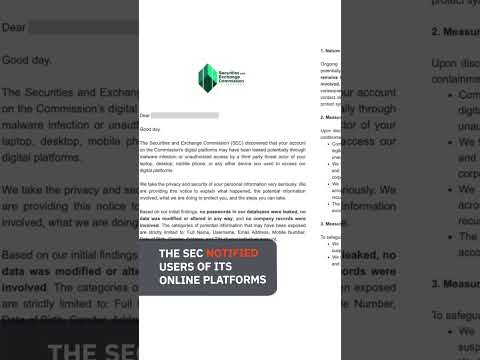
The SEC notified users of its online platforms on Monday, November 9. In an email notice sent to registered users, the commission attributed the leak to “malware infection or unauthorized access by a third-party threat actor” targeting users’ devices.

DATA LEAK ADVISORY. Screenshots of the email notice sent by the Securities and Exchange Commission informing registered users of a personal data breach. Contributed screenshots

The SEC warned users that exposed records may have included their full names, usernames, email addresses, mobile numbers, birth dates, genders, addresses, and Taxpayer Identification Numbers. But it maintained that “no data was altered, no internal corporate record was involved, and no passwords” were exposed.

According to a statement, the commission detected the breach on November 6 and reported it to the NPC three days later on November 9.

The BIR also issued an advisory on November 9 stating that it was addressing potential breaches in coordination with the Cybercrime Investigation and Coordinating Center and the DICT-National Computer Emergency Response Team.

Both the SEC and BIR expressed that they had taken security measures after the cybersecurity breaches.

As of this posting, the other eight government agencies have yet to release official statements about the reported data leaks.

Government agencies remain liable

Section 21 of the Data Privacy Act holds personal information controllers accountable for personal information under their custody, including records processed by third parties.

Belarmino emphasized that submitting a breach notification does not exempt government agencies from their responsibility in protecting personal data.

“The NPC expects government agencies to demonstrate accountability not merely through compliance with notification requirements, but through concrete and effective measures to safeguard personal data and prevent similar incidents from recurring,” he said.

The NPC added that it continues to monitor the reported security incidents across several government agencies and urged the public to stay alert against potential security threats. – Rappler.com


Similar Posts

  • | |

    Press freedom across South Asia

    Press freedom across South Asia faces significant structural constraints. Media environments throughout the region share a common historical legacy often relying on inherited colonial-era penal codes alongside modern cybersecurity legislation. However, the legal frameworks and regulatory instruments used to govern the press vary across neighboring countries. Comparative Analysis by Country  Pakistan Pakistan Electronic Media Regulatory Authority (PEMRA), Prevention of Electronic Crimes Act (PECA), and administrative policy frameworks like the Foreign Media Facilitation Guidelines. Media regulation in Pakistan relies heavily on administrative controls, licensing restrictions, and broad content advisories prohibiting coverage of sensitive political or national security subjects. While constitutional protections exist under Article 19, exceptions based on glory of Islam, national defense, and public order give authorities broad latitude to issue blackout orders, manage foreign correspondents’ mobility through No Objection Certificates (NOCs), and impose structural pressure on broadcast networks.  India Information Technology Rules (2021), Digital Personal Data Protection (DPDP) Act, and the Unlawful Activities Prevention Act (UAPA). While India possesses a large and diverse private media market, journalists increasingly face legal scrutiny under broad national security and anti-terror legislation. Amendments to digital media laws allow central authorities to demand the takedown of online content deemed harmful to state interests. Furthermore, criminal defamation suits and restrictions on access to conflict areas (such as Jammu & Kashmir) remain common mechanisms of regulatory pressure. Bangladesh Cyber Security Act (CSA)—which replaced the controversial Digital Security Act (DSA) and state information ministry directives. For years, non-bailable clauses in cybersecurity statutes were widely criticized by media watchdogs for chilling investigative reporting on corruption or state officials. Following recent political transitions, draft media reform policies have been introduced, though press operations remain tightly monitored during periods of political volatility and public unrest.  Sri Lanka Online Safety Act, Prevention of Terrorism Act (PTA), and Official Secrets Act. Sri Lanka’s regulatory framework expanded significantly with the passage of the Online Safety Act, which created a government-appointed commission with sweeping powers to classify online content as false statements and order its removal. Critical reporting regarding state response to economic crises or wartime history continues to face legal and physical friction in sensitive provinces. Nepal: Press Council Act and National Mass Communications Policy. Nepal consistently ranks highest in South Asia on global press freedom indices, supported by a constitution that explicitly guarantees press rights without prior restraint. However, challenges persist regarding local government transparency, criminal defamation provisions, and proposed social media regulation bills that civil society groups fear could introduce licensing hurdles for digital outlets.  Afghanistan Direct directives issued by the Ministry for the Propagation of Virtue and the Prevention of Vice and the Ministry of Information and Culture. Following the political shift in 2021, independent journalism in Afghanistan has faced near-total suppression. Women journalists are largely banned from broadcasting, international news services face widespread blocking, and all local reporting is subject to strict pre-publication censorship. Common Trends Across the Region Across South Asia, governments are increasingly shifting control from traditional print/broadcast regulators toward cybersecurity, online safety, and data protection laws to monitor digital newsrooms and independent creators. Constitutional guarantees of free speech throughout South Asia uniformly contain broad public order and national defense exceptions, which states routinely cite to enforce reporting restrictions during regional crises. Beyond direct legal action, states across the region frequently utilize non-judicial levers such as withholding state advertising funds, slow-walking accreditation, or requiring special travel permits to shape editorial stances.

Leave a Reply

Your email address will not be published. Required fields are marked *