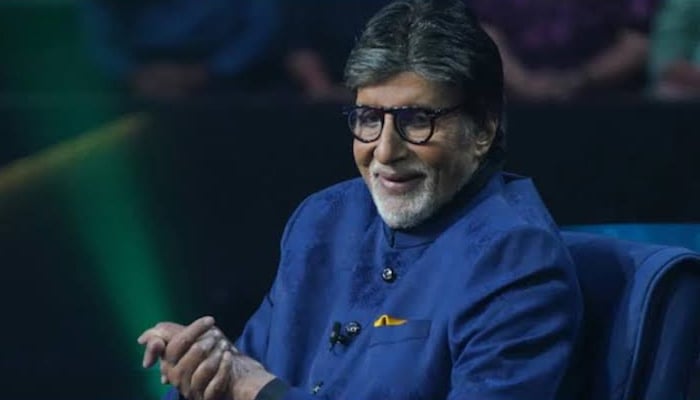
amitabh bachchan opens
|

Amitabh Bachchan opens up about doing household chores to keep wife Jaya happy


Bollywood legendary actor Amitabh Bachchan has recently opened up about his personal life, revealing that he does not hesitate to take care of household chores himself when necessary.

The 83-year-old actor made the revelation during a recent episode of his long-running television quiz showKaun Banega Crorepati (KBC), where he spoke about his daily life and his relationship with his wife, veteran actress Jaya Bachchan.

During the programme, Amitabh said that he willingly helps with household responsibilities and performs different chores himself, particularly when there is no domestic staff available at home. He explained that he does not consider household work beneath him and is comfortable taking responsibility for routine tasks.

The veteran actor also shared that there are usually several domestic workers at his residence. According to him, the household may have four, eight or even 10 staff members to take care of various responsibilities. However, when none of them is present, he takes care of the work himself rather than waiting for someone else to do it.

Amitabh said that he even handles cleaning and other household tasks when required. His comments offered fans a glimpse into the actor’s personal routine away from the cameras and his busy professional life.

The Bollywood star also spoke about cooking, admitting that it is one household responsibility he is not particularly skilled at. He said that he does not know how to cook, so there are times when he orders food from outside.

On other occasions, he asks Jaya to prepare something for him. According to Amitabh, Jaya enjoys preparing meals for him and takes pleasure in knowing whether he liked the food.

The actor explained that Jaya sometimes prepares different dishes for him and then asks how he found the meal. He suggested that her interest in cooking for him and seeking his opinion is a source of happiness for her.

His comments about helping around the house and appreciating his wife’s cooking quickly attracted attention, as fans were given an uncommon insight into the couple’s long-standing relationship. Amitabh and Jaya Bachchan have been married for more than five decades and are among Bollywood’s most well-known couples.

The actor’s remarks also highlighted a more personal side of his life, contrasting with his public image as one of Indian cinema’s most celebrated performers. Despite his decades-long career, Amitabh continues to maintain a strong connection with audiences through his television appearances and films.

Amitabh Bachchan is currently in the spotlight due to the 18th season of Kaun Banega Crorepati, the popular quiz-based television programme that he has hosted for several seasons. The show has become closely associated with the actor, who is widely recognised for his distinctive hosting style and interactions with contestants.

Through his latest comments, Bachchan once again connected with viewers by sharing simple details about his life at home. His willingness to discuss household responsibilities, his limited cooking skills and his wife’s enthusiasm for preparing meals provided fans with a relatable glimpse into the private life of one of Bollywood’s most iconic stars.

Similar Posts

  • | |

    Jungkook asks fans to stop shoving cameras in his face

    BTS member Jungkook has addressed fans directly after a series of privacy violations left him visibly frustrated, drawing a clear line between genuine fan support and behaviour that crosses into rudeness and disrespect. During a live session on Weverse, Jungkook spoke candidly about an incident that had clearly bothered him. He described going into a bakery to simply buy bread when a fan shoved a camera directly into his face without warning or permission. “Taking pictures together isn’t a problem, but I went in to get some bread and there was someone who shoved a camera in my face. That’s not good manners,” he said, adding plainly that this kind of behaviour was “kind of rude.” It was not an angry outburst. It was a measured and direct appeal from someone who has consistently tried to maintain a warm relationship with his fanbase while also asking to be treated like a human being rather than a subject for content creation. This is not the first time Jungkook has raised these concerns. He has previously spoken about fans showing up near his home, sending unsolicited deliveries and tracking his private movements and whereabouts. Each time, he has responded with patience and directness, asking people to reconsider whether what they were doing was genuinely supportive or simply intrusive. The latest comments come at a significant moment for BTS as a group. The band is currently preparing for its highly anticipated group comeback, with all members having completed or in the process of completing their mandatory military service in South Korea. Fans have been eagerly watching every update, which may partly explain the heightened intensity of interest in the members’ private lives during this period. But for Jungkook, that context does not change the basic principle he was articulating. The response from the BTS ARMY was largely supportive. Many fans took to social media to echo his message, encouraging other supporters to engage with the group’s work in ways that did not involve crossing personal boundaries. The conversations that followed touched on a broader tension that exists within large, dedicated fanbases, where the line between admiration and intrusion can blur, sometimes without the fan even realising it. Jungkook’s willingness to address the issue directly, on his own terms, in a live conversation with fans rather than through a formal statement, reflects a specific kind of relationship he has always tried to maintain. He speaks to his audience honestly and without pretence, which is precisely why the message landed the way it did. Respecting a public figure’s private moments is not a complicated ask. When someone is simply trying to buy bread, the most supportive thing a fan can do is let them.

  • | |

    Sunny Deol protects Shabana Azmi in Batwara 1947 trailer

    Veteran Bollywood actor Sunny Deol has unveiled the trailer for his upcoming historical drama Batwara 1947, offering audiences a powerful glimpse into a story set during the Partition of India in 1947. Released on Tuesday, July 28, the trailer showcases Deol in a striking new role as a man determined to protect humanity amid one of the darkest chapters in the subcontinent’s history. Sharing the trailer on social media, the 68-year-old actor wrote, “Har insaan ka pehla mazhab MAA hai (Every person’s first religion is a mother). #Batwara1947 Trailer Out Now. 14th August in cinemas near you.” The film is set against the backdrop of the 1947 Partition, when millions of people were displaced following the creation of India and Pakistan. The story follows a Muslim family that migrates to Lahore after independence and discovers that an elderly Hindu woman is still living in the house allocated to them. Sunny Deol plays Sikander Mirza, who arrives in Pakistan with his wife Hamida Mirza, portrayed by Preity Zinta, and their son Javed Mirza, played by Karan Deol. Upon reaching their new home, they meet an elderly Hindu woman, played by Shabana Azmi, who refuses to abandon the house where she has spent her entire life. As tensions rise and others attempt to force the woman out of the property, Sikander chooses compassion over hatred. Defending her against growing hostility, he delivers one of the trailer’s most memorable lines: “Hindu woman? She is a mother. Do not label her with Hindu-Muslim. Our first religion is mother! The first word that we speak is mother.” The emotional dialogue has resonated strongly with viewers, many of whom praised the film’s message of humanity above religious divisions. The trailer also highlights the violence, fear and forced migration experienced during Partition while emphasising themes of empathy, sacrifice and coexistence. Soon after the trailer’s release, social media users shared positive reactions. One viewer commented, “No religion can be good or bad, only human can be good or bad.” Another fan wrote, “Goosebumps Yar… Only Sunny Deol and Preity Zinta can give 100% justice to this Movie.” A third praised the film’s overall presentation, commenting, “A powerful, emotional, and thought-provoking trailer that promises a grand cinematic experience. With Rajkumar Santoshi’s direction, Sunny Deol’s powerful performance, A.R. Rahman’s unforgettable music, and a talented ensemble cast, Batwara1947 has all the ingredients to become one of the most impactful historical dramas of the year.” Directed by Rajkumar Santoshi, the film boasts an impressive cast featuring Sunny Deol, Preity Zinta, Shabana Azmi, Karan Deol, Ali Fazal, Abhimanyu Singh and Khushi Hajare. Academy Award-winning composer A.R. Rahman has provided the film’s music, adding to anticipation surrounding the project. Batwara 1947 is scheduled to release in cinemas on August 14, 2026, coinciding with Pakistan’s Independence Day. With its emotionally charged narrative and message of unity during a time of division, the film is already generating significant attention ahead of its theatrical release. 

  • | |

    Selena Gomez rejects ‘baseless’ Wondermind fraud claims

    Selena Gomez has rejected allegations of fraud linked to Wondermind, the mental fitness company she co-founded with her mother, Mandy Teefey, and former business partner Daniella Pierson. The singer and actress responded after two companies, Wondermind SRS 44 LLC and Bespoke Wondermind LLC, filed a lawsuit against her and Teefey. The plaintiffs accused the company’s leadership of making false claims about Wondermind’s operations, management and available resources. Gomez and her legal adviser, Mathew S. Rosengart, strongly denied any wrongdoing. They described the allegations as baseless and said there was no factual or legal basis for claims that Gomez had participated in fraud. Her legal team said they intend to challenge the allegations in court and have filed a motion seeking dismissal of the claims against her. The lawsuit reportedly alleges that investors were led to believe Gomez would play an active role in Wondermind as its head of marketing. The plaintiffs also claimed that Gomez was bound by a contract to perform certain responsibilities but failed to fulfil them. According to the allegations, potential investors were told that Wondermind had a valuation of about $95 million and was seeking a $5 million investment. The plaintiffs also claimed that the company had discussed potential partnerships with major financial institutions, including J.P. Morgan and Fidelity. The lawsuit further alleges that Wondermind had promised to provide mental health and wellness services to employees and develop a new digital application as part of its business plans. Gomez launched Wondermind with Teefey and Pierson in 2021. The company later expanded its digital content and mental fitness platform in 2022. Gomez has now made it clear that she intends to defend herself against the allegations. Teefey has not publicly commented on the lawsuit so far.

  • | |

    Met Gala 2027 to honour British fashion designer

    The Metropolitan Museum of Art has announced that celebrated British fashion designer John Galliano will be the focus of its Spring 2027 Costume Institute exhibition, titled John Galliano: Horizons. The exhibition will also serve as the inspiration for the Met Gala 2027, making Galliano only the third living designer to receive a solo exhibition at the museum. The announcement marks a significant milestone in Galliano’s career. Before him, only Yves Saint Laurent in 1983 and Rei Kawakubo of Comme des Garçons in 2017 had been honoured with individual exhibitions while still alive. The Costume Institute exhibition will officially open on May 9, 2027, with the Met Gala serving as its traditional fundraising event before remaining on display until January 9, 2028. According to the museum, John Galliano: Horizons will explore the designer’s extraordinary career, tracing his creative evolution from his acclaimed 1984 graduation collection at Central Saint Martins to his work at Givenchy, Christian Dior, his own label, and Maison Margiela. The exhibition will feature garments, sketches, research books and archival material drawn from the Costume Institute’s extensive collection. Vogue editor-in-chief Anna Wintour, who has long admired Galliano’s work, praised the designer while announcing the exhibition. “There is no one more deserving of an exhibition of this scale than John Galliano,” Wintour said in a statement. She continued, “His body of work, at Dior, Givenchy, Margiela, his namesake label and more, combines erudition and creativity, darkness and light, the past, the present, the future all smashing together in a brilliant way.” The exhibition has been curated by Andrew Bolton, who explained the philosophy behind the project and why Galliano’s career remains an important subject in contemporary fashion. Bolton described the exhibition as treating “fashion as a form of cartography, mapping not territories but affinities, tensions, and transformations.” He further explained that the exhibition would examine “how Galliano has remapped the world through fashion and how his conduct, its consequences, and changing cultural values have reshaped our understanding of his work.” Organisers have also confirmed that the exhibition will not avoid one of the most controversial chapters of Galliano’s life. In 2011, the designer was dismissed from both Christian Dior and his own fashion label after making racist and antisemitic remarks. He was later convicted by a Paris court for public insults based on race, religion and ethnicity. According to The New York Times, the museum’s decision to move forward with the exhibition followed a private meeting held in May between Galliano, Andrew Bolton, Anna Wintour and several Jewish community leaders in New York. Rather than overlooking the controversy, the exhibition aims to place it within the broader context of Galliano’s life and career, examining both his artistic achievements and the consequences of his actions. With John Galliano: Horizons, the Metropolitan Museum of Art hopes to present a comprehensive look at one of fashion’s most influential and debated designers, while the Met Gala 2027 is expected to celebrate his lasting impact on the global fashion industry.

  • | | |

    Imran Khan breaks silence on gender stereotypes, feminism and Bollywood’s portrayal of men

      Ahead of his much-anticipated return to the big screen, Indian actor Imran Khan has spoken candidly about gender stereotypes, feminism, masculinity, fatherhood and the influence cinema can have on social attitudes. In a recent conversation, the actor explained that his growing concern over the way gender-based assumptions have become part of everyday discussions played an important role in shaping his decision to speak more openly about these issues. Khan said he had become increasingly interested in examining the expectations society places on both men and women. According to him, certain assumptions about how people should behave based on their gender have become so common that they are often expressed without being questioned. The actor said he felt a personal responsibility to contribute to conversations surrounding these issues. Rather than remaining a passive observer, he wanted to use his public platform to encourage people to reconsider ideas that have gradually become normalised in society. Khan also discussed the relationship between feminism and conversations about men’s rights. He argued that debates surrounding both subjects can sometimes become trapped within the same stereotypes they are attempting to challenge. In his view, some men who criticise feminism for being problematic may fail to recognise that their own arguments can be influenced by patriarchal thinking or ideas associated with toxic masculinity. For Khan, feminism should not be understood as an attempt to marginalise men or exclude anyone from the conversation. He stressed that discussions about feminism and masculinity should ultimately focus on equality and creating a society in which people are not restricted by traditional gender expectations. The actor also turned his attention to the portrayal of men in Indian cinema, particularly characters who struggle to cope with romantic rejection. Khan argued that Bollywood has repeatedly presented emotionally immature male characters in a sympathetic manner, often encouraging audiences to overlook their problematic behaviour because the characters are experiencing heartbreak. He criticised films in which a male protagonist responds to rejection with anger, obsession or inappropriate behaviour, while the narrative continues to portray him as a victim deserving sympathy. According to Khan, these stories can unintentionally normalise unhealthy emotional responses and send the wrong message about relationships and masculinity. Khan suggested that cinema has a significant cultural influence and therefore filmmakers should consider how their characters and storylines may shape public perceptions. Instead of constantly justifying problematic behaviour through a character’s emotional pain, films could present more mature and realistic portrayals of men dealing with rejection, relationships and vulnerability. His comments come as he prepares to make his return to acting after a prolonged break from the industry. Khan’s decision to step away from films had kept him largely out of the public eye, making his comeback a significant moment for fans who have followed his career. Now, as he prepares to return to the screen, Khan appears interested not only in acting but also in engaging with wider social conversations. His recent remarks reflect his desire to use his experiences and public platform to question established ideas about gender, relationships and masculinity. With his comeback approaching, audiences will be watching closely to see whether Khan’s renewed presence in cinema also brings a different perspective to the kinds of stories and characters he chooses to be part of.

  • | |

    Rakhi Sawant gets emotional about her Pakistani fans

    Rakhi Sawant has always been one of Indian entertainment’s most unfiltered personalities, and a recent interview with BBC Hindi has given her fans on both sides of the border a moment to genuinely pause and reflect. In the interview, the actress and digital influencer spoke with visible emotion about her Pakistani fans, delivering a remarkably candid account of a connection that has quietly shaped her personal life in ways she had perhaps not expected. Sawant, who now follows Islam and has spoken openly about her affection for Muslims, did not approach the subject diplomatically or with the kind of measured language public figures typically deploy when navigating Indo-Pakistani sentiment. She spoke from personal experience, and the honesty of what she said has resonated widely. “They love me a lot,” she said, speaking of her Pakistani fans. “We Pakistanis and Hindus share a love-and-hate relationship, but whenever something happens to me, Pakistanis reach out first. Sometimes I have a fever, and no one from India shows up, but they come and take me to the hospital.” The admission was striking in its specificity. She was not speaking in generalities about cultural warmth or neighbourly affection. She was describing concrete acts of care at moments of genuine vulnerability, people showing up when she was unwell, accompanying her to hospital, filling a gap that others had left empty. She continued with equal candour, acknowledging the political narrative that frames the two countries as adversaries while making clear that her personal experience simply did not match that framing. “I know they are our enemy, our country’s enemy, but what’s true is true,” she said. “They love me a lot. I am just a neighbour residing in this building, and as neighbours, they are always there for me.” The online reaction to the interview has been overwhelmingly warm and has prompted a broader conversation that goes well beyond Sawant herself. Both Pakistani and Indian viewers flooded the comments to express agreement with the sentiment she was articulating. The most consistent thread running through the responses was the distinction between the political relationship that governments maintain and the human relationships that ordinary people choose to build across that same divide. Commenters from both countries wrote that neither people were each other’s real enemies, and that it was politicians who constructed and maintained the hostility that defined the official relationship between India and Pakistan. People on the ground, many argued, wanted something different entirely. Rakhi Sawant’s emotional honesty in this interview did not resolve any political realities. But it gave voice to something that is rarely said plainly enough in either country: that the warmth that exists between people when it is allowed to breathe is real, and sometimes shows up most clearly when someone needs to be taken to hospital and someone else simply decides to come.

Leave a Reply

Your email address will not be published. Required fields are marked *