
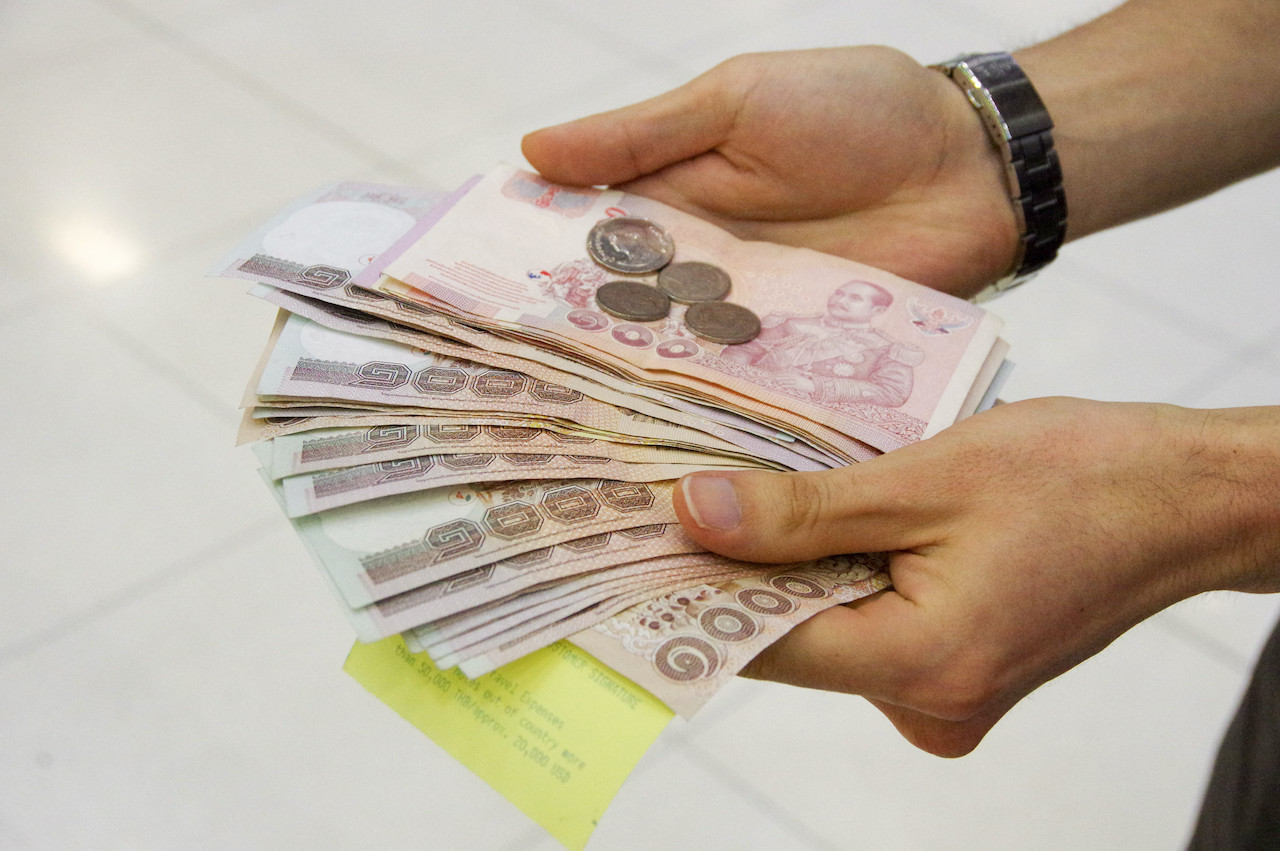
baht weakens again

Baht Weakens Again Amid Rising Middle East Conflict and US Dollar Surge

BANGKOK, Thailand — The Thai baht is projected to continue its downward trajectory against the US dollar this week, having recently touched a nearly 15-month low. The currency’s depreciation is being driven primarily by escalating geopolitical risks in the Middle East, surging global oil prices, and a resurgent US dollar.

Thai Tourism Sector Could Lose 15-17% of Revenue If Baht Strengthens Beyond 30 Per US Dolla

Market analysts at Krungthai Global Markets indicate that the baht will remain under significant depreciation pressure in the near term. Following a drop to a 14.5-month low of 33.64 baht per dollar last week, the currency is forecast to test the key resistance range of 33.75 to 33.80 baht per dollar, with the potential to weaken further to between 34.00 and 34.40 baht per dollar in the coming days. This movement aligns with broader global market shifts, including a sharp decline in global gold prices to below 4,000 US dollars per ounce and a rally in crude oil prices fueled by concerns that the ongoing conflict between the US and Iran, which has seen continued clashes since mid-July, could become increasingly prolonged.

Strategists emphasize that the baht is likely to remain highly volatile as investors navigate the compounding effects of regional geopolitical tensions and shifting expectations surrounding the US Federal Reserve’s monetary policy. While a potential easing of Middle East tensions or a scaling back of expectations for further US interest rate hikes could trigger a temporary rebound, analysts caution that any appreciation would likely be capped around the 33.40 to 33.50 baht per dollar mark, with stronger structural support sitting at 33.00. In light of this volatility, financial experts are strongly advising businesses and investors to implement comprehensive hedging strategies, including the use of options, to effectively mitigate foreign exchange risks.

Similarly, Krungsri Global Markets anticipates the baht will trade within a range of 33.30 to 34.00 baht per dollar this week, noting that the fresh rally in global energy markets remains the primary catalyst for the currency’s weakness. This depreciation occurs against a complex macroeconomic backdrop; the US dollar had briefly weakened against most major currencies, with the notable exception of the Japanese yen, following the release of softer-than-expected US inflation data for June, which showed headline and core inflation easing to 3.5 percent and 2.6 percent, respectively.

In response to the market turbulence, the Bank of Thailand has affirmed its vigilant stance. Governor Vitai Ratanakorn stated that the central bank is closely monitoring the renewed escalation of tensions in the Middle East and stands ready to intervene to manage baht movements in alignment with Thailand’s underlying economic fundamentals. The Governor noted that while the current weaker currency has provided a supportive tailwind for the nation’s export and tourism sectors, a protracted conflict in the Middle East poses a significant risk by potentially driving up inflation expectations and dampening the country’s overall economic growth outlook.

Bank of Thailand to Limit Online Gold Trading to Ease Baht Pressure

As global markets brace for further developments in the Middle East and await clearer signals on US monetary policy, the Thai baht is expected to remain sensitive to external shocks.

-Thailand News (TN)

Similar Posts

  • | |

    DSP among three killed in Balochistan attacks

    Three people, including a deputy superintendent of police (DSP), were martyred in separate attacks across Balochistan, officials said. The incidents were reported in Barkhan, Kech and Chagai districts. A truck driver was also injured during one of the attacks. Six labourers were abducted in Kech. Meanwhile, five trailers and two gas bowsers were set on fire in Chagai. In Barkhan, DSP Rakhni Murid Bugti was killed when armed men opened fire on his police vehicle. The incident occurred near Khatta Chowki on Tuesday evening. The DSP was reportedly patrolling the area when the attackers targeted his vehicle. Police, Frontier Corps (FC), Counter-Terrorism Department (CTD) personnel and other security forces reached the area after the attack. The security personnel launched a search operation to trace the attackers. Authorities also increased security around the area. Another deadly incident occurred near Kalatak in Turbat, the district headquarters of Kech. According to officials, armed men stopped a vehicle carrying seven labourers on Monday night. The attackers opened fire on the vehicle. Javed Khan, a resident of Swabi district in Khyber-Pakhtunkhwa, was killed in the attack. The attackers then abducted the other six labourers. Four of those abducted belong to Punjab, while two are from Khyber-Pakhtunkhwa. A passer-by was also caught in the crossfire. Abdul Razzaq, a resident of Solband, was killed in the incident. Police and security agencies launched a search operation after receiving information about the abduction. Efforts were underway to locate and recover the missing labourers. In another incident, armed men blocked the N-40 highway in Chagai during the same night. The highway connects Quetta with Taftan and is an important route in the region. The attackers reportedly blocked the road at Padag. They also opened fire outside a roadside hotel. The assailants later set five trailers and two gas bowsers on fire. A truck driver sustained injuries during the firing. Law enforcement personnel reached the area soon after the attack. Police and other security agencies launched a search operation to locate those responsible. Investigators also cordoned off the affected area and began collecting evidence.

  • |

    President approves military and civil honours

    President Asif Ali Zardari has approved several summaries sent by Prime Minister Shehbaz Sharif, including military honours for 1,172 personnel of the armed forces and civil armed forces. The approved honours recognise the services and contributions of personnel from various ranks and institutions. The awards will acknowledge their dedication, professionalism and service to the country. President Zardari also approved the summoning of separate sessions of Parliament on August 17. The National Assembly will meet at 5pm, while the Senate will convene at 4pm. In another significant decision, the president approved a special 100-day remission in the sentences of prisoners on the occasions of Independence Day and Eid Milad-un-Nabi ﷺ. The concession will provide eligible prisoners with relief in their sentences under the applicable rules and conditions. President Zardari further approved national civil awards for citizens from various fields in recognition of their outstanding contributions and services. The honours cover individuals who have made notable contributions in their respective areas and brought recognition to the country. The approvals form part of the president’s constitutional responsibilities and reflect the government’s efforts to recognise public service, honour outstanding contributions and provide relief to eligible prisoners on important national and religious occasions.

  • | |

    University Road corridor to be completed by Septem…

    Sindh Senior Minister for Transport Sharjeel Inam Memon has said that 80 to 85 per cent of the work on the corridor along Karachi’s University Road has been completed. He said the remaining work is expected to be finished by September 15, after which the road project will be fully completed. Sharjeel Memon made the remarks during a visit to the BRT Red Line project. He reviewed the ongoing construction work and the traffic situation along University Road. The minister said traffic is currently moving smoothly on the road and that there are no major disruptions to the flow of vehicles. He also announced that a large number of double-decker buses are expected to arrive in Karachi next month. Electric vehicles will also be introduced as part of efforts to improve the city’s public transport system. According to the minister, the Sindh government has already approved 500 electric buses. He added that Pink Scooties would soon be made available for women as part of initiatives aimed at improving mobility and transportation options. Sharjeel Memon said the provincial government was working on several public service projects across different sectors. He maintained that the Pakistan Peoples Party comes to power through the public mandate and focuses on completing development and welfare projects after assuming office. Speaking about Thar, the minister said the region has extensive coal reserves that can be used to generate relatively inexpensive electricity. He said Thar coal could also be utilised to meet the energy requirements of power plants across Pakistan. He further highlighted what he described as the Pakistan Peoples Party’s contribution to the country, including its role in Pakistan’s development as a nuclear power. Discussing the performance of the Sindh government, Memon said work was continuing around the clock in different departments. He said significant progress had been made on a housing programme aimed at constructing 2.1 million homes, with a large number of houses already completed. The minister described the housing initiative as one of the largest projects of its kind in the world. He also referred to the Shahrah-e-Bhutto, saying heavy traffic on the newly constructed road demonstrated its importance and success. He claimed Sindh was the only province focusing on practical development rather than political propaganda. On Karachi’s transport needs, Memon said public transport services would be expanded across the city without discrimination. He said voters could support any political party, but the government would continue to provide transport facilities in every part of Karachi. The minister also highlighted developments in Sindh’s healthcare sector. He said the provincial government was providing free and modern medical facilities and had introduced several initiatives before similar measures were adopted elsewhere. Memon also pointed to the province’s air ambulance service, saying the facility had already been operational for some time.

  • | |

    Sindh schools adopt facial recognition attendance

    The Sindh government has approved the introduction of a Facial Recognition Attendance Monitoring and Evaluation System (FRAMES) in public schools as part of a broader effort to improve governance, transparency and accountability in the education sector. The decision was taken during a meeting of the School Education Department chaired by Chief Minister Murad Ali Shah. The meeting was attended by Education Minister Sardar Ali Shah, the chief secretary and other senior government officials. During the meeting, the education minister gave a detailed briefing on the proposed system and informed participants that all technical preparations for its implementation have been completed. He said the project is designed to introduce data-driven governance and improve monitoring of teachers and non-teaching staff across government schools. According to the briefing, the first phase of the project will begin in six districts, with one district selected from each division of Sindh. Registration of teachers and non-teaching employees in these districts has already been completed, paving the way for the system’s launch. Chief Minister Murad Ali Shah announced that the new attendance system will become operational in the selected districts from August 17. If the pilot phase is successful, it will be expanded gradually to all districts across the province. Under the FRAMES system, attendance of teachers and school staff will be recorded through facial recognition technology. Officials said the system will automatically record employees’ arrival and departure times, creating a secure, accurate and tamper-proof attendance record. The education department also informed the meeting that geo-tagging of government schools has been completed. Officials said the system has been designed to function effectively even in remote areas with weak internet connectivity, ensuring uninterrupted monitoring throughout the province. Murad Ali Shah said improving teachers’ attendance is essential for raising educational standards and ensuring quality education for students. He said every child has the right to receive quality education, and achieving that goal requires teachers and school staff to perform their duties regularly and responsibly. The chief minister emphasized that the use of modern technology would strengthen accountability and improve discipline within the education system. He said digital monitoring would help eliminate irregularities, increase transparency and provide education authorities with reliable data for decision-making. He directed officials to establish an effective support and monitoring mechanism during the initial implementation phase. He also instructed the education department to provide schools with all necessary technical assistance and training to ensure the smooth operation of the new system. Officials said information collected through the facial recognition platform will help education authorities evaluate attendance patterns, improve administrative oversight and identify areas requiring further reforms. They added that the initiative is expected to enhance institutional discipline, strengthen governance and improve the overall performance of public schools.

  • | |

    LHC Judge appointments spark Rawalpindi lawyers’…

    Rawalpindi: A dispute has erupted among lawyers’ groups in Rawalpindi over recent appointments and nominations of judges to the Lahore High Court, with some bar organisations raising questions over the representation of Rawalpindi Division and demanding a review of the process. The controversy intensified after the Peoples Lawyers Forum Rawalpindi Division called the proposed nominations unacceptable and demanded that the Judicial Commission examine the reasons behind the selections and the rejection of other candidates. The forum questioned why no candidate from Rawalpindi Division was included in the nominations and demanded details about the criteria used for selecting nominees. Meanwhile, the High Court Bar Association Rawalpindi and District Bar Association Rawalpindi also expressed concern over what they described as the continued lack of representation of Rawalpindi Division in Lahore High Court appointments. The District Bar Association Rawalpindi stated that ignoring the region’s experienced lawyers raised concerns about merit, transparency and regional balance. The association said Rawalpindi Division has a large legal community consisting of seven district bars and fourteen tehsil bars, producing many renowned lawyers, judges and legal professionals who have contributed to Pakistan’s judicial system. According to the association, no member of the Rawalpindi Division bar has been confirmed as a Lahore High Court judge since 2017, despite several capable lawyers and additional judges from the region having served with distinction. The High Court Bar Association Rawalpindi described the continued absence of representation as a matter requiring attention and said consultations would be held with district and tehsil bars to decide future steps. The Peoples Lawyers Forum also called on President Asif Ali Zardari and Peoples Lawyers Forum President Nayyar Hussain Bukhari to take notice of the situation. The forum requested that the notification process should be reviewed and that the Judicial Commission should provide details about the nominated candidates, their qualifications, selection reasons and the reasons why other candidates were not considered. The lawyers’ group demanded that if the process was found inconsistent with rules or principles of fairness, recommendations should be reconsidered and a fresh merit based review should be conducted. However, the dispute remains focused on questions of representation and transparency rather than any confirmed wrongdoing. The final decision regarding judicial appointments rests with the relevant constitutional authorities and judicial forums. The issue has now placed attention on the balance between merit based appointments and regional representation in the higher judiciary. Lawyers’ organisations have called for a transparent mechanism that ensures qualified candidates from all regions receive equal consideration while maintaining the independence and quality of the judicial system.

  • Recent Poll Reveals Most Thais Support Death Penalty for Severe Crimes

    BANGKOK – A recent public opinion poll shows that a large majority of Thai citizens strongly support the death penalty. People firmly believe capital punishment is necessary to stop violent crime across the entire country. Furthermore, the survey highlights a massive demand for strict justice and safer local communities. Researchers at North Bangkok University officially […]

Leave a Reply

Your email address will not be published. Required fields are marked *