
Diaspora

  • | | |

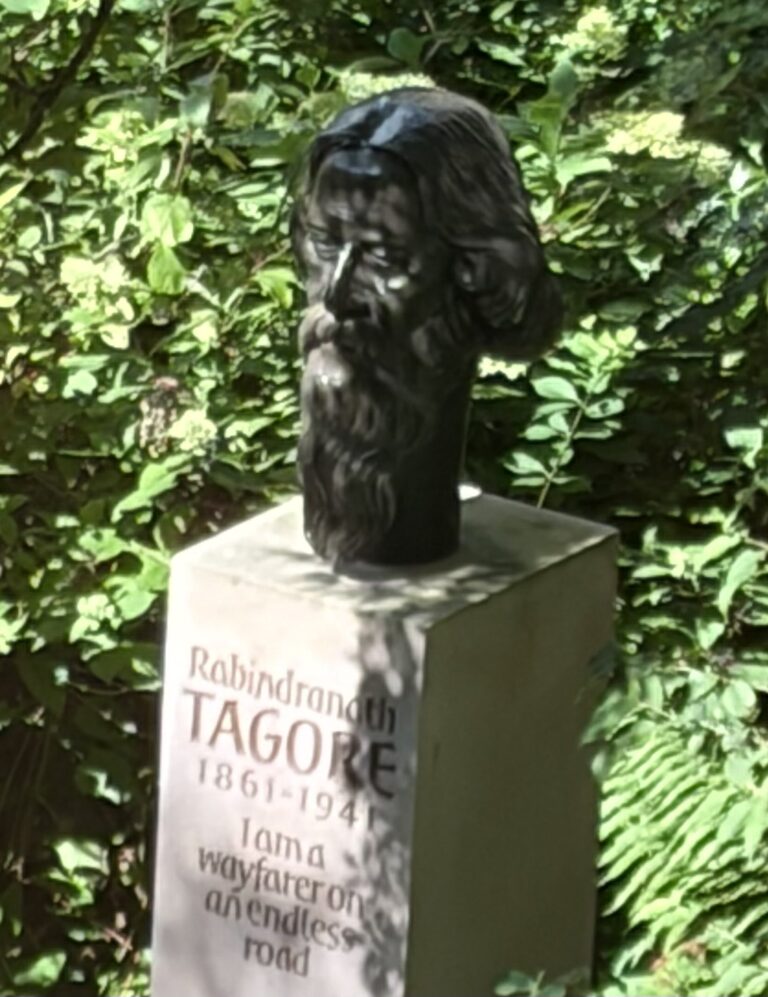
    Rabindranath Tagore’s statue in Edinburgh

    The Sandeman House garden in Edinburgh holds a bronze statue of Asia’s first Nobel laureate in Literature, Rabindranath Tagore. Inscribed upon the pedestal supporting his likeness are his famous words, “I am a wayfarer on an endless road.” A Cross-Cultural Bridge Travelers often seek out Scotland’s capital for its ancient castles, gothic architecture, and literary heritage tied to the likes of Sir Walter Scott or Robert Louis Stevenson. However, discovering Tagore’s presence in this peaceful courtyard offers a cross-cultural bridge. The statue, unveiled to commemorate the deep-seated connections between Scotland and India. It is particularly the intellectual dialogue between Scottish polymath Patrick Geddes and Tagore himself. This monument serves as a physical testament to a global humanism that transcends geographic boundaries. Tagore’s India Tagore was far more than a celebrated poet and author. He was an uncompromising philosopher, musician, visual artist, and social reformer whose thoughts shaped modern South Asia and beyond. At the heart of his vast body of literature lies a profound critique of borders, nationalism, and sectarian division. Tagore envisioned an India, and indeed a world, defined by radical openness. In his mind, India is a sanctuary where diverse faiths, ethnicities, and cultures could coexist in mutual respect. He rejected narrow chauvinism in favor of an inclusive internationalism, advocating for a world where the mind is without fear and the head is held high. Tagore’s Literary Legacy In the contemporary geopolitical landscape, Tagore’s ideals feel relevant. Across the globe, modern youth face a climate marked by rising social polarization, cultural fracturing, and ideological echo chambers. In response, a growing movement of young activists, writers, thinkers, and students are turning back to Tagore’s literary legacy as a blueprint for unity. They are rediscovering his essays and poetry not merely as historical artifacts, but as active tools to reclaim a society rooted in pluralism and dialogue. By reimagining Tagore’s vision for a modern era, today’s generation is fighting to restore an environment where freedom of thought, artistic expression, and inclusivity thrive over division. His stance on education emphasized learning in harmony with nature and breaking down rigid academic and social silos. Young scholars and community organizers are channeling this exact ethos, utilizing art, literature, and grassroots civic engagement to rebuild cross-cultural bridges in an increasingly fragmented world. Message of Universal Brotherhood   Standing before Tagore’s statue in Edinburgh’s quiet garden, one is reminded that his journey as a “wayfarer” was never meant to be walked alone. His message of universal brotherhood, preserved in stone far from his native Bengal, serves as a timeless compass. For the youth striving to cultivate a more empathetic and open world, Tagore’s endless road remains wide open, inviting everyone to walk forward together.

  • | | |

    Omar Musa secures 2026 Miles Franklin Award with Fierceland

    Omar Musa has been named the winner of the prestigious 2026 Miles Franklin Literary Award for his novel, Fierceland. Recognized as Australia’s most celebrated literary prize, the award honors novels of the highest literary merit that explore Australian life in all its phases. Musa’s victory highlights a powerful shift in the country’s literary landscape, celebrating a work that fearlessly confronts historical legacies while weaving together rich cultural folklore. Deconstructing Colonial Narrative Frameworks At the core of Fierceland lies an ambitious, multi-layered critique of Joseph Conrad’s classic 1899 novella, Heart of Darkness. Where Conrad’s seminal text depicted the non-Western world through a lens of exoticism, peril, and foreign mystery, Musa flips the narrative on its head. He reclaims the riverlands and lush rainforest environments not as places of terrifying obscurity, but as vibrant ecosystems steeped in history, memory, and indigenous knowledge. The True “Darkness” Musa confronted the colonial storytelling. In fact, he challenges readers to examine how Western literature has historically framed non-Western landscapes and their people. Fierceland presents the journey inward as a descent into moral decay. This journey is an essential process of unlearning, confrontation and reclamation. The novel demonstrates that the darkness lies within the unchecked impulses of imperial exploitation. It also compels the reader to not surrender to the historical erasure. The Role of Spectral Presence and Cultural Folklore Ghosts and supernatural forces drift consistently throughout the narrative of Fierceland. These forces serve as both literal story elements and profound allegorical symbols. Rather than functioning purely as horror tropes, these spectral figures act as guardians of history and physical manifestations of unhealed wounds. Musa attributes this atmospheric depth to his upbringing and heritage. He reflects on the influence of his family and heritage. Musa noted that ghost stories are deeply woven into the fabric of Malaysian culture. Growing up, he listened to his father recount haunting tales from his homeland. He developed an early appreciation for oral traditions where the living and spiritual realms continually intersect. In Fierceland, these inherited myths explore themes of displacement, grief, and ancestral connection.  These myths gave a voice to forgotten histories that refuse to remain buried. A Multidisciplinary Voice in Modern Storytelling Musa’s background is of an acclaimed spoken-word poet, hip-hop artist, and woodcut printmaker. His own roots shine brightly throughout the pages of Fierceland. The prose is defined by a rhythmic, visceral cadence that reflects his poetic mastery. His ability to blend social commentary with lyricism creates a sensory reading experience.   Winning the 2026 Miles Franklin Literary Award positions Musa as one of the most compelling voices. The judging panel has recognized the evolving nature of Australian literature. Fierceland stands as a testament to the power of reclaiming narrative agency. The novel proves that when old myths are critically dissected, extraordinary stories can emerge.

  • |

    Creative expression as survival in times of crisis

    In times of severe military occupation, state violence, and political trauma, art and literature undergo a fundamental transformation. They shift from aesthetic expression to vital tools for survival, record-keeping, and resistance. When conventional channels of news, speech, and movement are heavily restricted or censored, art and literature fulfill critical functions within a society. Documenting Counter-Narratives and Resisting Erasure In occupied zones, official narratives often frame political conflict using terms like normalcy or integration. They sanitize structural violence and human suffering. Kashmiri writers, poets, and essayists use narrative to preserve collective memory against state-enforced amnesia. Through poetry, fiction, and memoirs, literature captures the psychological reality of curfews, enforced disappearances, communication blackouts. It reminds of the loss of autonomy, rendering the lived experience of civilians indelible. Fine arts, illustration, and graphic art record incidents and emotional states that photojournalism or state-approved media often cannot access or transmit.  Processing Collective and Intergenerational Trauma Art creates a necessary intellectual and emotional container for a traumatized populace. Concepts such as unheimlich (the uncanny, or feeling un-homed in one’s own land) or grief over exile and displacement find structural expression through creative metaphors. Poetic forms allow writers to articulate loss, mourning, and fear in ways that transcend direct prose. The work of iconic Kashmiri poets such as the late Agha Shahid Ali, whose poetry continues to resonate. It demonstrates how verse can turn localized grief into a universal cry for human dignity. Artists frequently turn to raw mediums like paint, installation, and physical textiles to project the interiority of living under siege, using symbolic motifs like barren land, barbed wire, cages, or domestic objects disrupted by violence. Evading Censorship Through Metaphor and Allegory When direct political discourse leads to state surveillance, detentions, or legal suppression, creative expression relies on metaphor, symbolism, and myth. Playwrights and novelists weave political critiques into historical, mythological, or surreal settings, allowing themes of oppression, tyranny, and liberation to be discussed safely. On the ground, quick visual mediums like graffiti, posters, and digital art become decentralized tools. The mediums act for mass communication and solidarity, circulating rapidly across networks even during communication rollbacks.  Transcending Boundaries and Building Global Solidarity Art and literature serve onnect the isolated region to the global diaspora and international human rights communities. On memorial dates like August 5 (observed as Youm-e-Istehsal or Black Day by Kashmiris and solidarity groups worldwide), exhibitions, literary readings, poster competitions, and performance art allow communities across the world to bear witness to the ongoing struggle. Art transforms passive sympathy into active political consciousness. It forces the global audiences to confront physical realities of occupation beyond distant headlines. In times of intense crisis, art does not exist as an escape from reality. Rather, it becomes the definitive site where human dignity, historical truth, and resistance are actively preserved.