[In This Economy] Should Filipinos’ ‘consumption culture’ be blamed for the weak peso?
On September 2, the peso-dollar exchange rate closed at P62.50 per dollar, yet another all-time low. This time last year, we were still at around P57.3 per dollar, implying a 9% drop.
Policymakers are becoming increasingly alarmed by the peso’s steady depreciation. On August 27, at the Senate briefing of the Development Budget Coordination Committee (DBCC), the economic managers were asked if there’s any way we can rein in the exchange rate.
Bangko Sentral ng Pilipinas (BSP) Governor Eli Remolona Jr. explained why the central bank cannot simply force the peso back to P60 per dollar.
At best, he said, the BSP can slow down a sharp depreciation by selling part of the country’s dollar reserves. In doing so, the BSP can make the peso dearer vis-à-vis the dollar, and therefore strengthen the peso a bit.
But the BSP cannot afford to sell too much of our dollars. Macroeconomic prudence dictates that we should always set aside an ample supply of “international reserves.” Governor Remolona rightly warned,“Mauubusan tayo ng reserves. Mauubusan tayo ng dollars.” (We will run out of reserves and dollars.)
As of end-July, the country had $103.3 billion in gross international reserves, or foreign assets (mostly dollars) the BSP can readily deploy, enough for 6.7 months of imports and related payments. While substantial, that amount is not bottomless.
Therefore, the BSP can only do so much to arrest the continual slide of the peso. After all, their primary mandate is to ensure low and stable inflation, not to manage the exchange rate. We’ve experimented with the latter in the 20th century, but that proved to be disastrous—especially since we’re not nearly earning enough dollars.
That brings us to Remolona’s other remarks. He told senators that he wished our exports were stronger, so we can earn more dollars, possibly through the proposed Pax Silica or the Luzon Economic Corridor. The more dollars flow into the country, the stronger the peso will be against the dollar.
Remolona added that the country’s saving rate is rather low. Then came the sound bite that provoked outrage in some circles: “Medyo mahirap sabihin ’to… pero mayabang tayo eh. May consumption culture ang tawag.” (This is rather difficult to say, but we are boastful. It is called a consumption culture.)
Predictably, many people were triggered. Labor coalition Nagkaisa said workers should not be blamed for buying basic necessities. “Food, transportation, electricity and medicine are not a ‘consumption culture.’ That is survival,” they said. Gabriela Women’s Party Representative Sarah Elago echoed this and said people cannot save because wages are too low.
IBON Foundation, meanwhile, said that such a comment was “astoundingly entitled, and bordering on willful ignorance.” They added, “Would be nice if economic policy was in the hands of folks who have a more than rhetorical grasp of the daily distress faced by the majority of Filipinos.”
The issue blew up on social media, but here let’s try to make sense of all this. While the BSP governor could have chosen his words better, essentially he’s correct. On the other hand, while critics are right to raise concerns, they also inadvertently put words in Governor Remolona’s mouth.
‘Consumption culture’
To start with, if you don’t know yet, the Philippine economy is indeed consumption-driven. The data show it plainly.
Figure 1 below shows that in 2025 as much as 73% of total spending in the economy, as measured by GDP or gross domestic product, was accounted for by consumption spending by the private sector.

From a macroeconomic perspective, intense consumption means that our country can only save so much. In fact, the Philippines’ overall saving rate—national savings as a share of national income—was just 30.1% in 2025. That’s quite low compared to Singapore (40%), Vietnam (37% in 2024), and Indonesia (35%).
Lower savings also mean lower resources for investment. Not coincidentally, we also have one of the lowest investment rates in the region.
But even with meager savings, we can still pay for investments if we earn enough resources from abroad. This is why Governor Remolona referred to the concept called “current account.” Roughly, it’s the difference between dollar inflows and outflows.
The problem is that we’ve long had a current account deficit, meaning that more dollars are pouring out than coming in (see Figure 2 below).
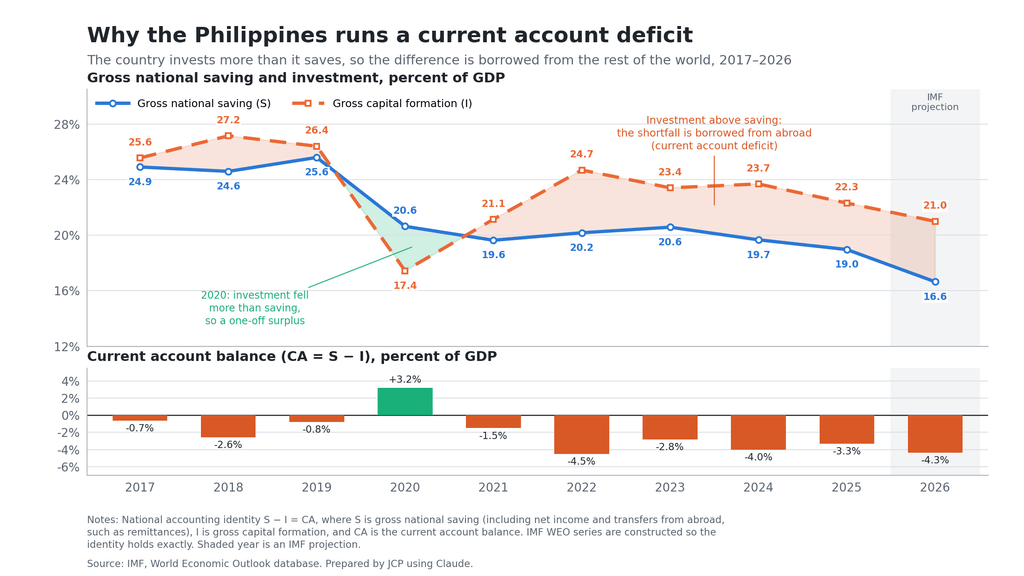
Figure 3 below shows that while we have a large current account deficit, many neighboring ASEAN economies enjoy current account enjoy surpluses instead.
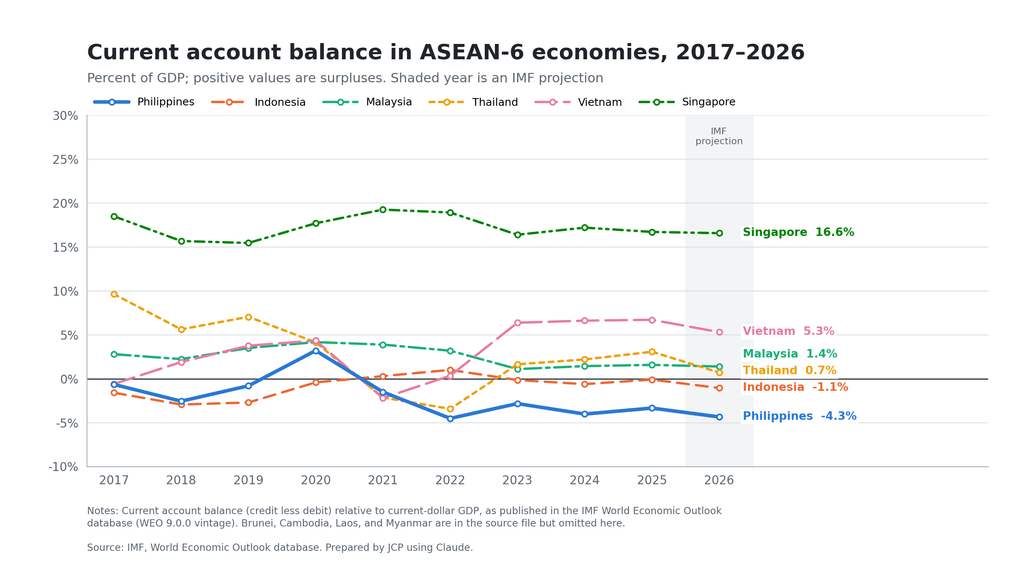
The reason for the Philippines’ current account deficit is that remittances from overseas Filipinos and earnings from the IT-BPM sector are not nearly enough to offset the outflow of dollars for, say, import and foreign debt payments.
Low private savings, coupled with a current account deficit, means that there’s really not enough resources to fund investments in the country.
I think this is what Governor Remolona was trying to say in the Senate. That’s why he put emphasis on the need to grow exports as a source of dollar earnings. This will be increasingly important since inflows of remittances are not as strong as in past decades, and the income of Filipinos in the IT–BPM sector face many threats like US protectionism (“onshoring”) and artificial intelligence (AI). Tourism, by the way, is another potential source of dollars for us.
To be sure, a current account deficit is not inherently bad. But if it’s too large, then it becomes a cause for concern. If we earn enough dollars from abroad, we can abate the current account deficit and pay for more investments here at home. At the same time, it can help reduce the pressure on the peso to further depreciate—the original concern raised by senators last week.
The problem is that many people focused too much on Governor Remolona’s remarks on consumption: “Medyo mahirap sabihin ’to… pero mayabang tayo eh. May consumption culture ang tawag.” Admittedly, Remolona could have chosen his words better, and deemphasized the saving rate angle (to some people, that sounded like the BSP was blaming ordinary citizens’ lack of saving).
But in fact, Remolona never said that Filipinos must further scrimp on money or tighten their belts amid these challenging times. Saving by individuals at the micro level is different from saving by countries at the macro level. Lack of savings at the national level can be augmented by exports, remittances, and income from abroad.
I would add that while we’re borrowing from abroad, it’s best to put that money in productive and worthwhile uses. This is why it’s infuriating to know that a large part of public investments has gone to corruptible flood control projects or farm-to-market roads or multipurpose buildings.
Oil and AI
Remolona drew more criticism when Senator Risa Hontiveros asked why Philippine inflation exceeded that of several neighbors. He cited our lack of domestic oil and said economies with AI industries could partly compensate. He himself called the comparison “oversimplified.”
There is a grain of truth here. An economy with high-value technology exports can earn more dollars, attract investment, and raise productivity. The International Monetary Fund has noted that the global AI investment boom is already boosting demand for Asian technology exports.
But AI does not directly make imported oil cheaper. Data centers also consume tremendous amounts of electricity: the International Energy Agency estimates that global data-center electricity use surged by 17% in 2025, while AI-focused centers used 50% more.

A better formulation is that strong, export-oriented technology industries can help an economy absorb an oil shock. In fairness, Remolona did mention a couple of times in the Senate briefing the urgent need to boost exports. AI is one possible source of productive capacity and dollar earnings. But by no means is it a substitute for energy security or a magic cure for inflation.
Miscommunication
In conclusion, I agree that BSP Governor Eli Remolona’s Senate statement needed more precision. He was hinting at an economic logic that makes a lot of sense, but also difficult to communicate—hence prone to misinterpretation.
Governor Eli Remolona did not tell workers to skip meals or medicine. That’s not what he said, and that would be both cruel and economically silly. Let’s avoid putting words into his mouth.
He also did not say that consumption is the enemy. Instead, the underlying message is that our country as a whole needs to find better ways to finance our investments—what private saving cannot rescue, maybe a boost in exports, remittances, or incomes from abroad can.
Ultimately, if we want higher national savings, we should ensure stable incomes and better-paying jobs for Filipinos, more efficient firms, sounder public finances, and financial institutions that channel savings into productive investment. – Rappler.com
Jan Carlo “JC” Punongbayan, PhD is an associate professor at the University of the Philippines School of Economics (UPSE). His professional experience includes the Securities and Exchange Commission, the World Bank Office in Manila, the Far Eastern University Public Policy Center, and the National Economic and Development Authority. JC writes a weekly economics column for Rappler.com. He is also co-founder of UsapangEcon.com and co-host of Usapang Econ Podcast.
His first book, False Nostalgia: The Marcos “Golden Age” Myths and How to Debunk Them, was published by Ateneo de Manila University Press in February 2023. His second book, Twin Plagues: How Duterte and Covid-19 Wrecked the Philippine Economy, was published by Penguin Random House SEA in June 2026. Follow him on Instagram (@jcpunongbayan).
Below are In This Economy pieces you may have missed:
Click here for other In This Economy articles.