photos kumamoto japan
|

IN PHOTOS: Kumamoto, Japan earthquake aftermath

MANILA, Philippines — A magnitude 7.1 earthquake hit Japan‘s southern Kumamoto prefecture on Tuesday, July 28, leading to at least 17 deaths.

Rescue operations continued, with several people pulled from the rubble of the partially collapsed Aeon shopping mall near the city of Kumamoto that was torn apart by an explosion just over an hour after the earthquake.

The earthquake caused significant damage to infrastructure, including roads and buildings, and disrupted power supply to thousands of homes. It also raised concerns about disrupted supply chains and logistics.

Here are some of the images in the aftermath of the powerful tremor:

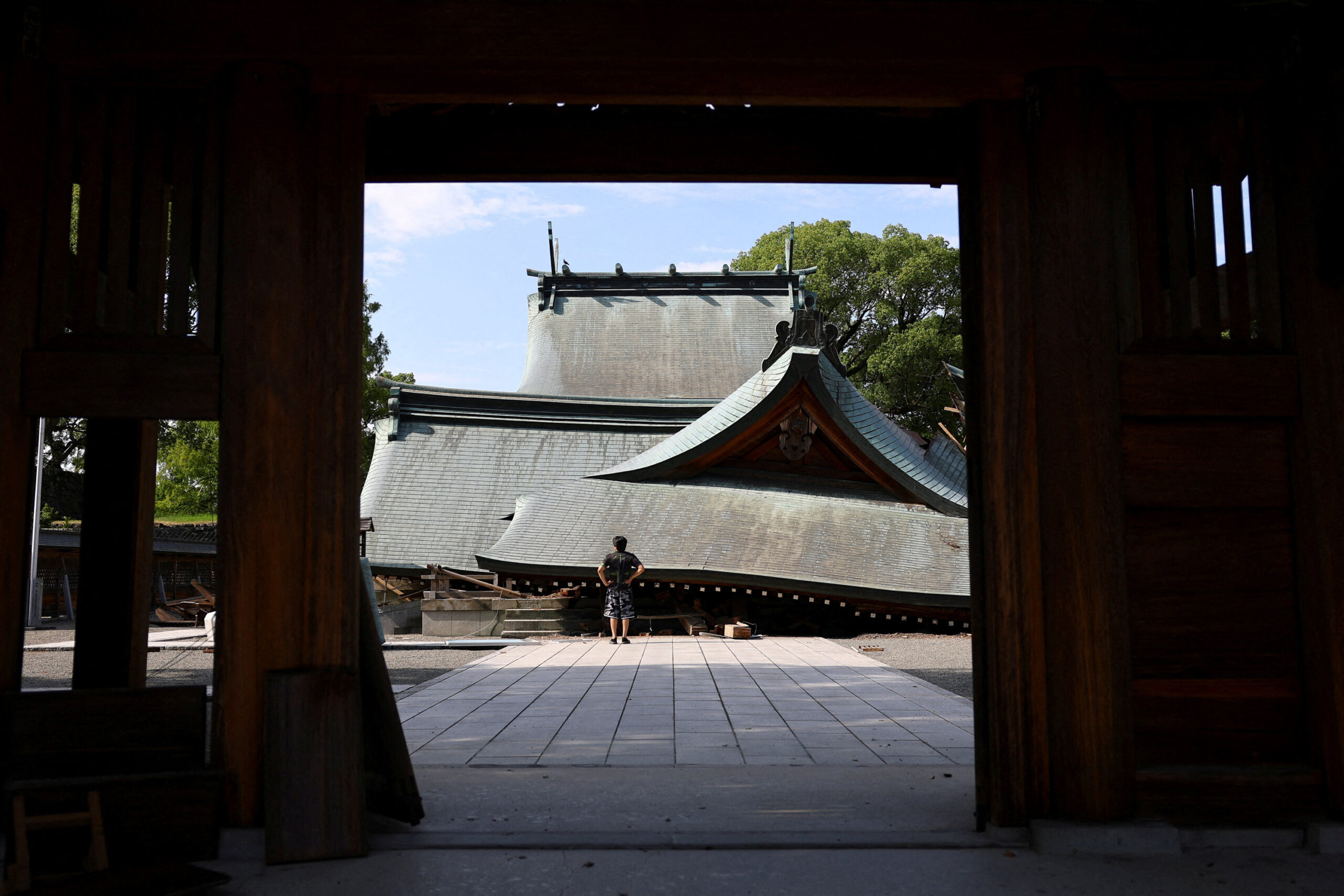
People remove debris from a collapsed gate at a temple after the earthquake in Japan’s southern Kumamoto Prefecture, on July 29, 2026. Issei Kato/Reuters
Major earthquake hits Japan's Kyushu region
A view of the damage from a landslide on the slopes of Mayuyama mountain after the earthquake, in Shimabara City, Nagasaki, on July 29, 2026. Kyodo via Reuters
Major earthquake hits Japan's Kyushu region
Surface raptures is seen in an agriculture field, after the quake in Yatsushiro City, Kumamoto Prefectureon, on July 29, 2026. Kyodo via Reuters
Major earthquake hits Japan's Kyushu region
A bullet train sits on the tracks as train services are suspended after the tremor in Yatsushiro City, Kumamoto Prefecture, on July 29, 2026. Kyodo via Reuters
A drone view shows a damaged bridge after an earthquake with a magnitude of 7.1 struck Japan's southern Kumamoto Prefecture
A drone view shows a damaged bridge n Yatsushiro, Kumamoto Prefecture, on July 29, 2026. Issei Kato/Reuters
Major earthquake hits Japan's Kyushu region
A view of the damage in Kumamoto Minami Hospital in Uki City, Kumamoto Prefecture, on July 29, 2026. Kyodo via Reuters
Aftermath of earthquake in Yatsushiro
A chimney at Nippon Paper Industries factory collapsed after the earthquake in Yatsushiro City, Kumamoto Prefecture, on July 29, 2026. Issei Kato/Reuters
Major earthquake hits Japan's Kyushu region
Rescue workers gather to conduct search operations at Nippon Paper Industries factory in Yatsushiro City, Kumamoto Prefecture, on July 29, 2026. Kyodo via Reuters
Major earthquake hits Japan's Kyushu region
A Torii gate collapsed after the earthquake in Katsushiro City, Kumamoto Prefecture, on July 29, 2026. Kyodo via Reuters
Major earthquake hits Japan's Kyushu region
A view of Aeon Mall shopping centre, after an explosion occurred following the earthquake in Kashima Town, Kumamoto Prefecture, on July 29, 2026. Kyodo via Reuters
AEON President Akio Yoshida bow at a press conference on July 29, 2026, after an explosion in their mall following Tuesday’s earthquake. Kyodo via Reuters
Aftermath of earthquake in Yatsushiro
Cars sit crushed beneath debris from a collapsed building in Yatsushiro City, Kumamoto Prefecture, on July 29, 2026. Issei Kato/Reuters
Aftermath of earthquake in Yatsushiro
Cars drive past a damaged building in Yatsushiro City, Kumamoto Prefecture, on July 29, 2026. Issei Kato/Reuters
Aftermath of earthquake in Japan's Kyushu region
A rescue worker walks by the damaged Aeon Mall shopping centre in Kashima Town, Kumamoto Prefecture, on July 29, 2026. Kim Kyung-Hoon/Reuters
Aftermath of an earthquake with a preliminary magnitude of 7.1, in Japan
Rescue workers conduct a search operation at the damaged Aeon Mall shopping centre in Kashima Town, Kumamoto Prefecture, on July 30, 2026. Kim Kyung-Hoon/Reuters

– With reports from Reuters/Rappler.com

Similar Posts

  • | |

    Egypt’s Salman Khalil defeats Pakistan’s Nasir Iqbal 

      Egypt’s Salman Khalil emerged victorious at the PN Fleet Club Open International Squash Championship after defeating Pakistan’s Nasir Iqbal in a thrilling final held at the Pakistan Navy Roshan Khan-Jahangir Khan Squash Complex in Karachi. The prestigious tournament, organized by the Sindh Squash Association, concluded with an impressive display of world-class squash and highlighted the growing of the event. Third-seeded Salman Khalil from Egypt outclassed Pakistan’s experienced player Nasir Iqbal in straight games to claim the championship title. Khalil secured the victory with game scores of 14-12, 11-3, and 13-11, demonstrating remarkable consistency, skill, and composure throughout the contest. Although Nasir Iqbal fought hard and received strong support from the home crowd, he was unable to overcome the Egyptian’s aggressive play and tactical brilliance. The final attracted several distinguished guests from Pakistan’s sports and military communities. Commander Karachi, Vice Admiral Faisal Amin, attended the event as the chief guest and distributed prizes among the winners and runners-up. The ceremony was also graced by the presence of Pakistan’s squash legend and former world champion Jahangir Khan, along with former Governor of Sindh Moinuddin Haider, who praised the high standard of competition and encouraged young players to pursue excellence in the sport. The championship featured a total prize purse of US$41,000 making it one of the most significant squash tournaments held in Pakistan this year. The event attracted talented players from different countries and provided local athletes with an opportunity to compete against international opponents on home soil. Speaking at the closing ceremony, Vice Admiral Faisal Amin expressed his satisfaction over the successful organization of the tournament. He said that hosting an international squash championship of this caliber was a positive step for Pakistan’s sporting landscape. He reaffirmed the Pakistan Navy’s commitment to promoting sports and supporting athletes through the organization of national and international competitions. According to him, such events help revive Pakistan’s rich sporting traditions while inspiring the younger generation to participate in healthy and competitive activities. Sindh Squash Association President Adnan Asad also addressed the audience during the prize distribution ceremony. He revealed that several more high-prize-money squash tournaments are being planned in the near future. He emphasized that the responsibility now lies with the players to work hard, improve their skills, and seize the opportunities being created for them. Asad expressed confidence that regular international competitions would contribute significantly to the development of Pakistani squash. Former world champion Jahangir Khan shared his hopes for the future of Pakistani squash. He said he dreams of seeing Pakistani players qualify for the Los Angeles Olympic Games and ultimately win the country’s first Olympic gold medal in squash. Jahangir stressed that achieving such success would require unwavering dedication, discipline, and hard work. He urged young players to focus solely on their training and performance if they aspire to become legends like Jahangir Khan and Jansher Khan, whose achievements once made Pakistan the dominant force in world squash. The successful conclusion of the PN Fleet Club Open International Squash Championship reflects Pakistan’s continued efforts to revive its historic legacy in squash by hosting international competitions, nurturing emerging talent, and providing athletes with valuable exposure at the highest level.

  • | | |

    Bangladesh moves toward talks with China to buy J-…

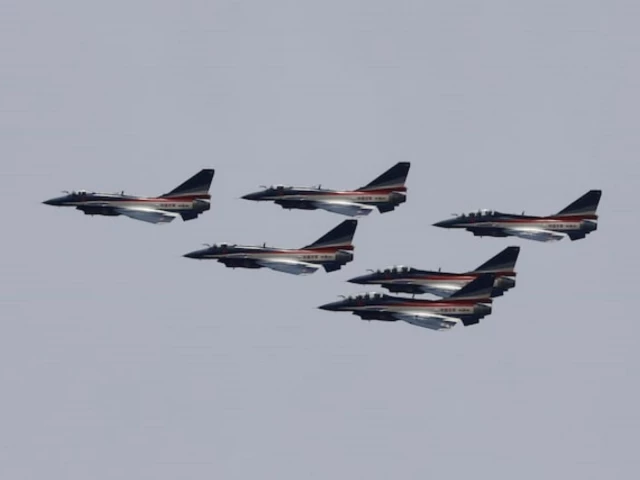
    Bangladesh is preparing to begin formal discussions with China over a possible purchase of J-10CE fighter jets and attack helicopters according to a government adviser. Prime Minister’s Information and Broadcasting Adviser Zahed Ur Rahman said Tuesday that a government committee is working on a draft agreement that could pave the way for negotiations with Beijing. The potential deal would represent one of Bangladesh’s largest defence purchases in recent years and could further strengthen the country’s military relationship with China. Beijing is already Bangladesh’s biggest supplier of defence equipment. The J-10CE fighter jet has received increased international attention since fighting between India and Pakistan in May 2025. Pakistan said its J-10CE aircraft were involved in shooting down Indian fighter jets during the clashes. India has disputed those claims. Ur Rahman said Bangladesh had observed reports about the aircraft’s performance during the conflict as it considers options to modernise its air force. Bangladesh is reportedly considering purchasing as many as 24 J-10CE fighter jets although officials have not confirmed the final number. Pakistan is currently the only confirmed foreign operator of the export version of the Chinese aircraft. The adviser did not reveal how many jets Bangladesh could ultimately purchase the expected cost of the agreement or when deliveries might begin. Those details, he said, would be decided during negotiations. The possible fighter-jet purchase comes as Bangladesh seeks to upgrade its military capabilities. The country has maintained close defence ties with China for years with Beijing supplying a wide range of military equipment. Over the past two decades, China has provided Bangladesh with warships, fighter aircraft, tanks and missile systems, making it Dhaka’s largest source of military hardware. If Bangladesh proceeds with the J-10CE acquisition, the move could further deepen defence cooperation between Dhaka and Beijing while giving Bangladesh a modern multirole fighter capable of performing air-to-air and air-to-ground missions.

  • | | |

    Iran claims victory on military, political fronts

    Iranian Parliament Speaker Bagher Ghalibaf has claimed that Iran has emerged victorious on both the military and political fronts of the ongoing conflict. Speaking about the situation, Ghalibaf said Iran was facing what he described as an unjust war imposed by the United States and Israel. He said the Iranian nation was confronting the conflict with courage and determination. According to Ghalibaf, Iran had successfully resisted pressure on both the military and political fronts. Ghalibaf said the Iranian people had remained united despite the challenges created by the conflict. He praised their resistance and said the nation had shown that it could withstand pressure from powerful opponents. His remarks came after the General Staff of the Iranian Armed Forces said that Iran would not retreat until the United States and Israel were completely defeated. The Iranian military leadership said resistance had become part of the mindset of Iran’s younger generation. It claimed that the legacy of resistance had been passed from one generation to another. According to the Iranian Armed Forces, the country’s new generation had remained firm in the face of what it described as the world’s most powerful military forces. The military leadership also said Iran would continue its struggle to protect what it called its legitimate rights. It said Tehran would not abandon its position until the opposing side surrendered. The Iranian Armed Forces further accused the United States of continuing its aggression to expand its influence and establish dominance in the region. Iranian officials have repeatedly presented the conflict as a struggle against foreign aggression. They have also stressed the importance of national unity and resistance in facing military and political pressure.

  • |

    Irish politicians urge action over citizen’s high-security pro-Palestinian trial in Germany

    A cross-party delegation of Irish politicians has called on Dublin to send official observers to the trial of the “Ulm 5” activists in Stuttgart and raise concerns over the severe detention conditions of Irish citizen Daniel Tatlow-Devally. Tatlow-Devally, 32, was arrested alongside four other Berlin-based European activists in September after trespassing at an Ulm facility owned by Israeli defense contractor Elbit Systems, where they destroyed equipment and smashed windows to protest German arms exports to Israel. German prosecutors have charged the group with trespassing, property damage exceeding €1 million, and membership in a criminal organisation under Section 129 of the German criminal code. The visiting delegation, including Sinn Féin TD Mairéad Farrell and representatives from Fine Gael, Labour, People Before Profit–Solidarity, and the Social Democrats, voiced alarm over Tatlow-Devally being confined to a 5×2-metre cell for 23 hours a day with only one hour of monthly visitation. They also highlighted courtroom barriers, such as holding the defendants behind glass panels that restrict direct legal communication. Farrell urged Irish Prime Minister Micheál Martin to press German Chancellor Friedrich Merz on human rights and legal access concerns during his upcoming visit to Dublin.

  • |

    PhD exams face explosive questions over quality

    A renewed debate over the reliability of PhD examinations has emerged following questions surrounding the doctoral thesis of Professor Jason Arday. Arday submitted his PhD thesis at Liverpool John Moores University in July 2015. The controversy resurfaced after Professor Richard Dawkins publicly questioned whether the thesis had been thoroughly examined. Other commentators have also raised concerns about its academic quality and allegations of plagiarism. The debate has now expanded beyond the individual case. It has prompted questions about how universities assess doctoral research and whether the existing system consistently maintains the required academic standards. A PhD normally represents several years of specialised research. A doctoral thesis can contain tens of thousands of words and often requires extensive academic reading and analysis. The assessment is generally carried out by two examiners. One is usually from the candidate’s university, while the other comes from an external institution. Critics argue that the workload involved in examining a thesis is not always matched by the financial compensation provided to examiners. Examiners are commonly paid a relatively modest fee for reviewing lengthy and complex research. This has raised concerns that some may not devote sufficient time to the process. There are also concerns about inconsistencies in examination decisions. Some candidates have reportedly failed their PhDs despite believing that their research met the required standard. Others have received a pass even when questions remained about the quality of their work. The appeal process can be particularly difficult for unsuccessful candidates. A failed PhD can mean years of research being lost. Students who finance their own studies can also face substantial financial losses. For those hoping to build academic careers, the consequences can be even more serious. Another issue is the selection of examiners. Supervisors often play a role in recommending academics to assess their students’ work. Critics say professional relationships within academia could potentially influence the choice of examiners or the assessment itself. Academic misconduct presents another challenge. Universities can spend considerable time investigating allegations of plagiarism and other forms of cheating. Lengthy investigations can involve hearings, appeals and administrative procedures. The discussion has also highlighted the subjective nature of academic assessment. Different examiners can sometimes reach different conclusions about the same research. In some cases, candidates who fail with one set of examiners may later receive a pass from another panel after an appeal. There is no suggestion that these concerns necessarily apply to Arday’s examination. The available debate does not establish whether his thesis met or failed to meet the required standard. However, the controversy has renewed calls for universities to examine their doctoral assessment systems. Questions include how examiners are selected, whether they receive adequate compensation, how thoroughly theses are reviewed and how allegations of academic misconduct are handled. The wider debate is therefore about more than one doctoral thesis. It raises fundamental questions about the credibility, consistency and accountability of the PhD examination process.

Leave a Reply

Your email address will not be published. Required fields are marked *