Police step up checks on foreign nominee businesses in Hua Hin
Hua Hin nominee crackdown stepped up by police
Immigration and police in Hua Hin have stepped up efforts to investigate suspected nominee business structures involving foreign nationals, as authorities intensify scrutiny of foreign-linked companies and land transactions.
A meeting was held at Hua Hin Police Station on July 30 to establish operational guidelines for a joint task force investigating cases in which Thai nationals may be acting as nominees for foreigners.
Pol Maj Gen Songprod Sirisukha, commander of Immigration Division 3, ordered senior Prachuap Khiri Khan immigration officers and investigation teams to take part alongside officers from Provincial Police Region 7 and Hua Hin Police.
The meeting, chaired by Pol Col Torawong Pitakoson, deputy commander of the Region 7 Investigation Division, assigned responsibilities for identifying people, businesses and locations potentially connected to nominee arrangements.
Hua Hin nominee crackdown follows wider scrutiny
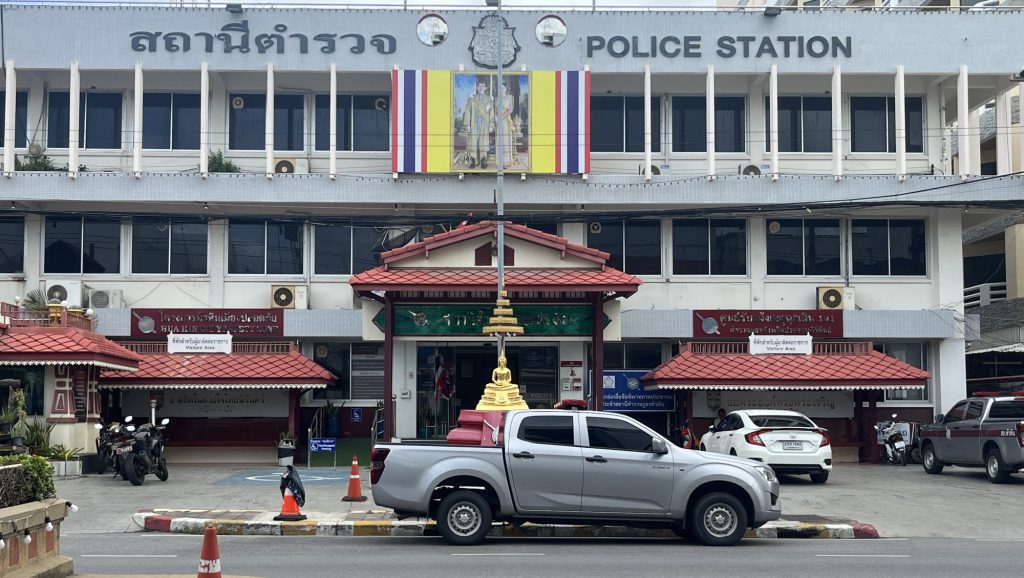
Hua Hin Police Station. File Photo
The latest move follows an announcement in May that more than 2,000 companies in Hua Hin with foreign investment could face closer scrutiny as part of a nationwide investigation led by the Department of Business Development (DBD) and other agencies.
DBD figures show Hua Hin district has 4,162 limited companies, of which 2,081 have some level of foreign investment.
Among them, 35 companies have foreign shareholders holding at least 50% of shares, while 2,046 have foreign shareholdings ranging from 0.01% to 49.99%.
British nationals are the most commonly recorded foreign shareholders, with interests in 355 companies, followed by Swedish nationals in 231, French nationals in 174, Germans in 128 and Norwegians in 125.
A company having Thai and foreign shareholders is not in itself illegal.
A nominee arrangement typically involves Thai nationals holding shares, assets or business interests on paper while a foreign investor provides the money, controls the business or receives the financial benefit. Such structures may be used to circumvent restrictions on foreign business activities or land ownership.
Authorities have said investigations can include checks on the source of investment funds, whether Thai shareholders had the financial means to acquire their shares, who controls a company and who ultimately benefits from its operations.
The DBD has increased checks on companies with foreign investment since January 2026 and has identified tourism, property, hotels, construction and other foreign-linked sectors as areas requiring closer scrutiny.
Thailand’s Foreign Business Act prohibits the use of Thai nominees to circumvent restrictions applying to foreign-owned businesses.