riyadh8217s strategic triangle

Riyadh’s Strategic Triangle: Security, Stabi…

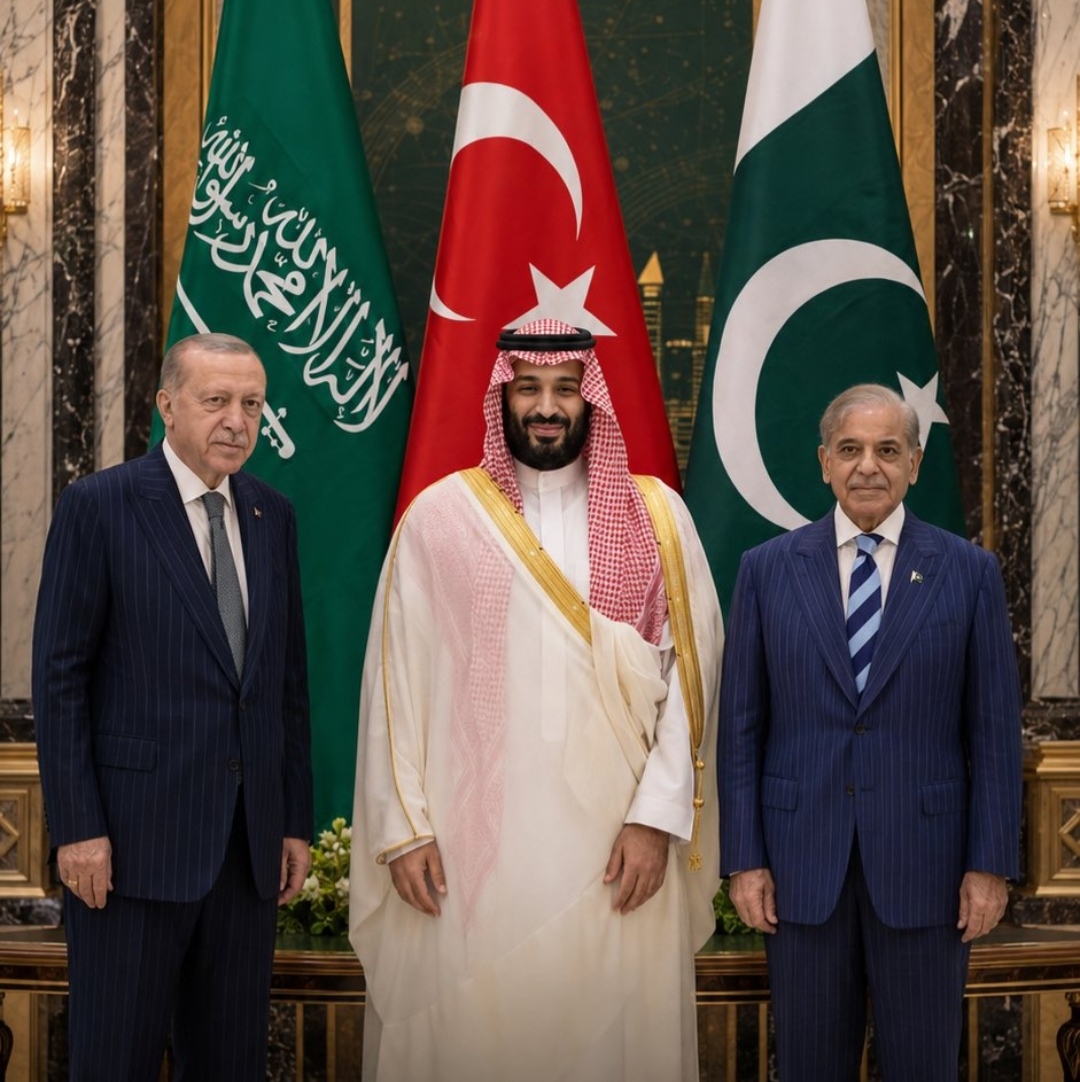
The visit of Pakistan’s Prime Minister and Chief of Defence Staff to the Kingdom of Saudi Arabia on 6–7 August 2026 was officially presented as a meeting with Crown Prince Mohammed bin Salman (MBS), accompanied by the performance of religious rituals in Islam’s holy cities. Yet, diplomacy is often conducted between the lines rather than in official communiqués. French newspapers, Indian news agencies, and Israeli media all reported that Pakistan, Türkiye, and Saudi Arabia were working toward a defence agreement expected to be signed on Friday. While no official confirmation has emerged, the reports have generated an important strategic debate. If such an agreement is indeed under discussion, what is its real agenda? Would it amount to a military alliance, and if so, against whom would it operate? More fundamentally, why would Pakistan and Türkiye, both facing considerable economic pressures, seek to enter such an arrangement? Or are we witnessing the gradual birth of a new regional security architecture in the vacuum created by the declining American military footprint in the Middle East, with Pakistan assuming an anchoring role?


The first narrative comes from Pakistan. Political analyst Parveen Sawamy argues that Pakistan is gradually emerging as the principal anchor of a broader Muslim strategic framework. According to this view, Islamabad has evolved from being merely a facilitator of dialogue to becoming a mediator and now potentially a guarantor of regional security. Among the members of the OIC, Pakistan enjoys a unique diplomatic position. It maintains working relations with almost every important regional actor, consistently supports the Palestinian cause, and remains outside the circle of states that have normalized relations with Israel. This balanced diplomacy provides Islamabad with credibility across the Muslim world.


Pakistan also possesses one of the most experienced armed forces in the Islamic world, capable of contributing to Gulf security should regional circumstances demand it. At the same time, Washington may not necessarily oppose such a role, particularly given the perception that General Asim Munir enjoys constructive relations with the Trump administration. Pakistan’s geographic proximity to Iran further strengthens its credentials, allowing it to maintain channels of communication with Tehran while preserving strategic partnerships with Gulf monarchies. If Islamabad succeeds in converting this diplomatic leverage into economic opportunity, a defence understanding with Riyadh and Ankara could mark the beginning of a new Muslim security framework based on deterrence, mediation, and regional peace rather than confrontation.


The second narrative revolves around Türkiye. President Recep Tayyip Erdoğan, despite facing domestic economic challenges, brings decades of NATO experience, an advanced defence industry, and diplomatic flexibility. Türkiye remains a NATO member, maintains dialogue with the United States, preserves working relations with Israel, and simultaneously engages actively with Asian and Muslim nations. Such strategic diversity enables Ankara to serve as a bridge between competing geopolitical camps.


From Türkiye’s perspective, participation in a trilateral framework would capitalize on its military technology and defence manufacturing capabilities while expanding economic cooperation with Pakistan and Saudi Arabia. Ankara also offers valuable diplomatic experience and could serve as a neutral venue for negotiations during future regional crises. If such cooperation enjoys quiet support from Washington, Türkiye would strengthen both its strategic autonomy and its influence across the Muslim world.


The third and perhaps most decisive narrative belongs to Saudi Arabia. Crown Prince Mohammed bin Salman (MBS) seeks durable security guarantees to preserve investor confidence in Vision 2030 and mega-projects such as NEOM. Economic transformation cannot succeed without regional stability. Recent conflicts have exposed the vulnerability of Gulf infrastructure to missile and drone attacks, prompting Riyadh to reassess its long-term security strategy. MBS increasingly recognizes that American military bases alone cannot guarantee the Kingdom’s security in an era of rapidly changing regional dynamics.


Pakistan and Türkiye therefore emerge as relatively affordable yet credible strategic partners. Saudi energy sustains both economies, while Islamabad and Ankara can provide military expertise, training, and strategic reassurance. More importantly, MBS appears less interested in confronting Iran through perpetual military rivalry than in managing competition through diplomacy backed by credible deterrence. If this approach succeeds, it could reduce regional tensions while safeguarding Saudi Arabia’s ambitious economic transformation.


Whether the reported defence agreement materializes or remains diplomatic speculation, the convergence of Pakistan, Türkiye, and Saudi Arabia reflects an important geopolitical trend. All three states require economic stability, strategic autonomy, and a more reliable regional security framework. Their interests intersect around the need to protect trade, investment, energy infrastructure, and political stability. If this strategic triangle evolves into a formal partnership, its true success will not be measured by the strength of its military capabilities but by its ability to prevent conflict, encourage dialogue, and foster prosperity. In a region long defined by rivalry, the most enduring alliance may ultimately be the one built not for war, but for peace.

Similar Posts

  • When Will Childhood Be Safe?

    The true measure of a society is not its skyscrapers, motorways, economic statistics or political slogans. It is revealed by something much simpler: how safe its children are. If a child cannot feel safe at home, in the neighbourhood, at a madrassa, at school or even on the street, then all our claims of progress deserve to be questioned. The growing number of cases of child abuse in Pakistan is not merely a matter of crime statistics. It reflects our collective indifference, weak institutions and a social culture that too often chooses silence over justice. Behind every reported case is a childhood that has been stolen, a family that has been shattered and an innocent mind carrying wounds that may never fully heal. According to the material available for this article, 1,914 cases of child abuse were reported across Pakistan during the first six months of 2026. Meanwhile, Sahil’s report recorded 3,630 cases of child abuse across the country in 2025, an increase of eight per cent over 2024. These figures were compiled from reports published in 81 newspapers across the four provinces, Islamabad, Azad Jammu and Kashmir and Gilgit-Baltistan. According to the report, more than nine children were subjected to some form of abuse every day in 2025. But is this the complete picture? Probably not. These figures represent only the cases that were reported. Countless incidents never reach the police or the courts because of fear, social stigma, family pressure, financial difficulties and the long, exhausting process of seeking justice. The reported numbers, therefore, should not be mistaken for the full scale of the problem. There is also a widespread assumption that children are mainly at risk from strangers. The reality is far more complicated. Long-term analyses of child abuse cases have repeatedly shown that a significant number of incidents involve people known to the child or the family. This is an uncomfortable truth, but one that parents must acknowledge. Teaching children simply to avoid strangers is no longer enough. They must also be taught that if a relative, teacher, neighbour, family acquaintance or influential person makes them uncomfortable or pressures them into doing something they do not want to do, they have the right to speak up. They should know that they can tell their parents or another trusted adult without fear of being blamed or punished. Such education is not about frightening children. It is about giving them confidence.Perhaps the most painful aspect of this crisis is that danger sometimes comes from the very place that should be a child’s safest refuge. Home is a child’s first shelter. The family environment is supposed to provide love, security and protection. But if that space becomes unsafe, where does a child go? Parents also need to pay close attention to sudden and unexplained changes in a child’s behaviour. Fear of a particular person, refusing to go to school, unusual silence, anger, withdrawal or a sudden change in behaviour may sometimes be warning signs. Not every behavioural change means that a child has been abused, but ignoring every unusual change is certainly not wise. Pakistan does not lack laws relating to child protection. The Zainab Alert, Response and Recovery Act 2020, the Juvenile Justice System Act 2018 and various provincial laws and policies provide a legal framework for protecting children. The real problem, however, is not the absence of laws. It is the failure to translate those laws into effective action. During a hearing at the Islamabad High Court in June 2026 concerning the implementation of the Zainab Alert law, the court was informed that some important provisions, including the practical operation of an immediate alert mechanism for missing children, had yet to be implemented as intended. The court was also told that 562 criminal cases relating to missing children and child abuse had been registered in Islamabad between 2022 and 2025. These figures raise a fundamental question: how seriously do we monitor the implementation of laws after passing them? The National Assembly’s Standing Committee on Human Rights also expressed concern in February 2026 over the performance of government institutions responsible for child protection and the lack of coordination between departments. It pointed out that several policies appeared to remain largely confined to official documents. We also need to understand that registering an FIR is not justice. It is merely the beginning of the process. If a child is abused, a case is registered and the accused is arrested, but the trial continues for years, witnesses come under pressure, evidence becomes weaker and the family eventually loses hope, then where is the justice despite the existence of laws? Cases involving children require a particularly sensitive approach to investigation and prosecution. Making a child repeatedly recount a traumatic incident, subjecting them to unnecessary questioning or taking their statement in an intimidating environment can deepen the trauma. Every district should therefore have properly trained child protection units where police officers, prosecutors, social workers and psychologists can work together. Specially trained investigators and prosecutors should deal with child abuse cases, while unnecessary delays in trials must be eliminated. We teach our children mathematics, science, English and computers. But do we teach them what to do if someone touches them inappropriately? Do they know that they have the right to say no? Do they understand that they are not obliged to obey an adult when something is wrong? Do they know whom to approach if someone threatens or intimidates them? Age-appropriate child safety education is no longer a luxury. It is a necessity. The purpose of such education should not be to frighten children but to give them a basic understanding of personal boundaries, appropriate and inappropriate touch, online risks and ways of seeking help. Parents and teachers also need training because children often communicate distress through changes in behaviour rather than directly asking for help. The dangers facing children today are not confined to streets, schools and neighbourhoods. Mobile phones and the internet have created another world in which children can

  • The Unleashed Furies

    This 14th of August, as the green and white flags go up from Karachi to Khyber and the air fills with the crackle of fireworks, there is a question every young Pakistani must ask themselves: what exactly are we celebrating? Is it merely the fact that a nation was born at the stroke of midnight 79 years ago? Or is it something far more demanding — the unfinished promise of that birth, the dream that millions carried across blood-soaked borders, the conviction that Pakistan would be not just a homeland, but a beacon? Nisid Hajari’s book Midnight’s Furies does not let us off easy. It drags us back to the raw, unvarnished truth of 1947 — and in doing so, it hands our generation something precious: the tools to understand who we are, where we came from, and what we still owe to those who paid the ultimate price for our freedom. Hajari wrote that on 9 August 1947, a train pulls out of Delhi bound for Karachi, 800 miles away. Onboard are Muslim clerks and officials who had served the British-run government of India with distinction. With them are their families, their ribbon-tied files, their children’s toys, their prayer rugs, and the gold jewellery that represented their life’s savings. They are not refugees fleeing in panic. They are pioneers, volunteers for a great experiment — the world’s first modern Muslim nation. As the train whistles out of Delhi, cheers of “Pakistan Zindabad!” drown out the engine. These men and women believe they are building something unprecedented. Something magnificent. They never arrive. Sikh saboteurs — soldiers in all but name, their tiny community having supplied the Indian Army with fighting men far beyond their numbers — have laid gelignite charges along the tracks. The mine detonates. The Pakistan Special shudders. And in that moment, the euphoria of independence meets the savagery of Partition. Hajari, who spent over a year buried in archives across New Delhi, London, and Washington, D.C., reconstructs this tragedy not from myth but from the “demi-official record” — the diaries, army sitreps, embassy cables, and informant reports that tell the real story. And the real story is this: Pakistan was born not in a garden of roses, but in a furnace. The arithmetic of that furnace defies comprehension. One British official, working from casualty reports, put the dead at 200,000. Others, accounting for disease, starvation, and exposure, insist the figure exceeds one million. At least 14 million people were uprooted — the largest forced migration in human history. Western Pakistan was virtually emptied of Hindus and Sikhs; Indian Punjab lost almost all its Muslims. This was carnage on a scale unseen until Rwanda 1994. Yet here is what Hajari forces us to confront: the killing lasted only six weeks. The violence was contained. What was not contained — what metastasised — was the psychological wound. In those weeks, something broke between India and Pakistan that has never been repaired. Leaders on both sides began suspecting each other of complicity in genocide. Mutual mistrust pushed infant nations to war within a year. And Pakistan, flooded with refugees, its economy and bureaucracy teetering on collapse, developed what Hajari calls a ‘deep-seated paranoia’ about its larger neighbour that shapes our politics to this very day. Hajari’s book is unsparing about the failures of leadership that turned Partition’s trauma into perpetual conflict. Nehru and Jinnah — the very architects of freedom — allowed vanity, prejudice, and petty dislike to poison the well. Nehru’s reckless declaration in August 1946 that a strong government would make the Muslim League’s movement “go down” — what Viceroy Wavell called tossing “a match onto dangerously dry kindling” — helped trigger the Great Calcutta Killing, the dress rehearsal for Partition’s horrors. Five thousand dead. Ten to fifteen thousand maimed. The Statesman newspaper, grasping for words, called it “a fury” — a word from mediaeval history. This Independence Day, let us do something radical. Let us honour the dead not by reliving their fears, but by fulfilling their hopes. Jinnah’s address to the Constituent Assembly on 11 August 1947 was crystal clear: ‘You are free; you are free to go to your temples, you are free to go to your mosques or to any other place of worship in this State of Pakistan.’ He envisioned a secular nation where religion was private, not political. Where Hindus, Muslims, Sikhs, and Christians would be equal before the law. Where the state would be a servant of all its citizens, not a weapon of the majority. Hajari’s book ends on a note of hard-won wisdom: ‘Only once those mistakes are properly understood and acknowledged, perhaps, will India and Pakistan begin to bridge the vast and dangerous gulf that still divides them.’ Understanding does not mean surrender. Acknowledgement does not mean apology. It means maturity. It means the confidence to say: we know our history, we honour our sacrifices, and we refuse to let the furies of 1947 dictate our future. So when the flag goes up this 14th August, let it mean something new. Let it mean that Pakistan is done being defined by what it fears. Let it mean that we are ready to be defined by what we build — by our universities and our hospitals, our clean rivers and our fair courts, our poets and our scientists, our daughters who dream without limits and our sons who know that strength comes from justice, not just arms.

  • Vietnam as an Economic Lesson for Pakistan

    Vietnam and Pakistan are often viewed as very different economies, yet they share several important characteristics: large populations, substantial labor forces, strategic geographic locations, sizeable domestic markets and considerable potential in agriculture, manufacturing and services. The more important difference, however, is not simply what the two countries possess, but how effectively they have leveraged those assets into production, exports, investment, foreign exchange and sustained economic growth. The contrast is increasingly visible in the numbers. In 2025, Vietnam’s economy reached approximately $514.7 billion, compared with $407.3 billion for Pakistan, despite Pakistan having more than twice Vietnam’s population. GDP per capita was about $5,066 in Vietnam against $1,596 in Pakistan, while economic growth was 8.0 percent compared with 3.7 percent. Vietnam also attracted FDI equivalent to 4.2 percent of GDP, compared with only 0.5 percent in Pakistan. These figures do not mean that the two countries started from identical circumstances. They do, however, demonstrate the consequences of different approaches to leveraging economic potential.   Vietnam’s transformation began with the Doi Moi reforms in 1986, which gradually moved the economy towards market oriented production and greater integration with international markets. Over the following decades, Vietnam built a growth model around manufacturing, exports, foreign direct investment, infrastructure and participation in global value chains. Trade became one of their principal engine of growth. The scale of this transformation is striking. Vietnam’s merchandise exports reached about $475 billion in 2025, while imports were around $455 billion, producing a trade surplus of approximately $20 billion. Total merchandise trade was therefore close to $930 billion, almost twice the country’s GDP. Manufacturing accounted for nearly 89 percent of exports. This demonstrates the power of economic leverage: labour, infrastructure, foreign investment and imported technology have been combined to produce goods for global markets and generate foreign exchange. The access to US provides a particularly revealing comparison. Vietnam exported approximately $153 billion of goods to the U.S. market in 2025. China, meanwhile, remained its largest source of imports. This reflects Vietnam’s position within regional production networks, where it imports machinery, components and intermediate goods and transforms them into products for export. Vietnam’s experience shows that imports are not necessarily a weakness when they support productive investment and future export capacity. Pakistan’s trade structure remains considerably different. According to the State Bank of Pakistan, goods exports were $32.3 billion in FY2025, while goods imports reached $59.1 billion, resulting in a merchandise trade deficit of $26.8 billion. Services exports were $8.4 billion, including ICT exports of $3.8 billion. The difference becomes even more significant when viewed through the balance of payments. Pakistan recorded a current account surplus of $2.1 billion in FY2025, but workers’ remittances contributed $38.3 billion to the external account. The goods and services trade balance remained in deficit by approximately $29.4 billion. This highlights a fundamental difference between the two economies. Pakistan has been able to stabilize its external account partly through remittances, whereas Vietnam has built a much larger export generating productive base. Remittances are vital for Pakistan, but they cannot substitute for an economy capable of generating foreign exchange through competitive production and exports. The U.S. market further illustrates the gap. The United States is Pakistan’s largest export destination, yet Pakistan’s goods exports to the U.S. are only a small fraction of Vietnam’s. The opportunity therefore exists, but Pakistan has not yet developed the scale, diversification and industrial capacity required to capture a much larger share of the market. The lesson is not simply to increase exports to the United States, but to develop the productive ecosystem that makes sustained export growth possible. Vietnam’s experience also contains an important warning. Its impressive export performance has been driven heavily by foreign invested companies. This has helped Vietnam integrate into global value chains, but it has also created concerns about domestic value addition and linkages between multinational corporations and local firms. The lesson for Pakistan is clear: attracting FDI should not be the final objective. FDI should contribute to technology transfer, supplier development, skills, local procurement and domestic value addition. Pakistan therefore needs to rethink the relationship between imports, investment and exports. Restricting imports may temporarily reduce pressure on the balance of payments, but it does not create competitiveness. Machinery, technology, industrial equipment and productive intermediate goods can expand future production and exports. The objective should be to reduce consumption driven imports while facilitating investment driven imports that strengthen domestic productive capacity. Pakistan’s strategic location linking South Asia with China, Central Asia, Afghanistan, Iran and the Middle East offers major economic opportunities, but infrastructure alone cannot deliver transformation. CPEC, Gwadar, economic corridors, industrial zones and digital connectivity must be linked with productive clusters, reliable energy, logistics, skills and international markets. Pakistan should leverage its existing strengths by moving agriculture towards processing and higher value exports, textiles towards design and technical products, minerals towards processing and value addition, and IT, engineering, pharmaceuticals, tourism and business services towards stronger export performance. Pakistan also needs to make exports a central objective of economic policy. Balance of payments stability cannot depend indefinitely on remittances, external borrowing and periodic financial assistance. FDI policy should focus on quality rather than simply quantity, with incentives linked to technology transfer, local supplier development, skills, domestic value addition and exports. Special economic zones should be developed around clearly identified industries and markets, supported by reliable infrastructure and efficient regulation. CPEC, ports, industrial zones, roads and digital infrastructure should function as integrated production and trade systems rather than isolated projects. Public private partnerships can help mobilize investment where projects are economically and financially viable. The central lesson from Vietnam is that economic success depends on leveraging existing advantages through strong institutions, policy continuity and effective coordination. Pakistan has a large market, substantial workforce, strategic geography, natural resources and access to major markets. The priority should be to convert these assets into productivity, exports, investment and sustainable foreign exchange earnings. Pakistan must turn geography into connectivity, population into productive human capital, resources into value added exports, infrastructure into industrial capacity

  • Trump Era is over?

    Donald John Trump entered the White House as the 45th President of the world’s oldest constitutional democracy in January 2017. As incumbent he lost the election at the end of his four-year term. He took oath of office as the 47th head of state in January 2025. As there is a two-term constitutional restriction most Presidents falter in the later years of power. It was George Washington, the founding father and the first President who set this tradition of going home after eight years at the helm. Franklin Delano Roosevelt ( FDR ) the 32nd President served from 1933 to 1945 until his death in office. He is the longest serving US President. As his rule stretched over four terms, a constitutional amendment was made to restrict the term in office to two. Since then, craziness of the final term has increased manifold as humans are fond of building their legacy to be remembered for all times to come. Richard Nixon had to resign in his second term on charges of break-in and lying. President Ronald Reagen got involved in the Iran Contra Affair that seriously dented his popularity. Jimmy Carter was a great President who never got a second term. Bill Clinton did well in his first term but then had to face impeachment because of the Monica Lewinsky affair in the second. Bush Sr had single term while Bush Jr started the Afghanistan war which proved to be disastrous. Barrick Hussain Obama promised to end wars but badly failed. In fact, the inferno spread in the entire Middle East. Joe Biden did not run for office for the second term as the first was not very glorious and he was out of steam so he nominated his Vice President for the top slot. Legacy is earned not forced. There are no short cuts to lasting glory. Craziness does not help it only complicates. Capturing and killing head of states in the 21st century indicates brutalized narrow thinking and over simplification of the long-term complexities. Such an approach may have worked in the 18th of 19th century but not anymore. Trump wanted to control oil. He first took control of Venezuela by abducting its President through palace intrigue. Most countries in the Middle East ( ME ) were already subservient. He decided to take control of Iran as was done in the decade of the fifties when Shah was reinstated through CIA action. Mohammaed Mussadiq the elected President was captured and imprisoned. The Pahlavi Dynasty ruled Iran till 1979 when it was over thrown by the Islamic Revolution led by Imam Khomeni. Since then, the country has been struggling for its sovereignty At the behest of the rogue Israeli Prime Minister Benjimin Nathenyau, Trump decided to attack Iran and kill its top leadership through clandestine on the ground information sharing and intrigue. Imam Khamenei, the successor to Imam Khomeni, was assassinated but the regime survived. Iran decided to retaliate. The US bases were the closet targets. Israel looked the other way for self-preservation leaving USA to face the wrath. The vulnerability of the oil rich states was exposed. Reality set-in. Yankees have to go home was the clear verdict. Power structure in the entire ME is gearing for change. Mecca Joint Defense Agreement ( MJDA ) has been signed by Turkey, Pakistan and Saudi Arabia, others may join soon. A reasonable peace agreement can provide the much-needed face saving for Pakistan is on the forefront. The Abraham Accord to legitimize the illegitimate state of Israel has been thrown in the cold storage. After Iran, Trump also sought regime change in Afghanistan which has not happened so far. His heroics have failed to produce results. Losers are rejected by the American public. Congressional elections are scheduled for Nov. The polls are not favorable for the Republicans. If Democrats gain control of the house, Trump may have to face impeachment. It will then be the end of his political ambitions, leaving behind a legacy of ill-planned misadventures for personal glorification. Fall of the most powerful leader of the only super power of the world will certainly have ripple effects. First, it will be the totally dependent and subservient leadership in the ME followed by other friendly regimes. The countdown has started for Trump. Collateral damage has to be understood and contained. I remember the words of the legendary Cricket Captain Hafiz Kardar when Pakistan was at the verge of victory in the Oval cricket test in the decade of the fifties; ” Only rain can save England from defeat “. Pakistan prevailed, Fazal Mahmood emerged as a hero. Since then, there has been no looking back. Pakistan emerged as a major player in the cricketing world. Trump should pray for divine intervention otherwise it is all over for him and his cronies.

  • Increasing Pakistan’s Water Resilience

    Stockholm Resilience Centre defines resilience as the capacity of a system to deal with change and continue to develop. System can be an individual, a forest, a city or an economy. In simple words, resilience refers to the ability of an ecosystem to deal with disturbances and returns to its former state. When it comes to water resource management in Pakistan, unfortunately, we are not managing our water resource as sustainably as we should. WWF Pakistan points out a robust difference in water consumption between communities in Pakistan. Those who can afford uses 10 times more water than global average that stands at 10 gallons a day. On the contrary, poor lacks access to water in Pakistan. How sad it is that there exist two different water realities in Pakistan. On one hand, we have people that uses 100 gallons of water each day. On the other hand, we have masses that don’t even have access to water. We must put an end to existing water inequality in Pakistan. Water forms the backbone of our society and economy and without sustainable water management practices in place, we can neither have socially equitable society nor can we achieve sustainable economic growth for Pakistan. We must ensure that each person in Pakistan should have access to clean water regardless of geographical location and financial resources at disposal. If we really want to achieve Sustainable Development Goals (SDGs) for Pakistan, we must end water inequality in Pakistan. An access to clean water is a basic human right and thus it should be available to all in the country. It is important to mention here that each of the 17 Sustainable Development Goals (SDGs) is strongly coupled with how we manage water as a natural resource. If we mange water wisely (with tomorrow in mind), we can easily achieve all 17 SDGs for Pakistan. However, an unsustainable water resource management will act as Achilles heel and prevent us in realizing Sustainable Development Goals. We certainly need a paradigm shift in managing water as a resource in Pakistan. Ministry of Planning, Development and Special Initiatives (Government of Pakistan) highlights that at the time of independence, per capita water availability in Pakistan was over 5000 cubic meters each year. Unfortunately, today, per capita water availability in Pakistan is sharply reduced to roughly 1000 cubic meters per person each year. In other words, each person in Pakistan now only has 1/5 of the water available every year, when compared to 1947 (at the time of independence). Public policy makers in Pakistan must tackle decreasing per capita water availability in Pakistan with utmost seriousness and do all it takes to tackle it in the most sustainable manner. Before we head on to solutions, we must understand the root causes of decreasing per capita water availability in Pakistan. According to Australian Centre for International Agricultural Research (ACIAR), population in Pakistan has increased 7-fold since independence in 1947. Naturally, when we distribute the same amount of water we have each year on 7 times more population, the per capita water availability in Pakistan would then sharply reduce. ACIAR then stresses on the fact that irrigated agriculture in Pakistan consumes 95% of surface water supply in the country. Another report from Pakistan Council of Research in Water Resources (PCRWR) highlights that irrigated agriculture consumes 93% of the available water resource and acts as the single largest sector of economy employing 44% of the labour force, generating 60% of the foreign exchange earnings and produces roughly a quarter of Pakistan’s gross domestic product (GDP). The already spoken report from PCRWR then points out that Pakistan waste 60% of water from canals to farm gates. Do you know that per capita water storage ability of Pakistan is roughly 159 m3? On the contrary, the per-capita water storage ability of USA and Australia is over 5000m3, followed by China with a per-capita water storage ability of 2200m3, Egypt 2362 m3, Turkey 1402 m3 and Iran with 492m3. PCRWR further indicates that inadequate water storage ability has forced Pakistan to lose 120 BCM of water during floods of 2010, 2012 and 2014. If Pakistan had ample surface water storage infrastructure in place, it could had saved at least half of 120 BCM of surface water that could then be used to increase per-capita water availability in the country. The remaining 60 BCM of floodwater could restore Indus River Delta where many species are fighting for their survival due to reduced river flow. There is a dire need for Pakistan to build small, medium and large dams to store surface water. Doing so, will increase surface water availability on year-round basis, decrease flood related damage to agricultural lands and infrastructure, increase per-capita water availability, reduce reliance on underground water, recharge aquifers and mitigate their depletion. We have what it takes to build a series of small, medium and large dams in Pakistan to harvest floodwater during monsoon season. Do you know that 1 billion cubic meters of water has 1 trillion litres of water? Now imagine, if 50 litres of water cost 1 USD, the price tag of 1 billion cubic meters (or 1 trillion litres) of water would be 20 billion USD. Thus, a cumulative cost for 60 BCM of floodwater would roughly be USD 1200 billion. Now, if we would sharply reduce the already spoken figure to its one-tenth, the cost would still be a whooping USD 120 billion for 60 BCM of floodwater. We must understand that this is just the price of water. It is crucial to mention here that water forms the basis of all sorts of social and economic development, and we must learn to manage water sustainably to ensure a resilient Pakistan for all. We must invest heavily in constructing dams of all sizes to increase surface water availability and to enhance per-capita water in Pakistan. Here is an example. Do you know that Sweden has roughly 10,000 dams to manage surface water. It is quite simple, the

  • Refill the Aral Sea First: A Life Spent Watching W…

    I have stood on the dry floor of the Aral Sea, and I can tell you that no photograph prepares you for it. It is not a desert in the way the Sahara is a desert, ancient and self-consistent. It is a wound — a seabed still faintly shaped like the water that used to cover it, salt crusted white across the sand, rusting fishing trawlers stranded kilometres from any shore, and children playing in the hulls of boats their grandfathers once sailed to catch sturgeon. It is, without exaggeration, the worst environmental tragedy I have ever witnessed with my own eyes. And I have spent thirty years of my life witnessing tragedies of water, in one direction or the other. The Aral Sea was once the fourth-largest inland body of water on Earth, spread across more than 68,000 square kilometres between what is now Uzbekistan and Kazakhstan, fed for centuries by the Amu Darya and Syr Darya rivers. Soviet planners diverted those rivers at massive scale to irrigate cotton fields, and the sea began to die — slowly at first, then catastrophically. More than ninety percent of it is gone. What remains has splintered into four smaller lakes covering barely 3,500 square kilometres. The fishing economy that once fed the region collapsed entirely. The exposed seabed, laced with agricultural pesticide residue and salt, now rises on the wind as toxic dust that settles on crops and in human lungs hundreds of kilometres away. Villages that once sat on the water’s edge now sit stranded in a dead landscape, and the world, for the most part, has forgotten this happened at all. That forgetting is its own quiet tragedy. I did not come to this subject as a tourist of disaster. I have spent three decades campaigning for the preservation of the Himalayan glacier system, including a sustained, and ultimately unsuccessful, effort to see the Siachen Glacier converted into a demilitarised peace park — a proposal grounded in a simple technical fact: Siachen is melting faster than almost any glacier on Earth, in significant part because of the sustained military presence stationed on its ice. I made the case, repeatedly, that removing that military footprint would slow a specific, measurable source of glacial loss, feeding directly into the Indus watershed that sustains hundreds of millions of people downstream. I did not succeed. The glacier continues to melt. The troops remain. I say this not as a complaint but as an honest accounting: I have given a large share of my working life to glacier preservation, and by the plainest measure — ice mass — I have not stopped the loss. That failure has not left me cynical. It has left me convinced that the scale of the response has to match the scale of the crisis, and that we have consistently chosen the smaller response. I think about this every time I look at the Maldives. It is a nation of low coral islands, its highest natural point barely more than two metres above sea level, and it is not speaking in metaphor when its own government has warned that the country could become uninhabitable, and eventually vanish beneath the waves, within this century if sea-level rise is not slowed. I do not think most people outside the region understand how literally existential that threat is. This is not a country that will lose some coastline. This is a country that could, within the lifetime of children alive today, cease to have any land at all. That is the other half of the water crisis I have spent my life watching, and it is the mirror image of the Aral. Where the Aral Sea disappeared because rivers were mismanaged and diverted without thought for the consequences, the oceans are rising because the atmosphere has absorbed decades of greenhouse gas emissions, and the ice sheets and glaciers that once held the planet’s frozen water in reserve are releasing it. Through most of the twentieth century, global sea levels rose at roughly 1.4 millimetres a year — barely perceptible within a human lifetime. Between 2006 and 2015, that rate had already accelerated to roughly 3.6 millimetres a year, and it continues to climb. A rise measured in inches sounds trivial until you understand what it does: it turns rare storm surges into routine flooding, drowns wetlands that once buffered coastal cities, backs up drainage systems and rivers, and makes what used to be called a hundred-year flood into a fixture of ordinary life. New York and Miami already experience “sunny-day flooding,” where nothing more than an unusually high tide sends seawater into city streets with no storm at all. Shanghai, Bangkok, Kolkata, Mumbai, and Dhaka — cities holding tens of millions of people and trillions of dollars of infrastructure — face the same mechanism at a scale that could displace populations larger than most countries. And the danger does not arrive gently. In July 2025, an 8.8-magnitude earthquake off Russia’s Kamchatka Peninsula — among the ten strongest ever recorded — sent tsunami warnings racing across the Pacific, triggering evacuations from Russia to Japan to Hawaii to the western coast of the United States. It was, by fortune more than design, a disaster the world mostly escaped. Scientists have been explicit that higher baseline sea levels make the next such event, and the next cyclone, more destructive than the last one would have been at a lower starting point. We are not simply facing more disasters. We are facing the same disasters arriving on a stage that has been quietly raised beneath them. I do not believe these two crises — a vanished inland sea and a rising global ocean — are separate stories. I believe they are the same failure, viewed from opposite ends of the same hydrological system: a civilisation that has never learned to treat the planet’s water as a single, finite, interconnected balance, to be managed with foresight rather than reordered by short-term convenience and corrected only after

Leave a Reply

Your email address will not be published. Required fields are marked *