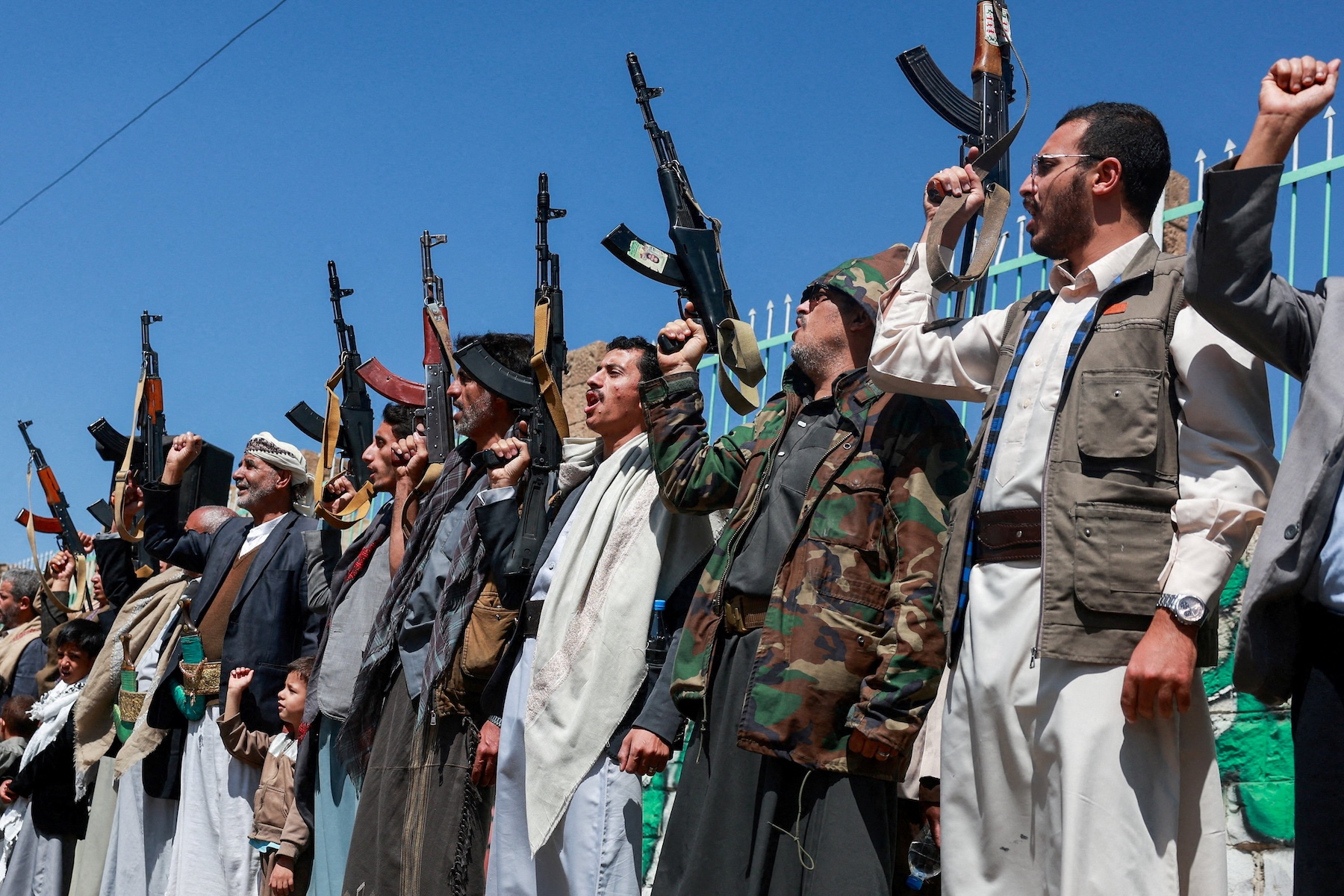
attacks saudi airports
|

Attacks on Saudi airports kill 3 people, as fighting escalates in Yemen

Three people have been killed in attacks on Saudi airports, the country’s civil aviation authorities said on Wednesday, October 7, as fighting intensified in Yemen between the Iran-aligned Houthis and Saudi-backed government forces.

One person was killed and eight wounded in an attack on King Khalid International Airport in the Saudi capital Riyadh, and two were killed and 28 wounded in an attack on facilities at Abha airport, it said in a statement.

One of the attacks was on Wednesday and the other on Tuesday, the civil aviation authorities said, without saying which attack had occurred on which day.

A Saudi-led coalition fighting the Houthis vowed retaliation, saying the attacks “will not go unpunished”. In a statement issued late on Wednesday, the coalition said it had attacked more than 80 Houthi military sites across the governorates of Saada, Hodeidah, Jawf and Marib.

The Saudi airport attacks were among a series of strikes targeting aviation infrastructure on Wednesday.

The Houthis attacked Aden’s international airport with ballistic missiles and explosive-laden drones earlier on Wednesday, the country’s Transport Ministry said.

One missile landed near the runway minutes before a flight from Cairo was due to land, the ministry said. The airport is the main international gateway for parts of Yemen outside Houthi control.

Battles in Yemen have focused in recent days on areas around the Bab el-Mandeb Strait, a shipping route that has become more crucial for energy exports since the conflict between the US and Iran restricted trade through the Strait of Hormuz.

This week, Yemeni government forces with Saudi-led coalition air support launched a counteroffensive to recapture strategic territory near the strait and around the town of Mocha that the Houthis had captured in September, but it is unclear if their advance will hold.

The fighting, a spillover from the wider US-Iran conflict, has revived a complex 12-year war in Yemen that led to one of the worst humanitarian crises globally and fragmented the Arab world’s most impoverished country. The number of people displaced since the latest round of fighting began has risen to more than 200,000, the International Organization for Migration (IOM) said on Wednesday.

“People are running for their lives and finding nowhere safe to go,” said IOM Director General Amy Pope, who called for more funding amid rising needs for food and shelter. Both sides allege that hundreds of people have been killed in fighting, without providing details. The UN says three in four families are going hungry in parts of Yemen.

The Houthis have repeatedly ​targeted infrastructure including airports, oil refineries and pipelines in Saudi Arabia, a US ally.

On Wednesday, the Saudi-led coalition said it had intercepted and destroyed a Houthi ballistic missile north of the Saudi capital Riyadh. It said it was tracking the launch platform over Houthi-controlled Sanaa and would destroy it, but gave no details of casualties or damage.

Houthi military spokesperson Yahya Saree said in a statement that the group had targeted King Khalid International Airport in Riyadh with several drones.

Battles over the strait

Any Houthi control of the strait could threaten shipping or global oil flows, and Saudi Arabia has been seeking international assistance to repel the Houthis. Turkey is sending mainly defensive and technical support, two officials said on Wednesday, after the NATO member and Pakistan pledged to implement a collective defence commitment under their newly formed alliance.

Syria is carefully considering providing military assistance to ally Saudi Arabia amid the escalating war against the Houthis, a US official and a Syrian military official briefed on the matter said.

Options being considered include defensive aid to protect the kingdom from attacks, or deployment of forces in an offensive capacity to help Saudi-backed Yemeni troops fight the Houthis, the officials said.

The US official said Saudi Arabia had requested that Syria deploy forces to fight the Houthis.

In response to a request for comment from the Syrian foreign ministry, a Syrian diplomat said Syria stood firmly with Saudi Arabia in the face of Houthi attacks but that the government’s primary focus was on domestic priorities such as recovery from the country’s civil war.

Fighting on the western front remains concentrated in the Dhubab district overlooking Bab el-Mandeb, with pro-government forces attempting an advance in the strategic hills to the east of that coastal plain, Yemeni military and government sources said.

On Monday, the Yemeni government said it had reached Mocha, which sits at a junction with a supply route to the critical battleground of Taiz, but the claim had been premature, according to Yemeni military officials on the ground and analysts.

The Houthis, who control much of Yemen’s north, seized the capital Sanaa in 2014, prompting a military coalition led by Saudi Arabia, fearful of rival Iran’s influence in Yemen and chaos on its borders, to intervene.

The Saudi-led coalition accuses Iran of arming, training and funding the Houthis. The group, mountain fighters who have emerged as a force of tens of thousands with missiles and drones that threatens the region, denies being part of Iran’s Middle East proxy network, and says it develops its own weapons. Tehran also rejects the allegations. – Rappler.com

Similar Posts

  • |

    Zelensky alleges Russia shared satellite intelligence with Iran to target US bases

    Ukrainian President Volodymyr Zelensky has accused Russia of helping Iran identify US military positions in the Gulf by providing satellite intelligence, adding another layer of tension to the already strained relationship between Moscow, Tehran, and Kyiv. His remarks come as Ukraine and Iran exchange fresh accusations following an attack on an Iranian vessel in the Caspian Sea. In a statement shared on social media, Zelensky claimed that Ukraine had observed increased Russian satellite monitoring of Gulf countries and American military installations since the beginning of July. According to him, the satellite images were later used by Iran, with a noticeable connection between the timing of the surveillance and Iranian attacks. He alleged that the imagery was gathered before strikes to assist with planning and then again afterward to evaluate the extent of the damage. While Zelensky did not release evidence to support the claim, he insisted the pattern was clear and significant. The allegations surfaced shortly after Ukraine announced a series of long range military operations in the Caspian Sea. Zelensky said Ukrainian forces had successfully struck vessels carrying military cargo linked to Iran as well as a warship. Ukrainian intelligence later stated that drones had targeted sanctioned cargo ships allegedly involved in transporting military equipment between Iran and Russia. The operation marked one of Kyiv’s most direct actions against assets connected to Tehran and reflected Ukraine’s growing willingness to challenge countries it believes are supporting Russia’s war effort. Iran reacted strongly to the reported strikes. The Iranian Foreign Ministry summoned Ukraine’s senior diplomat in Tehran to protest what it described as a hostile and unlawful attack. Iranian officials said one sailor was killed and several others were injured when a commercial vessel exploded following the strike. The ministry rejected any suggestion that Iran had played a role in the war between Russia and Ukraine and insisted the country had remained outside the conflict. Iranian Foreign Minister Abbas Araghchi also condemned the attack, describing it as a serious violation of the United Nations Charter. He claimed the operation had been carried out to advance Israeli interests and accused Kyiv of trying to draw Europe deeper into the regional conflict. Araghchi said he had discussed the matter with European Union foreign policy chief Kaja Kallas and Russian Foreign Minister Sergei Lavrov, warning that Iran would not allow the incident to pass without a response. Zelensky’s latest accusations regarding Russian support for Iran are not entirely new. Earlier reports citing US officials claimed that Moscow had shared intelligence with Tehran about American military positions in the Middle East during the recent conflict involving Iran and the United States. Those reports also suggested that China could have played a supporting role, although no public evidence has confirmed those claims. The issue has also created mixed messages within the US government. During a congressional hearing, US Defence Secretary Pete Hegseth acknowledged that Russia and China were helping Iran in different ways. He said there was clear cooperation among American rivals but declined to discuss the full extent of that support, arguing that the details should remain classified for security reasons. Only days later, however, President Donald Trump publicly disagreed with that assessment. Writing on his Truth Social platform, Trump said he did not believe Russia or China had assisted Iran. He stated that both Russian President Vladimir Putin and Chinese President Xi Jinping had assured him they were not involved in supporting Iranian military operations. Despite those conflicting views, Zelensky maintained that Russian satellite activity offered direct evidence of cooperation. He specifically pointed to satellite surveillance conducted on July 19 and 20, claiming Russian satellites closely monitored four air bases used by the United States in Bahrain, Jordan, and Kuwait. According to the Ukrainian leader, the timing of those observations raised serious concerns about Russia’s role in helping Iran monitor American military assets in the region.

  • Thai Tourism Braces for Impact of Mideast War

    BANGKOK — Thai tourism should brace for an influx of foreigners seeking a safe haven amid growing geopolitical conflict, similar to the surge experienced during the Russia-Ukraine War a few years ago, according to industry leaders who see both opportunities and challenges emerging from the current Middle East crisis, the Bangkok Post reported. Thai authorities […]

  • |

    South Africa proposes stricter protocols for former leaders following Jacob Zuma’s controversial India visit

    South Africa’s Department of International Relations and Cooperation has submitted formal recommendations to parliament to establish stricter rules and greater transparency regarding foreign travel undertaken by former heads of state. The legislative push follows intense backlash over a recent visit to India by former President Jacob Zuma, during which the 84-year-old politician was photographed at a temple alongside fugitive businessman Ajay Gupta. The Gupta family remains central to South Africa’s massive “state capture” corruption scandal, which involved allegations of systemic political influence and state asset siphonage that ultimately contributed to Zuma’s resignation in 2018. The incident sparked severe political friction, leading South Africa’s High Commissioner to India, Anil Sooklal, to be recalled after he was also pictured alongside Zuma and Gupta. Foreign Affairs Minister Ronald Lamola confirmed that the proposed protocols would require former presidents to disclose complete details regarding international itineraries prior to departure. The advance documentation would allow government agencies to evaluate security requirements alongside potential diplomatic, political, and reputational risks to the nation. The controversy marks the latest diplomatic dispute involving the former president, who now leads the opposition uMkhonto we Sizwe (MK) party following his expulsion from the ruling African National Congress (ANC). Last year, the South African government issued a formal diplomatic protest to Morocco after Zuma engaged in talks supporting Moroccan sovereignty over the disputed Western Sahara region, directly contradicting official South African foreign policy.

  • |

    Ousted Bangladeshi leader Sheikh Hasina vows December return despite facing execution

    Former Bangladeshi Prime Minister Sheikh Hasina has announced plans to return to her home country in December, despite facing a death sentence following her conviction for crimes against humanity. Speaking via audio broadcast to journalists at the Foreign Correspondents’ Club in Delhi, her first direct address to the press since being ousted in August 2024, the 78-year-old former leader acknowledged the grave risks associated with her return. “I know that they may put me in jail or they may kill me, anything may happen, but still I have to go back.” Hasina stated, while declining to reveal specific travel dates or logistics. Hasina fled to India two years ago following a mass student-led uprising that ended her 15-year rule. Last year, a special tribunal in Dhaka sentenced her to death in absentia after prosecutors presented evidence, including verified audio recordings, showing she authorised the use of lethal force against demonstrators. UN reports estimate that up to 1,400 people were killed during the crackdown. Hasina continues to reject the charges as politically motivated, alleging that external groups transformed student protests over government job quotas into a violent movement. The announcement has heightened diplomatic tensions between New Delhi and Dhaka. Bangladesh’s newly elected government, led by Prime Minister Tarique Rahman of the Bangladesh Nationalist Party (BNP), expressed outrage over India permitting Hasina to address international media, renewing its demands for her immediate extradition. Meanwhile, analysts suggest Hasina’s high-stakes gamble aims to re-energise her banned party, the Awami League, whose supporters face increasing political isolation and violence ahead of her proposed return.

  • | | | |

    Iran, Oman move closer to Hormuz shipping agreement

    TEHRAN: Iran and Oman have reached a preliminary understanding on the geographic coordinates of a proposed shipping route through the Strait of Hormuz, marking progress in negotiations aimed at regulating navigation through one of the world’s most strategically important waterways. Iranian Foreign Ministry spokesperson Esmaeil Baghaei said discussions between Tehran and Muscat had advanced positively and that both sides had agreed on the geographical framework of the proposed route. He added that a joint statement outlining the key points of the understanding was in its final stages and could be issued if the process is not disrupted by external factors. Despite the progress, Baghaei emphasised that the agreement alone would not automatically guarantee security in the Strait of Hormuz. He noted that ensuring stability in the region would require broader cooperation and continued diplomatic engagement. According to regional officials familiar with the negotiations, the proposed arrangement would give Iran a greater role in overseeing vessels entering the Gulf through the strategic waterway. However, several technical and operational issues still need to be resolved before any final agreement can be implemented. The Strait of Hormuz remains one of the world’s busiest energy transit routes, carrying a significant share of global oil and gas exports. Any changes to shipping arrangements in the area are closely watched by international markets due to their potential impact on global trade and energy supplies. Officials involved in the negotiations described the talks as constructive, while indicating that further consultations would continue before a formal announcement is made. Both Iran and Oman have maintained that dialogue remains the preferred path for addressing issues related to maritime navigation and regional stability.

Leave a Reply

Your email address will not be published. Required fields are marked *