
#booklover

  • |

    Why marginalia is devised for conversation

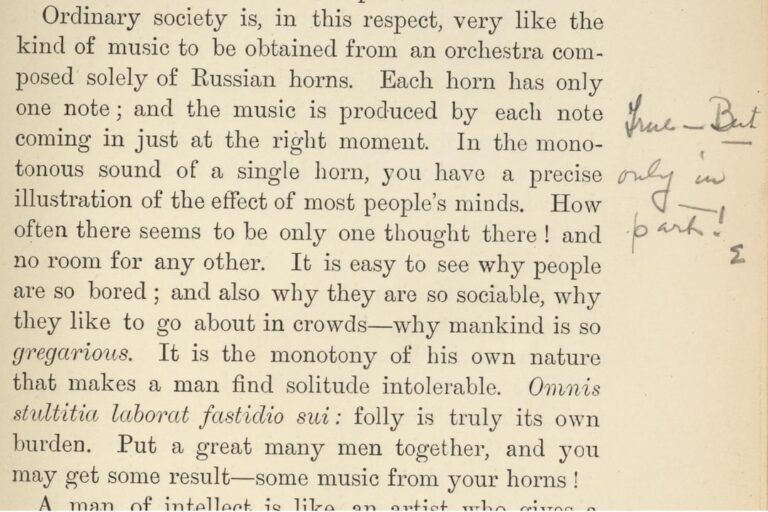
    For centuries, books were treated as sacred, untouchable artifacts. Readers were taught to open a spine with reverence, turn pages by the edges, and never, under any circumstance, mark the paper. But in the modern reading culture, a quiet revolution has taken root: marginalia is no longer viewed as defacement. Today, it is recognized as a vital form of active intellectual engagement. Marking up a book transforms reading from a passive act of consumption into an active. Reading is a two-way dialogue between the reader and the writer. When you read with a pencil, pen, or sticky tab in hand, your relationship with the text fundamentally shifts. You cease to be a distant spectator observing someone else’s thoughts. In other words, you become a collaborator. Underlining a sentence, drawing an exclamation point next to a surprising plot twist, or a counterargument in the margin forces your brain to process language at a deeper level. It requires you to articulate why a passage resonated or failed. Furthermore, annotated books serve as personal time capsules. When you reopen a novel you marked up five or ten years ago, it offers an unfiltered reflection into who you were at that exact moment in your life. You might find yourself cringing at an old marginal note. Then you agree passionately with a circled phrase, or realizing that a passage you completely ignored years ago now carries personal meaning. The book becomes a physical record not just of the author’s story, but of your own cognitive and emotional evolution. Edgar Allan Poe once wrote: ‘In getting my books, I have been always solicitous of an ample margin … for the facility it affords me of pencilling suggested thoughts, agreements and differences of opinion …’ Practically speaking, marginalia also sharpens critical thinking. Students, scholars, and casual readers alike find that tracking themes through custom color-coded tabs or brief summary notes at the end of chapters drastically improves retention and comprehension. It prevents the common phenomenon of eye-scanning where your eyes move across sentences while your mind wanders elsewhere. Annotation demands presence. Ultimately, scribbling in the margins strips away the artificial pedestal we often place books upon. It reminds us that literature is not meant to sit pristine and untouched on a display shelf. Literature is meant to be wrestled with, questioned, celebrated, and lived in. The next time you open a book that challenges or moves you, don’t hold back. Pick up a pen, claim the empty white space on the page, and join a conversation that has been taking place across centuries.  

  • |

    How the art of Tsundoku quietly transforms our minds

    Walk into the home of almost any avid reader, and you are bound to encounter the unread shelf. The uncracked spines perched on nightstands, overflowing from crowded bookshelves, or quietly gathering dust in living room corners. For years, Western cultural narratives have framed these unread collections as evidence of poor self-discipline, financial wastefulness, or half-baked literary ambitions. However, behavioral psychology and cultural reporting offer a far richer perspective. This habit is known in Japanese as tsundoku. It is not an intellectual failure. It is passionately human. It is rather psychologically beneficial relationship with knowledge, identity, and curiosity. The word tsundoku dates back to Japan’s Meiji era in the late nineteenth century. It cleverly fuses tsunde-oku (to pile things up for later) with dokusho (reading). This habit is unlike hoarding, which carries clinical connotations of distress and emotional attachment to clutter. tsundoku is characterized by a playful, optimistic spirit. It describes the act of gathering books with every intention of absorbing them, even if time inevitably falls short of ambition. In order to understand why so many people practice tsundoku, psychologists look at how the human brain processes reward and anticipation. When you pick up an intriguing volume in a bookstore, your brain’s neural circuits trigger a sudden release of dopamine. Interestingly, this neurochemical hit does not wait for you to actually finish the final chapter. The simple act of purchasing a book acts as a pivot for the learning experience itself. In that single moment of acquisition, your brain projects a vivid future self. One that’s sitting quietly by a window, sipping tea, and expanding their wisdom. The purchase satisfies a psychological longing for growth, even before page one is turned. Furthermore, an unread collection creates what essayists and thinkers call an antilibrary. The read books truthfully represent the territory of knowledge you have already conquered. In contrast, unread books serve as a physical map of your own ignorance. Surrounding yourself with stories you have yet to explore harbours intellectual humility. It keeps you constantly aware that the world is far larger, richer, and more complex than your current understanding. In a fast-paced modern culture obsessed with optimization, tracking goals and productivity metrics, an unread stack stands as a testament of pure potential. There is also immense emotional comfort in physical books. Unlike endless, urgent digital feeds or unread emails, physical volumes sit silently without making demands. They anchor a home, offering a tactile, grounding presence that reflects who you were when you bought them and who you hope to become in the future. So, if your personal library continues to consume your available free time, resist the urge to feel guilty. Those unread pages are not a monument to broken promises. They are a physical testament to a hungry mind that refuses to stop asking questions.