marginalia devised conversation
|

Why marginalia is devised for conversation

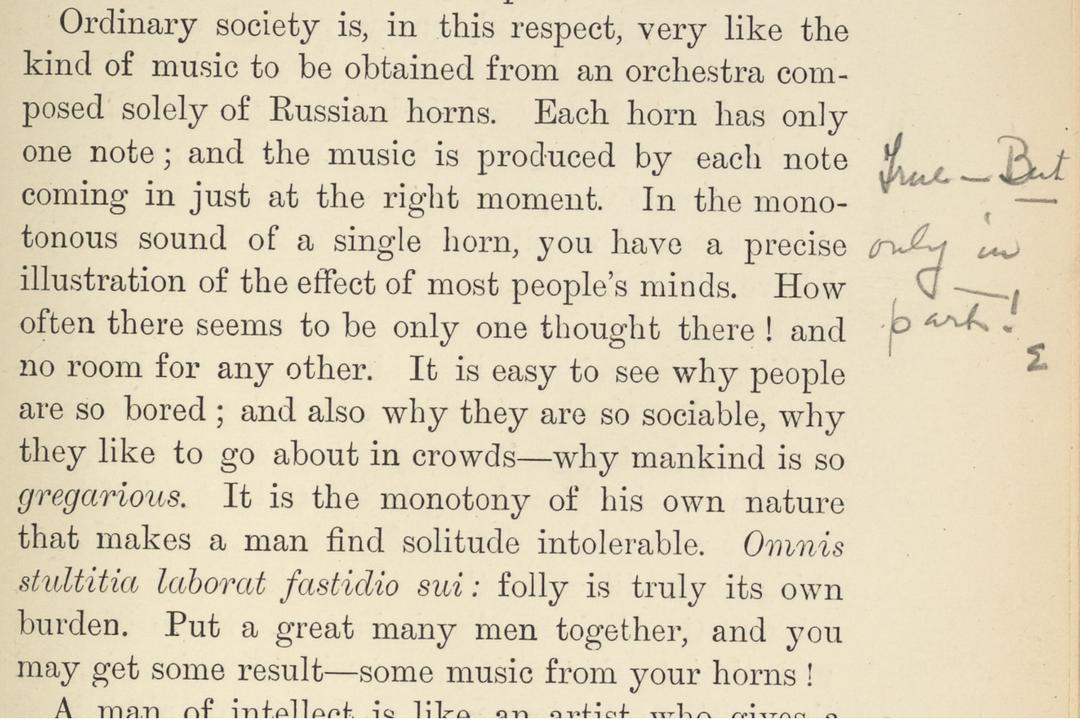
For centuries, books were treated as sacred, untouchable artifacts. Readers were taught to open a spine with reverence, turn pages by the edges, and never, under any circumstance, mark the paper. But in the modern reading culture, a quiet revolution has taken root: marginalia is no longer viewed as defacement. Today, it is recognized as a vital form of active intellectual engagement. Marking up a book transforms reading from a passive act of consumption into an active. Reading is a two-way dialogue between the reader and the writer.

When you read with a pencil, pen, or sticky tab in hand, your relationship with the text fundamentally shifts. You cease to be a distant spectator observing someone else’s thoughts. In other words, you become a collaborator. Underlining a sentence, drawing an exclamation point next to a surprising plot twist, or a counterargument in the margin forces your brain to process language at a deeper level. It requires you to articulate why a passage resonated or failed.

Furthermore, annotated books serve as personal time capsules. When you reopen a novel you marked up five or ten years ago, it offers an unfiltered reflection into who you were at that exact moment in your life. You might find yourself cringing at an old marginal note. Then you agree passionately with a circled phrase, or realizing that a passage you completely ignored years ago now carries personal meaning. The book becomes a physical record not just of the author’s story, but of your own cognitive and emotional evolution. Edgar Allan Poe once wrote:

‘In getting my books, I have been always solicitous of an ample margin … for the facility it affords me of pencilling suggested thoughts, agreements and differences of opinion …’

Practically speaking, marginalia also sharpens critical thinking. Students, scholars, and casual readers alike find that tracking themes through custom color-coded tabs or brief summary notes at the end of chapters drastically improves retention and comprehension. It prevents the common phenomenon of eye-scanning where your eyes move across sentences while your mind wanders elsewhere. Annotation demands presence.

Ultimately, scribbling in the margins strips away the artificial pedestal we often place books upon. It reminds us that literature is not meant to sit pristine and untouched on a display shelf. Literature is meant to be wrestled with, questioned, celebrated, and lived in. The next time you open a book that challenges or moves you, don’t hold back. Pick up a pen, claim the empty white space on the page, and join a conversation that has been taking place across centuries.

 

Similar Posts

  • |

    Increasing fuel prices

    From Meer Baloch Through the columns of your respected newspaper, I would like to draw the attention of the concerned authorities to the continuous increase in fuel prices in Pakistan. The rising cost of petrol and diesel has made life difficult for ordinary people. Higher fuel prices increase transportation costs, which also raise the prices of food, medicines, and other daily necessities. Poor and middle-class families are suffering the most because their incomes remain the same while expenses continue to rise. The government should take effective measures to control fuel prices and provide relief to the public. It should also promote affordable public transport and reduce unnecessary taxes on fuel. I hope my letter will create awareness and encourage the authorities to take prompt action.

  • |

    Longing for other lives

    You might be driving along a quiet stretch of highway at dusk and notice a remote house set against the rolling hills. Its porch light glowing softly against the fading twilight. It happens in an instant. Your mind steps inside for a fleeting moment. You picture yourself standing in that kitchen, tending to a warm pot of soup, learning the rhythms of the local wildlife and forget the press of unread emails. Or perhaps it happens when you see a cozy cottage on a distant coast. Might be an apartment perched above a neighborhood bookstore. Or a tiny rural train station where only a few passengers wait. For a few seconds, you inhabit that alternate life. But as quickly as the thought arrives, reality hits back. For many people, these sudden bursts of romantic daydreaming trigger a wave of subtle unease. It is common to treat such longings like a mild psychological symptom. It is an indicator that something in our current existence is lacking. We wonder if we made wrong turns along the path, selected the wrong career or settled into the wrong neighborhood. We assume that fantasizing about a simpler life means we are secretly desperate to escape our reality. However, a change in perspective shows that this assumption may misinterpret how the human mind functions. Understanding Fernweh: The Opposite of Homesickness The key to re-evaluating this feeling lies in a concept from the German language: fernweh. The word is translated literally as far-pain. Fernweh describes a deep, aching yearning for distant places. It stands as the emotional mirror image of homesickness. While homesickness pulls us back toward the familiar, fernweh pushes toward the unfamiliar. Fernweh is neither a practical plan for relocation nor a symptom of dissatisfaction. It exists in a unique middle ground. It is more than a mere desire to escape reality, yet far less than a literal plan to manifest a new lifestyle. When we treat longing as a sign of discontent, we force ourselves into an unnecessary dilemma. We start assuming we must either change our lives or suppress our thoughts entirely. In reality, these brief mental excursions rarely end with us packing a suitcase. Instead, they leave us returning to our daily routine feeling subtly expanded, as if our capacity for wonder has been stretched open. The Multiple Selves and the Purpose of Imagination The alternative selves we envision during daydreams: the quiet caretaker of a lighthouse, the keeper of a village shop, or the isolated writer in a secluded cabin, are not criticism on our present choices. They do not demand that we abandon our jobs or start over from scratch. Rather, these imagined lives serve as quiet reminders that human beings are inherently complex. The person managing household budgets, answering routine emails and searching for misplaced keys is not the entirety of who we are or who we could be. Human imagination evolved specifically to explore endless possibilities without requiring us to physically execute every scenario. Seeing Distant Peace as Invitation Instead of seeing distant places as destinations we failed to reach, we can view them as invitations. They invite us to reconnect with our curiosity, our creativity and our capacity for reinvention. They reassure us that another way of seeing the world remains entirely possible, even within the routine of daily living.   Ultimately, longing for another life or a distant land does not mean you chose the wrong life. It simply demonstrates that your imagination remains curious and alive. As long as a distant porch light or a road over a hill can capture your wonder, you can take comfort in a profound truth. The truth is your internal life will always be far larger than the single outer life you happen to inhabit.

  • Poor condition of roads in Dasht

    I want to draw the attention of the concerned authorities to the poor condition of roads in Dasht. Many roads are broken and full of potholes. During the rainy season, they become muddy and difficult to use. The damaged roads cause traffic problems and accidents. Students, patients, farmers, and other people face great difficulties while travelling. Sometimes vehicles are also damaged because of the bad roads. I request the concerned authorities to take immediate action and repair the roads in Dasht. Good roads are necessary for the safety and development of the area. I hope that the authorities will pay attention to this serious problem.

  • Early sugar control benefits brain health

    A new study suggests that giving children little or no sugar before the age of two may help reduce their risk of developing dementia later in life. Researchers found that people who were exposed to very low amounts of sugar during pregnancy and in their first two years of life had a 23% lower risk of dementia as adults. Health experts say eating too much sugar is already linked to type 2 diabetes which can damage blood vessels and increase the risk of dementia. The new findings suggest that limiting sugar early in life may also support long term brain health. The study’s lead author, Dr. Jiaxin Zheng said the results show that reducing sugar intake during early childhood could have lasting benefits for brain health. Researchers added that while the findings are encouraging more studies are needed to confirm the connection between low sugar intake in early life and a lower risk of dementia.

  • Frailty, thy name is woman

    Frailty, thy name is woman. When William Shakespeare wrote those famous words in Hamlet, he was reflecting a cultural dogma that would shackle women for centuries. For generations, society treated female vulnerability not as a situational condition, but as an inherent biological truth. Women were categorized as delicate creatures requiring protection, physically incapable of heavy labor, and psychologically unsuited for high-stakes conflict. That archaic myth has officially crumbled. Across military frontlines, deep-sea research facilities, high-altitude athletics, and outer space, women are consistently performing tasks once deemed physically and mentally impossible for them. The notion that physical and emotional fragility is uniquely female is just outdated. It is empirically false. To understand how rapidly this paradigm is shifting, one needs to look no further than recent milestones in defense and aerospace news. Over the past decade, armed forces around the globe including the United States, Britain, and Ukraine have systematically opened elite infantry, combat engineering, and special forces units to women. Reporting from military defense outlets highlights that female service members are completing rigorous combat fitness tests, enduring punishing load-bearing marches carrying 80-pound packs, and demonstrating tactical mastery under live fire. During recent global conflicts, female soldiers have served directly on combat lines, driving heavy tactical vehicles, executing artillery strikes, and providing direct tactical support under extreme duress. The old argument that women lack the physical stamina or aggressive grit for battlefield conditions has been disproven not by rhetoric, but by operational reality. Beyond Earth’s atmosphere, space exploration news provided another definitive refutation of female frailty when NASA astronauts Christina Koch and Jessica Meir conducted the world’s first all-female spacewalk. Working outside the International Space Station for more than seven continuous hours, the pair maneuvered massive hardware components while tethered over 200 miles above Earth. Operating in heavy, pressurized extravehicular suits requires immense upper-body endurance, spatial coordination, and psychological coolness under pressure. Their performance demonstrated that when training, gear, and opportunity align, gender is completely irrelevant to high-risk technical performance. For centuries, skeptics cited raw biological differences such as lower average muscle mass compared to men as definitive proof of female inadequacy for physically demanding tasks. However, modern exercise physiology and ergonomics present a far more nuanced picture. While average biological markers differ across populations, top-tier female athletic conditioning overlaps significantly with high-level male capabilities. A trained female soldier or weightlifter easily outperforms the vast majority of untrained men in functional strength, endurance, and power output. Studies in ultra-endurance athletics such as 200-mile marathons and open-water ocean swims show that women often narrow the performance gap as distance increases. Female physiology displays high metabolic efficiency in utilizing fat stores during prolonged exertion, alongside exceptional psychological resilience in managing physical discomfort. Modern warfare, heavy industry, and aviation rely less on brute force and more on endurance, technical precision, decision-making, and specialized gear. Advances in ergonomic equipment and load-distribution technology ensure that operational success hinges on skill and stamina rather than raw power alone. Physical capability is only half the equation. The traditional stereotype of frailty was always as much about mental weakness as physical limitation. Women were portrayed as overly emotional, prone to panic, and ill-equipped for decisive leadership during crises. Real-world experience repeatedly contradicts this bias. From emergency room physicians navigating mass-casualty events to political leaders steering nations through global pandemics and conflicts, women consistently exhibit calm, strategic resolve under fire. Calling frailty a woman’s trait was never a scientific fact. It was a social construct designed to limit access, independence, and authority of women. When women were barred from gymnasiums, sports, military academies, and executive boardrooms, society pointed to their absence as proof of their inability. Once those doors were forced open, the illusion dissolved. Acknowledging that frailty is not a female trait does not mean pretending that men and women are biologically identical. It means recognizing that human potential is defined by discipline not by gender.

  • Thieves cook 14 egg omelet before robbery

    In a strange burglary case from India’s Rajasthan state thieves surprised police by stopping to cook and eat a 14 egg omelet before stealing valuables from a house. According to Indian media reports the burglars broke into an empty home and stole an LED TV cash and jewelry worth thousands of dollars. Before leaving they went into the kitchen cooked a large omelet using 14 eggs and ate it. Police said the house belongs to Harjit Singh who was in Mumbai with his family for cancer treatment when the burglary happened. The thieves searched the house and left many rooms in a mess before escaping with the stolen items. Officers reached the scene after receiving a report and started an investigation. Since the family is still in Mumbai police have not yet confirmed the full list of stolen items or the total financial loss. A police official added that the neighborhood had a private security guard but the thieves managed to enter the house without being caught.

Leave a Reply

Your email address will not be published. Required fields are marked *