explainer asean digital
| | | |

EXPLAINER: What is the ASEAN Digital Economy Framework Agreement?

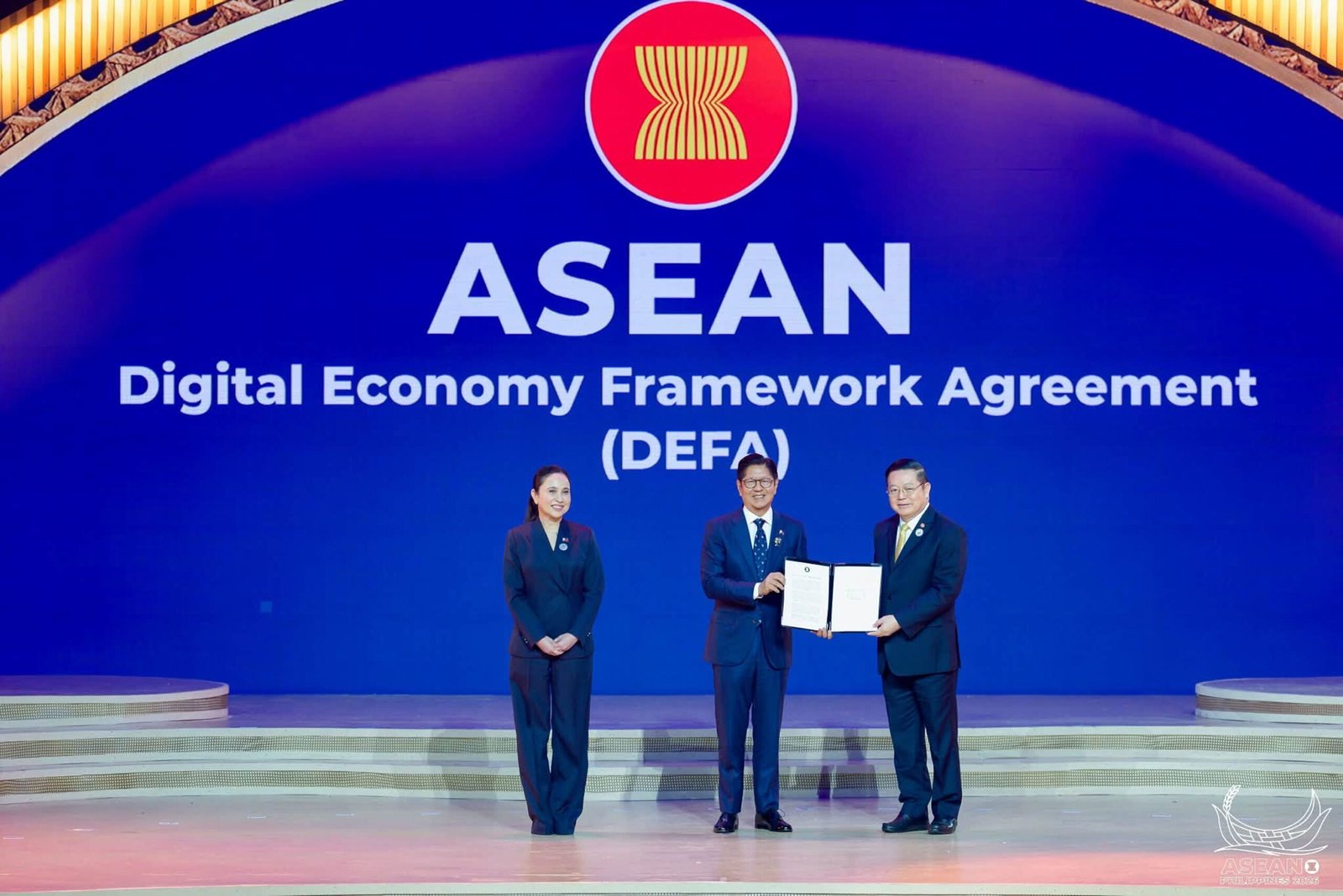
MANILA, Philippines – Members of the Association of Southeast Asian Nations (ASEAN) have signed the ASEAN Digital Economy Framework Agreement (DEFA), the first region-wide agreement of its kind.

Signed by ASEAN’s 11 member-countries on Saturday, November 14, DEFA establishes common rules for digital trade in a market of nearly 680 million people. Negotiations began in 2023, with the agreement becoming a priority deliverable of the Philippines’ ASEAN chairmanship this year.

“DEFA is not simply about economic growth. It is establishing the rules, systems, and cooperation that will allow our people and businesses to participate more fully in that growth,” Trade Secretary Cristina Roque said during the signing ceremony on Saturday.

Roque also said DEFA could help ASEAN’s digital economy grow from an estimated $1 trillion to $2 trillion by 2030.

But what exactly will it do?

At a high level, DEFA hopes to establish an “interconnected ASEAN digital marketplace,” with a framework covering cross-border e-commerce, electronic payments, protection of source code, cybersecurity, online consumer protection, and cooperation on emerging technologies such as artificial intelligence. It’s another step in ASEAN’s long-held aspiration of economic integration, though critics say progress toward a single market and production base has been painfully slow.

“DEFA will facilitate paperless trading, cross-border e-commerce, and trusted cross-border data flows, and it will establish interoperable trade systems,” ASEAN Secretary-General Kao Kim Hourn said at the ASEAN Business and Investment Summit on Saturday.

In practical terms, that means lower transaction costs, simpler cross-border operations, and easier access to customers in the region, especially for micro, small, and medium enterprises (MSMEs). This includes cutting down on paperwork through the wider use of electronic trade documents, signatures, and invoices, as well as establishing clearer rules for cross-border data transfers.

According to Finance Secretary Frederick Go, more than half of enterprises trading in ASEAN still face paper requirements at the border, and two out of three in using digital payments also reported delays.

“DEFA is built to remove exactly those frictions,” Go said in a speech at the ASEAN Business and Investment Summit.

Must Read

From micro to massive, ASEAN’s entrepreneurs face regulatory hurdles


From micro to massive, ASEAN’s entrepreneurs face regulatory hurdles

When will it take effect?

Though the agreement has been signed, its implementing rules have yet to be fully developed, meaning many of the specifics remain unclear, and its benefits could still take months, if not years, to be felt.

“We hope, after signing today, ASEAN will fast track the ratification process and while the ratification process is moving forward, we are working on the implementation plan so that this will be ready by May next year when DEFA goes into effect,” Hourn said.

ASEAN expects the agreement to enter into force in 2027, with May identified as a target for implementation. The full text of the ASEAN DEFA is also expected to be published on the ASEAN Secretariat website by early 2027.

Locally, the Department of Trade and Industry plans to conduct trade shows and information campaigns in 2027 to help entrepreneurs understand the agreement.

Another thing to watch would be whether the gains under DEFA would redound only to large businesses or would reach all the way to MSMEs. As ASEAN Business Advisory Council (ASEAN-BAC) chair Joey Concepcion III put it, MSMEs will be the acid test for the agreement.

“What works for the smallest businesses can also work for the largest companies. If we can make cross-border trade simple, efficient, and secure enough for MSMEs, we create a foundation that can benefit businesses of every size,” the Go Negosyo founder said in a statement. – Rappler.com

Similar Posts

  • |

    Pakistan Stock Exchange ends week lower as KSE-100 falls 1,325 points

    The Pakistan Stock Exchange (PSX) witnessed a relatively volatile trading week, with the benchmark KSE-100 Index ending lower after losing 1,325 points over the five trading sessions. The benchmark index settled at 180,104 points at the close of the week, compared with its previous level, reflecting a decline in investor sentiment and selling pressure across the market. During the week, the KSE-100 Index moved within a range of 2,568 points. The index touched a weekly high of 182,347 points, while its lowest level stood at 179,778 points, highlighting fluctuations in trading activity throughout the period. Despite the overall decline in the benchmark, trading activity remained substantial. A total of approximately 3.41 billion shares changed hands during the week, with the combined traded value reaching around Rs152 billion. The market’s overall capitalization also came under pressure during the reporting period. According to the weekly market data, total market capitalization declined by approximately Rs107 billion, falling to Rs20.13 trillion. Market participants continued to monitor developments affecting domestic economic conditions, investor confidence and broader market sentiment. The movement in the benchmark index reflected a cautious approach among investors, with fluctuations in buying and selling activity contributing to the week’s overall performance. The decline in the KSE-100 Index comes despite continued interest in equities, as investors assessed market valuations and economic indicators while keeping a close watch on developments that could influence the direction of the stock market in the coming sessions.

  • |

    Global food prices hit three-year high in July

    Global food prices reached their highest level in three years in July. The United Nations Food and Agriculture Organization (FAO) said global food prices rose significantly due to weather conditions and the Iran-US war reaching a three-year high. The FAO Food Price Index tracks monthly changes in international prices of major food commodities. According to the index, global food prices rose to 131.1 points in July compared with 130.3 points in June. This was the highest level recorded since January 2023. The FAO’s chief economist had told a news agency in recent days that the world was once again facing food price inflation due to the wars in Iran and Ukraine as well as the El Niño climate phenomenon which can affect crop production. El Niño is a climate pattern in which a large part of the Pacific Ocean becomes unusually warm contributing to an increase in global temperatures. According to the international organization, wheat prices increased by 5.8% resulting in an overall 3.4% increase in commodity prices. Wheat exports through the Black Sea were affected while rising temperatures disrupted crop production in major wheat-growing regions. The FAO Vegetable Oil Price Index increased by 2% reaching its highest level since June 2022. Vegetable oil prices rose due to the Iran war and increased demand for biodiesel. Sugar prices increased by 5.6% amid weather-related concerns in Europe and Asia. However, meat prices declined by 2.8%.

  • |

    Electricity tariff likely to increase by Rs1 per unit from next month

    ISLAMABAD: Electricity consumers across Pakistan may face higher power bills from next month as electricity distribution companies have approached the National Electric Power Regulatory Authority (NEPRA) seeking a quarterly tariff adjustment. According to sources, the proposed adjustment could result in an increase of around Rs1 per unit in electricity prices during the upcoming quarter. The distribution companies have submitted their adjustment request to NEPRA, which will examine the figures and determine the impact on consumers under the applicable quarterly tariff mechanism. Sources said the expected increase is linked to the expiry of the existing quarterly adjustment relief. Under the current arrangement, consumers are receiving a relief of Rs1.99 per unit, which is scheduled to expire at the end of the current month. With the relief ending, electricity tariffs are expected to rise for consumers across the country from next month, subject to NEPRA’s approval of the proposed adjustment. The quarterly tariff adjustment mechanism is used to pass on changes in electricity generation costs and other relevant expenses to consumers. Depending on the regulator’s assessment, the resulting adjustment can either increase or reduce electricity bills. The proposed increase is likely to add to the financial burden on households and businesses already facing elevated electricity costs. Consumers are now awaiting NEPRA’s decision, which will determine the final impact on electricity tariffs in the upcoming quarter. NEPRA is expected to review the distribution companies’ submissions before announcing its decision. The final adjustment may differ from the amount initially sought by the power distribution companies following the regulator’s scrutiny of the data and applicable costs.

Leave a Reply

Your email address will not be published. Required fields are marked *