vantage point inside
| | | | | | | |

[Vantage Point] Inside the addictive architecture of the AI microdrama

The 90-second melodramas flickering across our phone screens are no longer mere digital junk food.

Behind the frantic cliffhangers, the barrage of interstitial ads, and the constant badgering for virtual coins lies a multibillion-dollar enterprise engineered with behavioral psychology, algorithms, and artificial intelligence (AI). It has set its sights on the one asset legacy streaming giants cannot manufacture: our time.

The tropes are unmistakable to anyone who has idled through Facebook, TikTok, or YouTube. A billionaire masquerades as a pauper. A wife discovers her husband cheating with her sister. An abused daughter turns out to be the rightful heiress to an empire. Dragons, werewolves, competing for crowns, thrones and what not. A ruthless CEO falls hopelessly in love with an ordinary subordinate. The acting is often stilted, the plots unhinged, and the dialogue rarely resembles anything spoken by living humans.

Yet we do not look away.

An installment barely lasts two minutes before its successor cues itself. Just as the villain faces ruin or the heroine brandishes proof that she owns the company, the frame snaps to black. The resolution is held hostage: download the application to see what comes next. Only then does it become clear that what looked like silly social media distraction is actually the entrance to a ruthlessly calibrated money-making machine.

This is the domain of the vertical microdrama, or duanju, a narrative format that exploded in China before sweeping across the globe. 

Monetizing the cliffhanger

Where conventional TV requires 30 to 60 minutes to nurture a conflict and coax it to resolution, the microdrama strips narrative arc down to pure adrenaline, compressing tension and catharsis into 60 to 180 seconds. Betrayal, humiliation, revenge, and revelation arrive in rapid succession. Just before the brain registers satisfaction, the screen cuts out, dangling another hook.

A 2026 study of 658 participants established clear pathways linking narrative immersion, emotional involvement, algorithmic personalization, and compulsive viewing habits. Microdramas introduce an ingenious twist to the familiar psychology of the infinite scroll: they monetize the cliffhanger.

In this context, legacy streaming models seem almost quaint.

Netflix asks for payment once a month and surrenders its entire vault. A microdrama app demands an economic decision every few minutes. Watch an advertisement. Earn coins. Spend coins. Unlock 90 seconds of the next episode. Buy another bundle. Or capitulate to a recurring subscription. 

On the Philippine App Store, ReelShort lists purchases and memberships at P299 and P499, including an auto-renewing P499 weekly subscription. DramaBox operates on a parallel tier of P299 and P499 memberships.

The arithmetic is startling. Sustained for four weeks, a P499 weekly tier totals P1,996. For perspective, Netflix Philippines charges P169 a month for Mobile, P279 for Basic, P449 for Standard, and P619 for Premium. Disney+ revised its Philippine monthly fees in December 2025 to P289 for Basic and P599 for Premium, while HBO Max remains leaner still at P149 for Mobile, P269 for Standard, and P399 for Ultimate.

A month of vertical melodrama can eclipse 11 months of Netflix Mobile, nearly seven months of Netflix Basic, seven months of Disney+ Basic, or over seven months of Max Standard. 

Must Read

Streaming services ‘winning hearts and minds’ of Filipinos, says new study


Streaming services ‘winning hearts and minds’ of Filipinos, says new study

Paying with time and attention

To be sure, this is not an exact parallel: a ReelShort subscriber gains access to a broad library instead of paying P1,996 for a single series, and users can reduce or avoid out-of-pocket costs through rewarded tasks and ad sequences. 

Yet that qualification merely underlines the brilliance of the trap. When viewers do not pay with money, they pay with time and attention.
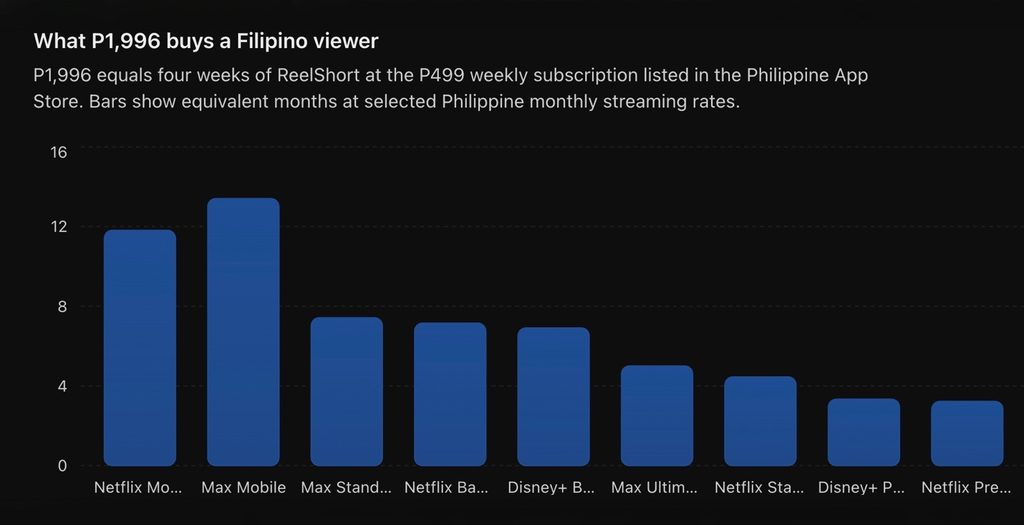
The price of the cliffhanger. ReelShort’s Philippine App Store listing shows a P499 weekly subscription. Four consecutive weekly periods would therefore cost P1,996. The graph shows how far the same amount would go on conventional streaming services: roughly 13.4 months of Max Mobile, 11.8 months of Netflix Mobile, 7.4 months of Max Standard, 7.2 months of Netflix Basic, 6.9 months of Disney+ Basic, five months of Max Ultimate, 4.4 months of Netflix Standard, 3.3 months of Disney+ Premium or 3.2 months of Netflix Premium. The comparison does not mean watching a single microdrama necessarily costs P1,996—viewers can use ads, rewards and other payment options. Rather, it illustrates how quickly a seemingly modest P499 weekly auto-renewing charge can add up compared with the monthly subscription model of mainstream streaming platforms.

The “free” tier is an illusion of thrift. ReelShort itself notes that content can be unlocked through optional ads and rewarded tasks, while App Store reviews describe viewers dutifully sitting through commercial breaks to tease out the next narrative turn. 

DramaBox users face the identical trade-off. The transaction is fluid — money, attention, or time — and the narrative is sculpted to ensure the user surrenders at least one value metric.

These micro-transactions swell into an immense commercial tide. Sensor Tower estimates short-drama apps generated roughly US$750 million in in-app revenue in the first quarter of 2026 alone, while downloads exceeded 850 million. 

Omdia estimates the broader global microdrama industry could generate around US$14 billion this year. China already commands an audience of more than 800 million microdrama viewers, while AI is transforming what was already a high-speed production line into something that resembles an entertainment factory.

The role of AI is surgical. These productions are not purely synthetic; human actors, writers, directors, and crews still populate sets. But machine learning increasingly assists in drafting scripts, producing synthetic imagery and voices, automating localization and dubbing, generating visual effects, and testing plot variations across global markets. It enables a cadence of imitation, adaptation, and output that traditional Hollywood could never match.

Filipinos sit squarely in its path. DramaBox and ReelShort hold the No. 2 and No. 3 spots, respectively, in the Entertainment category of Apple’s Philippine App Store. Domestic powerhouses like ABS-CBN have entered vertical drama production, as Southeast Asia cements its status as one of the world’s most lucrative hubs for short-drama downloads.

The danger to Netflix, Disney+, and broadcast television is not an overnight wave of cancellations. It is a war of attrition over the clock. American mobile viewers already devote substantial daily hours to microdramas, while Southeast Asian audiences increasingly treat them as a surrogate for long-form video.

There are only so many hours between arriving home and going to sleep. Every forty minutes spent unraveling whether a mistreated but brilliant wife takes revenge on her cheating billionaire husband is 40 minutes permanently denied to prestige cinema, network broadcasts, or flagship series.

Legacy studios spent billions building sprawling libraries under the assumption that sheer abundance would guarantee audience loyalty. The architects of the microdrama discovered something far more potent: ordinary viewers do not always hunger for a two-hour movie. Frequently, our resolve dissolves before 90 seconds of unrestrained melodrama, an outrageous premise, and an unanswered question.

And the very moment our curiosity is piqued to discover what happens next, the price of finding out has already been calculated.

I welcome your views on these and other issues where decisions made in power shape the country’s economic future. – Rappler.com

This analysis draws from: Sensor Tower’s State of Short Drama Apps 2026; Omdia’s 2026 microdrama market and mobile-engagement research; Apple Philippines App Store listings for ReelShort and DramaBox; Netflix Philippines; Disney+ Philippine pricing; and Max Philippine pricing. The accompanying graph was generated by Vantage Point with raw data computed on Excel and exported to Photoshop for enhancement. The chart compares four P499 weekly ReelShort subscription periods (P1,996) with prevailing monthly rates of major streaming services.

Must Read

[DECODED] No, this ‘handsome’ Duterte grandson is not real


[DECODED] No, this ‘handsome’ Duterte grandson is not real

Below are some Vantage Point pieces you might have missed:

Click here for other Vantage Point articles.

Similar Posts

  • |

    Power sector circular debt rises by Rs364 billion in FY2025-26

    ISLAMABAD: Pakistan’s power sector circular debt increased by Rs364 billion during fiscal year 2025-26, highlighting persistent weaknesses in the electricity supply chain despite substantial government subsidies and efforts to contain the buildup of unpaid liabilities. According to the circular debt report for June 2026, the increase was significantly higher than the previous year, when the debt had risen by around Rs45 billion. The latest increase represents a surge of roughly 709% year-on-year in the annual flow of circular debt. The Power Division has not yet formally uploaded the one-page circular debt report for June 2026 on its official website. The latest figures indicate that structural problems, including distribution company inefficiencies, weak bill recovery, payment disputes and delays in tariff adjustments, continue to generate fresh liabilities in the power sector. The development comes despite the government’s efforts to contain the debt through budgetary support and subsidies. IMF target and government commitments The International Monetary Fund (IMF) had permitted Pakistan to record up to Rs400 billion in circular debt flow during the year, while simultaneously requiring the government to take measures to prevent the accumulation of new liabilities and eventually bring the flow down to zero. Under the IMF programme, the government has been relying on tariff adjustments, subsidy rationalisation and other reforms to improve the financial health of the electricity sector. However, the latest increase suggests that governance and operational problems remain a major obstacle to achieving a sustainable reduction in circular debt. The government provided approximately Rs302 billion in subsidies aimed at supporting the power sector and reducing the debt burden. However, the amount was insufficient to maintain the circular debt stock at the level of Rs1.614 trillion recorded at the end of June 2025. As a result, the debt stock recorded a net increase of around Rs61 billion during the year. The Power Division had earlier stated that the federal government allocated Rs893 billion for the power sector in the FY2025-26 budget. However, around Rs98 billion of the allocated amount was not released, affecting the government’s ability to reduce the outstanding liabilities. A Power Division spokesperson said that if the entire budgeted allocation had been released, the circular debt stock could have fallen further to around Rs1.577 trillion. The funding shortfall, according to the official, contributed to the Rs61 billion increase recorded during the year. Distribution companies remain a major source of losses Inefficiencies within power distribution companies continued to be one of the biggest contributors to the accumulation of circular debt. The government incurred approximately Rs262 billion in losses during FY2025-26 because of inefficiencies in distribution companies. The amount was only around Rs3 billion lower than the previous year, indicating that little progress has been made in addressing operational weaknesses. Another Rs64 billion was added to the circular debt because of lower electricity bill recoveries. Although significant, this amount was around 51% lower than the corresponding figure recorded in the preceding year. The figures underline the financial pressure created by electricity theft, transmission and distribution losses, weak collection systems and inadequate enforcement against non-paying consumers. Privatisation of distribution companies The government has initiated the process of privatising three relatively profitable distribution companies — Faisalabad Electric Supply Company, Gujranwala Electric Power Company and Islamabad Electric Supply Company. However, the proposed privatisation is not expected to immediately resolve the broader circular debt problem because a substantial portion of sector losses originates from other distribution entities. Earlier, the government had considered a model under which profitable distribution companies would be combined with loss-making entities before privatisation. The plan, however, was subsequently abandoned in favour of offering comparatively stronger companies separately. Experts have repeatedly argued that privatisation alone cannot eliminate circular debt unless the underlying issues of electricity theft, poor recoveries, governance and operational losses are addressed across the entire distribution network. K-Electric dispute adds to debt Payment disputes with K-Electric also contributed substantially to the increase. According to the report, approximately Rs194 billion was added to the circular debt because of non-payments by K-Electric. The company’s outstanding payments are linked to a dispute concerning the delayed finalisation of its multi-year tariff by the National Electric Power Regulatory Authority. The prolonged disagreement has created financial pressure throughout the power supply chain, adding to the accumulation of unpaid liabilities. In addition, around Rs75 billion was added to the circular debt because of delays in tariff adjustments. The government, meanwhile, made payments of approximately Rs129 billion against principal loans of the power sector. Without these payments, the annual circular debt flow could have exceeded Rs600 billion, according to the figures. The Power Division also benefited from a reduction of around Rs98 billion in the circular debt flow because of subsidy payments. Interest payments add further pressure Interest charges also contributed to the accumulation of liabilities, adding around Rs14 billion to the circular debt during the fiscal year. These financing costs ultimately increase the burden on consumers because the cost of servicing the sector’s outstanding liabilities is recovered through electricity bills. Consumer groups have frequently criticised the practice, arguing that households and businesses that regularly pay their electricity bills are effectively being charged for inefficiencies, theft and non-payment elsewhere in the system. Subsidies and burden on consumers The government’s continued reliance on subsidies has helped prevent an even larger accumulation of circular debt, but it has also placed pressure on the national budget. The power sector received hundreds of billions of rupees in subsidies during the year, while the government simultaneously pursued tariff increases and other measures intended to improve cost recovery. The contrast has raised questions about whether existing policies are addressing the underlying causes of circular debt or merely shifting the burden between consumers, the federal budget and power-sector entities. The government has also been under pressure to address similar financial problems in the gas sector. Although no comparable subsidy was provided for the gas sector, the authorities were expected to prevent a further increase in its circular debt. The government reportedly refrained from passing the full reduction in gas prices on

  • |

    PIA-style model proposed for DISCO privatisation

    ISLAMABAD: The government has proposed a new financial structure for the privatisation of three major power distribution companies. The plan covers Faisalabad Electric Supply Company (FESCO), Gujranwala Electric Power Company (GEPCO) and Islamabad Electric Supply Company (IESCO).The proposal is based on the restructuring model used during the privatisation process of Pakistan International Airlines (PIA). Under the proposed plan, selected assets and liabilities of the three companies will be separated from their balance sheets.The government plans to establish a Special Purpose Vehicle (SPV) for this purpose. The SPV will be owned by the government. It will hold specific assets and liabilities removed from the DISCOs. The restructuring is aimed at making the companies more attractive to private investors. The government wants to offer financially stronger entities to potential buyers.Land assets are among the items expected to be separated from the DISCO balance sheets. Liabilities related to retired employees and pension benefits will also be shifted to the SPV.These pension-related liabilities were worth around Rs312 billion for the three companies as of June 2025. The final amount could change after the companies’ balance sheets are restructured. The government plans to use audited financial results for March 2026 as the basis for the final calculation.The three DISCOs had combined assets of around Rs1.2 trillion in June 2025. Their combined liabilities stood at approximately Rs1.05 trillion.The companies together reported net positive equity of around Rs145 billion. However, the financial position of the three companies varies considerably.GEPCO had negative equity of around Rs14.4 billion as of June 2025. The final figures may be different because the government is using March 2026 audited accounts for the restructuring process. The Privatisation Commission board has recommended that the Cabinet Committee on Privatisation approve the restructuring plans. The plans cover the first group of DISCOs selected for privatisation.The proposed arrangements have been prepared using audited financial statements for the period ending March 31, 2026. Officials believe the new structure could increase the value of the companies for the government.It is also intended to make the transactions commercially viable for private-sector investors. The government hopes the approach will attract stronger interest from domestic and international buyers.The strategy closely resembles the model adopted for PIA. During the airline’s privatisation process, the government separated more than Rs650 billion in liabilities from PIA’s balance sheet.The move was designed to leave the airline in a stronger financial position before its transfer to new owners. A similar approach is now being considered for the three DISCOs.The Privatisation Commission has been informed that both local and foreign investors have shown interest in the companies. The government has already announced deadlines for Expressions of Interest.Investors interested in FESCO must submit their Expressions of Interest by August 7, 2026. The deadline for GEPCO is August 21, 2026.For IESCO, the deadline has been set for September 7, 2026. FESCO has a relatively stronger financial position among the three companies.Its assets stood at around Rs410.3 billion as of June 2025. Its liabilities were approximately Rs347 billion.The company reported positive equity of around Rs63 billion. The equity position was supported by deposits for shares and gains from asset revaluation.FESCO also recorded a profit after tax of around Rs9.4 billion. Its non-current liabilities stood at approximately Rs217.6 billion.Staff retirement benefits accounted for around Rs123 billion of these liabilities. The company’s current liabilities were estimated at about Rs130 billion.Trade payables made up around Rs118 billion of the current liabilities. GEPCO reported a profit after tax of around Rs13.7 billion.Its total assets stood at approximately Rs238 billion. However, its equity remained negative at around Rs14.4 billion.The company’s total liabilities were around Rs252.5 billion. Staff retirement benefits accounted for approximately Rs79 billion.IESCO reported a loss after tax of around Rs1.42 billion during the same period. The company had total assets of approximately Rs547 billion.Its liabilities stood at around Rs450 billion. Despite recording a loss, IESCO had positive equity of around Rs97 billion. The company’s equity position was supported by a share deposit of approximately Rs67 billion. It also benefited from a surplus revaluation of around Rs158 billion.IESCO’s liabilities included staff retirement benefits worth around Rs110 billion. The company also carried deferred tax liabilities.The proposed privatisation is part of Pakistan’s wider power-sector reform programme. It is also linked to commitments made under Pakistan’s agreement with the International Monetary Fund (IMF).Pakistan has repeatedly pledged to reduce government involvement in the power distribution sector. The commitment to privatise at least three DISCOs has been made several times since 2013.Previous attempts, however, failed to reach completion. The IMF has urged Pakistan to implement structural reforms in the power sector.The broader objective is to reduce electricity costs for households and businesses. The reforms also aim to improve the operational efficiency of power distribution companies.The IMF has previously noted delays in the private-sector participation process for DISCOs. The first group, consisting of FESCO, GEPCO and IESCO, faced delays after potential investors raised concerns about the proposed transaction structure.The government has now said that those concerns have been addressed. Officials expect the privatisation process to move forward.The government is targeting completion of the first phase by early 2027. The proposed SPV will be an important part of the process.It is intended to separate selected financial burdens from the three companies before they are offered to private investors. The government hopes the restructuring will improve investor confidence and make the DISCO transactions more commercially attractive.

  • |

    ECNEC approves Rs1.15tr development projects amid major cost escalations

    ISLAMABAD: The government has approved 16 development projects with a combined estimated cost of around Rs1.15 trillion, including the controversial Lahore-Sahiwal-Bahawalnagar motorway and the fifth extension of the Tarbela hydropower project, whose cost has surged by nearly 282% from the original estimate. The decisions were taken by the Executive Committee of the National Economic Council (ECNEC), chaired by Deputy Prime Minister Ishaq Dar. Several of the projects had previously been considered by development forums and returned with revised costs following delays, changes in scope and rising construction expenses. Of the total approved amount, approximately Rs320 billion represents additional expenditure linked to cost increases and delays, highlighting the financial pressures facing major public-sector development schemes. The government, however, issued only a brief statement following the ECNEC meeting and did not provide a complete breakdown of all the projects and their financial details. The omission of the Lahore-Sahiwal-Bahawalnagar motorway from the official summary was particularly notable given the political controversy surrounding the scheme. Lahore-Bahawalnagar motorway approved The ECNEC approved the Rs407 billion Lahore-Sahiwal-Bahawalnagar Motorway project, retaining its original 295-kilometre alignment in accordance with a directive issued by Prime Minister Shehbaz Sharif earlier this year. The first package, covering an 18.5-kilometre stretch from the Lahore Ring Road to Raja Jang Interchange, was approved at an estimated cost of Rs49 billion through federal financing. The project has faced opposition from the Pakistan Peoples Party (PPP), which has raised objections to the scheme and its proposed alignment. Given the heavy financial burden on the Public Sector Development Programme (PSDP), the ECNEC directed the National Highway Authority (NHA) to examine public-private partnership options for sections that could attract private investment. For commercially viable portions, the NHA will arrange its contribution through its own revenues in the form of Viability Gap Funding. For sections that are considered financially unviable, alternative arrangements will be explored, including contributions from the Punjab government, loans or financing from international financial institutions and direct federal funding, subject to the availability of resources. Tarbela extension faces major cost increase One of the most significant approvals was the fifth extension of the Tarbela project, which received approval at a revised cost of Rs316 billion. The project’s original estimated cost stood at approximately Rs82 billion, meaning its revised price tag represents an increase of about 282%. The steep escalation has already attracted scrutiny from government officials. During the Central Development Working Party (CDWP) review, Planning Minister Ahsan Iqbal reportedly raised concerns over project management, transparency and oversight. Questions were also raised regarding the technical capacity of personnel associated with the project. The Ministry of Water Resources had previously highlighted shortcomings in an inquiry into problems encountered during project implementation. An inquiry into the failure of the downstream cofferdam reportedly concluded that the structural collapse was linked to design changes, inadequate supervision and delayed administrative action rather than flooding. The findings attributed the failure to the shift from roller-compacted concrete to a rock-fill structure, along with weaknesses in project oversight. The incident resulted in delays and financial losses, adding to concerns over the project’s rising cost. The Ministry of Finance also sought an explanation for the substantial increase in the project’s estimated cost. Since the scheme is being financed through international financial institutions, the ministry asked the Water and Power Development Authority (Wapda) to provide details regarding the mechanism for repayment. Despite the concerns and requests for additional information, the ECNEC ultimately approved the revised project cost. Road and infrastructure schemes The committee also approved the 48-kilometre Khwazakhela-Besham Expressway at a revised cost of Rs116.6 billion. The new estimate is around 47% higher than the original cost. Another interprovincial road scheme aimed at improving connectivity between Gilgit-Baltistan and Azad Jammu and Kashmir was approved at Rs29 billion, representing an increase of approximately Rs10 billion over its initial estimate. The Rathoa Haryam Bridge over the reservoir channel on the Mirpur-Islamgarh Road also received approval at a revised cost of Rs10.8 billion. Its original estimate had been only Rs1.4 billion, reflecting a substantial increase over the initial projection. The ECNEC further approved the Lahore Wastewater Treatment Plant at a cost of Rs56.6 billion, around Rs4.2 billion above the earlier estimate. Poverty alleviation and education initiatives The Southern Punjab Poverty Alleviation Project was approved at Rs29.7 billion and will cover 10 districts: Bahawalnagar, Bahawalpur, Bhakkar, Dera Ghazi Khan, Khushab, Layyah, Mianwali, Muzaffargarh, Rahim Yar Khan and Rajanpur. The scheme includes an additional cost escalation of around Rs6.8 billion and is aimed at improving socioeconomic conditions and livelihood opportunities in some of the region’s less-developed areas. The ECNEC also sanctioned Rs10.6 billion for the Fulbright scholarship programme, under which 816 scholarships are planned. Of these, 550 MS and 141 PhD scholarships will be administered through the United States Educational Foundation in Pakistan (USEFP), while the Higher Education Commission (HEC) will provide funding for another 125 PhD scholarships through the PSDP. Water projects in Sindh and Balochistan The Mazarani Dam project in Qambar Shahdadkot, Sindh, was approved at an estimated cost of Rs16.1 billion. The committee directed the provincial authorities to begin Command Area Development alongside construction of the main dam so that the project’s agricultural and economic benefits could be realised during its second phase. The Winder Dam project was also approved at Rs21.6 billion, with the federal government expected to contribute Rs15.6 billion. Meanwhile, the Mashkel Dam in Washuk, Balochistan, received approval at a cost of Rs41 billion. The project will be financed by the Balochistan government, while an environmental assessment report will be incorporated into the official project documentation.w Power-sector efficiency projects The ECNEC approved several schemes aimed at improving the performance of electricity distribution companies. A Rs24 billion project for the Supply, Installation, Testing and Commissioning of Asset Performance Management Systems at Lahore Electric Supply Company (LESCO) was approved. The committee also sanctioned Rs19 billion for the Electricity Distribution Efficiency Improvement Project of Hyderabad Electric Supply Company (HESCO). A similar initiative for Peshawar Electric Supply Company (PESCO) was approved at Rs30.2 billion. These projects are intended

Leave a Reply

Your email address will not be published. Required fields are marked *