
ecnec approves rs115tr
|

ECNEC approves Rs1.15tr development projects amid major cost escalations

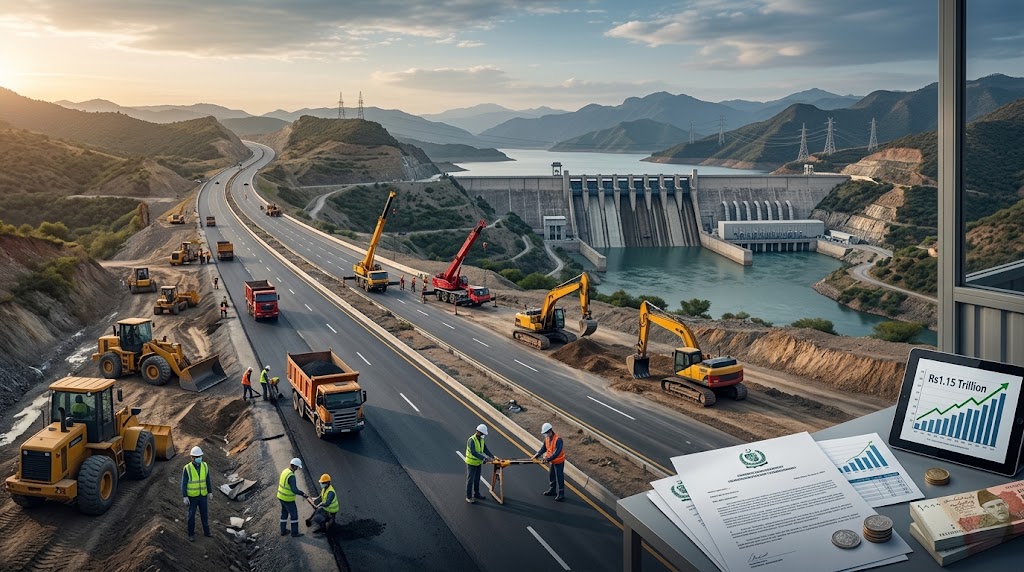
ISLAMABAD: The government has approved 16 development projects with a combined estimated cost of around Rs1.15 trillion, including the controversial Lahore-Sahiwal-Bahawalnagar motorway and the fifth extension of the Tarbela hydropower project, whose cost has surged by nearly 282% from the original estimate.

The decisions were taken by the Executive Committee of the National Economic Council (ECNEC), chaired by Deputy Prime Minister Ishaq Dar. Several of the projects had previously been considered by development forums and returned with revised costs following delays, changes in scope and rising construction expenses.

Of the total approved amount, approximately Rs320 billion represents additional expenditure linked to cost increases and delays, highlighting the financial pressures facing major public-sector development schemes.

The government, however, issued only a brief statement following the ECNEC meeting and did not provide a complete breakdown of all the projects and their financial details. The omission of the Lahore-Sahiwal-Bahawalnagar motorway from the official summary was particularly notable given the political controversy surrounding the scheme.

Lahore-Bahawalnagar motorway approved

The ECNEC approved the Rs407 billion Lahore-Sahiwal-Bahawalnagar Motorway project, retaining its original 295-kilometre alignment in accordance with a directive issued by Prime Minister Shehbaz Sharif earlier this year.

The first package, covering an 18.5-kilometre stretch from the Lahore Ring Road to Raja Jang Interchange, was approved at an estimated cost of Rs49 billion through federal financing.

The project has faced opposition from the Pakistan Peoples Party (PPP), which has raised objections to the scheme and its proposed alignment.

Given the heavy financial burden on the Public Sector Development Programme (PSDP), the ECNEC directed the National Highway Authority (NHA) to examine public-private partnership options for sections that could attract private investment.

For commercially viable portions, the NHA will arrange its contribution through its own revenues in the form of Viability Gap Funding. For sections that are considered financially unviable, alternative arrangements will be explored, including contributions from the Punjab government, loans or financing from international financial institutions and direct federal funding, subject to the availability of resources.

Tarbela extension faces major cost increase

One of the most significant approvals was the fifth extension of the Tarbela project, which received approval at a revised cost of Rs316 billion.

The project’s original estimated cost stood at approximately Rs82 billion, meaning its revised price tag represents an increase of about 282%.

The steep escalation has already attracted scrutiny from government officials. During the Central Development Working Party (CDWP) review, Planning Minister Ahsan Iqbal reportedly raised concerns over project management, transparency and oversight.

Questions were also raised regarding the technical capacity of personnel associated with the project. The Ministry of Water Resources had previously highlighted shortcomings in an inquiry into problems encountered during project implementation.

An inquiry into the failure of the downstream cofferdam reportedly concluded that the structural collapse was linked to design changes, inadequate supervision and delayed administrative action rather than flooding. The findings attributed the failure to the shift from roller-compacted concrete to a rock-fill structure, along with weaknesses in project oversight.

The incident resulted in delays and financial losses, adding to concerns over the project’s rising cost.

The Ministry of Finance also sought an explanation for the substantial increase in the project’s estimated cost. Since the scheme is being financed through international financial institutions, the ministry asked the Water and Power Development Authority (Wapda) to provide details regarding the mechanism for repayment.

Despite the concerns and requests for additional information, the ECNEC ultimately approved the revised project cost.

Road and infrastructure schemes

The committee also approved the 48-kilometre Khwazakhela-Besham Expressway at a revised cost of Rs116.6 billion. The new estimate is around 47% higher than the original cost.

Another interprovincial road scheme aimed at improving connectivity between Gilgit-Baltistan and Azad Jammu and Kashmir was approved at Rs29 billion, representing an increase of approximately Rs10 billion over its initial estimate.

The Rathoa Haryam Bridge over the reservoir channel on the Mirpur-Islamgarh Road also received approval at a revised cost of Rs10.8 billion. Its original estimate had been only Rs1.4 billion, reflecting a substantial increase over the initial projection.

The ECNEC further approved the Lahore Wastewater Treatment Plant at a cost of Rs56.6 billion, around Rs4.2 billion above the earlier estimate.

Poverty alleviation and education initiatives

The Southern Punjab Poverty Alleviation Project was approved at Rs29.7 billion and will cover 10 districts: Bahawalnagar, Bahawalpur, Bhakkar, Dera Ghazi Khan, Khushab, Layyah, Mianwali, Muzaffargarh, Rahim Yar Khan and Rajanpur.

The scheme includes an additional cost escalation of around Rs6.8 billion and is aimed at improving socioeconomic conditions and livelihood opportunities in some of the region’s less-developed areas.

The ECNEC also sanctioned Rs10.6 billion for the Fulbright scholarship programme, under which 816 scholarships are planned.

Of these, 550 MS and 141 PhD scholarships will be administered through the United States Educational Foundation in Pakistan (USEFP), while the Higher Education Commission (HEC) will provide funding for another 125 PhD scholarships through the PSDP.

Water projects in Sindh and Balochistan

The Mazarani Dam project in Qambar Shahdadkot, Sindh, was approved at an estimated cost of Rs16.1 billion.

The committee directed the provincial authorities to begin Command Area Development alongside construction of the main dam so that the project’s agricultural and economic benefits could be realised during its second phase.

The Winder Dam project was also approved at Rs21.6 billion, with the federal government expected to contribute Rs15.6 billion.

Meanwhile, the Mashkel Dam in Washuk, Balochistan, received approval at a cost of Rs41 billion. The project will be financed by the Balochistan government, while an environmental assessment report will be incorporated into the official project documentation.w

Power-sector efficiency projects

The ECNEC approved several schemes aimed at improving the performance of electricity distribution companies.

A Rs24 billion project for the Supply, Installation, Testing and Commissioning of Asset Performance Management Systems at Lahore Electric Supply Company (LESCO) was approved.

The committee also sanctioned Rs19 billion for the Electricity Distribution Efficiency Improvement Project of Hyderabad Electric Supply Company (HESCO).

A similar initiative for Peshawar Electric Supply Company (PESCO) was approved at Rs30.2 billion.

These projects are intended to improve asset management, operational efficiency and the overall reliability of electricity distribution networks.

Skills development project

The committee also approved the Rs28 billion Improving Workforce Readiness in Punjab Project.

The initiative is designed to modernise Punjab’s technical and vocational education and training system and improve the employability of young people by aligning workforce skills more closely with market requirements.

Similar Posts

  • |

    Indian officer suspended after firing rifle during student protest

    Indian authorities have suspended a police officer after he fired an AK-47 rifle into the air while attempting to disperse student protesters in the eastern state of Bihar. The incident has intensified criticism of the government’s handling of nationwide demonstrations that recently led to the resignation of Education Minister Dharmendra Pradhan. The confrontation took place on Saturday in the city of Siwan, where students were protesting against alleged irregularities in national examinations and broader concerns about unemployment. Videos shared on social media showed a police officer in riot gear running toward a crowd of protesters before pointing his assault rifle into the air and firing at least three rounds. Police later confirmed that the footage was authentic. Senior Bihar police official Nilesh Kumar said no one was injured during the incident. He explained that the suspended officer belonged to an intelligence unit that normally deals with dangerous criminals and had been issued the rifle as part of his official duties. However, Kumar said the weapon was used inappropriately because the protesters were students and did not pose a threat that justified such action. He said the officer’s conduct could not be defended under any circumstances and confirmed that disciplinary proceedings had begun. According to Kumar, further action will be taken following an investigation into the incident. The protests began after question papers for a national medical college entrance examination were leaked in May. More than two million students had taken the exam before authorities were forced to order a retest because of the security breach. The controversy sparked widespread anger among young people who accused the government of failing to protect the integrity of the examination process. As demonstrations grew larger, students also began raising concerns about rising unemployment and fears that artificial intelligence could reduce future job opportunities, especially in India’s information technology and outsourcing sectors. These issues helped expand the movement beyond the examination scandal, drawing support from students across different parts of the country. Public pressure eventually led to the resignation of Education Minister Dharmendra Pradhan, who stepped down after nearly five weeks of protests. Despite the resignation, demonstrations have continued as students demand broader reforms and greater accountability from the government. The police response has faced increasing criticism. Officers have been accused of using excessive force against demonstrators, including beating students with batons and firing tear gas during a large march toward India’s parliament in New Delhi earlier this month. Human rights advocates and opposition leaders argue that authorities have responded too aggressively to mostly peaceful protests. Speaking in parliament, Congress Party president Mallikarjun Kharge condemned the police action and described it as one of the most serious attacks on democratic rights in recent years. He said reports that an assault rifle had been used against student protesters in Bihar were deeply troubling and called for those responsible to be held accountable. Parliamentary proceedings were repeatedly disrupted as opposition lawmakers raised the issue and demanded answers from the government. Ministers did not immediately respond before both houses were adjourned amid heated exchanges. The controversy also drew attention from India’s judiciary. Supreme Court Justice Ujjal Bhuyan expressed concern about what he described as the shrinking space for people to express different opinions in the country. In a public speech, he said the right to voice opinions and participate in peaceful demonstrations is a fundamental freedom guaranteed to every citizen. His remarks were seen as an unusual intervention by a sitting judge and added to growing calls for restraint in the handling of public protests.

  • |

    UK expands Global Talent visa scheme to attract world’s top scientists and engineers

    In a major boost to Britain’s science and innovation ambitions, the UK government has announced a significant expansion of its Global Talent visa programme, allowing more than 100 research-intensive companies to sponsor leading scientists and engineers from around the world. Previously focused primarily on universities and research institutions, the expanded scheme will now enable eligible private-sector research organisations to recruit exceptional international talent directly. The move is aimed at strengthening the UK’s position as a global leader in cutting-edge technologies, including artificial intelligence (AI), quantum computing, nuclear fusion, clean energy and life sciences. The government said attracting the world’s brightest researchers would accelerate scientific breakthroughs, support innovation-led industries and create highly skilled jobs across every region of the UK. The initiative forms part of a broader strategy to boost economic growth through investment in advanced research and technology. By widening access to the Global Talent visa route, ministers hope Britain will remain one of the world’s most attractive destinations for leading researchers, scientists and engineers amid increasing international competition for high-skilled talent.

  • |

    ‘Incredibles 3’ shifts spotlight to Violet, Dash, teases new villain

    Fans got their first real look at “Incredibles 3” during D23, where Pixar director Pete Docter offered a preview of what to expect from the franchise’s next chapter. The reveal took place at Friday’s fan event in Anaheim. According to multiple reports, the new film picks up just a few weeks after “Incredibles 2.” This time, though, the focus shifts away from the parents and toward the family’s superpowered kids. After Bob led the original film and Elastigirl took centre stage in the sequel, “Incredibles 3” will finally put the spotlight on the family’s eldest children. Docter confirmed that Violet and Dash are eager to prove themselves as capable Supers in their own right. He explained that the siblings want to show they are ready for real hero work, even though their parents are not entirely convinced. As a result, the kids have been sneaking out at night to protect the city on their own. That decision, Docter noted, does not go over well once their parents find out. Making matters more complicated, the family is also struggling to keep Jack Jack’s unpredictable powers under control. Beyond the family dynamics, Docter teased a new threat that is taking a serious toll on Bob emotionally. He explained that Bob is grappling with his own relevance in a world of Supers that may have moved past him. According to Docter, the story explores how legality does not automatically mean morality within this world. He pointed out that even though Supers are now legal again, that doesn’t guarantee all of them are good. The filmmaker nearly revealed more about the film’s central villain, describing the character as more powerful than the entire Parr family and every other Super combined. Before he could share further details, Edna Mode actress interrupted him, urging him not to spoil the movie ahead of release. “Incredibles 3” is currently scheduled to hit theatres in June 2028, giving fans plenty of time to speculate about the new villain’s true identity and abilities.

  • | | |

    India behind anti-Pakistan propaganda network: Tar…

    ISLAMABAD: Federal Minister for Information and Broadcasting Attaullah Tarar has alleged that an entire network involved in spreading misleading propaganda and disinformation against Pakistan and Pakistani agencies has links to India. Speaking at a press conference in Islamabad, the minister said most of the content being circulated was related to the banned Action Committee in Kashmir. Tarar claimed that evidence of Indian funding for elements associated with the banned Action Committee was now in the public domain. He said numerous Indian social media accounts had emerged with evidence linking them to the campaign. According to the minister, posts shared through these accounts were aimed at provoking people against the state. He alleged that social media platforms were being used to promote groups involved in mob mobilisation and attempts to take the law into their own hands. The minister said efforts had been made to encourage such elements through social media. He alleged that the campaign was designed to create unrest and chaos in Kashmir. Tarar said Pakistan’s recent successes had not been acceptable to its adversaries. He said Pakistan had achieved gains not only on the military front but also on the diplomatic front. The information minister said the government would continue defending Pakistan’s national interests on every front. He stressed that efforts to spread disinformation and destabilise the country would not be allowed to undermine Pakistan’s interests. Tarar’s remarks came amid continued debate over social media campaigns and alleged foreign influence in Pakistan’s internal affairs. The minister urged the public to remain alert to misleading content and propaganda being circulated online.

  • | |

    Google marks Pakistan’s 79th Independence Day with special Doodle

    ISLAMABAD: Pakistan’s 79th Independence Day has received a colourful digital tribute from Google, which replaced its familiar homepage logo with a special Doodle inspired by the country’s national colours. The special artwork appeared on Google’s Pakistan homepage on Friday, August 14, adding a digital touch to celebrations taking place across the country and among Pakistani communities around the world. Instead of the company’s usual multicoloured “Google” logo, users visiting the search engine in Pakistan were greeted with a design reflecting the green and white colours of the national flag. The simple but eye-catching tribute has brought Pakistan’s Independence Day celebrations to one of the world’s most visited digital platforms, allowing millions of users to see the national-day themed artwork while using Google’s search service. A digital salute to Pakistan Google regularly creates special Doodles to mark national days, historic milestones, cultural occasions, achievements and notable personalities around the world. These temporary artworks replace or transform the company’s standard logo and often incorporate symbols associated with the occasion being commemorated. For Pakistan’s Independence Day this year, Google has continued that tradition with a design centred on the country’s national identity. The appearance of the Doodle comes as Pakistanis across the country celebrate August 14 with flag-hoisting ceremonies, patriotic songs, cultural events and public gatherings. From Islamabad and Lahore to Karachi, Peshawar and Quetta, streets, homes and public buildings have been decorated with the green and white colours of Pakistan. The digital tribute also gives the country’s large overseas community another reason to celebrate, with Pakistanis living in different parts of the world marking the occasion through social media, community events and family gatherings. Not Google’s first Pakistan tribute Google’s recognition of Pakistan’s Independence Day is not a new tradition. Over the years, the technology giant has marked Pakistan-related occasions with Doodles featuring elements of the country’s history, culture, architecture, art and natural heritage. Past designs have highlighted national symbols, historic landmarks and distinctive aspects of Pakistani identity, bringing them to a global online audience. The Doodles have become more than simple changes to a search-page logo. For many users, they offer a brief visual reminder of an important national occasion while connecting local celebrations with the wider digital world. This year’s green-and-white design carries a similarly simple message: Pakistan’s Independence Day is being celebrated not only on streets and public squares but also across the digital landscape. As the country marks 79 years of independence, Google’s colourful tribute has added a modern, global dimension to a day rooted in Pakistan’s history, identity and national pride.

  • | |

    Rajab Butt’s mother reveals his relationship status details and age

    Rajab Butt’s mother has broken her silence on one of the most discussed personal sagas in Pakistani vlogging, appearing on Dr Ruby Malik’s podcast for The Digitalline.pk to share details about her son’s age, his marriage and the possibility of a reconciliation with his wife Emaan. Rajab Butt is one of Pakistan’s most followed digital influencers, with around 9 million YouTube subscribers, nearly 3 million Instagram followers and a massive audience on TikTok Live. In recent months, his personal life has attracted as much attention as his content, following reports of a separation from Emaan shortly after the birth of their son Kivan, a formal divorce notice, and subsequent reconciliation speculation. His mother addressed the situation directly, beginning with a revelation about how the marriage came to be in the first place. “Rajab Ali is 30 years old now, Alhamdulillah,” she said. “I arranged his marriage entirely on my own. It was my choice because Rajab wasn’t ready to get married. His priority was to build our house and get Ghazal married first, as we didn’t even have our own home. We sold the house that I had received as my share of the family property, and I invested all of that money into Rajab’s business. Alhamdulillah, he fulfilled both responsibilities, and then I insisted that he get married. I found the proposal myself, and I love Kivan more than anyone.” The account was unexpectedly candid. It revealed not only how the marriage came about but also the financial sacrifices the family made to support Rajab’s career, including the sale of property that was her own personal inheritance. It painted a picture of a mother who invested enormously in her son’s future and then took it upon herself to find him a wife when she felt the time was right. When asked directly about the possibility of Rajab and Emaan reconciling, she declined to speculate. “I don’t know whether Emaan and Rajab will patch up because it is their personal matter,” she said, drawing a clear line around a question she clearly felt was not hers to answer. She was equally measured when asked whether she was already searching for a new marriage proposal for her son. “I have no idea who his future wife will be because I won’t be searching for a proposal this time,” she said, before closing with a prayer: “May Allah make it easy for both of them.” The interview offered a rare maternal perspective on a story that has played out almost entirely through the couple’s own social media accounts and through speculation from their online audiences. Whatever happens next between Rajab and Emaan, his mother’s message was clear: she loves her grandson, she arranged the marriage in good faith, and the rest is in Allah’s hands.

Leave a Reply

Your email address will not be published. Required fields are marked *