What to Know About celebrating 4/27 with Chevy’s Long-Lost 7-Liters—the Z11 and the Mark II “Mystery Motor”
As we discussed earlier this month, Henry Ford II had declared war on the competition with his “Total Performance” directive in 1962. But over at GM, the word “performance” fueled some queasy feelings amongst the brass. The General’s outright racing ban was imminent, but Chevrolet’s clandestine performance guru Vince Piggins wasn’t going down without a fight. Piggins issued a memo in mid-1962, fast-tracking the development of two race engines for NASCAR and the drag strip: the Mark IS and Mark IIS V8s, both displacing today’s magic number of 427 cubic inches.

First, the Mark IS. This engine was a one-year-only offering better known as RPO Z11, available on the 1963 Impala. Before the first chapter of GM’s big-block story came to a close, the famous 409 W-series V8 that we wrote about earlier this month was stroked up to a full seven liters to create the Mark IS (“S” for stroked). The engine’s stroke was increased to 3.95 inches while the bore remained 4.3125 inches; additional modifications included higher-flow heads, a two-piece high-rise intake manifold, and dual Carter AFB carbs. Compression was a vein-bursting 13.5:1, and the entire lump spun out 430 horsepower (though the real figure was said to dance around 500 ponies).

Impalas equipped with RPO Z11 for ’63 also received special aluminum front-end components in place of steel, and were devoid of amenities. Some 50 Z11 Impalas left the factory, and drivers like Dave Strickler—whose “Old Reliable IV” captured the overall “Little Eliminator” title at Indy in 1963—as well as Don Nicholson, Ronnie Sox, Butch Leal, Huber Platt, Hayden Proffitt, and others drove these full-size bowties to great success on the strip in Super Stock and Factory Experimental competition.

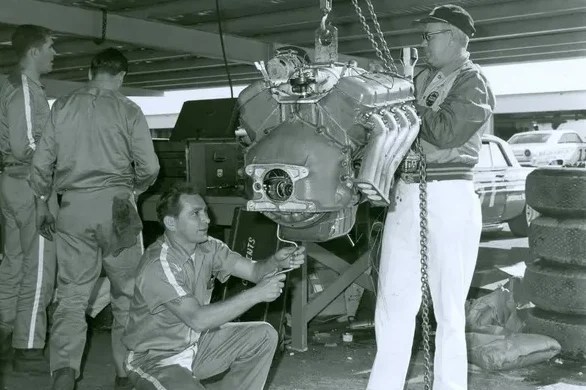
Now, on to the Mark II 427. This was the legendary “Mystery Motor” built by GM specifically for NASCAR, briefly touched upon in our 4/02 feature. It didn’t belong to any of the production big block families (neither the Mark I W-head series nor the mid-1960s Mark IV “Rat” motors) but shared elements with both. The bore and stroke were identical to the Z11 427, and the porcupine heads presaged those of the forthcoming 396. The Mark II’s development, and even its very existence, was closely guarded, earning it the nickname “Mystery Motor.”
Richard L. Keinath was the man behind the Mark II’s design. Development began in 1960 but was fast-tracked for completion in late 1962. Big-block whisperer Ray Brock later wrote the in-depth analysis above for Hot Rod Magazine‘s May 1963 issue, noting the differences between the Z11 427 and the new Mystery Motor dubbed the “H-D 427.” Most notably, the new mill featured its distinctive staggered/canted-valve “Porcupine” heads, featuring alternating intake and exhaust valves—a design later used on the Mark IV family of V8s. Brock was the only journalist allowed to lay hands on the new motor.


Images: Hot Rod
The Mystery Motor was tested in secrecy at GM’s Mesa, Arizona, test track, far from the Detroit bean counters and their prying eyes. Eight days before the 1963 Daytona 500, it discreetly appeared in two Z06 Sting Rays campaigned by Mickey Thompson at the 1963 NASCAR American Challenge Cup, a 250-mile competition for sports cars, GTs, and coupes with engine displacement below 427.7 inches.
The engine was formally made public less than a week later during qualifying at the Daytona 500, where it powered five Impalas destined for the grid. This caused quite a stir since NASCAR at the time was a stock car series, and the new engine wasn’t “stock” for any car on any Chevy lot anywhere. Nevertheless, Bill France let the race proceed, and the Impalas ran up front for much of the race. The video above shows just how capable the new engine was, as G.C. Spencer, a perennial mid-pack finisher, charges right past AJ Foyt to claim the lead. But mechanical issues winnowed down their numbers, and Johnny Rutherford claimed the best finish for a Mystery Motor car, driving his Smokey Yunick-prepped Impala across the line in 9th place despite setting a lap record of 165.14 mph. Unfortunately, the Mark II’s competition career was cut short as the racing ban implemented by GM chief exec Fred Donner in January 1963 went into full effect. Drivers supplied with the 427s like Ray Fox, Rex White, and Yunick continued to campaign their engines in the face of teething troubles and lack of factory support.


Both of GM’s earliest 427s are twice as scarce as hen’s teeth these days. As for the Mark IS 427, a handful of cars hailing from the heyday of Super Stock racing are said to survive, like Terry Prince’s former Z11 Impala that showed up on BaT in 2023. Production figures for the Mystery 427 are difficult to pin down, with estimates ranging from 16 to 48. In the 2010s, vintage racer Tom McIntyre reunited a Mickey Thompson Sting Ray with a Mystery Motor V8 found in the liquidation of Smokey Yunick’s Best Damn Garage in Town. Otherwise, sightings are few and far between, but we’ll hold out hope that a proper Mystery Motor shows up on BaT in the future.
References: Mac’s City Motor Garage, Hot Rod, Car Guy Chronicles, and NHRA