This Week’s Weird and Wonderful—April 3, 2026: A Practical Look
Welcome to the Weekly Weird and Wonderful, wherein we, your faithful BaT editorial staff, present a curated list of cool, unusual, interesting, or otherwise noteworthy vehicles currently live on BaT. This is of course but a small fraction of the ~1,000 listings that await you over on our live auctions page, so once you’ve finished reading, feel free to make your way over there and spend the rest of your weekend clicking away.

Enjoy this week’s selection of Weird and Wonderful BaT auctions, and let us know what else you think should be on our list!
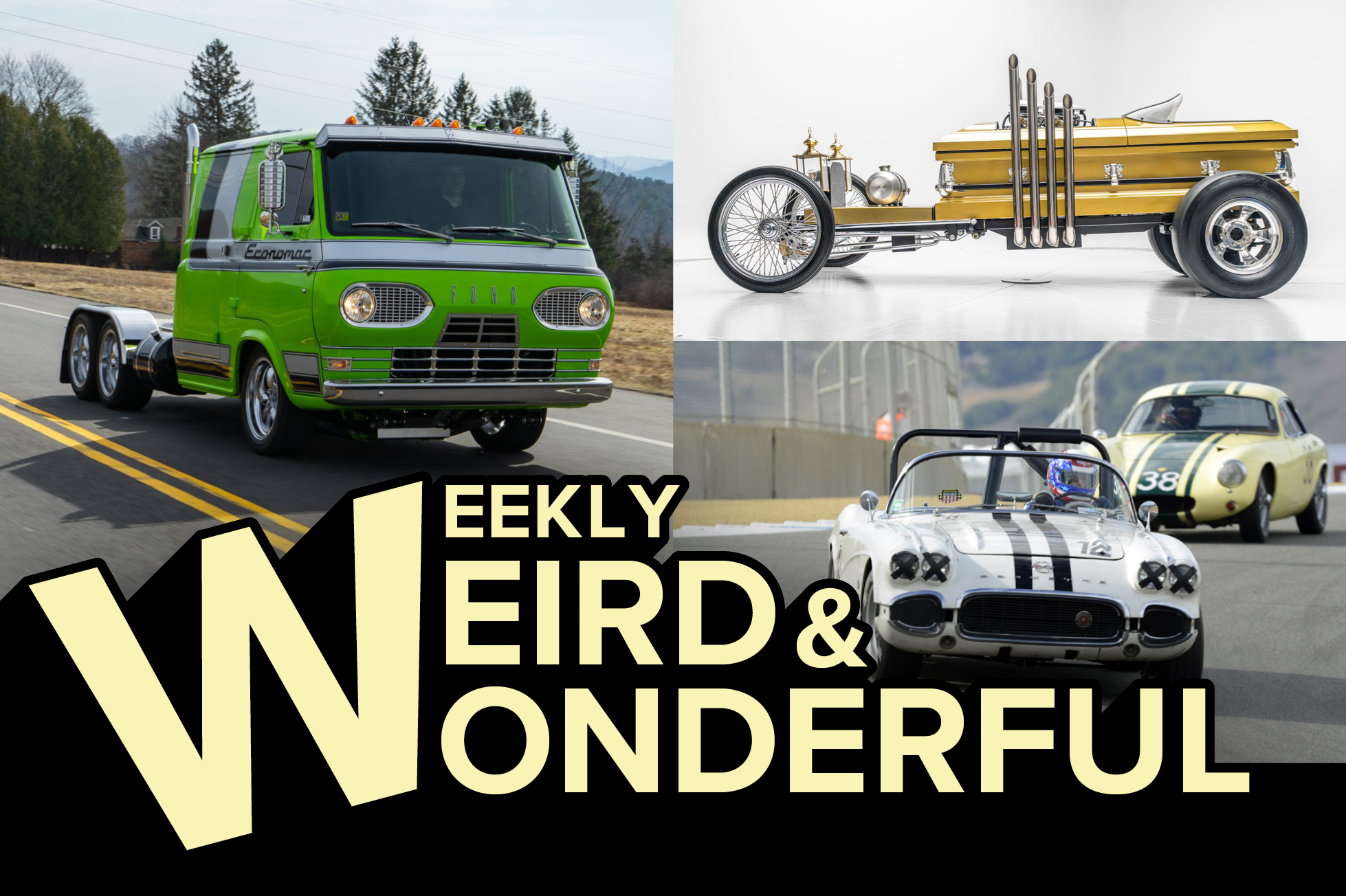
“The Munsters” Drag-U-La Re-Creation
Without the heroic antics of Drag-u-la, the Munster Koach might have been lost to history—tucked away in the garage of neighborhood bully “Leadfoot” Baylor, who won it from Herman Munster while racing for pink slips down at the local dragway. Thankfully, Grandpa Munster’s ad-hoc racer triumphed at the strip (despite some sabotage involving the drag chute), and the Munster Koach came back to its rightful owners. The lesson here, kids, is always double down on your mistakes.


Both of the Munsters’ cars were built for the show by George Barris, and the car currently up for auction is somehow the second Drag-u-la tribute that Bullet Motorsports has brought to BaT. This one is not street-legal, and there are a couple elements (other than the obvious) that would make it a death trap on public roads. The pedal arrangement consists of a brake on the right and clutch on the left, while the throttle is controlled by a T-handle on the dash. That alone would take some getting used to, but low-speed driving is out of the question, as the radiator has no cooling fan and the built 302 is very much not a prop.
Ford Econoline-Bodied, Six-Wheeled, Mid-Engined Custom “Economac”


The “why” rarely matters with builds like these, but we’d certainly like to tap into the mind of the creative maniac behind the “Economac.” Built over more than a decade by the current owner’s father Dale, this machine was designed to resemble a vintage Mack semi that a man named Dale (callsign: “Dale”) might drive. It’s a two-thirds of a first-generation Econoline van transformed into a tilt-forward cab with suicide doors, plopped onto a custom six-wheeled frame with a faux fifth-wheel out back. The chassis houses a mid-mounted 351ci Windsor V8 linked to a four-speed automatic trans, although astute observers will notice a third pedal in the cab; the seller mentions that a five-speed manual transmission is also included. We certainly appreciate the, ahem, forward thinking.
Ex-Cleetus McFarland Jet-Powered 2010 Chevrolet Camaro “Turbinaro”


We’ve been on a bit of a turbine kick lately, but we’ve never, ever seen a jet-engine sleeper before. The “Turbinaro” (not to be confused with “turbinado,” a fancy brown sugar) was the unfinished project of its late previous owner, and was scooped up by automotive YouTuber/mad scientist Garrett “Cleetus McFarland” Mitchell, who brought the beast fully to life. It definitely doesn’t look stock, but there are no visual cues to prepare you for what sounds like Satan’s own airplane toilet, coming to suck you into Hell. The kerosene burner is a Boeing T50-BO-12 turboshaft engine—an early helicopter powerplant—and in stock tune made an utterly reasonable 365 horsepower at 6,000 rpm. In its current tune, this translates to an underwhelming 120 horsepower to the wheels, as shown in the dyno video below.
So, it turns out the Turbinaro is more show than go, even with the aftermarket afterburner, but that’s probably better for everyone in the second-hand turbine car market. This would definitely be a cars and coffee hall-of-famer and we’d sure feel cool operating the overhead chopper control stack while getting around town.
1961 Dolphin International Mk II Formula Junior Project

Last week we featured one of Dolphin Engineering’s earliest Formula Junior cars, and this week another Dolphin has surfaced on BaT: an International Mk II. In an August 1961 issue of Car and Driver, John Crosthwaite admitted the team needed to raise its game to stay competitive in Formula Junior racing. Ken Miles had his own opinions, calling it too safe: “If a new boy masters this car and then climbs into a powerful sports car, he is likely to be in trouble simply because he has never been exposed to the tricks a mishandled race car can perform.” Powered by a Ford mill mated to a Fiat 600 transaxle, the evolved Dolphin was lower, lighter, and dressed in a fiberglass body crafted by Dick Troutman of Scarab fame.


This International Mk II has been in the SoCal area since the ’90s, and was acquired by the seller in 2014. The tubular spaceframe has since been repaired and the 15″ mag wheels refurbished. Minus the engine and braking components, the rest of the kit and caboodle is being sold as an incomplete project by the seller, who penned an extensive history of the Dolphin Formula Junior race cars as shown in the gallery.


The history behind Iso Rivolta is compelling, though it doesn’t rival the beauty of the IR 300 itself. Renzo Rivolta made his money manufacturing refrigerators before the war and pivoted to motorcycles afterward, becoming the third largest manufacturer of two-wheeled conveyances by 1950. The industrialist entered the automotive world with the Isetta (the very same microcar later licensed by BMW), before committing to his own sports tourer—the IR 300. Giotto Bizzarrini handled engineering, Giorgetto Giugiaro at Bertone styled it, and a Chevrolet V8 supplied motivation—a real power throuple. From 1962-1970, 797 cars were produced. This handsome example was refurbished under current ownership and is offered on dealer consignment today.
25-Years-Owned 1962 Chevrolet Corvette 327/360 Fuelie Race Car and Ex-Pikes Peak 1962 Chevrolet Corvette 327/360 Fuelie 4-Speed


Prior to 1962, professionals were forbidden from racing in the SCCA. If you had won money racing, you were out, period. Grids were full of privately owned cars like this fuel-injected Corvette, which cost Duddley Higginson $5,300 and came more-or-less track ready with off-road exhaust, quick-ratio steering, heavy-duty drum brakes, and a positraction rear axle. The car has been a racer ever since, and for many years was owned by stalwart BaT seller and member GeorgeLyons—who is also currently in the running for high bidder. You’ve got to love an old battle-wagon that wears it scars proudly. May you race forever, #12.


Pikes Peak has always been a “run what you brung” affair, and in 1962, Chevy dealer Al Daniels brung this fuel-injected Corvette, a recent trade-in that he put on the podium in third place. Having achieved glory in the clouds, the car couldn’t be unceremoniously returned to the used lot, so it was converted back to stock and remained with the Daniels family for the next 57 years. Its retirement in Florida lasted just two years, and then the ‘Vette sold on BaT and went back to Colorado in 2021—like an old sheriff with unfinished business. Maybe it’s time to strap on the roll bar for one more run to the top…


At first glance, this looks like a Fisker Karma, but Karma divorced Fisker and started a solo career. Following Fisker’s 2012 bankruptcy, Karma arose from the ashes as its own firm when the Wanxiang Group bought the rights to the model and its name in 2014. They gave it a Tesla-ish nose, and renamed it the Revero. For 2020, the Revero GT received a 1.5L BMW inline-three in place of the earlier GM four-pot for range-extending duties. Combined output? 536 horsepower and 550 lb-ft of torque.


In the mid-1950s the overhead valve V8 was taking over, and those who preferred their eight cylinders in a neat row were in trouble. By 1954, Packard was all but done with the straight eight, though three different flavors were offered for its final year. The 288 and 327 cubic inch versions were the milder options, while the heftier 359ci Thunderbolt featured nine main bearings and produced 212 horsepower. This car sports the 359 under the hood and is one of 863 convertibles built for the model year.

For 1937, this bike is pretty refined, with a four-valve head, progressively coupled drum brakes, a lever-operated center kickstand, and an adjustable enclosed-spring girder fork. But that should be no surprise to anyone acquainted with Rudge. The British company began as a bicycle builder, and as they branched out into motorcycles and wheels, they introduced innovations like the knockoff wheel, an early CVT-style belt-driven gear change, and the canoe sidecar. The company was paired with hardware company Whitworth (of spanner fame) early in its development, and as such placed a high value on build quality.

This bike was a labor of love for Rob North, a frame builder who built racing bikes for Triumph in the ’60s and ’70s. He found it being used as wall art in a central California lodge, and began an intensive restoration described in the included article from the October 1997 issue of Motorcycle Classics. Upon completion, which involved much fabrication and trial-and-error engineering, North took the bike for an 1,850-mile road trip up the West Coast into Canada. The listing videos show it kicking over without any fuss, and the hollow thrum of its big single-pot sounds like nothing on the road today. Pretty Special, indeed.
1910 Waverley Electric Model 75-C Brougham/Victoria and 2024 Rimac Nevera


We’ve covered a number of early EVs in this feature, and at first glance this Waverly Electric Model 75-C looks like the others. But manufacturers realized that flexible architecture was possible with electric power early on, and the Brougham/Victoria coachwork shown above is “convertible” in the truest sense of the word. The entire greenhouse lifts off, including the doors and front bench, turning the car into an open two-seater runabout (with a small jump seat folding out of the floor). The listing comes to us courtesy of Hyman Ltd., who seems to know the location of every brass-light car in the Louisiana Purchase. They’ve linked us to a Facebook video excerpt showing @F40_Motorsports locating the car in long-term storage some years back.


A hundred and fourteen years later, this is the state of the art in electric propulsion. The Croatian-built Rimac Nevera is a quad-motor, carbon-fiber-monocoque beast that lays down an absurd 1,914 horsepower with 1,741 lb-ft of torque, and clocked a top speed of 258 mph in testing. This is the second example we’ve listed on BaT. Incidentally, the history of men’s neckwear also links the Nevera to the Waverly, as the supercar’s sculpted side channels pay tribute to the cravat, a piece of Early Modern Croatian military kit that remained popular in the Edwardian Era as the “puff tie.”
Honorable Mentions:
Consecutive-Serial 1942 Ford GPWs

To the outsider an Army jeep is an Army jeep, but true MV-heads have a dense lexicon of terms to describe the differences between variants. These two Ford GPWs are VEP (Very Early Production—first-contract vehicles with serial numbers 1—15000) examples with “script” tubs (Ford script on the tailgate and stamped into the frame), and Willys-style frames (i.e. round front crossmembers). They also have consecutive serial numbers, 712 and 713, and though they were separated at birth, they were reunited by the seller in the early 2000s. Originality is hard to ascertain with vehicles that lived hard lives in the field and were repaired and modified using materials at hand. The seller refurbished both of these GPWs, and for authenticity’s sake kept many of the period adaptations in place.
Li’l Red Express-Style 1982 Dodge Ram D150 Utiline

Is this D150 really blue or red? Don’t worry—this isn’t a test of human color perception. In fact, it’s a blue take on the iconic Li’l Red Express truck of the 1970s. And if it looks like a Hot Wheel, that’s no coincidence: this build took inspiration from the diecast version released in the 2017 Hot Trucks series.

Carrozzeria Vignale took a humble Fiat 500, dressed it up like the prewar 508 Balilla Coppa d’Oro (styled by Alfredo Vignale himself), and named it the Vignale Gamine. Unfortunately, their attempt at a mass-market success flopped. Sales were stale for the coachbuilder, and Vignale went under and sold off the pieces of its operation to De Tomaso. A sad fate for a jolly-looking car. This particular example first graced the pages of BaT in 2013 and has returned in a refurbished state.
1991 Audi 200 20V Turbo Quattro Avant

We are all indebted to Audi for bringing us so many great sport wagons over the years (many with three pedals), from the Porsche-tuned RS2 to S4 and S6 Avants to the late-model RS6 beastwagens. This unassuming family hauler—a 200 20V Turbo Quattro wagon—is one of the rarest. The turbocharged 20-valve inline-five found in the Ur-Quattro was offered to US buyers in wagon form for a single model year. Just 150 were imported, all with five-speed manual transmissions.
Thanks for checking out this edition of the Weekly Weird & Wonderful! Follow this page to get updates when new installments post, and tell what caught your eye or what you think we’ve left out!