girls schools upper
| |

18 Girls’ Schools in Upper Dir recommended for t…


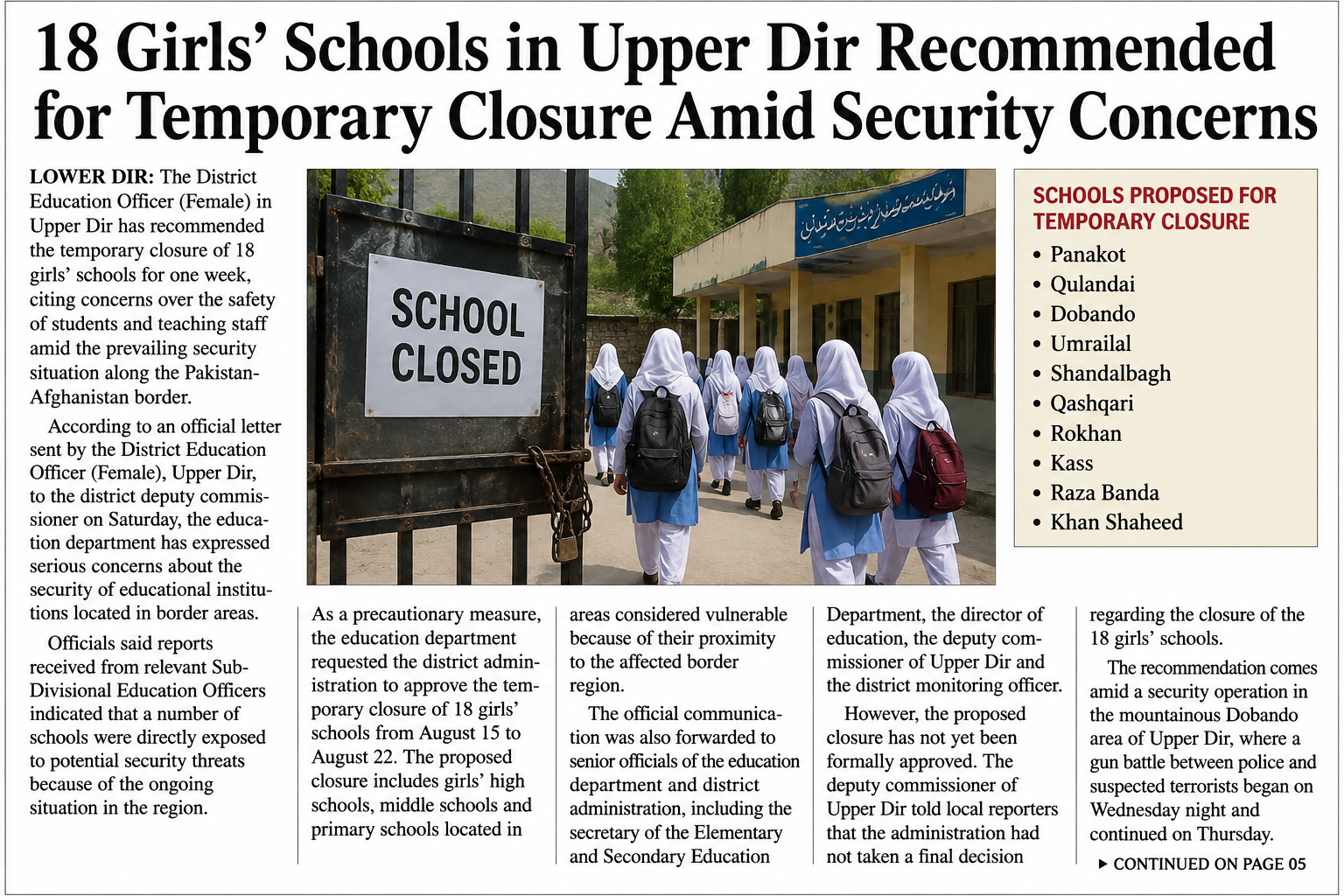
LOWER DIR: The District Education Officer (Female) in Upper Dir has recommended the temporary closure of 18 girls’ schools for one week, citing concerns over the safety of students and teaching staff amid the prevailing security situation along the Pakistan-Afghanistan border.

According to an official letter sent by the District Education Officer (Female), Upper Dir, to the district deputy commissioner on Saturday, the education department has expressed serious concerns about the security of educational institutions located in border areas. Officials said the uncertain situation has raised fears about the safety of students and teachers travelling to and attending schools in vulnerable areas.

The letter stated that reports received from relevant Sub-Divisional Education Officers indicated that a number of schools were directly exposed to potential security threats because of the ongoing situation in the region.

As a precautionary measure, the education department requested the district administration to approve the temporary closure of 18 girls’ schools from August 15 to August 22. The proposed closure includes girls’ high schools, middle schools and primary schools located in areas considered vulnerable because of their proximity to the affected border region.

The schools included in the recommendation are situated in Panakot, Qulandai, Dobando, Umrailal, Shandalbagh, Qashqari, Rokhan, Kass, Raza Banda and Khan Shaheed.

The official communication was also forwarded to senior officials of the education department and district administration, including the secretary of the Elementary and Secondary Education Department, the director of education, the deputy commissioner of Upper Dir and the district monitoring officer.

However, the proposed closure has not yet been formally approved. The deputy commissioner of Upper Dir told local reporters that the administration had not taken a final decision regarding the closure of the 18 girls’ schools.

The recommendation comes against the backdrop of heightened security concerns in the mountainous areas of Upper Dir. A security operation is currently underway in Dobando, where a gun battle between police personnel and suspected terrorists began on Wednesday night and continued into Thursday.

Officials said the opposing sides remained positioned against each other during the operation and that heavy weapons were reportedly being used. At the time of the reports, however, authorities had not confirmed any casualties resulting from the encounter.

The latest security concerns come after a separate deadly incident in neighbouring Lower Dir last month. Two policemen were martyred and 16 others were injured during an exchange of fire with suspected terrorists at Haidari Top, a mountainous location in the district.

According to officials, law enforcement personnel had launched a search-and-strike operation in the area after receiving information about the presence of suspected terrorists. During the operation, armed militants reportedly launched a sudden attack on the security personnel.

The ensuing gun battle continued for several hours, resulting in casualties among the law enforcement personnel.

The security situation has prompted authorities to remain cautious, particularly in areas where schools are located close to conflict-affected or sensitive zones. The education department’s recommendation to temporarily suspend classes is intended as a preventive measure rather than a permanent closure.

The final decision regarding the 18 girls’ schools will rest with the district administration. Officials are expected to assess the security situation before deciding whether educational activities can continue safely or whether the temporary closure should be implemented.

For now, authorities are closely monitoring developments in the border areas, while the education department has emphasised that the safety of students and teaching staff remains the primary concern.

Similar Posts

  • | |

    Australian court rejects Indian appeal in Basmati …

      An Australian court has dismissed an appeal filed by the Agricultural and Processed Food Products Export Development Authority (APEDA) in the Basmati word mark case, marking a significant legal development for Pakistan’s rice exporters. According to the Ministry of Commerce, the Australian court’s decision has reaffirmed Pakistan’s principled position that the term “Basmati” cannot be treated as the exclusive property of India. The ruling is being viewed by Pakistani authorities as an important legal success in protecting the rights of the country’s Basmati rice producers and exporters. The Australian court has also ordered the Indian institution APEDA to pay the legal costs associated with the proceedings. The decision follows a legal dispute over the use and registration of the word “Basmati” in Australia. APEDA had applied to register the word “Basmati” as a certification trademark. The application was challenged, leading to legal proceedings concerning whether the term could be claimed exclusively for Indian rice products. Pakistan has consistently maintained that Basmati rice is also produced in Pakistan and that Pakistani exporters should have equal rights to use the name. The Ministry of Commerce said Australian authorities had already acknowledged that Basmati rice is produced in Pakistan, strengthening Islamabad’s position in the dispute. The latest court decision has therefore been welcomed by Pakistani officials as confirmation of the country’s longstanding stance on the geographical and commercial identity of Basmati rice. The Ministry of Commerce stated that the ruling represents an important legal victory for Pakistan because it supports the principle that Pakistani exporters should not be deprived of the right to use the term Basmati for rice produced in the country. Federal Minister for Commerce Jam Kamal congratulated the Ministry of Commerce team on what he described as Pakistan’s legal success in the case. He appreciated the efforts of the officials and legal representatives involved in defending Pakistan’s position before the Australian authorities. The dispute is significant because Basmati rice is an important agricultural and export commodity for both Pakistan and India. The term has considerable commercial value in international markets because consumers associate Basmati with a distinctive variety of aromatic long-grain rice. Pakistan is among the countries known for producing and exporting Basmati rice, particularly from areas in Punjab. The country has sought greater recognition of its rights over the Basmati name in international markets, arguing that the rice is a shared agricultural heritage of the region and is produced on both sides of the border. APEDA’s attempt to register “Basmati” as a certification trademark had raised concerns in Pakistan because exclusive registration could potentially affect Pakistani exporters’ ability to market their products using the internationally recognized name. The Australian court’s rejection of APEDA’s appeal is consequently being seen by Pakistan as an important development in safeguarding its exporters’ commercial interests. The order requiring APEDA to pay legal costs also adds to the significance of the decision for Pakistan. The Ministry of Commerce has emphasized that the ruling strengthens Pakistan’s position in international legal and commercial forums. Pakistani authorities are expected to continue protecting the interests of local rice growers and exporters and ensuring that they retain the right to market their Basmati rice under its recognized name. The decision could also contribute to broader efforts to strengthen Pakistan’s agricultural exports and promote its Basmati rice in international markets.

  • | |

    Nolan’s Odyssey explores the cost of flawed choices

    Christopher Nolan’s The Odyssey explores a character who is far from a conventional hero. Odysseus is brave, intelligent and determined. He is also deeply flawed. That complexity appears to be at the centre of Nolan’s interest in the ancient Greek epic. The nearly 3,000-year-old story follows Odysseus as he attempts to return to Ithaca after the Trojan War. His journey is filled with violence, loss, temptation and encounters with powerful gods and mythical creatures. Yet the film is not simply about a warrior trying to find his way home. It is also about the consequences of his decisions. Odysseus repeatedly makes choices that produce consequences he struggles to control. His actions often begin with understandable motives. Revenge, anger, pride and a desire to protect his men push him into increasingly dangerous situations. His treatment of the Trojans is one example. Odysseus considers himself a man who respects the rules of combat. However, the Trojan War forces him into tactics that contradict his personal principles. The wooden horse becomes the most striking example of this conflict. His deception helps the Greeks defeat Troy, but it also establishes a chain of events that follows him long after the war ends. His encounter with the Cyclops Polyphemus further exposes his weaknesses. Odysseus and his crew manage to escape the Cyclops’ cave. But instead of leaving quietly, Odysseus attacks again. His decision is driven by anger and revenge. The consequences are devastating. Polyphemus calls upon his father, Poseidon, to punish Odysseus. The resulting curse turns the journey home into an extended ordeal. Odysseus continues trying to save his men. However, his efforts repeatedly end in tragedy. One decision leads to another, and the consequences gradually become impossible to contain. His crew members begin to lose faith in their commander. The man determined to bring them home becomes the leader whose decisions ultimately contribute to their deaths. This moral conflict is familiar territory for Nolan. The director has repeatedly built stories around protagonists whose choices carry enormous consequences. Bruce Wayne, for example, attempts to protect Gotham by allowing a dangerous lie surrounding Harvey Dent to survive. The consequences eventually force him to confront the price of that decision. In Oppenheimer, the central character develops the atomic bomb in an attempt to help defeat Nazi Germany. Yet his success leaves him haunted by the destructive power he helped unleash. Dunkirk presents another interpretation of home. For the soldiers trapped on the beaches of France, home represents survival, safety and the possibility of returning with their dignity intact. For Oppenheimer, however, home becomes something more complicated. It represents the peace of mind he can no longer recover after witnessing the consequences of his work. For Odysseus, home is deeply personal. Ithaca represents his family, his kingdom and the identity he lost during two decades away. Returning home is therefore more than reaching a physical destination. His journey changes him. He leaves as a king and eventually returns disguised as a beggar. Along the way, he encounters monsters, hostile forces and divine punishment. He also watches his companions disappear one by one. By the time Odysseus reaches the end of his journey, the question is no longer simply whether he can return home. The bigger question is whether a man who has experienced so much violence can ever truly return as the person he once was. That question sits comfortably within Nolan’s broader storytelling style. His characters often achieve their goals but pay an enormous personal price. Their victories rarely come without consequences. The Odyssey brings that recurring theme to one of its most ancient and powerful forms. Odysseus survives the journey, but survival does not erase what happened along the way. His homecoming becomes a reckoning with the violence, losses and choices that shaped him. Nolan’s interpretation therefore turns the epic into more than an adventure story. It becomes a meditation on guilt, responsibility, identity and the lasting cost of extraordinary choices. At its heart, The Odyssey asks what happens when a man spends years fighting to return home, only to discover that the journey has changed the meaning of home itself.

  • |

    South Korea pushes for US-North Korea talks after Trump cuts drills

    South Korea has called for renewed dialogue between the United States and North Korea after US President Donald Trump ordered a reduction in annual military exercises with Seoul. The South Korean government said it hopes Trump’s relationship with North Korean leader Kim Jong Un can help restart diplomatic engagement between Washington and Pyongyang. President Lee Jae Myung’s office said Seoul was ready to take diplomatic steps to encourage meaningful discussions. The goal, according to the presidential office, is to reduce tensions and promote peace and stability on the Korean Peninsula. The statement followed Trump’s decision to scale back US military exercises with South Korea. Trump said his decision was influenced by his relationship with Kim. In a social media statement, Trump argued that the exercises were expensive and could send an inappropriate or hostile message to North Korea. Trump also referred to the situation involving Iran while explaining his decision. He said he had recently asked the South Korean president whether Seoul wanted to participate in efforts concerning the denuclearisation of Iran, but that South Korea had declined. North Korea had not immediately issued a response to Trump’s announcement. Pyongyang has repeatedly criticised joint US-South Korean military exercises. North Korean authorities have previously described the drills as preparations for a potential invasion and warned that they could trigger a strong response. The latest developments come after President Lee proposed direct discussions with North Korea on Saturday. Lee called for both sides to abandon threats and begin talks aimed at formally ending the long-running conflict on the Korean Peninsula. He said discussions between the directly involved parties could also create an opportunity to explore measures aimed at stopping the expansion of North Korea’s nuclear capabilities. South Korea has long sought greater diplomatic engagement to reduce military tensions with its northern neighbour. However, negotiations between Washington and Pyongyang have remained stalled. Trump and Kim previously held high-level meetings, raising hopes of progress on North Korea’s nuclear programme. Those efforts ultimately failed to produce a lasting agreement. Analysts believe Trump’s latest decision could be intended to create conditions for renewed negotiations. However, they warn that North Korea may demand significant concessions before returning to the negotiating table. Leif-Eric Easley, a professor at Ewha University in Seoul, said Trump’s recent comments about Kim indicated a possible willingness to re-engage with North Korea. Easley also cautioned that Pyongyang has been strengthening its military capabilities while benefiting from its relationship with Russia during the war in Ukraine. He warned that reducing US-South Korean military exercises could create challenges for the alliance. It could also affect coordination between the two militaries and slow South Korea’s efforts to assume greater responsibility for its own defence. The professor further argued that a reduction in military preparedness could weaken deterrence against potential conflicts in the wider Asian region. South Korea now faces the challenge of balancing diplomacy with military preparedness. Seoul wants to use the current opening for dialogue while maintaining security cooperation with Washington.

  • | | | |

    Israeli forces arrest 14 Palestinians in West Bank…

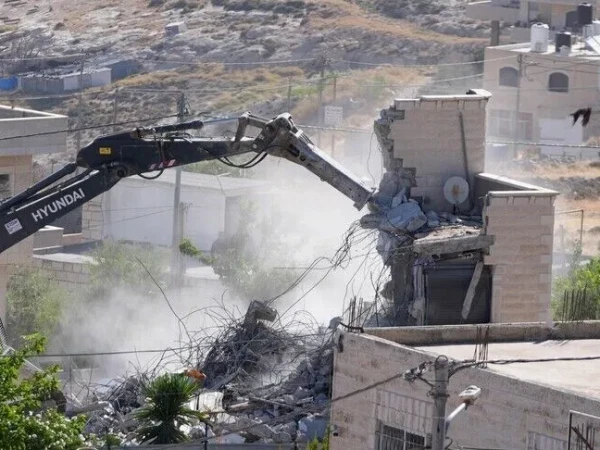
    RAMALLAH: Israeli forces detained at least 14 Palestinians, including a woman, during a series of military raids across the occupied West Bank on Tuesday, while three homes were also demolished, according to local sources. The latest arrests come as tensions continue to rise across the occupied territory, where Israeli military operations, arrests and settler violence have intensified in recent days. The raids targeted several locations, including Nablus, Jenin and Tulkarm, according to reports. Eight detained in Nablus In Nablus, Israeli forces entered the Ras al-Ain neighbourhood and stormed three buildings. Soldiers searched several homes before detaining eight Palestinians, including a woman, local sources said. The operation reportedly involved searches of residential properties, with residents subjected to questioning before the detainees were taken away. The raid was part of a wider military campaign across the northern West Bank, where Israeli forces have repeatedly carried out overnight and early-morning operations. Raids reported in Tubas and Jenin In Tubas province, Israeli troops entered the town of Tammun and remained there for several hours before withdrawing. No arrests were reported from the operation. Meanwhile, in the Jenin area, Israeli forces entered Al-Yamoun, where they arrested a former Palestinian prisoner from Jenin city. Another Palestinian was detained in Deir Ghazaleh, located northeast of Jenin, according to local sources. The arrests added to growing concerns over the continuing military pressure on Palestinian communities in the occupied West Bank. More arrests in Tulkarm Further arrests were reported in the Tulkarm area. Israeli forces detained a Palestinian customs police officer and a young man from Irtah, a suburb south of Tulkarm. Two other Palestinians were also arrested following raids and searches of homes in the village of Far’un. The latest operations come against a backdrop of escalating violence in the West Bank. Reuters reported this week that Palestinian residents have described mounting pressure from military raids and settler attacks, warning that the situation is approaching a breaking point. At the same time, reports of demolitions have added another layer to the tensions. Anadolu Agency reported that three Palestinian homes were demolished during the wider military campaign, with Israeli authorities citing claims related to construction permits. The developments are likely to fuel further concern over the security and humanitarian situation in the occupied West Bank, where repeated raids, arrests, demolitions and clashes have continued to affect Palestinian communities.

  • | |

    Sardar Yousaf renews call for creation of Hazara p…

    Federal Minister for Religious Affairs Sardar Muhammad Yousaf has reiterated his demand for the creation of a separate Hazara province, saying there is broad political consensus on the issue and that administrative reforms are essential to improve governance and public service delivery. Addressing a joint press conference in Islamabad alongside Senator Talha Mahmood, the minister said the movement for Hazara province began in 2010 and has remained a longstanding demand of the region’s people. He said seven young people sacrificed their lives during the movement, adding that their contributions would always be remembered. According to the minister, people from different political parties have consistently supported the establishment of Hazara as a separate province. Sardar Yousaf noted that the Khyber Pakhtunkhwa Assembly has passed constitutional resolutions in support of Hazara province on three occasions—in 2014, 2018, and 2020. He added that bills seeking the creation of the new province have also been introduced in both the National Assembly and the Senate and have been referred to the relevant standing committees on law and justice. The minister said the creation of new administrative units has become a necessity in view of Pakistan’s growing population, which now exceeds 250 million. He argued that additional provinces would improve governance, revenue collection, and the implementation of development projects. He stressed that the demand for Hazara province is not linked to any single political party but represents a united movement supported by people from all walks of life, including political leaders, lawyers, journalists, students, traders, and religious scholars. Sardar Yousaf said several national political leaders have publicly expressed support for the Hazara province during visits to the region and public gatherings. He maintained that smaller administrative units would bring government services closer to the people, help address public issues more effectively, and strengthen the federation. He also paid tribute to those who lost their lives during the Hazara province movement, noting that Hazara Martyrs’ Day is observed every year on April 12 in their memory.

  • |

    Indian activists challenge AI-powered police surveillance following student demonstrations

    Indian digital rights activists and student leaders are challenging Prime Minister Narendra Modi’s government in the Delhi High Court over the deployment of artificial intelligence-powered mass surveillance during recent youth protests in New Delhi. Student activist Aishe Ghosh filed a petition with the Delhi High Court seeking to declare the police’s mass surveillance of demonstrators unconstitutional. The lawsuit requests the immediate destruction of all personal and biometric data collected during the demonstrations and asks the court to establish clear binding guidelines governing the use of surveillance technologies at public gatherings. The controversy intensified after photographs circulated showing a mobile police surveillance unit, branded “Ikshana” and developed alongside security firm CP Plus, deployed at the main protest site. The vehicle featured telescopic masts providing 360-degree coverage, AI-powered cameras, and real-time facial recognition capabilities that displayed face accuracy metrics to match attendees against law enforcement databases. Furthermore, police officers were documented recording the social media handles of arriving participants. Digital rights organisations, including the Internet Freedom Foundation, have formally requested the Delhi Police Commissioner to delete all biometric data gathered during the events. Advocates emphasise that India currently lacks a dedicated legal framework governing police deployment of facial recognition systems, making such intrusive measures disproportionate and illegal. During court proceedings, Solicitor General Tushar Mehta defended law enforcement actions, arguing that expectations of privacy at a public gathering were misplaced and asserting that the security measures were absolutely necessary in the interest of public order. Delhi Police maintained that the technology was used solely to identify individuals with criminal histories and count crowd size without restricting freedoms. The court challenge continues despite the end of the student demonstrations, which were triggered by widespread examination paper leaks in national competitive tests. The protests culminated in the resignation of Union Education Minister Dharmendra Pradhan and the announcement of a government panel tasked with overhauling the national examination system.

Leave a Reply

Your email address will not be published. Required fields are marked *