many smokers still

Many smokers still miss major health risks

A new study has found that public understanding of the health risks of smoking has improved only slightly over the past 20 years.

Researchers studied more than 240,000 smokers from 46 countries. Most participants knew that smoking can cause lung cancer.  However far fewer were aware that smoking can also greatly increase the risk of heart disease heart attacks and strokes.

Gaps in public awareness

The study also found that many smokers do not fully understand the dangers of secondhand smoke.  They may not know that breathing in someone else’s cigarette smoke can also increase the risk of heart disease heart attacks and strokes.

The research was published in the journal BMJ Open. Researchers said that despite health warnings on cigarette packs tobacco control policies and years of public awareness campaigns important gaps in knowledge still remain.

Heart risks often overlooked

Lead author Janet Chung Hall, a scientist with the University of Waterloo’s International Tobacco Control Policy Evaluation Project said the lack of awareness about the serious effects of smoking and secondhand smoke is concerning.

Experts estimate that smoking related heart and blood vessel diseases cause more than two million deaths worldwide every year. The researchers say stronger public health campaigns are needed to help people understand that smoking does not only damage the lungs.

It can also seriously affect the heart and blood vessels. Better awareness of these risks could encourage more smokers to quit and help reduce the harmful effects of tobacco on both smokers and people around them.

Similar Posts

  • The revival of Kathak in the heart of Lahore

    In the quiet underbelly of Lahore’s Alhamra Arts Council, an ancient pulse woke from its slumber. It began with the whisper of clinking of ghungroos. Hundreds of brass ankle bells are braided onto raw cotton strings and then they wait to catch the cadence of a human heartbeat. For decades, the classical movement of Pakistan seemed confined to memories and clandestine. That’s how a heritage has been subjected to silence under the shadow of political conservatism. Yet inside the halls of the Lahore Kathak Festival, the art form proclaimed its victorious home-coming. Kathak derives its name from katha: the Sanskrit word for story. The story starts even before borders were drawn across rivers and plains. Itinerant storytellers wandered the northern expanses of the undivided subcontinent. They combined Hindu mythology, Sufi mysticism and local folklore into rhythmic physical poetry. When these storytellers stepped into the imperial courts of the Mughals, the art form transformed. It absorbed Persian elegance, geometric precision and the subtle emotional nuances of Urdu ghazals. Kathak became a living art created from the shared civilizational fabric of the region. It became an artistic synthesis that belongs as fundamentally to the Indus valley as it does to the banks of the Ganges. To embrace Kathak in modern Pakistan is to reclaim forgotten cultural roots. Post-partition artistic discourse attempted to segregate Pakistan’s creative identity from its ancient subcontinental ancestry. It resulted in treating classical dance with suspicion or elitist detachment. Pioneer icons like Sheema Kermani, Nighat Chaudhry and Bina Jawwad stood as solitary legacies during decades when dancing was criminalized. Their bodies became active spaces of memory when state patronage vanished. Kathak – A Breathing Idiom Now, a dynamic new wave of young performers is stepping into the limelight with devotion and fresh perspective. Organizers like Maan Sayeed and Momina Farooq Khan recently brought together maestros and young aspirants. They proved that classical dance is not a monument preserved, but a breathing idiom. On stage, young artists offered performances that blurred the line between heritage and modernity. Soloist Aliza Khalid, clad in radiant white, set her precise footwork to the haunting melodies of Seraiki folk music. Elsewhere, ensemble dancers whirled in breathtaking pirouettes (chakkars), their skirts flaring like blooming lotus petals in sync with the sudden claps of the tabla.   What makes this emerging movement so profound is its insistence on inclusivity and identity. The overflowing auditoriums where audiences stood shoulder-to-shoulder in the aisles signaled a hungry public desire to reconnect with an art form that speaks directly to the soul. It feels like through every intricate hand gesture (hasta) and rhythmic cycle (taal), these young dancers demonstrate that Kathak is an act of reclamation. It honors the land’s heritage, reminding us that art transcends temporal political boundaries to express the eternal human story.

  • |

    Tradition, impersonality and mythic structure in “The Waste Land”

    Eliot’s masterpiece The Waste Land is published in 1922 just three years after “Tradition and the Individual Talent“. The poem serves as the ultimate practical demonstration of his theoretical ideas. Rather than describing tradition abstractly, Eliot uses allusion, polyphony, structural juxtaposing, and mythic framing to explain how a modern poem can absorb European history to process post-WWI disillusionment. Eliot argued that a poet must possess a historical sense. It is an awareness of the past’s presence alongside the contemporary moment. In The Waste Land, centuries of literary tradition exist on a single plane. In Section I (The Burial of the Dead), the speaker encounters acquaintance in modern London named Stetson and asks:    That corpse you planted last year in your garden, Has it begun to sprout?  In the very next line, Eliot links this modern London scene directly to the Punic Wars between Rome and Carthage. You who were with me in the ships at Mylae!   Modern industrial London and ancient Rome are collapsed into the same spiritual wasteland. The historical sense allows Eliot to treat human trauma across millennia as simultaneous rather than sequential. In his Impersonal Theory, Eliot argued that the poet’s mind acts as a catalytic medium. It’s  fusing disparate feelings and literary artifacts into a new substance without injecting personal bias. Throughout the 433 lines of The Waste Land, Eliot incorporates over 35 distinct literary references, 6 foreign languages, and references to sacred texts across Eastern and Western traditions. Eliot quotes Edmund Spenser’s Renaissance poem Prothalamion: Sweet Thames, run softly, till I end my song. He juxtaposes Spenser’s idyllic, nymph-filled river with the industrial Thames of 1920s London, scattered with silk handkerchiefs, cardboard boxes, cigarette ends. As commuters cross London Bridge, Eliot echoes Dante’s Inferno (Canto III): I had not thought death had undone so many. The modern office workers are literally mapped onto the souls trapped in Hell’s vestibule. He isn’t relying on a traditional narrative arc or a subjective personal narrative. Eliot uses what he famously called the Mythic Method (a technique he also praised in James Joyce’s Ulysses)..Eliot grounds the entire poem in two scholarly texts on mythology and ritual. From Ritual to Romance (the Grail Legend and the sterile Fisher King). The Golden Bough (ancient fertility cults, dying-and-rising gods). The underlying archetype, a sterile land awaiting a spiritual rain to restore fertility, unifies the fragmented scenes of modern decay (mechanized sex, empty conversations, spiritual apathy). Therefore, the individual talent grounds chaos in timeless mythic order. In order to achieve the extinction of personality, Eliot abandons a central I persona. Instead, he speaks through a chorus of shifting voices. A Marie in Munich, a hyacinth girl, a cockney woman in a pub, and Saint Augustine. In his famous explanatory notes to line 218, Eliot exposes he unifying center of the poem:  Tiresias, although a mere spectator and not indeed a ‘character’, is yet the most important personage in the poem, uniting all the rest… What Tiresias sees, in fact, is the substance of the poem. Tiresias: the blind, bisexual prophet of Greek myth (from Sophocles and Ovid). It has lived as both man and woman and seen the depths of classical tragedy. Eliot submerges his own biographical ego into an ancient, collective consciousness by adopting Tiresias as the central perspective Eliot’s concept of tradition is not narrowly provincial. His concept relates to the broader heritage of human thought. In the final section “What the Thunder Said”, the modern mind seeks a cure for its spiritual dryness not in the West, but in the Upanishads. The thunder speaks the Sanskrit syllables: Datta (give), Dayadhvam (sympathize) and Damyata (control). The poem concludes with the solemn formal chant: Shantih shantih shantih The Peace which passeth understanding. The final line: “These fragments I have shored against my ruins” summarizes Eliot’s entire philosophy of tradition. Modern civilization may be in ruins, but the individual poet reconstructs meaning by gathering and rearranging the enduring fragments of global tradition.  

  • Why Safe Migration Begins with Information 

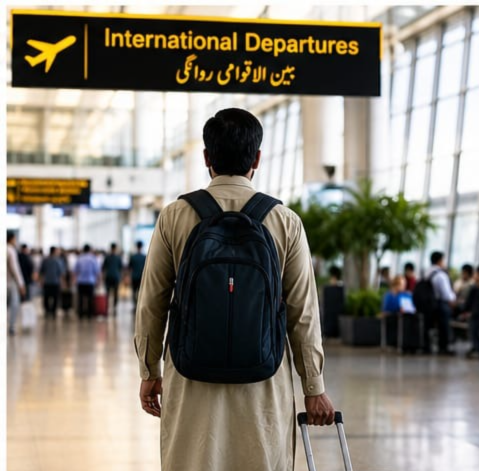
    By Tahseen Ullah  Imagine a young Pakistani sitting in a village in Punjab, Khyber Pakhtunkhwa or Sindh, scrolling through his phone. He sees an attractive job offer for Germany, Italy, Saudi Arabia, the UAE—or even an IT position in Southeast Asia. The salary is impressive, accommodation is promised and the visa will supposedly be arranged within weeks. A WhatsApp number is provided, and someone in his community has already shared the opportunity. He has ambition, perhaps a degree or technical skills. What he may not have is reliable information. This information gap can turn an aspiration for overseas employment into financial loss, irregular migration, exploitation, human smuggling or even trafficking. For Pakistan, this is an increasingly important challenge. Overseas employment is a lifeline for millions of Pakistani families, supporting children’s education, access to healthcare, improved living standards and household economic security, while remittances make a vital contribution to the national economy. At the same time, rapidly changing global labour markets are creating new opportunities beyond traditional destinations. Yet, as these opportunities grow, so do the risks of fraudulent recruitment, misinformation, disinformation, human smuggling and trafficking. Ensuring that Pakistanis can access authentic and accurate information, guidance, verify employment opportunities and make informed decisions is therefore essential to turning migration aspirations into safe and dignified and productive employment opportunities. A fake job advertisement, misleading social media post or fraudulent agent can create a false impression of employment and migration opportunities. Misinformation may be shared unknowingly, while disinformation is deliberately designed to deceive. For prospective migrants, however, the consequences can be equally serious. The risks are particularly concerning for young, educated, and IT skilled Pakistanis. In parts of Southeast Asia, deceptive job advertisements and promises of visit visas that are later claimed to be convertible into work visas have reportedly been used to lure individuals into situations involving human trafficking for forced criminality, where victims may be coerced into participating in online scams and other criminal activities. What initially appears to be a lucrative employment opportunity can therefore become a pathway to exploitation, coercion and serious harm. In the migration journey, information is not just knowledge, it is protection. Before accepting any overseas opportunity, prospective migrants should ask: Is the employer genuine? Is the recruiter authorised? Is the visa appropriate for the job? Is there a written employment contract? Are the salary and working conditions clear? What are the actual costs? Most importantly, where can this information be verified? The principle should be simple: check before you trust, verify before you pay and consult before you travel. To make an informed decision, prospective and intending migrants should first verify job offers and recruitment arrangements from the Bureau of Emigration & Overseas Employment and its field offices, the Protectorates of Emigrants, while seeking information, guidance and referral from Government departments, Migrant Resource Centres (MRCs) Pakistan and other recognised migration information and counselling services before paying, signing or travelling. These sources can help migrants understand legal/ regular migration pathways, recruitment procedures, employment contracts, workers’ rights and available complaint mechanisms. Before making a migration decision, understand the process and seek guidance. Consult relevant sources before paying an agent, signing documents or travelling—a few minutes of verification can prevent years of financial and personal consequences. However, information alone is not enough. Safe migration also requires quality skills, reskilling and upskilling. International labour markets increasingly demand technical competencies, language skills, digital literacy and recognised qualifications. TVET institutions and universities should therefore align training with genuine labour-market demand and equip young people with both occupational and migration-related knowledge. A skilled worker who cannot identify a fraudulent opportunity remains vulnerable. Conversely, reliable information without relevant skills can leave genuine opportunities beyond reach. Skills and information must therefore go together. A comprehensive approach to migration must move beyond simply facilitating departure. Safe migration requires informed preparation before departure, protection during employment and support upon return, supported by strong coordination among government institutions, international organization, civil society organizations, Pakistani missions abroad, bilateral agreements with destination countries, training providers, employers, recruiters, universities, and migration information and counselling services. The message to young Pakistanis should be clear: Do not migrate on the basis of a social media post, WhatsApp message or an agent’s promise. Seek information, consult the relevant authorities, verify the opportunity, acquire the required skills and follow the legal and regular migration pathway. Migration should be a pathway to opportunity—not a pathway to exploitation. In today’s information environment, knowing where to seek information, whom to consult and what to verify before migration may be as important as the skills required for the job itself. Safe migration begins long before the airport. It begins with an informed decision. Tahseen Ullah is a development and migration sector practitioner specialising in migration management, education and child protection. He can be reached at tahseenanthro@gmail.com.   LinkedIn: Tahseen Ullah  The views expressed are his own and do not reflect the views of his employer or any affiliated organisation.

  • Why does food make your mouth water

    Have you ever seen your favorite food smelled it or simply thought about it and suddenly felt your mouth watering? This can happen even when you are not very hungry. Just seeing or smelling food can make your body prepare for eating. Experts call this the “cephalic phase of digestion.” In simple words it means your body can start preparing for digestion before food even reaches your mouth. Your brain prepares your body When you see, smell or think about a favorite food your brain gets a signal that food may be coming.  It then sends signals to different parts of the digestive system. One of the first things that happens is that your mouth produces more saliva.  Saliva makes food softer and easier to chew and swallow. It also helps start the digestion process. That is why seeing hot pizza, biryani, jalebi or another favorite dish can make your mouth water.  Your body is already getting ready to eat. It is not always about hunger Mouth watering does not always mean you are very hungry.  You may even feel full and still have a strong reaction to your favorite food. Food cravings can be affected by its smell appearance memories and past experiences. For example, the smell of a homemade dish from childhood may bring back old memories and make you want to eat it again. Smells can trigger strong reactions Sometimes you do not even need to see food. A delicious smell from the kitchen can make you feel hungry within seconds. But the opposite can also happen. A bad smell unpleasant sight or negative memory can make you feel sick or lose your appetite. For example if you once became sick after eating a certain food, your brain may connect that food with the bad experience. Later even its smell may make you feel nauseous. •Your body has a protective system These reactions are part of the close connection between the brain and the digestive system.  Your brain does not only help you notice food you like it can also help protect you from food that may be harmful. A bad smell or unpleasant appearance can make you avoid certain food. In some cases it may even cause nausea or reduce your appetite. So the next time your mouth waters when you see your favorite dish remember that your body may already be preparing for the meal before you take your first bite.

  • Remove light grease with warm water

    Stainless steel pots and pans are used almost every day but they can lose their shine over time. Grease, oil food stains and burnt marks can make them difficult to clean. The good news is that you do not always need expensive cleaning products.  A few simple items already available at home can help keep your stainless steel cookware clean and shiny. Soak away light grease For light grease and small stains soak the pot in warm water with some dishwashing liquid for a while.  The warm water helps soften stuck food and grease. After soaking gently clean the surface with a soft sponge. Avoid using too much force. Use vinegar for burnt food When food gets burnt avoid scraping the pot with a sharp or rough tool.  This can leave scratches on the stainless steel. Instead pour a small amount of white vinegar over the burnt area and let it sit for a few minutes.  Then gently clean it with a soft sponge and wash the pot well. Try Baking Soda for Tough Stains For stubborn marks make a thick paste by mixing baking soda with a little water.  Apply the paste to the stained area and leave it for about 30 minutes. After that gently wipe the area with a wet sponge and rinse the pot thoroughly with clean water. Do not leave dirty pots for long Cleaning becomes much easier when you do not leave dirty cookware sitting for hours.  Remove leftover food soon after cooking and wash the pot when possible. Burnt food and grease become harder to remove when they are left on the surface for a long time. Protect your hands while cleaning Frequent contact with water and dishwashing products can make your hands dry.  Wearing rubber or disposable gloves while washing dishes can help protect your skin. After cleaning dry your hands properly and apply a moisturizer to help prevent dryness.

  • The jaded gender talks

     By Saman Aftab We are so habitual of listening to the gender inequality, women empowerment, and ever growing population talks that now these topics have become an essential subject for the matter of discussing societal issues. But what we people have lacked to unravel is the very essence of these debates. Why gender inequality exists? Why we are still lagging behind in terms of employing more women? Why we are unable to control the growing rate of population in our country? Before addressing the ‘absolutely unavoidable’ questions, let me take the readers down an irksome memory lane of my life. Last year when our maid broke the news of her pregnancy to us, our most obvious question was why now? Considering her age which was 42 years that time and her financial grim along with unsupportive role of her husband in bearing the burden of their five children, this question clicked in every mind. And her answer though not surprising was quite gloomy for the existence of every female in this world; “baji, larka chahye humen” (we need a boy). She had four daughters and a deaf son. Her statement broke my heart because it questioned the capabilities of her daughters who were all physically and mentally sound. This memory was not worth forgetting because as a female it made me feel inferior. But this Babygirl vs Babyboy thing is not new, in fact it is one of the most deeply rooted concerns of our society. The normalcy of demanding the birth of a boy from a married woman is consolidating with the passage of time. The worst part of this matter – it’s getting acceptance. Ironically, majority of mothers in law showcase such demands to the newly married couple, as if it is in their hands to ‘design’ the genetic make-up of their offspring. The heart wrenching memory got afresh, when Tabassum shared her so called good news with us. Tabassum, 35 years old woman who works as a maid in three houses, a mother of four girls is expecting again for the sake of receiving a son this time. Her good news reminded me of her last fourth delivery when she gave birth to a girl in government hospital and she was made to give her daughter to a rich family on the persuasion of her drug addict husband. Whether they got money in return was dubious but chances of such happening were bright. I really hope and pray that this time she gets a son, otherwise the couple will continue to bring unwanted girls in this world and ruin their lives. For all the existing daughters of this couple are living a dark and disowned life. This brutal reality of life is not constrained to lower class people and it has crossed the demarcation of social groupings based on all classes, religions and races. Let us take an example of my sister’s friend, who is married to a well-established businessman and living in a posh locality. The poor lady who has a rich family, is a mother of two cute little girls. Although the little girls born to riches are living a good life, their mother is undergoing severe mental anxiety and pressure for not having a son. And of course, she for the sake of getting rid of such pressure is planning to have another baby neglecting her present deteriorating health condition. Unfortunately, the instances are innumerable and the rate of their occurrences is increasing day by day. Why boy child is mostly preferred over girl child? The answer lies in the heart of several burdens tied with bringing up a girl till her marriage. Among so many liabilities, the extra protection needed by the girls in our society and the curse of dowry have aggravated the scenario to such an extent that today girls are seen as “misfortune”. Of course exceptions are always there. Let us shift the focus from this melancholy to addressing those “absolutely unavoidable” questions raised earlier. 1: Gender inequality; Homo sapiens (humans) are generally categorized into three groups namely man, woman and transgender. Men are always ranked superior for enormous reasons but if we see things more pragmatically, it becomes evident that parents are left with sons in their old age while their daughters somehow abandon them and serve in laws for the rest of their lives. Call it our family system, it is the way it is. Then how can girls be loved or demanded? For voicing rights for equality, women should also bear the responsibilities equally. If a woman is capable of doing an employment being educated or skilled, she must pursue it for sake of giving all the best of resources to her parents that are expected of a son. The root cause of inequality among genders is the leverage given to men of being more useful and thus more needed. As long as the share of women in the society is constrained only to domestic chores and family caretaking, this inequality will never fade away. More women should be encouraged to become financially sufficient and independent. But how? This leads to our second question. 2: Women empowerment; there should be more campaigning with regards to educating girls and investing in their skill building. More powerful the educational background of a woman is, more will be the chances of her getting a good job for the sake of financial security. Thus, the number of women working for the betterment of society and raising capital will rise exponentially. And finally once these two milestones are achieved, the third ordeal of our country will evade automatically. 3: Overpopulation: as discussed in the start, demand and desire for the birth of a son has contributed a lot more towards overpopulation. Men are expected to take care of their parents but the same goes for women also. And in this age of compatibility, women should come forward and play a vital part in developing this society. Instead of placing all the

Leave a Reply

Your email address will not be published. Required fields are marked *