good business kasangkapwa
| | | |

[Good Business] Kasangkapwa in the advent of agentic AI

Last year, I wrote about the hybrid space between a person and an AI and named it kasangkapwa (companion in the journey toward shared identity). Watching my students build with agentic AI this trimester, I realized I need to pay attention to a different relationship.

These past two weeks, my undergraduate class in Management in the Digital World held its final presentations. Six groups, each embedded with an actual partner organization, mostly micro- and small enterprises, each running an action research project around an AI-assisted prototype. Group projects involved prototyping customized queuing and point-of-sale systems, sales pipelines, inventory forecasting, entrepreneurial incubator dashboards, knowledge management systems, and invoice processing. These are all undergraduate business students. Almost none of them code.

Two years ago, this output was out of reach. One year ago, it would have needed an engineering elective and a semester of suffering. This trimester, with agentic AI platforms that plan, execute, and revise with minimal supervision, it needed a good brief, a few weekends, and the discipline to check the machine’s work. 

Mid-presentation, an Eraserheads line from their song “Para sa Masa” (For the Masses) lodged in my head and would not leave: “Pinilit kong iahon ka, ngunit ayaw mo namang sumama.” (I tried so hard to save you, but you didn’t even want to go with me.)

The surprise of the trimester was that the scarce skill turned out to be restraint. Group after group had to be pulled back from burying a small business under features nobody asked for. One team’s first cycle failed exactly this way. They arrived with a polished solution; the owner received it politely and did not use it. The prototype worked. The relationship, initially, did not; until further alignments were done. 

Must Read

[Good Business] Kasangkapwa: Navigating the hybrid space of human-AI collaboration


[Good Business] Kasangkapwa: Navigating the hybrid space of human-AI collaboration

The bottleneck has moved

For as long as I have supervised student consulting projects, the limit on what a project could deliver was the student. Analysis, design, execution: all rationed by skill and time. Our pedagogy is calibrated to that scarcity. We teach students to build better because building was the hard part.

Agentic AI dissolves that scarcity, and the bottleneck relocates to the other side of the table. The constraint now is the partner organization’s capacity to absorb change: the store owner’s hours in a day, her trust in three undergraduates she met in June, her willingness to alter routines that have fed her family for a decade. My students could suddenly build far past her readiness. That gap is where projects now fail.

From a pair to a system

Last year, in this column, I proposed the word kasangkapwa for AI’s in-between status: more than kasangkapan, a mere tool, yet incapable of the loob that makes another being kapwa (shared identity). I treated it then as a two-party matter, a person and a machine in a hybrid space, and I argued that the discipline it demanded was interior: dual awareness, active discernment, keeping your own voice.

My students’ projects seemed to outgrow that pairing. What actually operated in the class was a system with four seats. The student group, whose members had to divide roles and re-explain to one another work an agent did overnight. The agentic AI, no longer just a conversation partner but a worker that runs unattended. The professor (myself), needed as a third set of eyes on the process running between students and machine. And the partner organization, the one seat with no interest in the technology at all, only in ginhawa: relief, breathing room, a slightly easier day.

Kasangkapwa, it turns out, cannot remain a private virtue. Once the AI can act on the world, the ethics of using it extend past your interior state and into what your ease of building does to other people.

Mabait na pamimilit

The Eraserheads line is funny until you occupy the owner’s chair. Being handed a system you never requested, by student consultants who anticipated a need you have not yet felt, is a mild form of coercion no matter how good everyone’s intentions are. Pamimilit na nakabalot sa kabaitan. (Coercion wrapped in kindness). And agentic AI has made this coercion nearly free to produce. The feature costs nothing to add. The burden of refusing it, of explaining the refusal, or of absorbing an unwanted system falls entirely on the person we claim to be helping.

I do not exempt myself. I require my students to use AI, and some have called this out in my teaching evaluations. My defense is that they will compete with and alongside these systems the moment they graduate, and exposure under supervision beats discovery under pressure. But the same logic that makes me push my students is the logic my students used on their partners. Alam ko kung gaano kadulas ang daang iyon. (I know how slippery that path is.)

Negotiating the depth of change

The team whose first cycle flopped is the reason I remain hopeful. Their failure bought them something no feature could: the owner saw that they could take no for an answer. Trust followed. In the second cycle, the owner asked for more than they had originally dared to propose, and the point-of-sale system that finally shipped was co-constructed, fitted to routines, adopted because of trust between the group and the owner. 

The lesson is to rethink pakikipagkapwa-tao (human relations) in the advent of agentic AI. My student groups reflected: negotiate the depth of change; agree on it with the partner instead of delivering it to them. Match the intervention to the partner’s readiness rather than to the machine’s capacity, because that capacity is now effectively unlimited and has stopped being a useful guide to anything. Underneath sits pakikiramdam (empathy/sensitivity), sensing what the other can receive, which no agent can perform on anyone’s behalf.

What the professor is for

My own role shifted more than I expected. The students rarely needed me for technical answers; the agent outclasses me there. What they needed was accompaniment through the process: the first-month exercise of articulating desired outcomes for the individual and the group, consultations in and out of class, a colleague who co-sat the project defenses so a second pair of human eyes read what the students and their machines had produced together. Formative touchpoint after formative touchpoint, ending in an oral defense, because standing in a room and answering an unrehearsed question remains the one deliverable no agent can complete for you.

Two rules now govern the class. First, everything a student builds with AI is a prototype. It stays a prototype, however finished it looks, until people who know the domain and carry the stakes have validated it, and the validator who matters most is the partner, hindi ang propesor (not the professor). Second, we watch the process and not only the product, because a finished-looking product now proves very little about the learning behind it.

It seems fitting to end this with another Eraserheads line: “Gusto mo bang sumama?” (Do you want to join?) Kasangkapwa, a year later, is now about pakikipagkapwa-tao (human relations) augmented by the agentic capabilities of generative AI. Should this relationship lead to Alapaap (clouds), that is for us humans to decide. – Rappler.com

Patrick Adriel “Patch” H. Aure, PhD, is an associate professor at the Department of Management and Organization and founding director of the PHINMA-DLSU Center for Business and Society, Ramon V. del Rosario College of Business, De La Salle University. Email him at patrick.aure@dlsu.edu.ph.

Here are other Good Business columns on AI:

Similar Posts

  • | | |

    Gold prices rise further in Pakistan as global rat…

      KARACHI: Gold prices in Pakistan continued their upward trend on Monday, with the price of gold per tola increasing by Rs2,000, according to the All Pakistan Sarafa Gems and Jewellers Association. Following the latest increase, the price of one tola of gold reached Rs461,936 in the domestic market. The latest rise comes amid an increase in international gold prices, which have also strengthened in the global market. According to the association, the price of 10 grams of gold increased by Rs1,715, bringing the rate to Rs396,035. The continued rise in gold prices is likely to keep the precious metal attractive for investors and buyers who traditionally consider gold a store of value during periods of economic uncertainty. In the international market, gold prices also recorded an increase. The price of gold rose by $20 per ounce to reach $4,395 per ounce. The latest movement in domestic gold prices reflects the influence of international bullion rates, while local market conditions and currency fluctuations can also affect the price of gold in Pakistan. Gold remains one of the most widely followed commodities in the country, particularly among investors, jewellery buyers and households that use the precious metal as a form of savings. Changes in gold prices can therefore have a direct impact on consumers, particularly those planning to purchase jewellery for weddings and other important occasions. The increase of Rs2,000 per tola means that buyers will now have to pay more for the same quantity of gold compared with the previous rate. Similarly, the rise in the 10-gram price indicates continued upward pressure on the domestic bullion market. The international increase of $20 per ounce has also contributed to the positive movement in local prices. Global gold rates are closely watched by Pakistani traders because changes in international bullion prices can influence domestic market rates. Gold prices around the world are affected by several factors, including investor demand, inflation expectations, currency movements, interest rates, geopolitical developments and uncertainty in global financial markets. During periods of economic or political instability, investors often turn toward gold because it is traditionally regarded as a relatively safe asset. For Pakistani consumers, movements in gold prices can be particularly significant because jewellery represents an important form of household wealth and savings. A sustained increase in prices can make gold purchases more expensive, while existing gold holders may benefit from higher market valuations. Market participants are likely to continue monitoring international bullion prices as well as developments in the domestic currency market to determine the direction of gold prices in Pakistan in the coming days. The latest figures show that gold continues to trade at historically elevated levels in both domestic and international markets. With the international price now standing at $4,395 per ounce, any further movement in global rates could have an impact on prices in Pakistan. For now, the domestic market has recorded another increase, with one tola of gold priced at Rs461,936 and 10 grams at Rs396,035. Investors, jewellery traders and consumers will be closely watching the market for further changes, particularly as fluctuations in international gold prices and currency rates continue to influence the local bullion market.

  • |

    PSX rallies above 181,000 as investors return to key sectors

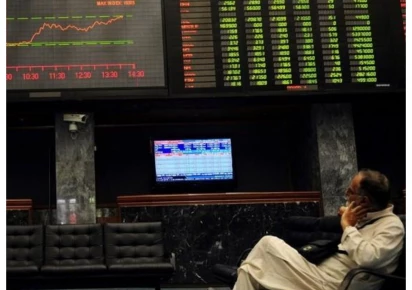
    KARACHI: Positive momentum returned to the Pakistan Stock Exchange (PSX) on Monday as investors stepped up buying activity across major sectors, pushing the benchmark KSE-100 Index above the 181,000-point mark during the opening phase of trading. At around 9:40am, the benchmark index was trading at 181,066.59 points, showing an increase of 961.98 points, or 0.53%, compared with the previous close. The early-session recovery reflected renewed investor interest in large-cap and index-heavy companies. Buying was particularly visible across automobile assemblers, cement, commercial banking, fertiliser, oil and gas exploration, oil marketing companies (OMCs), power generation and refinery sectors. Among the major stocks supporting the upward movement were Mari Petroleum (MARI), Oil and Gas Development Company (OGDC), Pakistan Petroleum Limited (PPL), Pakistan Oilfields Limited (POL), Hub Power Company (HUBCO), Habib Bank Limited (HBL), MCB Bank, Meezan Bank Limited (MEBL) and United Bank Limited (UBL). Most of these index-heavy shares traded in positive territory during the initial hours. The recovery came after a difficult week for the domestic equity market. The KSE-100 Index had closed the previous week at 180,104.61 points, declining by 1,325.41 points, or 0.7% on a week-on-week basis. Market sentiment had been affected by heightened geopolitical uncertainty, particularly concerns over the future of the US-Iran ceasefire and the potential impact of regional tensions on international energy supplies. Investors also remained cautious over developments affecting shipping activity around the Strait of Hormuz and the Red Sea, both of which are critical routes for global energy and trade. Despite the pressure on equities, Pakistan’s domestic fiscal position and external-sector indicators had provided some support to investor confidence. However, geopolitical developments continued to dominate trading decisions, particularly because any prolonged disruption to oil supplies could raise import costs and increase inflationary pressures. Global markets remain cautious The cautious mood was also evident across international markets on Monday. Asian equities moved largely sideways as investors monitored developments in the Middle East and assessed the implications for energy prices and global inflation. Oil prices recorded significant gains during the previous week as uncertainty surrounding efforts to end the Iran conflict increased concerns about potential supply disruptions. Investors remained particularly focused on developments concerning the strategic Strait of Hormuz, where tanker traffic had remained disrupted amid the continuing tensions. Iran on Saturday called on the United States to acknowledge defeat, while US President Donald Trump warned Americans that higher gasoline prices could persist as long as the conflict continued. The situation in the wider region also remained volatile. In southern Lebanon, Israeli strikes on Saturday killed at least 11 people, according to the Lebanese health ministry. The casualties came amid renewed tensions following an earlier US-mediated framework aimed at easing hostilities between Lebanon and Israel. Oil prices remain elevated Crude oil prices remained at elevated levels on Monday after recording strong gains during the previous week. Brent crude was trading around $88.50 per barrel, little changed during the session after climbing approximately 6% last week. Meanwhile, US West Texas Intermediate (WTI) crude slipped around 0.3% to $82.12 per barrel, following a weekly gain of about 5.4%. Higher international oil prices remain a key concern for oil-importing economies such as Pakistan because a sustained increase can widen the import bill, put pressure on the current account and contribute to domestic inflation. For investors at the PSX, developments in global energy markets are particularly important because oil and gas companies have significant representation in the benchmark index, while higher fuel costs can also affect the profitability of other industries. Asian equities mixed In regional markets, MSCI’s broadest index of Asia-Pacific shares outside Japan was broadly flat on Monday. Japan’s Nikkei 225, meanwhile, gained around 0.4%. The mixed performance reflected investor caution as markets continued to assess the potential economic consequences of prolonged geopolitical tensions. Concerns over energy prices, inflation and interest-rate expectations remained central to global market sentiment. At the PSX, however, the strong opening suggested that domestic investors were willing to look beyond short-term geopolitical concerns and accumulate fundamentally strong stocks. Whether the KSE-100 can sustain its early gains will depend on developments in global oil markets, regional tensions and trading activity in heavyweight sectors as the session progresses.

Leave a Reply

Your email address will not be published. Required fields are marked *