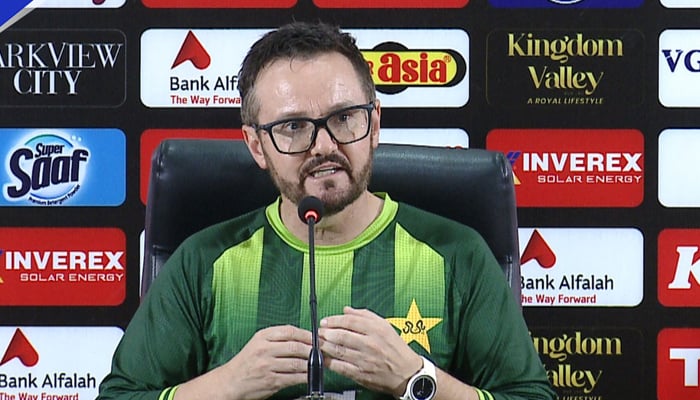
wasim akrams 1992
|

Wasim Akram’s 1992 heroics inspire Rabada ahead of 2027 World Cup

JOHANNESBURG: South Africa fast bowler Kagiso Rabada has revealed that one of Wasim Akram’s greatest World Cup performances is motivating him as the Proteas prepare for the 2027 ICC Cricket World Cup on home soil.

Rabada, speaking at the official World Cup 2027 venue and brand announcement event in Johannesburg, acknowledged that hosting cricket’s biggest tournament brings an added sense of responsibility. However, the experienced pacer said he prefers to view home advantage as an opportunity rather than a burden.

“I think there’s a lot more to it at the moment with us hosting it,” Rabada said.

Rather than feeling pressured to deliver a title in front of home supporters, the 31-year-old wants South Africa to embrace the occasion and protect what he described as their “fortress”.

“For me, it’s about representing the badge,” Rabada said, stressing the pride that comes with playing a World Cup in front of South African fans.

The fast bowler also looked back at the 1992 World Cup final, identifying Pakistan great Wasim Akram’s devastating spell against England as one of the tournament moments he remembers most vividly.

Akram changed the final with two remarkable deliveries that removed Allan Lamb and Chris Lewis in successive balls, helping Pakistan seize control before eventually lifting the trophy.

For Rabada, the performance represented everything he admires about fast bowling: pace, skill, intensity and the ability to rise to the biggest occasion.

“He was fast, had so much skill, and just had this presence, this heightened energy about him,” Rabada recalled.

The South African pacer hopes his team can create a similarly memorable moment in 2027. South Africa have repeatedly shown the ability to reach the latter stages of major ICC tournaments but have struggled to convert those appearances into a world title.

Rabada believes that barrier is no longer psychological.

“We’ve shown that we can go and play in finals and in the semi-finals,” he said.

The remaining challenge, he added, is taking that final step.

With the 2027 World Cup set to be staged across South Africa, Zimbabwe and Namibia, Rabada and his teammates will have a major opportunity to write their own chapter in cricket history.

And if Rabada can channel even a little of Akram’s 1992 magic, South African fans may have plenty to celebrate.

Similar Posts

  • |

    Uganda football captain David Owere killed in robbery attack

    KAMPALA: Uganda’s football world has been plunged into mourning after national team captain David Owere died following a brutal attack during an alleged robbery near his home in Kampala. The 27-year-old footballer was reportedly confronted by suspected robbers in the Makindye area while they attempted to steal his mobile phone and other valuables. Police said Owere resisted the attackers, triggering a violent assault that left the young captain critically injured. Witnesses said the attackers allegedly pelted Owere with stones before fleeing the scene. He was found unconscious and was quickly taken to a nearby clinic for treatment. As his condition remained serious, Owere was later transferred to a private hospital. Despite receiving medical care, the footballer succumbed to his injuries, bringing a sudden and tragic end to the life of one of Uganda’s emerging football leaders. His death has shocked supporters and the football community across the country. Owere was a key figure for both the Uganda national team and SC Villa, one of Uganda’s most successful clubs. His versatility allowed him to play as a right-back as well as in midfield, while his leadership qualities earned him the captain’s armband. SC Villa paid an emotional tribute to their captain, saying the club had lost far more than a footballer. The Uganda Football Federation also mourned Owere, describing him as an exemplary leader who made an impact both on and off the pitch. The federation highlighted his influence on younger players and his role as an inspirational figure within Ugandan football. The circumstances of his death have raised concerns about violent crime in Kampala, with the alleged attack occurring close to the player’s home. Police are expected to investigate the incident and pursue those responsible for the attack. For Uganda’s football fans, Owere’s death is a devastating loss. At only 27, he had already established himself as a respected captain and leader, leaving behind teammates, supporters and a football community struggling to come to terms with his sudden death.

  • | | |

    Constitutional provisions fuel referendum debate

    Debate over the possibility of holding a national referendum has resurfaced in Pakistan, prompting discussions among political observers and constitutional experts about the legal framework governing such a move. Although the government has made no official announcement regarding a referendum, speculation in political circles has raised questions about when and how a nationwide vote can be conducted under the Constitution. Constitutional experts say Articles 48(6) and 48(7) of the Constitution empower the prime minister to propose a referendum on a matter of national importance. Under Article 48(6), the prime minister may refer such a proposal to a joint sitting of Parliament. If approved by the joint session, the matter can be presented to the public through a referendum in the form of a “Yes” or “No” question. Article 48(7) further provides that Parliament may legislate the procedure for conducting a referendum and determining its results. Legal experts note that, unlike a constitutional amendment, such legislation does not require a two-thirds majority and can be passed through a simple majority of members present, provided the quorum is complete. The renewed debate has also revived interest in the history of referendums in Pakistan. The concept first gained prominence during the political crisis that followed the March 7, 1977 general elections. Opposition parties, united under the Pakistan National Alliance (PNA), rejected the election results, alleging widespread rigging. They later boycotted provincial assembly elections and launched a nationwide protest movement demanding fresh elections, dissolution of assemblies and the resignation of then-prime minister Zulfikar Ali Bhutto. Despite mediation efforts by Saudi Arabia, negotiations between the government and the opposition failed, and the political deadlock culminated in the imposition of martial law by General Muhammad Zia-ul-Haq on July 5, 1977. Following these developments, constitutional provisions allowing referendums were introduced through the Seventh Constitutional Amendment. Pakistan’s first referendum was held on December 19, 1984, during General Zia-ul-Haq’s rule. While the public was asked to vote on the continuation of the Islamization process, a “Yes” vote effectively extended Zia’s presidency for another five years. Official results declared overwhelming support for the proposal, though opposition parties questioned both the process and the outcome. A second nationwide referendum was held in April 2002 under General Pervez Musharraf. The exercise enabled him to secure another five-year presidential term before the general elections later that year. After the 2002 elections, Musharraf was formally elected president by an electoral college comprising Parliament and the four provincial assemblies under the framework established through the Seventeenth Constitutional Amendment. Political analysts say recent discussions intensified after comments made during a media briefing by the Director General of Inter-Services Public Relations (ISPR), whose carefully worded responses to questions on constitutional matters drew public attention.

  • |

    Mike Hesson holds key meeting ahead of Champions Cup

    MULTAN: Pakistan white-ball head coach Mike Hesson has arrived in Multan for the National Champions Cup, where he held an important meeting with the coaching staff of all four participating teams as the domestic tournament gets ready to kick off the 2026-27 season. Hesson met the head coaches of the four sides — Misbah-ul-Haq, Ijaz Junior, Iqbal Imam and Aizaz Cheema — to discuss ways of improving players’ one-day cricket skills and ensuring that the tournament serves as a meaningful platform for national selection and development. Pakistan bowling coach Ashley Noffke and National Cricket Academy (NCA) Head of Coach Education Shahid Aslam also attended the meeting, adding further weight to discussions around player development and coaching standards. The meeting comes at an important time for Pakistan cricket, with the Champions Cup being viewed as the first major step towards preparations for next year’s World Cup in South Africa. Hesson’s presence in Multan signals the national team management’s focus on closely monitoring domestic performances while identifying players capable of making the jump to international cricket. Particular attention is expected to be given to players’ consistency, tactical awareness and ability to handle pressure in the 50-over format. The tournament will also provide coaches with an opportunity to assess emerging talent in a competitive environment. The National Champions Cup will begin on August 11, coinciding with the official start of Pakistan’s 2026-27 domestic cricket season. With the World Cup on the horizon, the tournament could prove crucial in shaping Pakistan’s next generation of one-day performers.

  • |

    Pakistan’s auto tax policy sparks industry divide over EV incentives

    LAHORE: Pakistan’s automobile industry is witnessing growing divisions over the government’s taxation policy for vehicles, with local manufacturers warning that the current framework unfairly benefits expensive imported and premium new energy vehicles (NEVs) while placing a heavier tax burden on affordable cars purchased by middle-income families. The controversy has intensified following the government’s decision to introduce a range of fiscal incentives for new energy vehicles, including battery electric vehicles (BEVs), plug-in hybrid electric vehicles (PHEVs) and range-extended electric vehicles (REEVs). While the policy is designed to accelerate Pakistan’s transition towards cleaner transportation and reduce reliance on fossil fuels, established local assemblers argue that the incentives are skewed in favour of luxury vehicle buyers instead of promoting affordable green mobility. Industry representatives say the taxation gap between conventional locally assembled vehicles and premium electric vehicles has widened considerably, raising concerns over fairness, competitiveness and the long-term sustainability of Pakistan’s domestic automobile manufacturing sector. According to industry estimates, a locally assembled Suzuki Alto—one of the country’s most affordable passenger vehicles priced at around Rs3 million—bears nearly Rs550,000 in taxes, including sales tax, federal excise duty (FED) and the recently introduced New Energy Vehicle (NEV) levy. In contrast, a premium REEV costing close to Rs10 million reportedly attracts sales tax of only around Rs100,000 while remaining exempt from both the federal excise duty and the NEV levy. The tax disparity has triggered criticism from domestic manufacturers, who argue that the current structure effectively penalises middle-income consumers while offering generous incentives to buyers of high-end imported vehicles. Local Assemblers Raise Concerns Pak Suzuki Motor Company spokesperson Ikhlaq Virk said the taxation framework has created an uneven competitive environment that disadvantages affordable vehicles widely used by Pakistani families. He said entry-level models such as the Alto and Cultus serve as essential transportation for the country’s middle class but receive no meaningful tax relief despite their affordability. Virk further noted that premium hybrid and electric vehicles, valued at nearly Rs10 million or more, continue to enjoy substantial concessions under the government’s clean mobility policy. He also pointed to reports suggesting that the sales tax on certain plug-in hybrid and hybrid electric vehicles could be reduced from 25 percent to 18 percent after changes introduced through the Finance Bill, arguing that such relief would primarily benefit affluent consumers rather than encouraging mass-market adoption. IMF Programme Adds Complexity The debate comes at a time when Pakistan remains under an International Monetary Fund (IMF) programme, which has required the government to increase tax revenues, rationalise subsidies and implement fiscal reforms to stabilise the economy. Against this backdrop, industry stakeholders argue that taxation policies should strike a balance between environmental objectives and economic realities, ensuring that clean energy initiatives do not disproportionately favour a small segment of wealthy consumers. The discussion has also reopened a broader policy debate over whether Pakistan’s green mobility strategy should focus solely on reducing emissions or also safeguard domestic manufacturing, employment and industrial investment. Analysts Call for Balanced Incentives Automobile industry experts believe Pakistan’s transition towards cleaner transportation is necessary, but they stress that government incentives should encourage widespread adoption instead of being concentrated in the luxury vehicle segment. Yousuf M. Farooq, Director Research at Chase Securities, said environmental goals should be pursued alongside industrial development and economic sustainability. He noted that while encouraging cleaner transportation is an important national objective, incentive programmes should also consider vehicle affordability, localisation, environmental benefits and the contribution of manufacturers to Pakistan’s economy. Farooq emphasised the need for a consistent taxation framework across all vehicle categories, including conventional internal combustion engine vehicles, hybrids, plug-in hybrids and range-extended electric vehicles, while maintaining adequate protection for local assembly operations and the domestic auto parts industry. He added that environmental incentives should not undermine the competitiveness of local manufacturers or threaten employment generated by Pakistan’s automotive sector. Local Industry Fears Investment Slowdown Pakistan’s automobile industry has invested billions of rupees over the past three decades in assembly plants, localisation programmes and vendor development. The sector supports hundreds of component manufacturers and provides employment to thousands of skilled workers across the country. Industry stakeholders warn that if imported premium electric vehicles continue to enjoy significantly lower taxation than locally assembled conventional vehicles, future investment in domestic manufacturing could slow, weakening Pakistan’s automotive supply chain and localisation efforts. Manufacturers believe a prolonged imbalance may discourage further expansion by existing assemblers while affecting the viability of local parts suppliers that have developed alongside the country’s automobile industry. Government’s Green Mobility Vision Supporters of the government’s policy argue that Pakistan cannot afford to lag behind the global transition towards electric mobility. Many countries are offering tax incentives, subsidies and policy support to encourage electric vehicle adoption, reduce dependence on imported petroleum products and lower carbon emissions. Pakistan, which spends billions of dollars annually on fuel imports, could also benefit from increased electrification of its transport sector by reducing its import bill and improving environmental sustainability over the long term. However, industry observers believe the core issue is not whether electric vehicles deserve policy support but how those incentives should be structured.

  • |

    Pakistan railways police recover stolen railway equipment worth millions in Karachi operation

    Karachi: Pakistan Railways Police have recovered a large quantity of stolen railway infrastructure during a targeted operation in Karachi, dealing a significant blow to those involved in the theft and illegal trade of railway assets. According to an official statement issued by the Pakistan Railways Police, the operation resulted in the recovery of approximately 32 tons of stolen railway material, including railway tracks valued at millions of rupees. Authorities described the recovery as an important step towards protecting the country’s railway infrastructure and preventing financial losses to the national exchequer. The raid was conducted in Orangi Town, where police arrested four suspects allegedly involved in stealing railway tracks. Officials also seized specialized equipment believed to have been used for cutting and removing railway tracks, indicating that the suspects were operating in an organized manner. Police said the recovered material has been taken into custody, while the arrested individuals are being interrogated to identify other members of the network and determine whether the group is linked to previous incidents of railway theft in different parts of the country. Inspector General (IG) Pakistan Railways Police said the department is committed to safeguarding national assets and ensuring the security of railway infrastructure. He emphasized that strict action would continue against individuals involved in stealing railway property or causing damage to public assets. The IG further stated that operations against criminal elements targeting railway installations will be intensified in the coming weeks, with enhanced surveillance and intelligence-based raids aimed at dismantling organized theft networks.

  • |

    Manchester City bring back Argentina star Geronimo Rulli after nine years

    MANCHESTER: Manchester City have brought Argentina international goalkeeper Geronimo Rulli back to the Etihad Stadium, signing the 34-year-old from Marseille on a two-year contract. Rulli will arrive as City’s second-choice goalkeeper behind Italy international Gianluigi Donnarumma, adding experience and international pedigree to Pep Guardiola’s squad. The move is also a return to familiar territory for Rulli, who spent the 2016-17 season with Manchester City. His first spell, however, ended without a senior appearance, making his return a very different opportunity. “This is an amazing opportunity for me and one I had to grasp,” Rulli said after completing the move. The goalkeeper added that joining City was an opportunity he could not afford to overlook, praising the club’s long-standing success and demanding standards. Rulli has earned eight Argentina caps and was part of the squad that lifted the 2022 FIFA World Cup and 2024 Copa America. He also travelled with Argentina to last month’s World Cup final, where they suffered a 1-0 defeat to Spain. His career has taken him across several major European leagues. Before arriving at Marseille, Rulli represented Real Sociedad, Villarreal, Montpellier and Ajax, gaining extensive experience at both domestic and European level. One of the most memorable moments of his career came in the 2021 Europa League final, when Villarreal faced Manchester United. Rulli not only converted his penalty during the dramatic shootout but also saved David de Gea’s effort as Villarreal won 11-10. Now, years later, the Argentine goalkeeper returns to Manchester with a new role and a wealth of experience behind him. The transfer also provides financial relief for Marseille, who are under pressure to balance their books after being fined €10 million for failing to meet UEFA break-even requirements. Marseille’s fifth-place Ligue 1 finish in the 2025-26 campaign also means they will miss out on Champions League revenue, increasing the need for player sales during the summer. Rulli’s departure follows several other exits from the French club. Argentine defender Facundo Medina has moved to Bayer Leverkusen, while high-profile forwards Mason Greenwood and Pierre-Emerick Aubameyang have also left. For City, meanwhile, Rulli offers a reliable and experienced option between the posts. For Rulli himself, the move represents a second chance at a club where his first chapter never truly began.

Leave a Reply

Your email address will not be published. Required fields are marked *