colombia earthquake kills
|

Colombia earthquake kills at least 22 as buildings collapse in several cities

BOGOTA, Colombia – At least 22 people were killed after a powerful earthquake struck western Colombia on Monday, August 10, bringing down buildings across several cities and leaving others trapped in the rubble, local authorities said.

The highest reported death toll was in Pereira, a city in Colombia’s coffee-growing region, where Mayor Mauricio Salazar said 18 people had died. In nearby Manizales, Mayor Jorge Eduardo Rojas said three people were killed.

One person died in Buenaventura, Colombia’s main Pacific port, when a building collapsed, trapping several people, Mayor Ligia del Carmen Cordoba said.

People remained trapped in Cali, one of Colombia’s largest cities, after more than two dozen structures collapsed, Mayor Alejandro Eder said. He added that the city had asked authorities in Bogota and Medellin to send disaster teams to support rescue efforts.

“At this point, two people have already been rescued alive, one elderly woman and one young girl. There are more people trapped,” Eder told Blu Radio. “We have at least 12 critical points and 25 collapsed structures that we are responding to.”
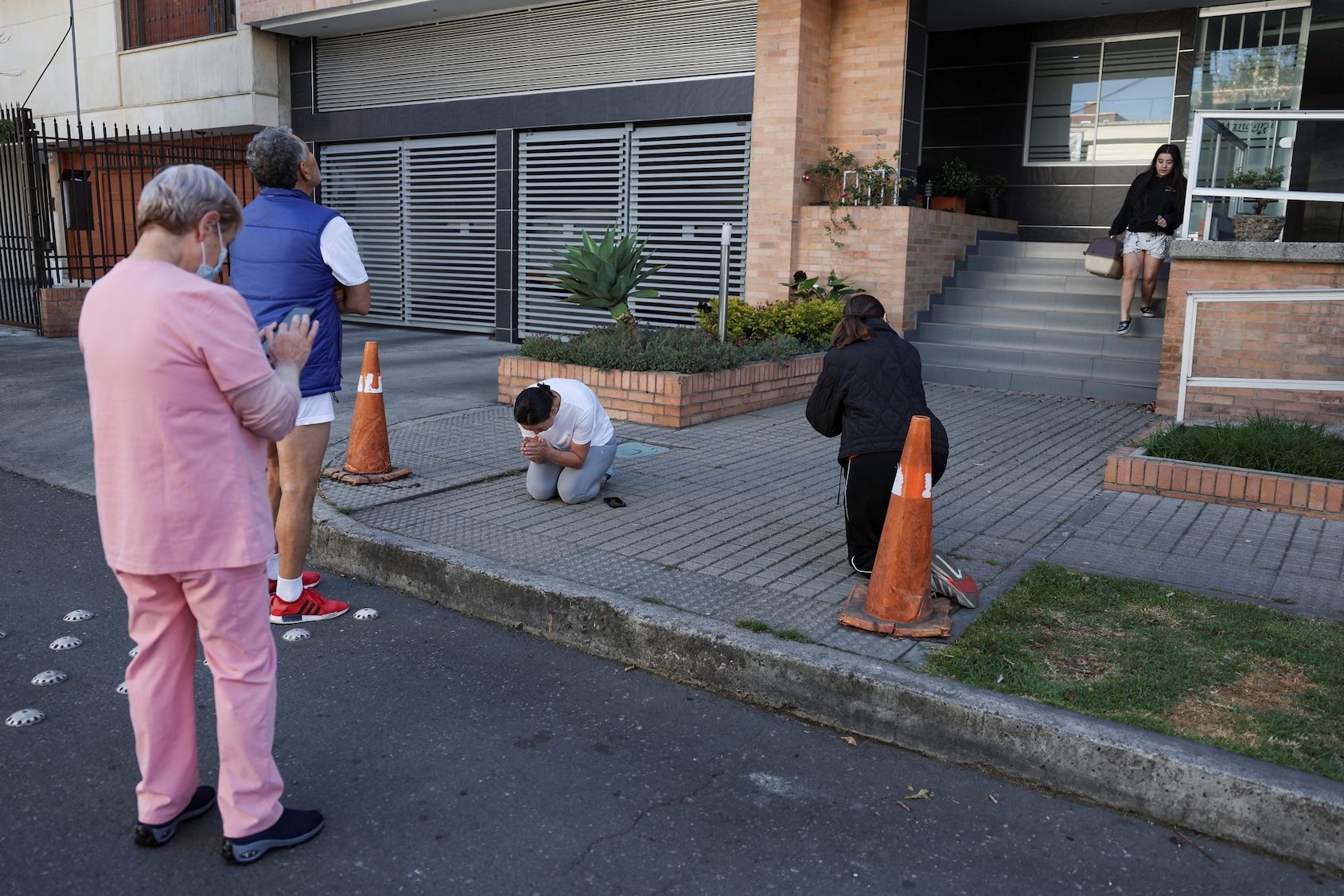
EVACUATION. A woman prays as people gather outside a building following an earthquake in Bogota, Colombia, on August 10, 2026. Photo by Luisa Gonzalez/Reuters

The earthquake’s epicenter was near San Jose del Palmar, in Choco, a sparsely populated province on Colombia’s Pacific Coast. Choco Governor Nubia Carolina Cordoba-Curi said there were injuries and significant damage in Quibdo, the provincial capital, and warned residents about aftershocks.

Colombia’s civil aviation authority said flights were suspended at airports in Pereira, Manizales, Quibdo, Armenia, Cartago and Buenaventura while inspectors checked for structural damage.

The country’s disaster agency said the earthquake, which occurred at 7:34 local time (1234 GMT), was felt in nine departments and all 32 departmental capitals, triggering evacuations and reports of damage. Colombia’s geological service pegged the magnitude at 7.4 and said the earthquake struck at a depth of 96 km (60 miles). The US tsunami warning system said there was no tsunami threat.

Reuters witnesses in the Venezuelan border state of Tachira and the central-western city of Barquisimeto reported the earthquake had been felt there. Venezuela was hit by devastating twin earthquakes in June, which killed more than 6,000 people, mostly on the coast near the capital, Caracas. – Rappler.com

Similar Posts

  • |

    Moroccan businessman’s death reignites Italy migration debate

    BOLOGNA: The death of a Moroccan businessman during a police restraint in the Italian city of Bologna has reignited Europe’s heated debate over migration, policing and the treatment of immigrants, with the case exposing the deeply personal human stories often overshadowed by political rhetoric. The incident comes as European governments face mounting pressure over migration policies. Just days after thousands of migrants crossed from Morocco into Spain’s North African enclave of Ceuta, Italian Prime Minister Giorgia Meloni announced plans to suspend a free-movement agreement with Spain, reinforcing her government’s tough stance on immigration. Amid the political storm, the death of Abderrahim Fakir, a 42-year-old Moroccan-born entrepreneur who had spent most of his life in Italy, has become a symbol of the broader tensions surrounding migration and law enforcement. Videos recorded by local residents on July 19 showed police officers restraining Fakir face down on the ground for several minutes after responding to reports of a distressed man behaving erratically in a residential area. The footage, which quickly spread across social media, sparked widespread public outrage and renewed scrutiny of police conduct. Authorities said officers were responding to emergency calls about a man shouting, kicking garage doors and striking a vehicle. An autopsy and official investigations into the officers’ actions remain ongoing, while four Red Cross volunteers who were present are also under review. The tragedy triggered thousands of peaceful protesters to gather in Bologna, demanding accountability and justice for Fakir’s family. However, demonstrations later turned violent when a small group clashed with police, leaving dozens of officers injured and further intensifying political divisions. Friends, relatives and lawyers describe Fakir as far more than the image portrayed in political debates. Having arrived in Italy from Morocco at the age of six, he built a successful life, eventually owning a small metalworking company after years of hard work. Behind that success, however, he had been battling severe anxiety. According to his lawyer, Fakir feared deportation after complications involving his residency permit, despite living in Italy for nearly four decades. He had also been struggling financially as his business declined, forcing him to lay off several employees. Family members said he concealed his emotional pain, insisting everything was fine even as he sought psychiatric assistance weeks before his death. Sociologists argue that Fakir’s story highlights the dangers of reducing migration to political slogans while ignoring the human lives behind the headlines. As Italy awaits the outcome of official investigations, his family says they continue to trust the country’s justice system and hope the full truth surrounding his final moments will emerge.

  • |

    Iranian lawmaker questions Saudi defence pact with Pakistan, Türkiye

    TEHRAN: Iranian parliamentarian Ebrahim Rezaei has questioned whether Saudi Arabia’s new defence agreement with Pakistan and Türkiye can guarantee the Kingdom’s security. Rezaei, a member of Iran’s Parliament National Security and Foreign Policy Committee, made the remarks in a social media post. He said Saudi Arabia should understand that the agreement with Pakistan and Türkiye would not provide the level of protection Riyadh had failed to obtain despite decades of reliance on the United States. Rezaei described the agreement as a “paper pact” and urged Saudi Arabia to reconsider its policies so that it would not have to seek security guarantees from other countries. His comments came shortly after Saudi Arabia, Pakistan and Türkiye signed a joint defence agreement in Makkah. The agreement was signed amid concerns over potential attacks on Saudi Arabia by Iran-aligned militias in Iraq and Yemen. Saudi officials have reportedly warned of such security threats. Under the new agreement, an attack against any one of the three countries will be considered an attack against all three. The pact aims to strengthen defence cooperation and develop joint capabilities among Saudi Arabia, Pakistan and Türkiye. A trilateral defence summit was held at Al-Safa Palace in Makkah, attended by Saudi Crown Prince Mohammed bin Salman, Turkish President Recep Tayyip Erdogan and Pakistani Prime Minister Shehbaz Sharif. According to Pakistan’s Foreign Office, the three leaders signed the agreement, formally described as the Makkah Defence Joint Agreement.

  • |

    North Korea fires missile ahead of US-South Korea drills

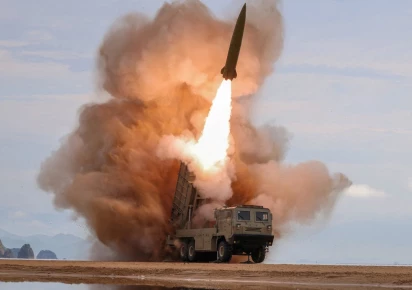
    SEOUL: North Korea launched a suspected ballistic missile into waters off the Korean Peninsula’s eastern coast on Wednesday, raising tensions just days before major military exercises between South Korea and the United States. South Korean and Japanese authorities detected the launch from the Wonsan area on North Korea’s east coast at around 6am local time. The missile travelled approximately 700 kilometres before falling into the sea, according to South Korean and Japanese defence officials. The launch came only days before the annual Ulchi Freedom Shield exercises, scheduled to begin on August 17 and continue through August 27. The drills are designed to strengthen the allies’ ability to respond to security threats from North Korea. Pyongyang has repeatedly criticised the exercises, describing them as preparations for a potential attack. Seoul and Washington maintain that the drills are defensive and necessary to improve their combined military readiness. South Korean officials said Wednesday’s launch was the latest in a series of weapons tests conducted by North Korea this year. It was assessed as the country’s 11th suspected ballistic missile test of 2026. North Korea had also launched a missile from the Wonsan region on August 6. Pyongyang did not publicly acknowledge that test. Analysts said the latest launch could have been part of North Korea’s ongoing weapons development programme. However, its timing may also have been intended to send a political and military message ahead of the upcoming US-South Korean exercises. South Korean authorities have not yet confirmed the exact type of missile involved. Officials said a detailed analysis was under way to determine its specifications. The missile’s reported range and launch location have prompted speculation that it could have been a hypersonic weapon or another advanced missile system. Officials have not confirmed those assessments. Seoul and Tokyo condemn launch South Korea and Japan strongly criticised the missile test. South Korean authorities convened an emergency security meeting and called on Pyongyang to stop activities that violate United Nations Security Council resolutions. South Korea’s military said it remained fully prepared to respond to any further provocation and would maintain its combined defence posture with the United States. Japan also lodged a formal protest through diplomatic channels. Japanese Defence Minister Shinjiro Koizumi condemned the launch and said Tokyo was closely monitoring developments. The latest test follows growing tensions over North Korea’s expanding weapons programme and Japan’s plans to strengthen its defence capabilities. North Korean state media had criticised Japan’s latest defence policy document a day earlier, accusing Tokyo of using the North Korean threat to justify an increase in military spending and capabilities. The US Indo-Pacific Command said it was coordinating closely with South Korea and Japan. Its initial assessment was that the missile launch did not pose an immediate threat to US territory, American personnel or its allies.

  • |

    Syria and Russia redefine military ties

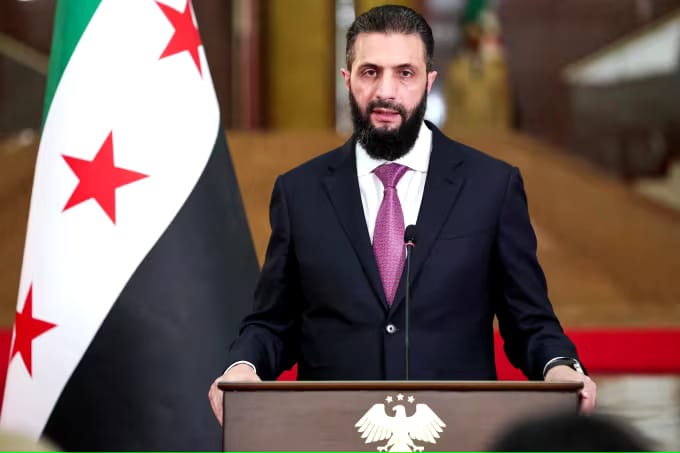
    Syria and Russia have reached a new agreement regarding the future of two strategically important Mediterranean military sites, marking a major shift in Moscow’s role in the country after years of close military cooperation with the former Syrian government. According to Syria’s Foreign Ministry, the agreement will bring changes to the way Russia operates at the Hmeimim air base near Latakia and the Tartus naval facility on Syria’s Mediterranean coast. Both locations served as key Russian military positions during the rule of former President Bashar Assad, who relied heavily on Moscow’s political and military support throughout Syria’s long civil war from 2011 to 2024. The Hmeimim air base became one of Russia’s most important overseas military installations, supporting Russian air operations in Syria and strengthening Moscow’s influence in the eastern Mediterranean. Meanwhile, the naval base at Tartus provided Russia with its only major naval facility outside the former Soviet Union, allowing it to maintain a strategic presence in the region. Under the newly announced arrangement, Syria will assume control of the Hmeimim air base and the commercial section of Tartus port as part of its civilian administration. The remaining military areas at both locations will reportedly be transformed into joint training and qualification centers rather than serving as traditional Russian military outposts. Syria’s Foreign Ministry described the agreement as a “reorganization of the Russian presence” along the country’s coastline. The ministry said the deal represents the most significant step forward in negotiations that have continued for around 18 months and could open the door to a new stage in Syrian-Russian relations. Russia has not yet issued an official public response to the announcement. However, Moscow’s position in Syria has changed significantly since the fall of Assad’s government. During the uprising and subsequent conflict, Russia was one of Assad’s strongest supporters, providing military assistance that helped his government remain in power. After Assad was removed from office, Russia allowed him and his family to seek asylum, while many remaining Russian forces gradually withdrew from Syria. Despite these changes, Syria’s new leadership has attempted to maintain diplomatic relations with Moscow. Interim President Ahmad al-Sharaa has met Russian President Vladimir Putin in Moscow on two occasions since taking office, with the future of the Mediterranean bases being one of the main issues discussed during their talks. At the same time, Syria has expanded its diplomatic engagement with Western nations and regional Arab countries. Several states that had distanced themselves from Damascus during Assad’s crackdown on opposition movements have begun rebuilding relations with the new Syrian authorities. The United States has also removed many of the sanctions that had severely affected Syria’s economy, while European countries have increased diplomatic contacts. French President Emmanuel Macron’s visit to Syria in July marked another important step, with both countries announcing plans to appoint ambassadors for the first time in 14 years. The agreement over Hmeimim and Tartus reflects the changing balance of international influence in Syria. While Russia remains an important partner, the country’s new government appears to be pursuing broader relationships with multiple global and regional powers as it seeks to redefine Syria’s future after years of conflict.

  • | |

    Oil surges above $83 as Strait of Hormuz tensions …

    Global oil prices continued their upward momentum on Friday, with Brent crude climbing above $83 per barrel as renewed tensions surrounding the Strait of Hormuz heightened concerns over potential disruptions to global energy supplies. Brent crude futures gained 1.1 percent to reach $83.48 per barrel, while US West Texas Intermediate (WTI) crude rose by 85 cents to $78.84 per barrel. The latest rally marks a sharp reversal from earlier this week, when crude prices had declined amid expectations that diplomatic efforts between Iran and Oman could ease regional tensions and pave the way for smoother maritime traffic through the Strait of Hormuz. However, investor sentiment shifted after reports that Iran, in coordination with Oman, proposed new restrictions on shipping through the strategic waterway. The proposal reportedly includes banning vessels belonging to countries considered hostile from passing through the strait and imposing substantial financial penalties on ships that violate the proposed regulations. The renewed uncertainty over one of the world’s most important oil transit routes has reignited fears of supply disruptions, prompting traders to push oil prices higher despite earlier forecasts predicting further declines. Analysts say developments in the Strait of Hormuz will remain a key factor influencing global energy markets in the coming days.

  • |

    UN warns Afghanistan’s child malnutrition crisis deepens

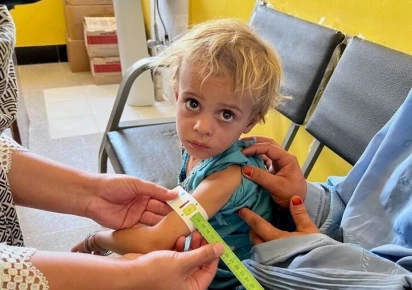
    Afghanistan is facing a rapidly worsening malnutrition emergency as severe funding cuts leave millions without life-saving assistance, the United Nations has warned. Speaking from Kabul, the World Food Programme’s (WFP) Afghanistan Director John Aylieff said the country’s nutrition crisis is escalating at an alarming pace, with growing numbers of severely malnourished children reaching health facilities too late to receive effective treatment. He said child wasting, the deadliest form of malnutrition, has now reached critical levels in nearly one-third of Afghanistan’s provinces. According to the WFP, ongoing conflict, disruptions to trade, the return of thousands of Afghan migrants from neighbouring countries, and shrinking international aid have combined to create an unprecedented humanitarian emergency. The UN official said last year recorded the sharpest annual increase in malnutrition cases, while the situation has deteriorated even further in 2026. Children under the age of two account for around 80 percent of the most severe cases, highlighting the devastating impact on the country’s youngest and most vulnerable population. Aylieff said the WFP has only enough resources to provide treatment to one out of every seven acutely malnourished women and children this year. The remaining six are forced to leave without assistance because of a severe shortage of funds. He warned that the cries of starving children in Afghan health centres reflect a preventable tragedy that could claim countless more lives if emergency funding is not secured. The humanitarian agency also expressed concern that widespread hunger could fuel migration, instability and extremism, stressing that a stable Afghanistan remains important for regional security. Millions of Afghans have also returned from neighbouring countries, including Pakistan and Iran, over the past three years, placing additional pressure on already overstretched resources. Although this year’s harvest has improved, the gains have been overshadowed by the country’s worsening economic and humanitarian challenges. The WFP estimates that nearly 14 million Afghans are currently experiencing acute hunger. However, funding shortages have limited food assistance to only a small fraction of those in need, while preventive food distribution programmes in high-risk areas have been suspended.

Leave a Reply

Your email address will not be published. Required fields are marked *