goodbye jeanette patindol
| | | | |

Goodbye, Jeanette Patindol, queen of strong, gracious single mothers

Some years back, when multi-awarded writer Jeanette Concepcion Patindol and I imagined her future, it looked like this: If God would bring a man into her life at a mature age, she would want a “slow, tender, pure old-fashioned courtship” with him. 

“The man would have to work to ‘earn you,’” I said. She deserved nothing less. 

Jean was at the point in her life where she had resolved to “do it right according to God’s ways now,” and which entailed “honoring myself.” So if a man “can honor me right down to our wedding day, then he’s truly the man God says is for me.” 

We were in our mid- or late-40s then, but we were giggling — in our chat — like teenagers. She said she wanted “to still experience a real first kiss at the altar and a real wedding night.” We checked out drawings of wedding dresses.  

Basta, when it happens na, our wedding day will be on a Christmas Day. You’re a secondary sponsor, ha? We’ll take care of travel arrangements for you and your boys, so you can spend Christmas in Bacolod,” she said. 

Jean and I had only spent a night (not even one full day) physically together in the more than two decades we were friends. She was based in Bacolod, her home city that she loved and where she thrived; I was working in Manila and going home every day via a traffic-plagued route to the south of the metro. 

Yet we had a bond that transcended our locations. 

Not your usual children’s books for families

In 2004, when my eldest son was a preschooler, he asked me a question that made me freeze: “Mommy, why is Daddy not living with us? Why does he come here, but he goes home to a separate house?” (In my head I was taking to task all the psychologists I had read who said the kid would ask that when he was 7 years or older yet.) 

I ran to his ninong, a literary writer and psych graduate, for advice, and he said: Read to the kid Papa’s House, Mama’s House — a book by Jean Lee C. Patindol, and freshly published by Adarna House. 

The story, using a child’s voice, showed how a young mind can get to understand that they can be loved fully even if their parents are separated. The book was the grand winner of the 2004 Salanga Prize and the 2004 Alcala Prize of the Philippine Board on Books for Young People. 

The book made me admire her from a distance. 

The following year, she published Tight Times, also under Adarna. It told the story of a family that had to be frugal, work harder, and make sacrifices through economic uncertainties — together. It clinched both the grand Salanga and Alcala prizes of the PBBY in 2007. 

That made me reach out to her via email. I told her: These books are autobiographical, aren’t they? I want to know the woman whose stories are resonating with a lot of us single-parent households. 

She had called me “soul sister” ever since. 

A woman of grace

Thanks to email and eventually social media, I “saw” how she raised her three children into decent, loving, passionate and compassionate, and successful young adults. “My Treasures,” she would call Thea, Paolo, and Bea in her posts. 

While she wrote books and papers, taught several courses, did strategic consultancies, mentored students, and earned post-graduate degrees, and received some more awards (2018 Most Outstanding Negrosanon Awardee for Education and Literature for the win!), there was no doubt that the rewards in life she was proudest of were how her children loved and honored her back. 

Still, the economics and business management graduate-turned-creative writer, touched so many lives — students who cherished her, colleagues who witnessed her model discipline and hard work, consultancies that realized her valuable perspective and her uncompromising stand on political, social issues, and moral issues. 

You could see that in testimonies tagging her over the years. I could see that in our private chats, where neither of us ever feared being judged or misunderstood when we spoke our minds and poured out our hearts. 

You could see that — and I say this with a heart broken by grief — in the eulogies posted by her family, friends, and circles who were made better by her life of integrity, her heart of compassion, her story of strength, her ways of grace. (See what her son Paolo, her sister Honey, her good friends Bugsy and Philip, the local media, her publisher have to say.) 

Ah, yes, grace — from her early “Grace with Fire” blog to her “Diyosa Ways” account of late, she encouraged women (all kinds of, not just single mothers like her) towards higher living. 

One night in Bacolod

Privately, she would send me prayers like: “Dear God, this is my friend whom I love…. Help her live her life to the fullest. Please promote her and cause her to excel above her expectations. Help her to shine in the darkest places where it is hard to love. Protect her at all times, lift her up when she needs You the most, and let her know when she walks with You, she will always be safe.”

Long before one senator developed the penchant for loosely invoking Jeremiah 29:11 in between his lies and propaganda, Jean would remind me of the certainty of God’s plan to prosper me and give me hope and a future. 

That night when she knocked on my door after I spoke at her school, in La Salle Bacolod, I remembered the excitement of seeing her smile in person for the first time; I remembered I almost cried finally getting to hug a friend who felt like she had been beside me all along. We drove around the city, laughing, giggling, crying, dreaming. 

And we thought we would get the chance to do that again — at least before her Christmas Day wedding that we dreamt of planning. 

On Thursday, August 13, at 6 pm, Jeanette Concepcion Patindol died after suffering a rare brain stem stroke. She was 58. 

Her wake will be held August 15-17 at the St. Pio Resurrection Chapel of the Sacred Heart Seminary, Lupit Church, Bacolod City. 

Sending you off with love and gratitude, friend, sister, fellow warrior and believer. – Rappler.com

Similar Posts

  • | | |

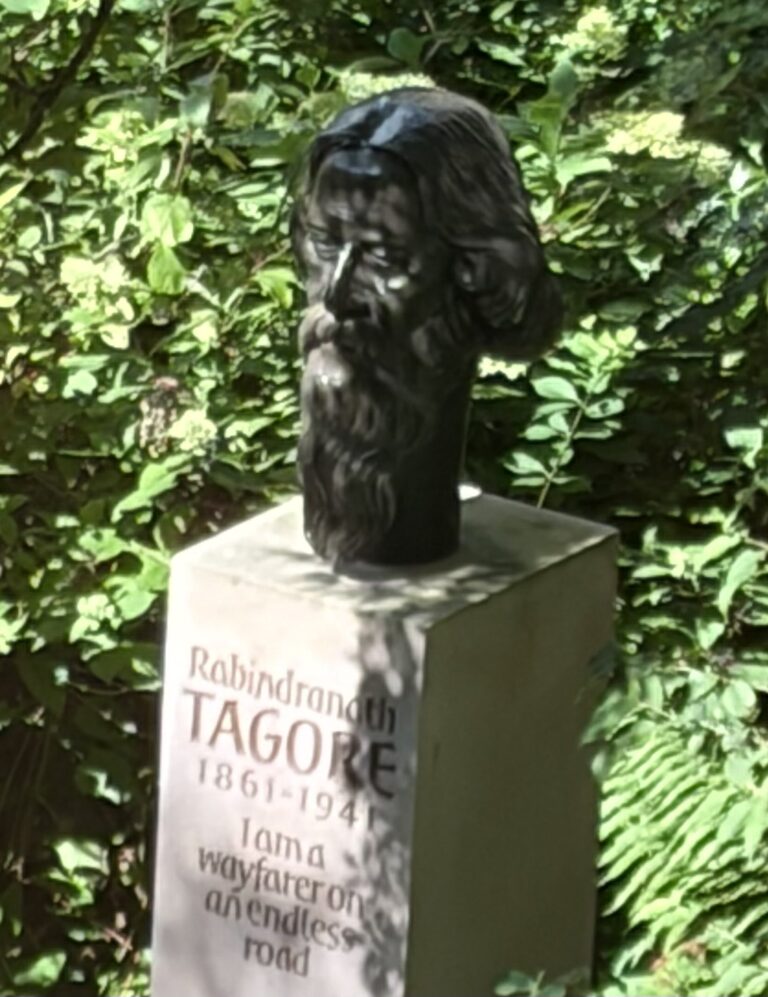
    Rabindranath Tagore’s statue in Edinburgh

    The Sandeman House garden in Edinburgh holds a bronze statue of Asia’s first Nobel laureate in Literature, Rabindranath Tagore. Inscribed upon the pedestal supporting his likeness are his famous words, “I am a wayfarer on an endless road.” A Cross-Cultural Bridge Travelers often seek out Scotland’s capital for its ancient castles, gothic architecture, and literary heritage tied to the likes of Sir Walter Scott or Robert Louis Stevenson. However, discovering Tagore’s presence in this peaceful courtyard offers a cross-cultural bridge. The statue, unveiled to commemorate the deep-seated connections between Scotland and India. It is particularly the intellectual dialogue between Scottish polymath Patrick Geddes and Tagore himself. This monument serves as a physical testament to a global humanism that transcends geographic boundaries. Tagore’s India Tagore was far more than a celebrated poet and author. He was an uncompromising philosopher, musician, visual artist, and social reformer whose thoughts shaped modern South Asia and beyond. At the heart of his vast body of literature lies a profound critique of borders, nationalism, and sectarian division. Tagore envisioned an India, and indeed a world, defined by radical openness. In his mind, India is a sanctuary where diverse faiths, ethnicities, and cultures could coexist in mutual respect. He rejected narrow chauvinism in favor of an inclusive internationalism, advocating for a world where the mind is without fear and the head is held high. Tagore’s Literary Legacy In the contemporary geopolitical landscape, Tagore’s ideals feel relevant. Across the globe, modern youth face a climate marked by rising social polarization, cultural fracturing, and ideological echo chambers. In response, a growing movement of young activists, writers, thinkers, and students are turning back to Tagore’s literary legacy as a blueprint for unity. They are rediscovering his essays and poetry not merely as historical artifacts, but as active tools to reclaim a society rooted in pluralism and dialogue. By reimagining Tagore’s vision for a modern era, today’s generation is fighting to restore an environment where freedom of thought, artistic expression, and inclusivity thrive over division. His stance on education emphasized learning in harmony with nature and breaking down rigid academic and social silos. Young scholars and community organizers are channeling this exact ethos, utilizing art, literature, and grassroots civic engagement to rebuild cross-cultural bridges in an increasingly fragmented world. Message of Universal Brotherhood   Standing before Tagore’s statue in Edinburgh’s quiet garden, one is reminded that his journey as a “wayfarer” was never meant to be walked alone. His message of universal brotherhood, preserved in stone far from his native Bengal, serves as a timeless compass. For the youth striving to cultivate a more empathetic and open world, Tagore’s endless road remains wide open, inviting everyone to walk forward together.

  • |

    The quiet trade between maturity and pure joy

    Grown-ups are not good at masking their concerns, although they can hide their delight and curiosity surprisingly well. Whereas with children it is the other way round. Children can tactfully mute their anxiety and conceal their sorrow, but will struggle not to express their excitement. That is what growing up means, in some simple way: learning to repress all expressions of pure happiness and joy. This quote exposes a subtle tragedy embedded within the journey to maturity. To become an adult, the passage suggests, is not merely to gain years or acquire responsibilities. Rather, it is to master the delicate art of emotional inversion. We trade the radiant honesty of childhood for a guarded composure. We learn to keep our wonder under lock and key while allowing our worries to spill openly across our brows. In recent cultural discourse and ongoing public health conversations surrounding wellness, psychologists have increasingly noted a pervasive phenomenon. The modern adult’s profound struggle with joy anxiety and burnout. Recent reports on workplace psychology and mental health trends reveal that adults frequently censor their enthusiasm to maintain a professional facade of stoicism and control. Society rewards composure and treats exuberance with suspicion, equating solemnity with competence. As a result, millions of people navigate their daily lives wearing a heavy armor of stress while systematically burying their moments of genuine awe, playfulness, and delight. When we observe children, their emotional mechanics operate in reverse. A child facing uncertainty or sorrow often swallows their tears to fit into the mysterious world around them. Yet, when confronted with something marvelous like a beetle on a leaf, a splash of rain, or an unexpected gift, their joy erupts without permission. It dances in their eyes and bursts into unfiltered laughter. Their happiness is an open room with no doors. For adults, however, delight becomes a secret kept strictly within. We learn to suppress the gasp of wonder, to filter our laughter into a polite smile and to temper our excitement lest we appear naïve or unprofessional. Meanwhile, our anxieties: the constant calculus of bills, schedules, deadlines, and social expectations leak out uncontrollably through furrowed brows, sighing lips, and taut shoulders. We become masters at channeling our burdens while keeping our light hidden in the shadows. This loss of expressive freedom raises a crucial question about the true cost of maturity. Must growing up inevitably mean muting our light? Reclaiming our capacity for uninhibited joy requires an intentional unlearning of the rules we spent decades acquiring. It demands that we grant ourselves permission to be thrilled without reservation, to wonder without apology, and to let our happiest moments spill freely into the open world. True maturity might not be the complete suppression of enthusiasm. It’s the courage to let unfiltered delight break through the cracks of our daily routine once more.

Leave a Reply

Your email address will not be published. Required fields are marked *