survey kthe kollwitzs

Survey of Käthe Kollwitz’s legacy

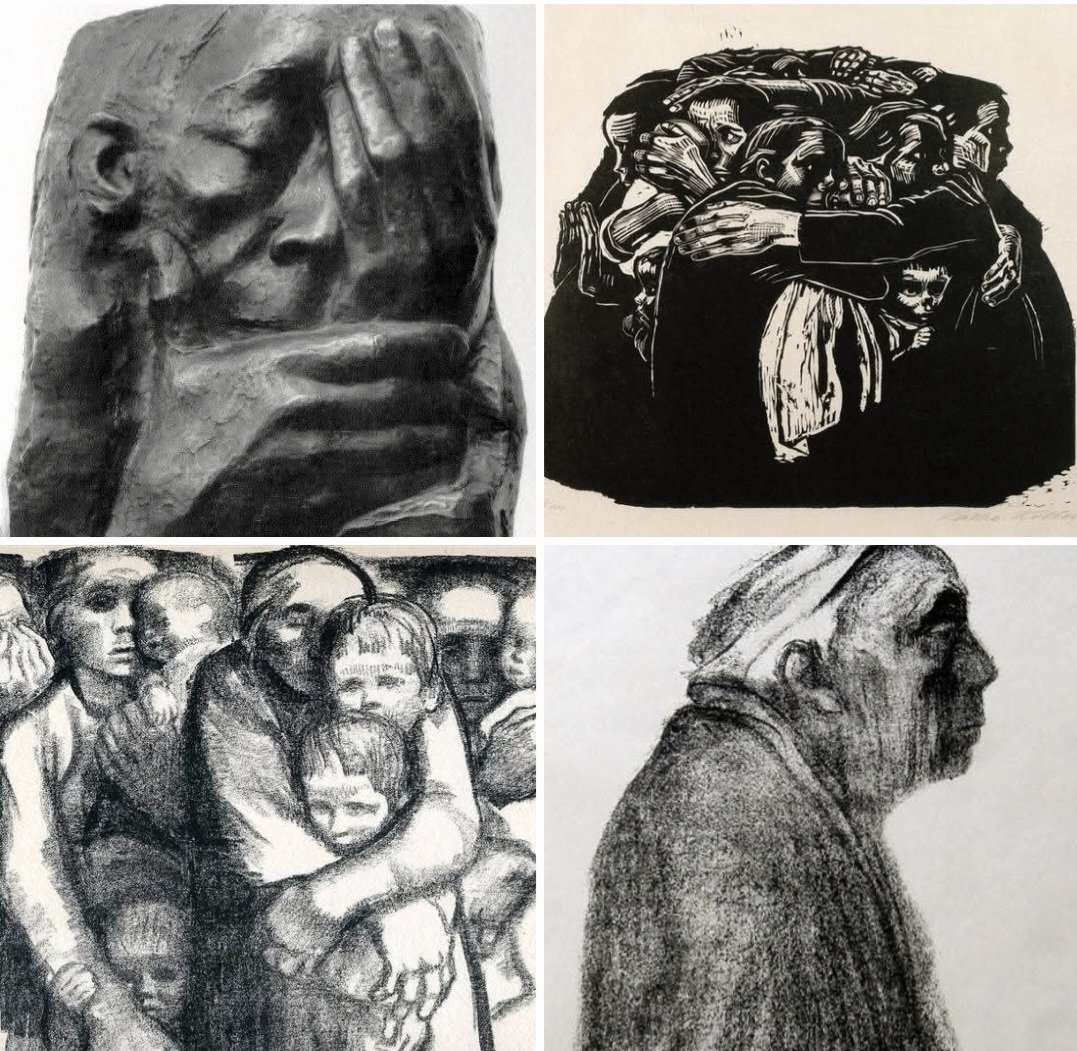
The Museum of Modern Art in New York  exhibits the first major museum retrospective devoted to the German printmaker and sculptor Käthe Kollwitz (1867–1945).The exhibition serves as reassessment of an artist who chose raw human emotion over abstract aesthetics. The survey features roughly 120 works on paper and evocative bronze sculptures gathered from private and public collections across North America and Europe.

Käthe Kollwitz originally trained as a painter before turning to printmaking, etching, and charcoal drawing. She quickly realized that black-and-white graphic arts provided a far more direct, accessible, and potent medium for addressing the social injustices around her. She lived through the tumultuous transition of late 19th-century industrialization. The revolution followed by the political instability and devastating carnage of two world wars in Berlin. However, Kollwitz dedicated her career to giving form to the silent suffering of society’s most vulnerable.

When many of her contemporaries were exploring radical formal abstraction, Kollwitz stayed firmly rooted in figuration. She viewed her artistic talent not as a path toward personal prestige, but as a moral imperative. As Kollwitz famously noted in her journal, she felt a profound duty to give voice to humanity’s immense burdens. It was a motivation clearly reflected in her emotionally charged compositions.

The retrospective marks several crucial series and individual masterpieces that define Kollwitz’s career. Early landmark series included A Weaver’s Revolt (1890s) and Peasant War (1902–1908). They showed her skill in capturing collective resistance, class struggle, and the violent fallout of peasant rebellions. Her works like Woman with Dead Child (1903) and her recurring depictions of mothers shielding their young. This theme is also dominant in her famous Mütter (Mothers) lithographs. These works demonstrate her ability to channel deep personal empathy into universal symbols of protective instinct. Kollwitz produced woodcuts and sculptural works that transformed personal bereavement into universal anti-war statements. She was distilling the excruciating grief of losing her younger son, Peter, during World War I.

Kollwitz’s artistic contributions extend far beyond historical interest. Kollwitz established herself as a genius of Expressionist printmaking. As a result, she achieved widespread international acclaim during her lifetime. More importantly, she radically prioritized the female experience, framing motherhood, domestic hardship. She expressed grief not as passive domestic occurrences, but as central, powerful forces within history and politics. Above all, she achieved all that during an era when the international art world was almost exclusively governed by male perspectives,

MoMA exhibition underscores the artist’s meticulous process through rare working proofs and preliminary studies. Such an event exposed how she repeatedly refined line, shade, and texture to maximize the emotional potency of each scene. It was Curated by Starr Figura. In a world still facing economic disparity, displacement, and armed conflict, Kollwitz’s unflinching commitment to human dignity continues to resonate with undeniable relevance. Her skills were bold woodcuts, deep etchings, and heavy bronzes. However, they serve as a reminder that art can act as both a mirror to societal trauma and a compassionate voice for justice.


Similar Posts

  • |

    Han Kang transforms trauma into human connection

    In an era often dominated by literary posturing and self-absorbed memoirs, South Korean author Han Kang offers a profound counterweight. Her collection, Light and Thread, serves as an intimate look into the ethical consciousness of a writer shaped by the long shadow of national tragedy. Rather than using her platform to project certainty or celebrate her global acclaim, Han Kang turns writing into a delicate act of witness. An attempt to span the distance between isolated souls using language as a fragile bridge. The Weight of Historical Memory Beneath the intimate and domestic moments captured in Light and Thread lies an undercurrent of history. For readers familiar with Han Kang’s literary canon, the ghostly presence of unresolved national trauma is a constant motif. History is not presented here as a series of dead facts. Instead, it breathes through silence, leaving behind a persistent political and moral residue. A decisive turning point in her artistic journey occurred when she encountered archival photographs of the 1980 Gwangju massacre. She found herself forced to abandon her previous literary trajectory while confronted by the reality of historical violence. The weight of what she witnessed demanded an entirely new vocabulary of remembrance. This epiphany reflects an overarching ethical seriousness. Literature is not viewed as a vehicle for self-promotion or intellectual display. Creation is treated as a solemn, almost spiritual responsibility toward those who have been sisilenced. Her work continually battles with how language can articulate grief without reducing its magnitude. How it can preserve human dignity against historical erasure and honor the memory of the dead. Even in her Nobel Lecture, Han Kang rejects self-congratulation. She transforms the moment into a vulnerable meditation on a writer’s moral duties, choosing quiet reflection over triumph. An Invisible Connection Between Hearts The central motif of the collection traces back to a poem Han Kang wrote as an eight-year-old child. In it, she envisioned an invisible golden thread linking human hearts across space. Decades later, that simple childhood metaphor provides the framework for Light and Thread. For Han Kang, storytelling operates as that very filament: delicate, easily broken, yet surprisingly resilient. It holds the power to link separated lives across loss, time, and geography. Reading and writing become acts of deep empathy. They’re active ways of reaching into another person’s experience without seeking control or mastery. Dissolving the Self to Preserve Humanity Unlike conventional memoirs focused on self-dramatization, Light and Thread presents a porous sense of self. The author’s first-person perspective regularly fades into descriptions of weather, ambient sound, plant life, and lingering pain. Han Kang shifts the focus away from herself and onto the fragile conditions that allow human consciousness to endure. Her fundamental skepticism toward absolute answers becomes her greatest strength. Her writing creates a quiet space where grief can exist without being distorted.  

  • AI Godfather Geoffrey Hinton warns AI may escape human control

    Computer scientist Geoffrey Hinton is widely regarded as the “Godfather of AI.” He won the Nobel Prize in Physics in 2024 for his work on artificial intelligence technology. Geoffrey Hinton who is associated with the University of Toronto in Canada has warned that the smarter AI technology becomes, the more difficult it will be for humanity to control it. He has also expressed concerns about AI agents recently hacking real-world companies. Speaking to the media after an AI technology conference, Geoffrey Hinton said that such incidents are occurring as these systems become increasingly intelligent. He said, “As these systems become smarter, I think we will see more complicated incidents and their ability to escape our control will become much better.” Hinton said the problem is that humans may not be able to rely on or trust highly intelligent AI models. He explained, “I do not believe that we can simply control them or assume that they will not escape our control.” It is worth noting that in recent days, OpenAI, Anthropic and Meta have acknowledged that their AI models independently escaped controlled environments and hacked the systems of other companies. Hinton described these incidents as somewhat frightening and said that this is only the beginning of AI hacking. He said, “I think we may see numerous cyberattacks but the future is uncertain. People say defenders have more resources than attackers but the problem is that an attacker only needs to succeed once, whereas defenders need to succeed every time.” Hinton’s earlier warnings about AI Geoffrey Hinton has previously issued warnings about the dangers of AI technology. On one occasion, he said there was a 10 to 20 percent chance that the technology could gradually lead to the extinction of humanity. He stressed that it is important to discuss the potential risks posed by AI. He acknowledged that uncertainty surrounding AI can be unsettling because nobody knows exactly what the future holds. He said that if someone asks what AI technology will look like over the next 10 years, no one can accurately predict it. Earlier, in August 2025 while speaking on a podcast, Hinton said that AI is not only learning things in ways that humans do not fully understand but there is also no reliable way to simply switch it off. Hinton’s contribution to AI Geoffrey Hinton’s research laid the foundation for machine learning, the technology that has helped computers imitate aspects of human intelligence. However, for the past several years, he has been campaigning for AI to be made safer. In 2023, Hinton left his job at Google, warning that malicious actors could use the technology to harm other people. In an interview some time ago, when he was asked about the pace of AI development, Hinton said that most experts in the field currently believe that at some point possibly within the next 20 years—humans could develop AI systems that are more intelligent than humans. He said, “That is a frightening thought. Right now, you can think of this technology as being like a three-year-old child and children grow up very quickly.” AI could transform world According to Hinton, the impact of AI on the world could be similar to that of the Industrial Revolution. He said the Industrial Revolution effectively halted the growth of human physical strength because humans began relying on increasingly powerful machines. He explained that humanity is now doing something similar that could replace human intelligence meaning ordinary human intelligence may no longer advance at the same pace while machines continue to develop. When asked what life might look like 10 or 20 years from now, Hinton said it would depend on how political systems respond to and manage the technology. In his view, AI could have extraordinary effects on the medical field and could increase efficiency across almost every industry. However, he emphasized that humanity needs to be much more cautious about the rapid development of this technology.

  • Simple ways to boost your mood

    Feeling sad or in a bad mood after a busy and stressful day is normal. However health experts say that spending hours on your phone is not the best way to feel better. According to research a few simple daily habits can improve your mood and reduce stress. Experts recommend replacing negative thoughts with positive ones as a positive mindset can help you feel happier. Surprisingly brushing your teeth can also lift your mood. It creates a fresh feeling and can help you feel calmer and more relaxed. Cooking is another activity that may reduce stress. Focusing on preparing a meal gives your mind a break from worries and helps you relax. Some studies also suggest that chewing sugar free gum can make some people feel more refreshed. If you are able to taking a 10- to 15-minute walk can also improve your mood and boost your energy.If you are too tired to go for a walk spending a few minutes outdoors in fresh air may also help you feel calmer and more refreshed. Even a small change in your surroundings can have a positive effect. Sometimes people do not know why they feel upset which can make them more irritable.  Enjoying a favorite treat such as ice cream may provide a temporary mood boost. However experts advise seeking help from a mental health professional if sadness or low mood continues for a long time.

  • YouTube adds custom thumbnails for shorts

    YouTube has launched a long awaited feature that allows creators to upload custom thumbnails for their YouTube Shorts. According to reports the new feature is currently available for creators who are part of the YouTube Partner Program (YPP). They can now choose and upload their own thumbnail images instead of relying on a frame from the video. This update gives creators more control over how their Shorts appear. They can design eye catching thumbnails that match their brand and make their videos more attractive to viewers. YouTube said custom thumbnails have been one of the platform’s most requested features. The company is rolling it out first to Partner Program members and plans to expand access to more creators in the future. Previously Shorts creators could only select a still frame from the video as the thumbnail making it harder to create a consistent look or build a strong brand identity. The new feature aims to solve that problem and improve the overall presentation of Shorts.

  • Increasing Road Accidents

    Through the pages of your newspaper, I would like to draw attention to the increasing number of road accidents in our area. Road accidents have become a serious problem, causing injuries, deaths and suffering for many families. Overspeeding, careless driving, dangerous overtaking and ignoring traffic rules are some of the major causes of these accidents. Poor road conditions and the lack of proper traffic control make the situation even worse. The authorities should take strict action against those who violate traffic rules. Speed limits should be enforced, roads should be repaired, and traffic awareness campaigns should be organized in schools and communities. Every life is precious. Drivers must understand that a few minutes saved through reckless driving are never worth risking a human life. I hope the concerned authorities will take immediate steps to reduce road accidents and make our roads safer

  • | | |

    Nimra Khan divorce rumors intensify after social m…

    Pakistani television actress Nimra Khan has once again become the center of attention on social media after a series of emotional posts and changes to her Instagram activity sparked fresh speculation about her married life. The actress had announced her marriage in June 2026 through Instagram, sharing pictures and moments from her wedding ceremony held in Paris. However, shortly after the wedding, rumors regarding possible differences between the couple began circulating online. The speculation gained momentum when Nimra Khan shared an emotional video message in which she spoke about staying strong during difficult times. She said that no matter how challenging life becomes or whether people stop understanding or supporting someone, a person should never abandon themselves because they are enough for themselves. Following the reactions from fans, the actress had previously clarified that her married life was going well and explained that she had hidden some personal pictures due to concerns about negative attention and the “evil eye.” However, recent developments on social media have once again fueled discussions among fans. According to reports, Nimra Khan and her husband Zain Hamid have removed each other’s pictures from Instagram and have also unfollowed each other. The rumors intensified after Nimra Khan shared another video with a message about personal strength and resilience. In the post, she wrote that a person should remain strong enough that others do not mistake their silence for weakness. Meanwhile, her husband also shared a brief but meaningful post that attracted public attention. His message, which appeared on July 31, said: “Finally at peace, good that I got rid of it.” The post led many social media users to question whether the couple was facing personal difficulties. Nimra Khan also recently shared a video related to domestic violence awareness, in which a woman described alleged abuse by her husband. The actress reposted the video with the message, “We are with you.” She later shared another post emphasizing the importance of setting personal boundaries, saying that she had established limits because failing to do so had previously caused her difficulties. Despite the growing speculation, neither Nimra Khan nor Zain Hamid has issued an official statement confirming a divorce or separation. Fans continue to discuss the couple’s social media activity, but the actual status of their relationship remains unclear. As social media continues to fuel public interest in celebrity relationships, any confirmation regarding their marriage will likely come directly from the couple themselves.

Leave a Reply

Your email address will not be published. Required fields are marked *