
spain declares national
|

Spain declares national emergency


MADRID: Spain has declared a national emergency after a series of fast-moving wildfires spread across areas near Madrid and the neighboring province of Ávila, forcing more than 10,000 residents to flee their homes. The fires, fueled by extreme heat and dry conditions, have overwhelmed emergency services and prompted one of the country’s largest wildfire responses in recent years.

The Spanish Interior Ministry announced the emergency declaration late Thursday, citing the simultaneous outbreak of multiple wildfires, challenging weather conditions, and the need to coordinate large-scale resources from various government agencies. Officials said the combination of several active fire fronts had significantly complicated firefighting operations and civil protection efforts.

Authorities explained that placing the situation under a national emergency allows the central government to take direct control of the response. Under Spain’s National Civil Protection System, the Interior Minister now oversees the coordination of firefighting teams, emergency services, and military support. Officials noted that this is the first time a wildfire has led to such a declaration under the current emergency framework.

The regional government of Madrid described the situation as one of “extreme gravity” and requested immediate assistance from the national authorities. Officials warned that active wildfires burning in Villa del Prado, San Martín de Valdeiglesias, and Almorox, located in the neighboring region of Castilla-La Mancha, were spreading rapidly and could exceed the current firefighting capacity. Another major blaze in Burgohondo, in the province of Ávila, was also moving toward the Madrid region due to strong winds and unfavorable weather conditions.

As a precaution, more than 10,000 people have been evacuated from several communities, including Villa del Prado, San Martín de Valdeiglesias, Pelayos de la Presa, and Aldea del Fresno. Emergency shelters have been established to accommodate displaced residents, while authorities continue to monitor the movement of the fires and issue evacuation orders where necessary.

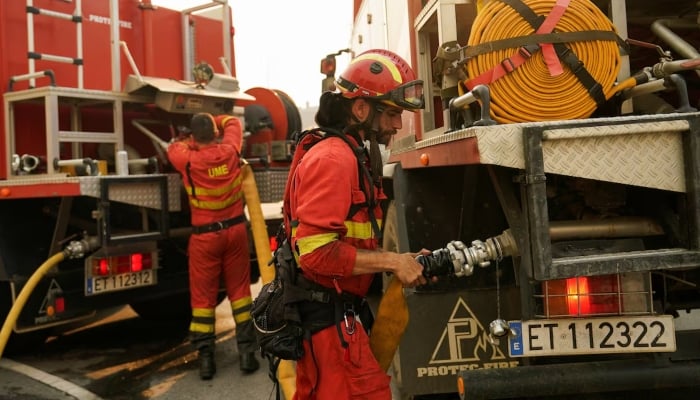
To combat the crisis, more than 270 emergency personnel and at least 40 ground firefighting units have been deployed across the affected regions. Specialized teams from Spain’s Military Emergency Unit (UME) have also joined the operation, providing additional manpower, equipment, and logistical support to local firefighters battling the flames.

Spain, along with many other countries in southern Europe, has experienced increasingly severe wildfire seasons in recent years. Scientists attribute the growing intensity of these fires to climate change, which has contributed to prolonged heatwaves, drought conditions, and unpredictable weather patterns. Experts also note that unusually heavy rainfall during the spring encouraged abundant vegetation growth. As temperatures soared during the summer, this vegetation dried out, creating vast amounts of highly combustible fuel that has allowed fires to spread rapidly.

The environmental impact has already been devastating. More than 100,000 hectares of land have burned across Spain so far this year, roughly matching the country’s average annual burned area over the past decade. The current wildfire season has also become one of the deadliest in recent history, with 13 people losing their lives.

Authorities have urged residents in high-risk areas to follow evacuation orders and remain alert as firefighters continue working around the clock to contain the blazes. Weather conditions remain challenging, raising concerns that the fires could continue to spread in the coming days despite the large-scale emergency response.

Similar Posts

  • |

    Typhoon Dolphin hits Japan’s Okinawa as China prepares for landfall

    Typhoon Dolphin has struck Japan’s southern Okinawa prefecture, injuring five people and causing power outages across approximately 14,000 properties. Major Japanese carriers ANA and Japan Airlines cancelled flights to the region as maximum sustained wind speeds reached 162 kph, with gusts hitting 216 kph. China has issued high-level alerts along its eastern coast, halting port operations and suspending 162 ferry routes in Zhejiang province ahead of expected landfall between Sunday and Monday. Airports and maritime hubs across eastern China, including Ningbo Lishe International Airport and Shanghai’s Yangshan port, have suspended operations or cleared vessels from harbors. In Taiwan, authorities reported the cancellation of 63 international flights, whilst Taipei rejected maritime traffic control directives issued by Beijing for the Taiwan Strait as baseless.

  • | |

    FIFA pushes ahead with controversial commercial investment plan despite opposition from UEFA and Concacaf

    FIFA has insisted that “nobody is selling football” whilst reaffirming its intention to proceed with a plan to sell minority stakes in its commercial operations to private investors, despite a fierce backlash from major regional governing bodies. UEFA voted to boycott future World Cups if the initiative moves forward, whilst Concacaf confirmed its 41 member associations also rejected the proposal put forward by FIFA president Gianni Infantino. Under the proposal, FIFA intends to establish a new commercial subsidiary, FIFA Forward Enterprise (FFE), to manage the commercial rights of major tournaments including the men’s World Cup. Private equity firm Thrive Eternal, founded by venture capitalist Joshua Kushner, is expected to lead the investor group purchasing a minority stake in the new entity, which carries an initial valuation of $20 billion. To secure the necessary 106 votes from FIFA’s 211 member associations, Infantino has offered an immediate $20 million payout to federations that back the proposal before a 19 September deadline. FIFA maintains the initiative will significantly increase development funding for smaller footballing nations without compromising the sport’s governance.

  • |

    France’s top court blocks social media ban for under-15s

        France’s Constitutional Council, the country’s highest constitutional authority, has rejected a proposed law that would have banned children under the age of 15 from accessing social media. The decision represents a setback for President Emmanuel Macron, who had strongly supported measures aimed at protecting young people from the potential harms of social media. The proposed legislation would have prevented children below 15 from creating social media accounts from September 1. It also required social media companies to close accounts belonging to existing under-15 users within four months. Platforms would have been required to introduce an age-verification system approved by France’s privacy regulator to determine whether users met the minimum age requirement. However, the Constitutional Council ruled that important parts of the legislation did not provide sufficient legal safeguards. In particular, the council objected to the requirement that users prove their age without clearly defining the conditions and limits surrounding the collection and use of such information. According to the council, the legislation placed disproportionate restrictions on freedom of expression and communication. It also failed to adequately protect individuals’ right to privacy. The ruling effectively prevents the law from coming into force in its original form. French lawmakers had approved the legislation in July, making France one of the first European countries to pursue such a comprehensive restriction on social media use by young teenagers. The move followed Australia’s decision to introduce a world-first social media ban for children under 16 in December. The Australian restrictions cover major platforms such as Facebook, Snapchat, TikTok and YouTube. Australian lawmakers are now considering stronger penalties for companies that fail to comply, although early data has indicated that the ban has had mixed results. Several other countries have also taken steps to restrict young people’s access to social media. China, the United Arab Emirates and Türkiye have introduced measures or discussed plans aimed at limiting children’s access to online platforms. At the European Union level, authorities have also indicated that stronger protections may be needed to shield children from harmful features and content on social media platforms. Major technology companies have generallyFrance’s Constitutional Council, the country’s highest constitutional authority, has rejected a proposed law that would have banned children opposed blanket restrictions, arguing that they already provide tools and age-based safeguards to protect younger users. At the same time, companies have indicated that they would follow government regulations where required. Google, Meta, Snap and TikTok had not immediately issued comments on the French court’s decision. Following the ruling, Macron instructed Prime Minister Sebastien Lecornu to revise the proposed legislation and address the Constitutional Council’s concerns. The Elysee Palace said the French president remains committed to introducing the reform. The government wants a revised version of the legislation to take effect before spring 2027, when France is scheduled to hold its next presidential election. Macron is constitutionally barred from seeking a third consecutive term, making the issue a significant part of his government’s remaining agenda.

  • |

    25 US states challenge Trump’s new tariffs in court

    NEW YORK: A coalition of 25 US states has filed a lawsuit against the administration of President Donald Trump, seeking to block a new round of tariffs imposed on imports from dozens of countries. The legal challenge was submitted to the US Court of International Trade in New York, where the states asked the court to suspend the tariffs, declare them unlawful and order the federal government to refund businesses that have already paid the import duties. The coalition argued that the administration exceeded its legal authority by introducing sweeping tariffs under Section 301 of the Trade Act of 1974. According to the lawsuit, the investigations cited by the administration as justification for the tariffs were used as a pretext to impose broad trade restrictions. The disputed tariffs, ranging from 10% to 12.5%, were introduced last month and apply to imports from 60 trading partners, covering a significant share of goods entering the United States. The Trump administration has defended the measures, saying they are intended to address concerns related to forced labour in international supply chains and to protect American trade interests. The White House maintains that the tariffs were imposed within the government’s legal authority and remain an important tool for securing fair trade practices. A White House spokesperson said the administration is using powers granted under US trade law to respond to what it considers unfair policies and practices affecting American commerce. Officials also argued that Section 301 tariffs have previously withstood legal scrutiny and continue to be a lawful instrument of trade policy. The lawsuit follows earlier legal disputes over President Trump’s tariff policies. Previous tariffs introduced under emergency economic powers were struck down by the US Supreme Court earlier this year, prompting the administration to replace them with the current Section 301 measures after a temporary global tariff expired in July. The states involved in the case contend that the latest tariffs are arbitrary and unlawful, arguing that while they support efforts to combat forced labour worldwide, such concerns cannot be used to justify what they describe as an illegal expansion of presidential tariff powers.

  • |

    US senator demands answers over USS Abraham Lincoln deployment

    WASHINGTON: US Senator Richard Blumenthal has called on the Pentagon to explain why the USS Abraham Lincoln has remained at sea for more than 250 days, raising concerns about the health, safety and readiness of thousands of sailors and Marines aboard the aircraft carrier. Blumenthal, a member of the Senate Armed Services Committee, sent a letter to Defence Secretary Pete Hegseth and Acting Navy Secretary Hung Cao seeking detailed information about the carrier’s prolonged deployment. The senator said the USS Abraham Lincoln left Naval Base San Diego on November 21, 2025, for what was originally expected to be a seven-month mission. Its deployment was scheduled to end in May but has since been extended, with no publicly announced date for its return. According to Blumenthal, the carrier has spent more than 200 consecutive days without a port visit, setting a record for the length of time it has remained at sea without such a stop. The prolonged deployment has triggered concerns about conditions aboard the carrier, including reported shortages of basic supplies, water contamination, plumbing problems and difficulties with mail deliveries. Blumenthal also raised concerns about the mental health and morale of crew members, as well as deck safety and general living conditions. He said reports of fatigue, deferred maintenance and limited opportunities for rest could increase the risks faced by personnel working aboard an aircraft carrier. The USS Abraham Lincoln carries around 5,000 sailors and Marines and operates in an environment involving aircraft, fuel, weapons, heavy machinery and complex electrical systems. Blumenthal warned that prolonged exposure to these conditions could create additional safety risks if crews are exhausted or equipment maintenance is delayed. The senator asked the Pentagon to provide information about reported habitability problems aboard the carrier, including issues involving hygiene supplies, mould, toilets, laundry facilities and water systems. He also requested details about the Navy’s measures for monitoring crew fatigue, morale, mental health and operational readiness. Blumenthal wants officials to disclose whether the extended deployment has been linked to increases in safety incidents, medical problems or disciplinary cases. Reports cited by US military publications have also described incidents in which sailors aboard the carrier allegedly attempted to go overboard during its prolonged deployment, intensifying concerns about the psychological pressure on personnel. The senator has asked the Navy to explain what measures are being taken to address such concerns and protect the wellbeing of the crew. The extended deployment comes as the United States continues military operations and maintains a significant naval presence connected to tensions involving Iran and the wider Middle East. Blumenthal questioned the Pentagon about the strategic purpose of keeping the carrier deployed for such an extended period. He asked officials to explain the military objectives linked to the Lincoln’s continued presence in the region and how the Navy determines whether the carrier remains operationally necessary. The senator also sought details about every extension of the carrier’s deployment, including who approved the extensions and what operational requirements were cited. He further questioned whether the Navy’s existing fleet structure and deployment system can maintain the current demand for aircraft carriers without undermining crew welfare, equipment readiness and future maintenance requirements. Blumenthal warned that maintaining a high operational tempo for an extended period could create a readiness problem in the future if the impact on personnel and equipment is not properly addressed.

  • |

    Pakistan pushes for renewed US and Iran talks under Islamabad agreement

    Pakistan has reaffirmed its commitment to helping revive negotiations between the United States and Iran, saying it is making every possible effort to bring both sides back to the framework established under the Islamabad memorandum of understanding signed last month. Officials believe renewed dialogue remains the best path to easing tensions in the Middle East and restoring regional stability. Speaking at the Foreign Office’s weekly media briefing on Thursday, spokesperson Tahir Andrabi said Pakistan remains concerned about the fragile security situation in the region despite a brief period of relative calm in recent days. He said the temporary reduction in violence had raised hopes for a lasting ceasefire, but recent developments have shown that the situation remains highly unstable. Andrabi stressed that Pakistan continues to support diplomacy as the only practical solution to the conflict. He said Islamabad welcomes every effort aimed at maintaining the pause in hostilities and encouraging both Washington and Tehran to return to negotiations. According to him, Pakistan remains actively engaged with all relevant parties and will continue supporting diplomatic initiatives. He added that discussions are still taking place to restore stability, particularly around the Strait of Hormuz, one of the world’s most important energy shipping routes. Pakistan, he said, is working to encourage both countries to resume talks under the Islamabad memorandum of understanding while also following the commitments outlined in the Pakistan Qatar joint statement issued on June 22. The Foreign Office urged both the United States and Iran to exercise restraint and honour their commitment to restart technical level discussions. Andrabi said continued dialogue is essential to resolving outstanding disputes and preventing another escalation that could threaten regional peace and global energy supplies. The Islamabad memorandum of understanding was signed on June 18 after weeks of diplomatic efforts. The agreement was intended to reopen the Strait of Hormuz and create conditions for ending the wider conflict that began following US and Israeli strikes on Iran earlier this year. Under the understanding, both sides had agreed to continue negotiations over the following two months. However, tensions returned on July 7 when Iran launched attacks on commercial vessels in the Strait of Hormuz, including a Qatari liquefied natural gas tanker. Tehran accused Washington of violating the agreement, leading to renewed US military strikes on Iranian targets. Since then, the conflict has expanded, with Houthi forces in Yemen imposing a naval blockade affecting Saudi Arabia and increasing pressure on another key maritime route. Violence has continued to spread across the region. On Wednesday, explosions were reported at a natural gas export facility in Egypt, while a US owned floating storage vessel was reportedly struck by a drone. At the same time, the United States and Saudi Arabia carried out joint operations against Iran backed armed groups in Iraq following attacks on American troops and Saudi energy infrastructure. After several days without major military action, the United States also launched fresh strikes against Iranian targets on Thursday in response to attacks on American bases in Jordan. During the briefing, Andrabi also rejected a recent documentary produced by Germany’s international broadcaster Deutsche Welle about Pakistan’s nuclear programme. He described the report as misleading and said it relied on outdated claims, speculation, and one sided sources. The spokesperson argued that the documentary failed to accurately reflect the history and purpose of Pakistan’s nuclear programme. He said responsible journalism requires balanced reporting and careful verification, adding that publishing unsupported allegations could damage the broadcaster’s credibility. He maintained that Pakistan has a strong command and control system for its nuclear assets, supported by legal, technical, and institutional safeguards that meet international standards. According to Andrabi, these arrangements have been recognised by independent experts. Responding to questions about India’s decision to block social media accounts belonging to Pakistan Television and other Pakistani platforms, Andrabi criticised the move, calling it another example of restrictions on independent media. He said the Indian government was attempting to limit access to alternative viewpoints while promoting an official narrative. He also urged the international community to take notice of what he described as shrinking space for free expression and media freedom in India.

Leave a Reply

Your email address will not be published. Required fields are marked *