spain declares national
|

Spain declares national emergency


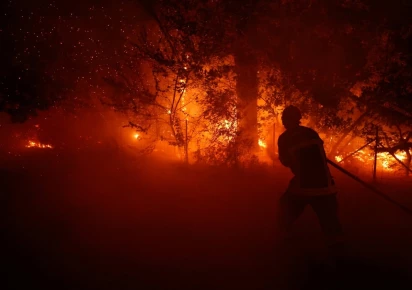
MADRID: Spain has declared a national emergency after a series of fast-moving wildfires spread across areas near Madrid and the neighboring province of Ávila, forcing more than 10,000 residents to flee their homes. The fires, fueled by extreme heat and dry conditions, have overwhelmed emergency services and prompted one of the country’s largest wildfire responses in recent years.

The Spanish Interior Ministry announced the emergency declaration late Thursday, citing the simultaneous outbreak of multiple wildfires, challenging weather conditions, and the need to coordinate large-scale resources from various government agencies. Officials said the combination of several active fire fronts had significantly complicated firefighting operations and civil protection efforts.

Authorities explained that placing the situation under a national emergency allows the central government to take direct control of the response. Under Spain’s National Civil Protection System, the Interior Minister now oversees the coordination of firefighting teams, emergency services, and military support. Officials noted that this is the first time a wildfire has led to such a declaration under the current emergency framework.

The regional government of Madrid described the situation as one of “extreme gravity” and requested immediate assistance from the national authorities. Officials warned that active wildfires burning in Villa del Prado, San Martín de Valdeiglesias, and Almorox, located in the neighboring region of Castilla-La Mancha, were spreading rapidly and could exceed the current firefighting capacity. Another major blaze in Burgohondo, in the province of Ávila, was also moving toward the Madrid region due to strong winds and unfavorable weather conditions.

As a precaution, more than 10,000 people have been evacuated from several communities, including Villa del Prado, San Martín de Valdeiglesias, Pelayos de la Presa, and Aldea del Fresno. Emergency shelters have been established to accommodate displaced residents, while authorities continue to monitor the movement of the fires and issue evacuation orders where necessary.

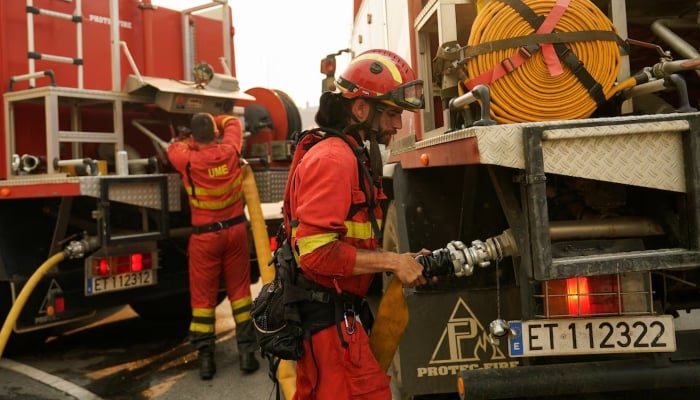
To combat the crisis, more than 270 emergency personnel and at least 40 ground firefighting units have been deployed across the affected regions. Specialized teams from Spain’s Military Emergency Unit (UME) have also joined the operation, providing additional manpower, equipment, and logistical support to local firefighters battling the flames.

Spain, along with many other countries in southern Europe, has experienced increasingly severe wildfire seasons in recent years. Scientists attribute the growing intensity of these fires to climate change, which has contributed to prolonged heatwaves, drought conditions, and unpredictable weather patterns. Experts also note that unusually heavy rainfall during the spring encouraged abundant vegetation growth. As temperatures soared during the summer, this vegetation dried out, creating vast amounts of highly combustible fuel that has allowed fires to spread rapidly.

The environmental impact has already been devastating. More than 100,000 hectares of land have burned across Spain so far this year, roughly matching the country’s average annual burned area over the past decade. The current wildfire season has also become one of the deadliest in recent history, with 13 people losing their lives.

Authorities have urged residents in high-risk areas to follow evacuation orders and remain alert as firefighters continue working around the clock to contain the blazes. Weather conditions remain challenging, raising concerns that the fires could continue to spread in the coming days despite the large-scale emergency response.


Similar Posts

  • Elon Musk admits his OpenAI bet backfired

    Elon Musk now believes one of his earliest moves to stop any single company from dominating artificial intelligence may have backfired badly. In a conversation with Zanny Minton Beddoes, editor-in-chief of The Economist, the xAI founder said he originally helped create OpenAI as a counterweight to Google, which had “more or less a monopoly on AI” at the time. Musk admitted things did not play out the way he had hoped. He pointed to Anthropic’s split from OpenAI, and its rise into a leading AI company, as proof his original bet triggered consequences he never saw coming. It ultimately sped up the AI race rather than slowing it down. He said he was not really trying to accelerate AI, but that creating OpenAI, followed by Anthropic spinning out of it, ended up producing knock-on effects that did exactly that. His takeaway was blunt, every road in AI now leads to faster development, not less. The comments arrive amid Musk’s ongoing legal battle with OpenAI CEO Sam Altman over the company’s shift from nonprofit research lab to commercial powerhouse. Musk has framed his frustration in simple terms, he says that he funded a nonprofit meant to be an open-source AI company owned by the world, only to watch it become an $800 billion closed-source for-profit business. That is the opposite of what he intended his donation for. Musk had sought $150 billion in damages from OpenAI, Altman, Microsoft, and other parties. A federal jury in Oakland ruled in May that his claims fell outside the statute of limitations, and Judge Yvonne Gonzalez Rogers dismissed the case on those grounds. Musk has said he plans to appeal to the Ninth Circuit. Despite the feud with Altman, Musk struck a notably warmer tone about Anthropic. He suggested the people who left OpenAI to start it did so because they had lost faith in Altman’s leadership, and he praised Anthropic CEO Dario Amodei as someone genuinely principled and seriously concerned about AI’s future. He went so far as to say the company’s team passed what he called his “evil detector.” Musk also floated a safety proposal: giving leading AI labs a window of a week or two to review rivals’ models before public release. His reasoning was that competitors checking each other, even amid personal animosity between CEOs, would actually make the process more honest rather than less.

  • |

    Philadelphia man indicted on federal civil rights charges in anti-Islamic arson attack

    Federal prosecutors have indicted 60-year-old Vincent Lang of Philadelphia for deliberately setting fire to the Northeast Philadelphia Islamic Center. A federal grand jury charged Lang with one count of malicious damage by fire to a building used in interstate commerce and one count of damage to religious real property. The Department of Justice confirmed that the indictment explicitly alleges Lang carried out the arson because of the religious character of the building, specifically targeting it because it was a Muslim place of worship. According to court documents and surveillance footage, the perpetrator approached the mosque on Tyson Avenue during the early hours of 5 July, ignited an improvised incendiary device, and threw it into the entryway. Local authorities reported that no injuries occurred during the blaze. Lang has remained in federal custody following his initial arrest on 16 July. If convicted on the federal civil rights charges, he faces a mandatory minimum of five years in prison and up to a maximum penalty of 40 years.

  • |

    7.4-magnitude quake strikes Colombia

    A powerful earthquake struck Colombia and several other parts of Latin America on Monday, causing injuries, damaging buildings and forcing evacuations in the capital, Bogota. The earthquake was recorded at different magnitudes by geological agencies. Colombia’s geological service measured it at 6.6, while the United States Geological Survey estimated its magnitude at 7.4. The epicentre was located in western Colombia at a depth of around 100 kilometres. Strong tremors were felt across large areas of the country. The shaking was also reported in neighbouring Ecuador and as far north as Panama. In Bogota, residents rushed out of buildings as emergency sirens sounded. Some people were seen gathering in the streets after leaving their homes and workplaces. Authorities ordered evacuations from a number of buildings as a precaution while emergency teams assessed possible structural damage. The situation was particularly serious in the western parts of Colombia. The governor of Choco province reported injuries and significant damage to buildings in Quibdo, the provincial capital. Cali, one of Colombia’s largest cities, also suffered substantial damage. Mayor Alejandro Eder said at least 20 buildings had collapsed and that people were believed to be trapped inside some of the structures. Rescue operations were launched in the affected areas. Cali authorities requested additional emergency teams from Bogota and Medellin to assist with search and rescue efforts. Images broadcast by local media showed buildings with damaged facades and sections of structures affected by the powerful tremors. Emergency authorities continued to assess the extent of the destruction as rescue teams searched damaged buildings for survivors. Officials have not yet released a complete account of casualties or property losses. The number of injured people is expected to change as assessments continue. The depth and strength of the earthquake allowed tremors to be felt across a wide area, including outside Colombia. Authorities urged residents to remain cautious and follow instructions from emergency services, particularly in buildings that may have suffered structural damage. The earthquake comes as parts of northern South America remain vulnerable to major seismic activity. In June, two powerful earthquakes struck Venezuela, with reported magnitudes of 7.2 and 7.5, causing widespread destruction and thousands of deaths.

  • |

    Wildfires force 43,000 to flee in France

    More than 43,000 people have been evacuated from southwestern France as massive wildfires continue to spread across several regions, threatening residential areas, forests and popular tourist destinations. French authorities have launched one of the country’s largest emergency operations of the year as firefighters work around the clock to contain the rapidly advancing flames. The worst-affected area is located near Arcachon Bay and the Cap Ferret peninsula in the Gironde region. The wildfire has already burned through more than 8,700 hectares of land and continues to spread because of strong winds, dry vegetation and extremely high temperatures. Authorities ordered the complete evacuation of the Cap Ferret peninsula, a major holiday destination on France’s Atlantic coast that attracts thousands of visitors every summer. Residents, tourists and campers were instructed to leave immediately as emergency services expanded evacuation operations. To speed up the evacuation, authorities arranged transport by both road and sea. Special boats were deployed from several coastal villages while vehicles used the peninsula’s only highway leading to the mainland. Emergency officials urged everyone in the affected areas to leave without delay for their own safety. French Interior Minister Laurent Nunez described the Gironde wildfire as the largest fire of the current season. He said around 80 homes have been damaged, including nearly 50 houses that were completely destroyed by the flames. More than 1,000 firefighters, supported by helicopters, military engineering units and civil security teams, are working to control the blaze in Gironde. Hundreds of police officers and emergency personnel have also been deployed to help with evacuations, traffic management and public safety. A second major wildfire is burning near Biscarrosse in the neighbouring Landes region. The fire has destroyed more than 2,500 hectares of forest and forced the evacuation of over 23,000 residents, tourists and campers. Local authorities said the blaze remains out of control after continuing to spread overnight. French President Emmanuel Macron has requested international assistance through the European Union Civil Protection Mechanism. Several European countries have agreed to send additional firefighting aircraft and helicopters to help French authorities contain the fires. Croatia is sending Canadair water-bombing aircraft, while Portugal will provide specialised firefighting planes. The Czech Republic and Slovakia are also deploying heavy helicopters to assist emergency crews. Emergency officials said there have been no confirmed fatalities in the Gironde wildfire so far. However, they warned that weather conditions remain highly dangerous and could make firefighting efforts even more difficult in the coming days. Fire experts say the blazes are spreading unusually quickly because of prolonged heatwaves, severe drought and strong winds. These conditions have left forests and vegetation extremely dry, allowing fires to expand rapidly across large areas. Authorities estimate that nearly 50,000 hectares of land have burned across France since the beginning of this year’s wildfire season, making it one of the country’s most destructive fire seasons in recent years.

  • |

    Pralhad Joshi appointed India’s Education Mi…

    Pralhad Joshi has been appointed as India’s new education minister following the resignation of Dharmendra Pradhan, who stepped down on Saturday after weeks of youth-led protests over a major exam leak scandal . The 63-year-old Joshi, who already serves as minister of new and renewable energy and consumer affairs, food and public distribution, will now also handle the education portfolio a task political analysts say is likely to prove challenging amid heightened public scrutiny over the country’s education system . Pradhan’s departure was one of the central demands of the student demonstrations that erupted after allegations surfaced that the National Eligibility cum Entrance Test (NEET) medical entrance exam paper had been leaked . Nearly 2.3 million test takers across India, as well as at examination centers in Doha, Dubai, Singapore, and Kathmandu, appeared for the NEET on May 3, competing for fewer than 130,000 spots in medical colleges . After the leak allegations, the Indian government announced on May 12 that the examination was voided and that a new test would be held. The decision left thousands of students disillusioned and frustrated, sparking protests that spread across the country and evolved into a major challenge for Prime Minister Narendra Modi and his Bharatiya Janata Party (BJP) . Joshi, one of the Modi government’s longest-serving ministers, is seen as close to the powerful prime minister . Following his appointment to lead the Ministry of Education, Joshi wrote on social media that he was “grateful” to Modi “for placing his faith” in him and “entrusting” him with responsibility . “I accept it with humility and a deep sense of duty,” he said . On Sunday, Joshi held his first meeting as education minister to assess the situation and implement new schemes aimed at restoring trust in the examination system . The move signals the government’s urgency to address the grievances of students and parents who have demanded greater transparency and accountability . The NEET scandal has exposed broader concerns about the integrity of India’s competitive examination system, which determines access to coveted professional seats. With millions of students’ futures hanging in the balance, Joshi’s appointment represents both a test of his crisis management skills and a pivotal moment for educational reform in the world’s most populous nation .

Leave a Reply

Your email address will not be published. Required fields are marked *