
beyond income 128
| |

Beyond income, 12.8% of Filipinos are poor across multiple dimensions in 2024

MANILA, Philippines – The Philippines may have finally reached single-digit poverty by the government’s traditional income measure, but a new and broader official way of measuring poverty shows that 12.8% of Filipinos were considered multidimensionally poor in 2024.

The Philippine Statistics Authority’s (PSA) first official Multidimensional Poverty Index (MPI) looks beyond how much a family earns and asks whether Filipinos are poor or deprived across education, health and nutrition, housing and basic services, and employment.


Beyond income, 12.8% of Filipinos are poor across multiple dimensions in 2024

Based on preliminary results of the 2024 Community-Based Monitoring System (CBMS), 12.4% of households were classified as multidimensionally poor. At the individual level, the rate was slightly higher at 12.8%, or roughly one in eight Filipinos.

That is higher than the 9.7% official income poverty rate for 2025, the record-low figure announced by the PSA in August that meant around 11 million Filipinos were living below the national poverty threshold.
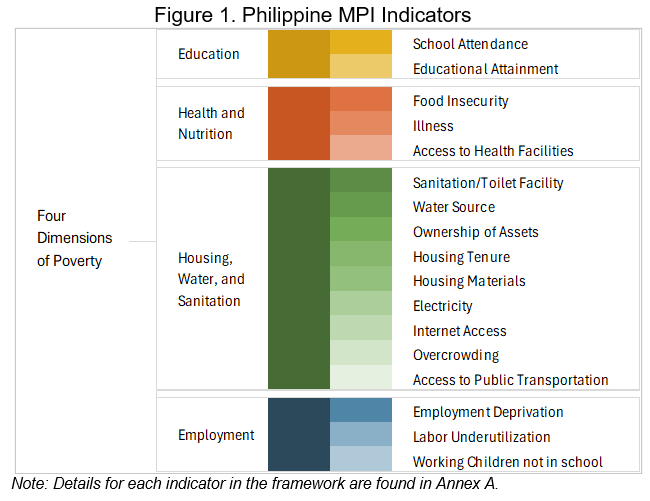
MULTIDIMENSIONAL. These are the 17 dimensions that the PSA now uses to measure multidimensional poverty. Image from PSA.

Note though that the figures measure different aspects of poverty and cover different years. The 9.7% poverty incidence for 2025 is based on whether Filipinos fall below the official income poverty threshold, while the new MPI uses 2024 data to measure deprivation across 17 different indicators. This new multidimensional measure of poverty should be seen as a complement to, rather than a substitute for, the country’s income-based poverty estimates, according to the PSA and Department of Economy, Planning, and Development (DEPDev).

Still, the MPI gives the government another official measure showing why crossing the income poverty line doesn’t necessarily capture the full extent of hardship.

What does being ‘multidimensionally poor’ mean?

The MPI gives equal weight to four broad dimensions: education; health and nutrition; housing, water, and sanitation; and employment.

Among the indicators are whether children attend school, whether an adult in the household finished high school, whether family members experience food insecurity, whether someone who needed medical care failed to get it, and whether the household has adequate water, sanitation, electricity, internet, housing, transport access, and employment.

A household is considered multidimensionally poor when its weighted deprivation score exceeds 25%

DEPRIVED. The dark bars show the share of all Filipinos deprived in each indicator, while the green bars show the share who are both deprived in that indicator and classified as multidimensionally poor. Image from PSA.

Education was the biggest contributor to multidimensional poverty, followed by housing, water, and sanitation. Health and nutrition as well as employment were also challenges identified.

Across the population, 38.7% of Filipinos lived in households deprived in housing materials, while 26.4% belonged to households without internet access. Another 24.1% lived in households deprived in sanitation or toilet facilities, 21.8% in household assets, and 20.2% in educational attainment.

Why many Filipinos still feel poor

The broader measure also provides context for the skepticism that followed the announcement that Philippine income poverty had fallen to 9.7%.

Under the official 2025 poverty threshold, a family of five needed around P14,634 a month to meet basic food and non-food needs. Earning even slightly more is enough to be classified as non-poor.

Filipinos’ own perceptions remain markedly different. In a Social Weather Stations survey conducted in June, 49% of Filipino families described themselves as poor. Self-rated poverty is subjective and cannot be directly compared with PSA statistics, but the gap illustrates the difference between statistical poverty and a household’s own assessment of their living conditions.
Must Read

Filipino family income grew 16.5% since 2023. So why doesn’t it feel like it?


Filipino family income grew 16.5% since 2023. So why doesn’t it feel like it?

At the Development Budget Coordination Committee hearing on Thursday, August 27, Balisacan said reaching upper-middle-income status was “not the end in itself,” adding that the greater challenge was translating economic progress into “better jobs, higher incomes, and improved living standards for Filipinos.”

He also warned that recent poverty gains remain vulnerable as prices stay elevated.

“If inflation remains elevated, it could slow or even reverse our recent advances in poverty reduction,” Balisacan said.

DEPDev said the MPI should allow government to better target programs such as adult literacy, affordable housing, healthcare, food security, and improvements in basic services. – Rappler.com

Must Read

[In This Economy] Less than 10% of Filipinos are now poor? Not so fast


[In This Economy] Less than 10% of Filipinos are now poor? Not so fast

Similar Posts

  • |

    UoG reviews over Rs6bn budget for FY2026-27

    GUJRAT: The Finance and Planning Committee of the University of Gujrat (UoG) has reviewed a proposed budget exceeding Rs6 billion for the fiscal year 2026-27, with a focus on financial sustainability, institutional reforms, student welfare and infrastructure development. The proposed budget was discussed during the committee’s 36th meeting held at the Hafiz Hayat Campus under the chairmanship of Vice Chancellor Prof Dr Zahoor Ul Haq, recipient of the Tamgha-e-Imtiaz. The budget will now be placed before the university syndicate for final approval. During the meeting, the committee was informed that the university had strengthened its financial position through improved governance and prudent resource management. Officials said the institution generated nearly Rs3.75 billion through its own resources, reducing dependence on external financial support. The meeting was told that governance reforms and administrative measures implemented during the previous financial year resulted in savings of around Rs400 million. University management said these savings had been redirected towards student welfare initiatives and development projects. According to the budget proposal, around Rs370 million has been allocated for scholarships, enabling financial assistance for nearly one-third of the university’s enrolled students. Officials said the move reflects the institution’s commitment to ensuring that deserving students continue their education despite financial constraints. The committee also approved plans to invest Rs450 million in the purchase of 18 new buses to improve transport facilities for students and staff. The university estimates the new fleet will reduce annual transportation expenses by nearly Rs60 million through improved operational efficiency. Members were further informed that the university is expanding the use of solar energy across its campuses. The initiative is expected to significantly reduce electricity costs while supporting environmentally sustainable operations. The meeting also reviewed reforms related to faculty workload management, which reportedly generated savings of Rs119 million. University officials said the measures were designed to optimise academic resources without affecting the quality of teaching and learning. Vice Chancellor Prof Dr Zahoor Ul Haq emphasised the importance of financial discipline, transparency and efficient utilisation of resources to ensure the university’s long-term growth. He said the proposed budget reflects the institution’s priorities of academic excellence, student support and sustainable development. The meeting was attended by Additional Treasurer Ghulam Safdar Malik, Additional Secretary Higher Education Department Zahida Azhar, Section Officer Finance Department Asghar Ali, who joined online, Registrar Muhammad Naeem Butt, Dean Faculty of Social Sciences Prof Dr Faisal Mahmood Mirza, Academic Council members Dr Ashfaq Ahmad Mirza and Dr Bushra Akram, Deputy Treasurer Muhammad Fawaz Khokhar, Director ORIC Prof Dr Audil Rashid and other committee members.

  • | | |

    FBR starts fiscal year strong with rs810 billion t…

    ISLAMABAD: Pakistan’s Federal Board of Revenue (FBR) kicked off the new fiscal year on a positive note by surpassing its July tax collection target, although a shortfall in income tax receipts and the government’s decision to reject a key enforcement proposal highlighted the challenges that lie ahead. According to provisional figures, the FBR collected Rs810 billion in July, exceeding its monthly target by Rs30 billion. The collection also marked a 7% increase compared to Rs757 billion collected during the same month last year. The strong performance was largely driven by robust sales tax collections, which reached Rs358 billion, surpassing the target by Rs53 billion and recording an 18% year-on-year increase. A significant 78% of total sales tax, amounting to Rs275 billion, was collected at the import stage, where tax compliance is generally higher. However, income tax collection remained below expectations. The FBR collected more than Rs300 billion in income tax, falling Rs23 billion short of the target. Analysts attributed the shortfall to advance tax collections made in June to meet last fiscal year’s revised revenue goals, along with reduced withholding tax rates for salaried individuals and property transactions introduced in the latest federal budget. Meanwhile, customs duty collection stood at Rs105 billion, matching the target, while federal excise duty generated Rs48 billion, slightly exceeding expectations. The July performance marks the beginning of a crucial fiscal year in which the government has committed to collecting Rs15.263 trillion in taxes under an agreement with the International Monetary Fund (IMF). Meeting the annual target is considered essential for securing future IMF loan disbursements and creating fiscal space for development, defence and water resource projects. The FBR also reported encouraging progress in tax compliance, receiving around 227,000 income tax returns during July after updated tax return forms became available. Additionally, the authority issued Rs98 billion in tax refunds, approximately Rs13 billion more than in the same period last year. Despite the positive revenue performance, the federal cabinet declined an FBR proposal to activate restrictions on high-value purchases by individuals with insufficient declared assets. Had the proposal been approved, it would have limited the purchase of luxury vehicles, expensive properties, large stock investments and major cash withdrawals by non-compliant taxpayers. Economic observers say the government’s ability to sustain monthly revenue growth will be closely watched, as consistent tax collection remains critical to maintaining fiscal stability and meeting commitments under Pakistan’s economic reform programme.

  • Thailand Real Estate Lock-In Is Easing as FSBO Gains Ground

    Thailand’s Real Estate market is showing a new kind of movement. Owners who once held onto condos, villas, and land-backed homes because changing ownership structures felt difficult are now testing direct sales. That doesn’t prove a nationwide FSBO boom. However, more owner-listed properties, slower transactions, weaker purchasing power, and higher closing costs point to a […]

  • |

    Gold prices rise as weaker dollar, softer US data boost rate-cut hopes

    Gold prices moved higher on Monday as a weaker US dollar and subdued economic data strengthened expectations that the Federal Reserve may keep interest rates unchanged at its upcoming policy meeting. Spot gold gained 0.4% to $4,391.07 per ounce by 0248 GMT, extending its recent momentum after the precious metal reached a more than two-month high during the previous week. US gold futures for December delivery also advanced 0.3% to $4,448.10 per ounce. The dollar’s decline provided additional support to bullion. The US dollar index fell 0.1%, making gold and other dollar-denominated commodities relatively cheaper for buyers using other currencies. According to Tim Waterer, chief market analyst at KCM Trade, gold began the week with strong momentum as weaker inflation data put pressure on the dollar and created room for bullion to approach the $4,400 threshold. Waterer said a sustained rise beyond the $4,500-per-ounce level would likely require further weakness in the dollar or a clearer decline in energy prices. US economic data shape rate expectations Recent US economic indicators have played a major role in reshaping expectations for Federal Reserve policy. An unexpected contraction in US nonfarm payrolls in July, combined with relatively moderate consumer-price inflation, has reduced market expectations for an interest-rate increase at the Fed’s next meeting. Data from the CME FedWatch Tool showed that traders were assigning a roughly 30% probability to a September rate hike, down from about 47% a month earlier. Expectations surrounding interest rates are closely watched by gold investors because bullion does not generate interest or dividends. When borrowing costs and yields are lower, the opportunity cost of holding gold declines, potentially increasing demand for the precious metal. Market participants are therefore looking ahead to the minutes of the Federal Reserve’s July meeting, scheduled for release on Wednesday. Investors will examine the minutes for indications about policymakers’ views on inflation, employment and the future direction of monetary policy. Any indication that the central bank is becoming less inclined to raise rates could provide additional support to gold, while a more hawkish tone could strengthen the dollar and place pressure on bullion. Geopolitical tensions remain in focus Geopolitical developments also continued to influence financial markets. US President Donald Trump’s representatives met Egyptian, Qatari and Turkish mediators in Cairo on Sunday as diplomatic efforts continued to advance a proposed Gaza peace plan, according to a diplomatic source. The talks were taking place against the backdrop of continued Israeli military operations in Gaza. Ongoing tensions in the Middle East have kept investors alert to the possibility of further disruptions to energy markets and global trade. Gold traditionally attracts safe-haven demand during periods of geopolitical and economic uncertainty. Any escalation in regional tensions could therefore influence investor flows into precious metals. Other precious metals gain Other major precious metals also recorded gains during Monday’s session. Spot silver climbed 1.4% to $65.53 per ounce, extending its positive momentum. Silver tends to benefit from both investment demand and expectations surrounding industrial activity. Platinum advanced 0.3% to $1,752.36 per ounce, while palladium rose 1.6% to $1,333.35.

Leave a Reply

Your email address will not be published. Required fields are marked *